Commercial Aircraft Landing Gear Systems Aftermarket Growth, Size, Share, and Analysis, By Component (Landing Gear Structures (Main Landing Gear (MLG), Nose Landing Gear (NLG), MLG Inner Cylinder Pivot Pin, Drag Brace Lower Lock Link Assembly), Control & Steering Systems (Nose Wheel Steering Computer, & Steering Control Unit), & Others), By Offering (MRO Services and Refurbished Parts (USM and PMA), By Aircraft Family (Airbus A220 (ex-CSeries), Airbus A320 Family (ceo/neo), Airbus A350, Boeing 737 Family (Classic/NG/MAX), Sukhoi Superjet 100, & Others), and Regional Forecast 2025-2045
 Download Free Sample
KEY MARKET INSIGHTS
 Listen to Audio Version
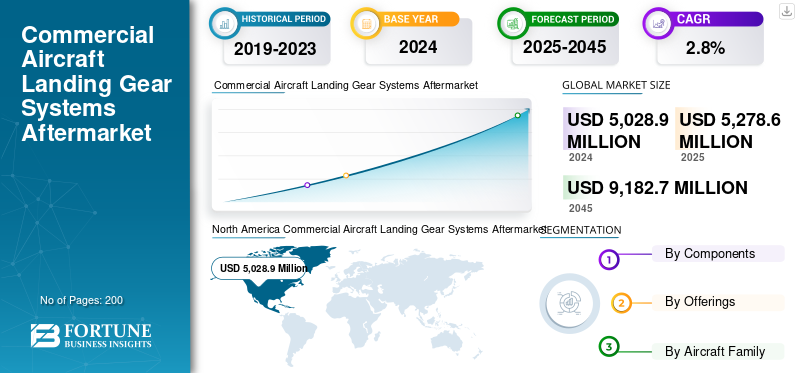
The global commercial aircraft landing gear systems aftermarket size was valued at USD 5,028.9 million in 2024. The market is projected to grow from USD 5,278.6 million in 2025 to USD 9,182.7 million by 2045, exhibiting a CAGR of 2.8% during the forecast period.
Aircraft Landing Gear, also known as the undercarriage, is a complex system that supports all aircraft types during taxiing, takeoff, and landing, absorbing the impact of landing and enabling braking and steering. It typically includes Landing Gear assembly’s structures, control systems and steering systems, sensors and monitoring, electric Actuation Systems, and Braking Systems.
Major players in the Commercial Aircraft Landing Gear Systems Aftermarket analysis report include Safran Landing Systems, Collins Aerospace (Goodrich), Liebherr Aerospace, Lufthansa Technik, GA Telesis, and AAR Corp., among others. These companies are driving the growth of the Commercial Aircraft Landing Gear Systems Aftermarket by investing in next-generation MRO technologies, strategic partnerships, and compliance with global aviation standards to remain competitive. Increasing demand for air travel, fleet expansions, and technological advancements in non-destructive testing technology, and focus on digital transformation, including the use of AI, machine learning, drones, and robotics for improved efficiency and predictive maintenance, are further driving the market growth.
Download Free sample to learn more about this report.
Commercial Aircraft Landing Gear Systems AfterMarket Key Takeaways
 Global Market Size & Forecast
- 2024 Market Size: USD 5,028.9 million
- 2025 Market Size: USD 5,278.6 million
- 2045 Forecast Market Size: USD 9,182.7 million
- CAGR: 2.8% (2025–2045)
 Market Share
- North America dominated the market with approximately 38–40% share in 2024.
- The landing gear structures segment held the largest market share.
- The actuation systems segment is projected to register the highest CAGR during 2025–2045.
 Key Regional Highlights
Asia Pacific
Asia Pacific is projected to witness steady growth during the forecast period.
North America
North America dominated the global market in 2024, accounting for approximately 38–40% of the global market share.
Europe
Europe was the second-largest regional market in 2024, accounting for approximately 28–30% of the global market share.
U.S.
U.S. market is expected to maintain its leading position, supported by the world's largest commercial and defense aircraft fleet.
Japan
Japan market is projected to witness steady growth during the forecast period.
Read More

Market Dynamics
Market Drivers
Surge in Air Travel and Commercial Aviation Industry to Fuel the Market Growth
Post-COVID-19 pandemic, there has been a great surge in air travel globally. As more people fly and the flight frequency increases, there is a rise in demand for aircraft maintenance, including landing gear MRO service and part exchange, driving the commercial aircraft landing gear systems aftermarket growth. Moreover, airlines are expanding their fleets to capture growing passenger numbers, leading to a higher demand for new landing gear and subsequent MRO services.
Additionally, older aircraft are being replaced with newer, more fuel-efficient models, creating a consistent demand for new landing gear systems and MRO services for both the old and new deliveries. Also, airlines are actively modernizing their existing fleets with upgrades and retrofits, including advancements in landing gear technology.
Need for cost-effective maintenance solutions further drives the Landing Gear MRO Market Growth
The increasing need for cost-effective landing gear maintenance solutions drives the growth in the commercial aircraft landing gear systems aftermarket. Airlines are under pressure to reduce operational costs, and efficient landing gear maintenance plays a crucial role in reducing the operation cost of aircraft effectively, as landing gear requires frequent maintenance, repair, and overhaul, resulting in a significant factor in the landing gear MRO market.
Moreover, sustainability and stringent airworthiness regulations and safety standards drive the need for regular maintenance and adherence to specific MRO procedures for landing gear systems.
Market Restraints
High Cost of MRO Services and Shortage of Skilled Personnel Restrains Market Growth
The cost of maintaining and repairing aircraft landing gear is high, forming a significant portion of airlines' operating expenses. This includes the cost of parts, labor, and specialized equipment. The high cost can lead airlines to delay or reduce maintenance, impacting safety and potentially leading to costlier repairs down the line.
A critical challenge is the lack of qualified and experienced technicians and engineers to perform landing gear MRO. This shortage can lead to delays in maintenance, increased costs due to the need for specialized training, and potential safety risks if maintenance is not performed to the highest standards.
Supply Chain Disruptions and Complex Regulatory Requirements Hinder Market Growth.
Disruptions in the global supply chain, whether due to geopolitical events such as tariff wars and the Russia-Ukraine conflict, nature disasters, or logistics challenges, can significantly affect the supply chain of components and raw materials, hindering the landing gear MRO market growth. Moreover, the aviation industry is heavily regulated, with varying regulations across different regions. This complexity can make it challenging for MRO providers to operate on a global scale and can increase compliance costs.
Market Opportunities
Advancements in Materials and Predictive Maintenance Technologies Propel the market Growth
Lightweight Materials: The increasing use of titanium alloys and carbon composites in landing gear reduces weights, improves fuel efficiency, and enhances durability. These advanced materials offer superior strength-to-weight ratios compared to traditional materials, allowing for lighter and more robust landing gear systems.
Predictive Maintenance: Technological advancements in sensors, steering actuators, and data analytics enable predictive maintenance, allowing for proactive identification and mitigation of potential issues, reducing downtime and maintenance costs, and driving the predictive maintenance technology share in the market.
Expansion in Emerging Markets and Aftermarket Services Provides a Great Market Opportunity
The expanding global aviation MRO market, particularly into emerging economies, coupled with a growing importance of aftermarket services, presents a significant opportunity for both established and new players in the landing gear MRO sector. This growth is mainly fueled by the increasing number of aircraft, particularly in Asia-Pacific and the Middle East, and the need to maintain the aging fleet.
Moreover, strategic alliances with airlines, OEMs, and other MRO providers can enable market entry and access to specialized technologies and resources.
Commercial Aircraft Landing Gear Systems Aftermarket Trends
Noticeable Shift Towards Lightweight Materials Leads New Market Trends
The commercial aircraft landing gear system aftermarket is experiencing a noticeable shift towards lightweight materials and predictive maintenance strategies. This trend is driven by the need for increased fuel efficiency, reduced operating costs, and improved aircraft reliability.
Titanium alloys and advanced composite materials are replacing heavier traditional materials, reducing the overall weight of landing gear systems. This material enables reduced fuel consumption, improved aircraft performance, and enhanced payload capacity.
Predictive Maintenance Enables Improved Maintenance Schedules, Further Shaping the Market Trend
Using sensors, IoT connectivity, and data analytics to monitor the condition of the landing gear component in real-time. Predictive maintenance enables improved maintenance schedules, reduced downtime, and cost savings. Resulting maintenance tasks to be performed only when needed, based on the actual condition of the components, rather than on a predetermined scheduled, which attracts airlines and MRO to invest in these services and technology.
Download Free sample to learn more about this report.
Impact of Russia-Ukraine Conflict
The Russia-Ukraine war has significantly impacted the commercial aircraft landing gear systems aftermarket, primarily through disruption to supply chains and increased costs. The conflict has led to sanctions, airspace closure, and heightened geopolitical instability, all of which have affected the availability of materials, increased fuel prices, and created uncertainty for airlines and MRO providers.
Supply Chain Disruptions
The war has impacted the global supply chain for materials such as titanium and other metals, impacting the availability of components for aircraft landing gear. This disruption is primarily due to Russia’s role as a major supplier of titanium, which is crucial for aerospace manufacturing.
The war has led to shortages, price increases, and production delays for aerospace companies. Many western aerospace companies are reducing or eliminating their reliance on Russian suppliers including VSMPO-Avisma, the world's largest titanium producer, leading to further supply chain adjustments.
Regionalization of MRO
Logistics lead times and materials shortages are driving a trend towards greater regionalization in MRO sourcing, with some companies establishing sister-sites/sister-companies in different regions. The war has prompted some companies to move away from Russian titanium and other materials, forcing them to establish new supplier relationships.
SEGMENTATION ANALYSIS
By Component
Landing Gear Structures Dominate the Market Owing to the Support Aircraft's Weight and Need for Robust Construction
The component segments divides the market into Landing Gear Structures (Main Landing Gear (MLG), Nose Landing Gear (NLG), MLG Inner Cylinder Pivot Pin, Drag Brace Lower Lock Link Assembly), Control & Steering Systems (Nose Wheel Steering Computer, Steering Control Unit, Digital Steering Computer, Digital Gear Control Unit, Gear Lever), Sensors & Monitoring (Gear Position Sensor, Tire Pressure Monitoring Sensor, Squat Switch, Proximity Position Sensor, Wireless TPMS, Digital Gear Health Monitoring), Actuation Systems (Gear Retraction Actuator, APU Door Actuator, LG Door Actuator, and Smart Door Actuator), and Braking System (Carbon Brakes Assembly, Carbon Ceramic Brakes, and Steel Brakes Assembly).
Among this component segment, landing gear structures hold the largest Commercial Aircraft Landing Gear Systems Aftermarket share. The dominance of the segment is attributed to its critical role in supporting the aircraft’s weight during flight cycles, requiring robust construction and a higher volume of production. This structural assembly includes the main landing gear (MLG), nose landing gear (NLG), MLG inner cylinder pivot pin, and drag brace lower lock link assembly, this component is important for maintaining safety and durability under extreme stress.
Due to their size, complexity, and use of advanced materials such as titanium and high-strength alloys, the structural components account for 44.35% of the overall landing gear system MRO cost, resulting landing gear structures segment dominating the market.
Actuation systems is aim to be the fastest growing segment by registering the highest CAGR during 2025 to 2045. Its growth is attributed to rising adoption of advanced electromechanical and electric actuation technologies. These systems are responsible for extending and retracting the landing gear, making them a vital part of aircraft safety and efficiency. Several accidents have occurred in which aircraft faced a problem with the actuating landing gear. For instance, in December 2024, Boeing 737-8K2 operating from Sandefjord (Torp), Norway to Amsterdam, tire delaminated on of the aircraft main landing wheels, which damaged the hydraulic system. This caused the landing gear to get stuck, the crew was unable to raise the gear during departure as well, and during landing they were unable to extend it. To avoid such landing gear failure its important actuation systems meets regular checkups and MRO requirement fueling the segment growth.
Moreover, increasing fleet modernization and OEM preference for smart, digitally controlled actuators that improve fault detection, reduce maintenance downtime, and support predictive health monitoring further propel the segment growth.
For Instance, in July 2022, Triumph Group entered into a 4-year Aftermarket Total Support agreement with Moog Inc. to provide landing gear and cargo door actuation MRO support for the Boeing 787 fleet of a leading Asia-Pacific operator.
To know how our report can help streamline your business, Speak to Analyst
By Offering
MRO Service Segment Leads the Market Due to High Frequency of Inspection, Overhaul, and Maintenance Cycles
The offering segment divides the market into MRO Services and Refurbished Parts (USM and PMA) segments.
MRO service segment is anticipated to be the dominating segment during the forecast period. The dominance of the MRO service segment is attributed to the high frequency of inspection, overhaul, and maintenance cycles mandated by aviation authorities. Landing gear is classified as “life-limited parts”, which means airlines need to send them for complete overhaul or replacement after a set number of flight cycles, typically every 8-10 years. These overhaul involves complete disassembly, non-destructive testing (NDT), corrosion treatment, replacement of components, and re-assembly, which makes MRO services both cost-intensive and frequent. As a result, airlines and operators spend a large share of their maintenance budgets on structured MRO services compared to refurbished parts.
Moreover, the rising global fleet size, increasing passenger traffic, and longer aircraft operation hours are driving demand for scheduled and unscheduled landing gear maintenance.
The refurbished parts segment is expected to be the fastest-growing segment over the forecast period. As airlines remain under constant pressure to minimize operation costs, and refurbished parts such as used serviceable material (USM) and Parts Manufacturer Approval (PMA) prove a cost-efficient alternative to a new OEM component. With refurbished part cost about 30-40% L less than brand-new parts, operators are increasingly relying on them to improve maintenance budgets, especially amid rising fuel prices and tight airline profit margin.
Additionally, growing retirement of older aircraft and fleet replacement programs, cost saving, sustainability advantages, and increasing availability of certified parts position the refurbished parts segment to register the highest CAGR in the landing gear MRO market during the forecast period.
By Aircraft Family
Boeing 737 Family Leads the Market Owing to Widely Operated Commercial Aircraft Type Globally
Further, the market is segmented by Airbus A220 (ex-CSeries), Airbus A320 Family (ceo/neo), Airbus A330 (ceo/neo), Airbus A350, Airbus A380, ATR 42/72, Boeing 737 Family (Classic/NG/MAX), Boeing 747, Boeing 767, Boeing 777, Boeing 787, Bombardier CRJ Series, COMAC C919, De Havilland Dash 8 (Q-Series), Embraer E-Jets (E1/E2), and Sukhoi Superjet 100.
The Boeing 737 Family dominates the commercial aircraft landing gear systems aftermarket, due to its one of the most widely operated commercial aircraft type worldwide. With approx. 7,000+ units delivered globally, the NG is the main aircraft for many airlines' short and medium-haul fleets. This large in-service fleet results in higher demand for scheduled landing gear inspections, repairs, and overhauls, making it the single largest contributor to MRO volumes. As the landing gear is a life-limited system and requires a complete overhaul every 8-10 years, the sheer size of the 737 Family fleet ensures the highest number of recurring MRO events compared to other aircraft types.
Because of long-operational lifespan, large active fleet, and slower replacement rates in regions including the Asia Pacific and Latin America, the Boeing 737 Family is dominating the segment with the aircraft family.
COMAC C919 Family is anticipated to be the fastest-growing segment during the forecast period of 2025 to 2045. The aircraft entered commercial service in 2023, and currently, COMAC is targeting delivering more than 2,000 units by 2040, supported by bulk orders from Chinese carriers such as China Eastern, Air China, and China Southern. As these aircraft accumulate flight cycles, demand for landing gear MRO service involving inspection every 5-7 years and overhaul every 8-10 years is expected to increase.
Commercial Aircraft Landing Gear Systems Aftermarket Regional Outlook
Commercial Aircraft Landing Gear Systems Aftermarket is studied across North America, Europe, Asia Pacific, the Middle East & Africa, and Latin America.
North America
North America Commercial Aircraft Landing Gear Systems Aftermarket Size, 2024 (USD Million)
To get more information on the regional analysis of this market, Download Free sample
The North America segment holds the largest commercial aircraft landing gear systems aftermarket share.
North America dominates the global commercial aircraft landing gear systems aftermarket, with around 38-40% total market share in 2024. This dominance is fueled by the wide active fleet base, especially the narrow-body aircraft, including the Boeing 737 family and Airbus A320neo, which have high landing gear overhaul frequencies and component replacement rates. The U.S. has the biggest contribution in the region thanks to its large commercial and defense aviation fleets.
The U.S. holds the largest share in the region as it’s the world's largest commercial and defense aircraft fleet, ensuring strong demand for landing gear overhauls and component replacements. Major operators including Collins Aerospace, Safran Landing Systems, and AAR Corp within the region, catering both OEM as well as standalone MRO services. The major carriers, such as American, Delta, and United, along with heavy military demand, are making the U.S. the largest market globally.
Europe
Europe is the world's second-largest commercial aircraft landing gear system aftermarket, with approximately 28 to 30% world share in 2024. The market is poised to show steady growth during the forecast period, with the backing of Airbus A320 family aircraft, Boeing 737, and wide-bodies such as the A330 and A350 operating with European airlines. France, Germany, and the UK lead demand, due to their high airline density and robust aerospace industrial presence.
The region is supported by a developed MRO ecosystem and a wide chain of OEMs, especially Airbus, Safran Landing Systems, Lufthansa Technik, and ST Engineering (Europe operations). Strategic MRO groups within France, Germany, and Eastern Europe, offers cost-effective landing gear overhaul and refurbishment. Moreover, Europe has the most robust regulatory guidelines, an expanding low-cost carrier base, and increasing international traffic, resulting in Europe to be as the second-largest global landing gear MRO market after North America.
Asia Pacific
The Asia Pacific region is anticipated to be the second fastest-growing segment during the forecast period.
The commercial aircraft landing gear systems aftermarket in the region is driven by the rapid expansion of commercial fleets across China, India, Japan, and South Korea. The region’s dominance in fleet growth, especially in narrow-body aircraft such as A320neo and Boeing 737 MAX, is fueling higher demand for landing gear overhauls, replacement parts, and refurbished services.
Countries such as Singapore, China, and India are investing heavily in maintenance infrastructure and partnership with global OEMs. ST Engineering, Singapore, China Eastern Airlines MRO, and Hindustan Aeronautics Limited, India, are some of the prominent players in the region shaping the regional MRO market ecosystem.
Moreover, airlines in the Asia Pacific are projected to account for over 40% of new aircraft deliveries globally by 2045, resulting in the demand for landing gear MRO in the region being set to grow at the fastest pace worldwide.
Middle East & Africa
The Middle East & Africa is anticipated to be the fastest growing segment during the forecast period, the region's growth is primarily driven by the Middle East, due to the presence of large carriers such as Emirates, Qatar Airways, Etihad Airways, and Saudi which operates some of world’s largest wide-body fleets, creating strong demand for landing gear MRO in the region.
Whereas, in Africa, fleet modernization initiatives particularly in Ethiopia, South Africa, and Nigeria are beginning to introduced opportunity for localized MRO services.
Moreover, the Middle East & Africa region is also investing in expanding MRO infrastructure to reduce dependence on North American and European service providers. In the Middle East, Emirates Engineering, Qatar Airways MRO, and Saudi Aerospace Engineering Industries (SAEI) are scaling their MRO capabilities, and in the case of Africa, Ethiopian Airlines MRO and South African Airways Technical are focusing on increasing component-level maintenance capacities.
Latin America
Latin America is showing slow growth compared to other regions. The region hold smaller but growing shares in the global commercial aircraft landing gear system aftermarket. The leading carriers, such as LATAM Airlines, Gol Linhas Aereas, and Aeromexico, mainly drive demand in the region. As this firms operates large fleets of narrow-body aircraft (A320 Family, Boeing 737 NG/MAX). These aircraft fleets are generating steady demand for landing gear overhaul cycles and replacement components, supporting the region’s aftermarket growth in the region.
Competitive Landscape
Commercial Aircraft Landing Gear System Aftermarket is Marked By a OEM-Associated Service Providers and Increasing Independent MROs
Dominant players such as Safran Landing Systems, Collins Aerospace, Liebherr Aerospace, and Héroux-Devtek control the market by playing their in-house designs, technological proficiency, and access to spare parts. These players typically have long-term service contracts with airlines and leasing operators, providing end-to-end solutions that include maintenance, repair, overhaul, and spare parts support. Their competitive edge comes from the guarantee of OEM-certified quality, faster access to technical advancements, and lifecycle cost optimization through service bundling.
Simultaneously, standalone MRO services such as Revima, Lufthansa Technik, AAR, GA Telesis, Triumph, ST Engineering, and FL Technics are making their presence globally by providing flexible, cost-effective, and quicker turnaround solutions. Airlines-owned MROs such as AIESL (India), Turkish Technic, and Korean Air MRO are also starting to emerge as regional players, utilizing captive fleets and authorizations to secure third-party business. On the whole, competition in this sector is influenced by a mix of OEM dominance over technology and independents' capability to offer price competitiveness, localized services, and refurbished/USM parts to lower maintenance costs.
LIST OF KEY COMMERCIAL AIRCRAFT LANDING GEAR SYSTEMS AFTERMARKET PLAYERS
|
Overall Provider |
MRO Service Providers |
Refurbished Parts Suppliers |
|
|
Safran Landing Systems (France) |
Boeing Global Services (U.S.) |
Parker Hannifin (U.S.) |
|
|
Collins Aerospace (Goodrich) (U.S.) |
Héroux-Devtek (Canada) |
Honeywell (U.S.) |
|
|
Liebherr Aerospace (France) |
Revima Group (France) |
Michelin (France) |
|
|
Lufthansa Technik (Germany) |
ST Engineering Aerospace (Singapore) |
Bridgestone (Japan) |
|
|
GA Telesis (U.S) |
FL Technics (Lithuania) |
HEICO Parts Group (HPG) (U.S) |
|
|
AAR Corp. (U.S.) |
Triumph Group (U.S.) |
Wencor / Dixie Aerospace (U.S.) |
|
|
|
AFI KLM E&M (France) |
Kaman (Kamatics/KAron) (U.S.) |
|
|
|
HAECO Group (China) |
First Aviation Services (U.S.) |
|
|
|
Turkish Technic (Turkey) |
GA Telesis (U.S.) |
|
|
|
SR Technics (Switzerland) |
REVIMA (France) |
|
|
|
Czech Airlines Technics (CSAT) (Czech Republic) |
APOC Aviation (Netherlands) |
|
|
|
TAP M&E (Portugal/Brazil units) (Portugal) |
AerFin (U.K.) |
|
KEY INDUSTRY DEVELOPMENTS
- For Instance, in June 2025, Safran Landing Systems signed a long-term collaboration agreement with Revima Group to expand global landing gear MRO services, integrating facilities in France and Thailand with OEM support.
- For Instance, in July 2024, GE Aerospace announced a USD 1 billion global MRO infrastructure investment, including new landing gear and engine component shops, aimed at reducing turnaround times by 30%.
- For Instance, in August 2025, Air Works India received state approval to build approximately USD 17 million (Rs 150 crore) aircraft MRO facility at Bhubaneswar Airport (BPIA), with capabilities for landing gear repair & overhaul.
- For Instance, in August 2025, AI Engineering Services Limited (AIESL) at Thiruvananthapuram Airport received EASA Part-145 approval, enabling it to perform landing gear and wide-body aircraft checks for European-registered aircraft.
- For Instance, in March 2023, Emirates Airlines awarded Lufthansa Technik two major contracts for complete Airbus A380 landing gear and component MRO services. Under this contract, Lufthansa Technik will overhaul the main landing gears of Emirates’ double-deck flagships. Additionally, the MRO Company will provide the airline with highly flexible extra capacity for A380 base maintenance, such as C-checks.
- For Instance, in October 2023, Wizz Air awarded Safran Landing Systems a 5-year landing gear MRO contract covering 57 aircraft of its A320 family fleet.
- For Instance, in November 2021, Safran Landing Systems was awarded a 5-year landing gear MRO contract by Gulf Air covering six Airbus A321s and one A320 aircraft. Operations took place at Safran Landing Systems’ MRO center based in Gloucester.
- For Instance, in September 2022, Revima Asia Pacific signed a 2-year contract with an Luxair airline to perform Boeing 737NG landing gear overhaul services.
REPORT COVERAGE
The research report delivers a detailed analysis of the market and emphases key aspects such as key players, offerings, objects, and end-users of Commercial Aircraft Landing Gear Systems Aftermarket. Moreover, the report deals with insights into Commercial Aircraft Landing Gear Systems Aftermarket trends, competitive landscape, market competition, product pricing, regional analysis, market players, competition landscape, and the market status, and highlights key industry growth. In addition to the factors stated above, the report encompasses several direct and indirect influences that have subsidized the sizing of the market in recent years.
Request for Customization to gain extensive market insights.
Report Scope & Segmentation
|
ATTRIBUTE |
DETAILS |
|
Study Period |
2019-2045 |
|
Base Year |
2024 |
|
Estimated Year |
2025 |
|
Forecast Period |
2025-2045 |
|
Historical Period |
2019-2023 |
|
Growth Rate |
CAGR of 2.8% from 2025 to 2045 |
|
Unit |
Value (USD Million) |
|
Segmentation
|
By Component · Landing Gear Structures o Main Landing Gear (MLG) o Nose Landing Gear (NLG) o MLG Inner Cylinder Pivot Pin o Drag Brace Lower Lock Link Assembly · Control & Steering Systems o Nose Wheel Steering Computer o Steering Control Unit o Digital Steering Computer o Digital Gear Control Unit o Gear Lever · Sensors & Monitoring o Gear Position Sensor o Tire Pressure Monitoring Sensor o Squat Switch o Proximity Position Sensor o Wireless TPMS o Digital Gear Health Monitoring · Actuation Systems o Gear Retraction Actuator o APU Door Actuator o LG Door Actuator o Smart Door Actuator · Braking System o Carbon Brakes Assembly o Carbon Ceramic Brakes o Steel Brakes Assembly |
|
By Offerings · MRO Services · Refurbished Parts o USM o PMA |
|
|
By Aircraft Family · Airbus A220 · Airbus A320 Family (CEO/NEO) · Airbus A330 (CEO/NEO) · Airbus A350 · Airbus A380 · ATR 42/72 · Boeing 737 Family (Classic/NG/MAX) · Boeing 747 · Boeing 767 · Boeing 777 · Boeing 787 · Bombardier CRJ Series · COMAC C919 · De Havilland Dash 8 (Q-Series) · Embraer E-Jets (E1/E2) · Sukhoi Superjet 100 |
|
|
By Region · North America (By Component, By Offerings, By Aircraft Family, and By Country) o U.S. (By Aircraft Family) o Canada (By Aircraft Family) · Europe (By Component, By Offerings, By Aircraft Family, and By Country) o U.K. (By Aircraft Family) o Germany (By Aircraft Family) o France (By Aircraft Family) o Russia (By Aircraft Family) o Rest of Europe (By Aircraft Family) · Asia-Pacific (By Component, By Offerings, By Aircraft Family, and By Country) o China (By Aircraft Family) o India (By Aircraft Family) o Japan (By Aircraft Family) o South Korea (By Aircraft Family) o Rest of Asia-Pacific (By Aircraft Family) · Middle East & Africa (By Component, By Offerings, By Aircraft Family, and By Country) o Saudi Arabia (By Aircraft Family) o Israel (By Aircraft Family) o Turkey (By Aircraft Family) o Rest of the Middle East (By Aircraft Family) · Latin America (By Component, By Offerings, By Aircraft Family, and By Country) o Brazil (By Aircraft Family) o Rest of Latin America (By Aircraft Family) |
Frequently Asked Questions
According to the Fortune Business Insights study, the global market was valued at USD 5,028.9 Million in 2024 and is anticipated to be USD 9,182.7 Million by 2045.
The market will likely grow at a CAGR of 2.8% over the forecast period (2025-2045).
The top ten players in the industry are Safran Landing Systems, Collins Aerospace, Liebherr-Aerospace, Héroux-Devtek, Lufthansa Technik, Revima Group, AAR Corp., ST Engineering Aerospace, GA Telesis, and FL Technics, based on parameters such as Services Portfolio, Regional Presence, and Industry Experience.
North America dominated the global Commercial Aircraft Landing Gear Systems Aftermarket in 2024, with USD 1,398.5 million, and is expected to continue leading the market, reaching an estimated USD 1,857.7 million by 2045.
Need for cost-effective maintenance solutions further drives the landing gear MRO market growth.
High Cost of MRO Services and Shortage of Skilled Personnel Restrains Market Growth.



- 2019-2045
- 2024
- 2019-2023
- 200
Get 30-60 hrs Free Customization
Expand Regional and Country Coverage, Segments Analysis, Company Profiles, Competitive Benchmarking, and End-user Insights.




















Related Reports
-
US +1 833 909 2966 ( Toll Free )
-
Get In Touch With Us