Commercial Vehicles Automotive Axle Market Size, Share & Industry Analysis, By Axle Type (Front Axle, Rear Axle, Drive Axle, Dead Axle, and Lift/Tag Axle), By Drive Type (Single Drive Axle, Tandem Drive Axle, and Multi-drive Axle), By Vehicle Type (Light Commercial Vehicles (LCV), Medium Commercial Vehicles (MCV), Heavy Commercial Vehicles (HCV), and Buses & Coaches), By Axle Material (Alloy Steel Axles, Carbon Steel Axles, and Lightweight/Composite Axles), and Regional Forecast, 2026-2034
 Download Free Sample
(Offer valid till 30th Sep 2026)

Commercial Vehicles Automotive Axle Market Size and Future Outlook
 Listen to Audio Version
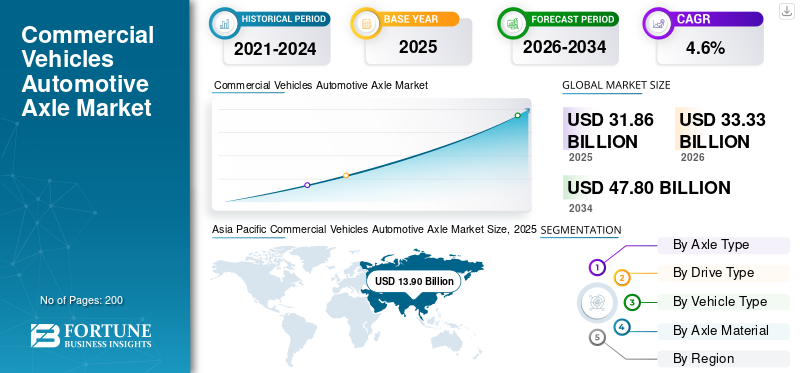
The global commercial vehicles automotive axle market size was valued at USD 31.86 billion in 2025 and is projected to grow from USD 33.33 billion in 2026 to USD 47.80 billion by 2034, exhibiting a CAGR of 4.6% over the forecast period. Asia Pacific dominated the commercial vehicles automotive axle market with a market share of 43.63% in 2025.
A commercial vehicle automotive axle is the load-bearing, power-transmission axle system used in trucks, buses, vans, trailers, and heavy-duty vehicles. It supports vehicle weight, connects wheels, transfers torque, enables steering or traction, and helps maintain stability under payload, braking, and road-stress conditions across logistics, construction, mining, municipal, and passenger transport applications. The market growth is supported by rising freight movement, commercial fleet replacement, infrastructure construction, mining activity, and the expansion of e-commerce delivery networks. The axle demand also increases as heavy trucks use higher-value tandem, drive, dead, and lift/tag axles. Electrification is adding value through integrated e-axles, lightweight materials, regenerative braking compatibility, and axles designed systems for electric trucks and buses.
Major players include Dana, Cummins-Meritor, SAF-Holland, BPW, Hendrickson, ZF, American Axle, Hyundai Transys, JTEKT, and Bharat Forge. These companies are depicting a shift from conventional mechanical axles toward integrated axle systems, electric axles, lightweight axles structures, trailer intelligence, braking integration, and aftermarket expansion to serve heavy-duty, electrified, and fleet-service demand.
Download Free sample to learn more about this report.
Commercial Vehicles Automotive Axle Market Key Takeaways
 Global Market Size & Forecast
- 2025 Market Size: USD 31.86 billion
- 2026 Market Size: USD 33.33 billion
- 2034 Forecast Market Size: USD 47.80 billion
- CAGR: 4.6% from 2026–2034
 Market Share
- Asia Pacific dominated the market with a 43.63% share in 2025.
- Drive axle segment held the largest market share in 2025.
- Single drive axle segment held the largest market share in 2025.
 Key Regional Highlights
North America
The market is driven by strong demand for heavy-duty freight vehicles, fleet modernization, and commercial vehicle electrification.
Asia Pacific
The market reached USD 13.90 billion in 2025, driven by expanding commercial vehicle production and freight transportation.
Europe
The market is supported by advanced truck manufacturing, lightweight axle adoption, and electrified commercial vehicles.
U.S.
The market is projected to reach USD 7.99 billion by 2026, driven by heavy-truck production and advanced axle technologies.
Japan
The market is projected to reach USD 1.60 billion by 2026, supported by demand for advanced light commercial vehicles and electric trucks.
Read More

COMMERCIAL VEHICLES AUTOMOTIVE AXLE MARKET TRENDS
Integration of Electric Axles to Reshape Commercial Vehicle Drivetrain Design
Electric axle integration is becoming a significant trend as commercial vehicle OEMs seek compact drivetrain layouts, better packaging, and improved efficiency. Instead of treating the axle only as a mechanical load-bearing part, suppliers are integrating motors, gears, controls, and power electronics into axle-based e-powertrain systems. This supports electric trucks, buses, and urban delivery vehicles by reducing drivetrain complexity and freeing chassis space for batteries. It also increases axle value per vehicle, especially in medium and heavy-duty applications.
In May 2023, ZF globally launched AxTrax 2, a modular integrated axle-based e-powertrain for commercial vehicles, with production planned in Europe and the U.S.
MARKET DYNAMICS
MARKET DRIVERS
Download Free sample to learn more about this report.
Expansion of Freight, Construction, and Heavy Truck Production to Support Axle Demand
Commercial vehicle axle demand expands when truck, bus, trailer, and heavy-duty vehicle production increases as every commercial vehicle requires axle systems for load support, torque transfer, and road stability. Heavy trucks create especially strong value demand given that they use more complex axle configurations, including drive axles, tandem axles, dead axles, and lift/tag axles. Construction, mining, long-haul logistics, and last-mile delivery also raise replacement demand due to higher utilization, propelling commercial vehicles automotive axle market growth.
In January 2025, ACEA reported that, in 2024, the sales of EU vans rose 8.3%, buses rose 9.2%, while trucks declined 6.3%, showing mixed but active commercial fleet demand.
MARKET RESTRAINTS
High Raw Material and Manufacturing Cost Pressure to Limit Margin Expansion
Commercial vehicle axles require high-strength steel, alloy steel, forged components, precision machining, heat treatment, bearings, housings, differentials, and braking or suspension interfaces. This makes the market sensitive to steel prices, energy costs, labor expenses, machining capacity, and logistics disruptions. The cost pressure is greater for heavy-duty and tandem axle systems given that they require higher fatigue resistance, larger housings, and more rigorous durability testing. Suppliers may pass some cost increases to OEMs but long-term contracts and competitive bidding can limit the recovery of margins. The restraint does not reduce the need for axles but it can slow replacement, delay the adoption of advanced materials, and pressure smaller suppliers. It also makes lightweight and electric axle systems more expensive during early commercialization.
MARKET OPPORTUNITIES
Electrified and Lightweight Axle Platforms to Create Higher-Value Growth Opportunities
Electrification creates an opportunity for suppliers to move beyond conventional axle housings and shafts into higher-value integrated systems. Electric trucks and buses require axle solutions that support motor integration, regenerative braking, battery packaging, lower weight, and improved payload efficiency. Lightweight/composite or optimized alloy axle designs can help fleets improve range, reduce energy consumption, and carry more freight within weight limits. This opportunity is the strongest in urban delivery, buses, refuse trucks, regional haul, and Class 7–8 electrification programs. In March 2023, SAF-Holland stated that its Haldex integration would combine axle and suspension systems, telematics, and EBS control into a single intelligent unit.
In August 2022, Cummins completed its acquisition of Meritor, adding drivetrain, axle, braking, aftermarket, and electric powertrain capabilities.
MARKET CHALLENGES
Balancing Durability, Electrification, Weight, and Cost Remains Technically Difficult
Commercial vehicle axle suppliers face the challenge of improving efficiency and electrification readiness while maintaining durability under heavy loads, harsh roads, long duty cycles, and strict safety expectations. Heavy trucks, buses, trailers, and off-highway vehicles require axles that resist fatigue, impact, corrosion, heat, and high torque. At the same time, OEMs want lighter systems, lower noise levels, improved energy efficiency, integrated electronics, and lower total cost. These goals can conflict as lightweight materials and integrated e-axles often require greater engineering complexity and higher validation costs. The challenge is especially evident in emerging markets, where operators need robust, affordable axles, while global OEM platforms increasingly demand advanced, electrified, and connected axle architectures.
Commercial Vehicles Automotive Axle Market Segmentation Analysis
By Axle Type
Heavy-Duty Payloads in Commercial Vehicles to Impel Drive Axle Segment Leadership
Based on axle type, the market is segmented into front axle, rear axle, drive axle, dead axle, and lift/tag axle.
The drive axle segment dominates the global commercial vehicles automotive axle market share as it performs the critical function of transmitting engine torque to the wheels while supporting high-payload operations in trucks, buses, and heavy-duty commercial vehicles. Growth in freight transportation, mining, long-haul trucking, and construction activity continues to increase the demand for high-capacity drive axle systems. Heavy commercial vehicles often use tandem and multi-drive axle configurations, further increasing segment value contribution.
The lift/tag axle segment is projected to grow at a CAGR of 5.4% over the forecast period. In September 2023, Dana introduced its next-generation eS9000r e-Axle platform for heavy-duty commercial vehicles to improve efficiency and torque delivery.
By Drive Type
Expanding Light- and Medium-duty Commercial Vehicle Production to Propel Single Drive Axle Segment Dominance
Based on drive type, the market is segmented into single drive, tandem drive, and multi-drive axles.
The single drive axle segment dominates the market due to the large global production volume of light- and medium-duty commercial vehicles used in urban logistics, e-commerce delivery, municipal transportation, and regional freight movement. Single drive systems offer lower weight, reduced maintenance requirements, improved fuel efficiency, and cost advantages for fleet operators. The rapid expansion of last-mile delivery and commercial van deployment across developing and developed economies continues to support segment growth.
The multi drive axle segment is projected to grow at a CAGR of 5.4% over the forecast period. In March 2024, Isuzu Motors announced plans to expand axle production for commercial vehicles, supporting logistics and delivery fleet growth in Asia and overseas markets.
By Vehicle Type
LCV Segment Leads the Market due to High Commercial Vehicle Demand in Urban Logistics and E-Commerce Distribution
Based on vehicle type, the market is segmented into light commercial vehicles (LCV), medium commercial vehicles (MCV), heavy commercial vehicles (HCV), and buses & coaches.
The LCV segment dominates the market due to strong demand for delivery vans, pickup trucks, mini trucks, and light cargo vehicles used in urban freight and e-commerce distribution. Increasing retail digitization, same-day delivery demand, and expansion of logistics networks are supporting higher LCV production globally. LCVs also generate high replacement axle demand due to high fleet utilization and frequent operational cycles.
The Heavy Commercial Vehicles (HCV) segment is projected to grow at a CAGR of 5.3% over the forecast period. In February 2024, Ford Pro reported continued growth in commercial van demand and connected fleet operations across Europe and North America.
To know how our report can help streamline your business, Speak to Analyst
By Axle Material
Superior Strength and Durability to Support Alloy Steel Axle Segment Leadership
Based on axle material, the market is segmented into alloy steel axles, carbon steel, and lightweight/composite axles.
The alloy steel segment dominates the market as they offer high fatigue resistance, superior load-bearing capacity, and long operational life under heavy commercial vehicle use. These axles are widely adopted across trucks, buses, trailers, mining vehicles, and construction equipment, where durability and reliability are critical. Alloy steel also offers better resistance to stress and impact during high-payload operations than conventional materials.
The lightweight/composite segment is projected to grow at a CAGR of 9.4% over the forecast period. In May 2023, SAF-Holland highlighted an increasing focus on lightweight commercial vehicle systems to improve efficiency and payload optimization.
COMMERCIAL VEHICLES AUTOMOTIVE AXLE MARKET REGIONAL OUTLOOK
By geography, the market is categorized into Europe, North America, Asia Pacific, South America, and the Middle East & Africa.
ASIA PACIFIC
Asia Pacific Commercial Vehicles Automotive Axle Market Size, 2025 (USD Billion)
To get more information on the regional analysis of this market, Download Free sample
Asia Pacific dominates the global market due to its massive commercial vehicle production base, expanding freight transportation networks, and strong infrastructure development across China, India, Japan, South Korea, and Southeast Asia. Rapid industrialization, urbanization, mining activity, and e-commerce expansion are driving the demand for heavy duty commercial vehicles. The region also benefits from increasing commercial vehicle exports and growing investments in electric trucks and buses. The rising adoption of tandem, multi-drive, and lift axle systems in construction and logistics fleets continues to strengthen market growth across the Asia Pacific.
CHINA COMMERCIAL VEHICLES AUTOMOTIVE AXLE MARKET
China dominates the Asia Pacific market with approximately 53.8% regional share, driven by its leadership in heavy truck production, commercial vehicle manufacturing, and logistics infrastructure development. Large-scale freight transportation, mining activity, and government infrastructure investments continue driving axle demand. The country also leads in electric truck and electric bus deployment, creating strong opportunities for integrated e-axle and lightweight axle technologies. According to OICA, China produced 4,260,835 commercial vehicles in 2025, making it the world’s largest commercial vehicle manufacturer. The country also produced 2,041,650 heavy trucks in 2025, significantly supporting the demand for drive axles, tandem axles, and heavy-duty axle systems.
INDIA COMMERCIAL VEHICLES AUTOMOTIVE AXLE MARKET
In Asia Pacific, the India market is projected to register the highest CAGR of 6.7% over the forecast period, driven by rapid infrastructure development, highway expansion, logistics modernization, and rising medium- and heavy-duty commercial vehicle production. The increasing penetration of organized freight transportation and e-commerce delivery fleets is also boosting axle demand. Growth in construction, mining, and intercity transportation further supports the adoption of higher-capacity drive and tandem axle systems.
JAPAN COMMERCIAL VEHICLES AUTOMOTIVE AXLE MARKET
The Japan market is projected to reach USD 1.60 billion in 2026, supported by the strong demand for technologically advanced light commercial vehicles and medium-duty trucks. The country benefits from highly developed automotive engineering capabilities and the increasing adoption of electric commercial vehicles. The demand for durable, lightweight, and fuel-efficient axle systems remains strong across urban logistics, regional freight transportation, and municipal fleet applications.
NORTH AMERICA
North America remains a significant market, driven by the strong demand for pickup trucks, heavy-duty freight vehicles, construction equipment, and long-haul transportation fleets. The region benefits from a large commercial vehicle parc, strong aftermarket replacement demand, and extensive logistics infrastructure across the U.S., Canada, and Mexico. The electrification of delivery fleets and the rising adoption of tandem and lift/tag axle systems are also supporting market expansion. Mexico continues to gain importance as a commercial vehicle manufacturing hub, supplying North American OEMs. Growth is further supported by fleet modernization, infrastructure spending, and increasing freight transportation activity across regional trade corridors.
U.S. COMMERCIAL VEHICLES AUTOMOTIVE AXLE MARKET
The U.S. dominates the North America market due to its massive freight transportation industry, high heavy-truck utilization, and large pickup-and-delivery van fleet. Construction activity, e-commerce logistics, and replacement axle demand from long-distance fleet operations support demand. The country is estimated to reach a market value of USD 7.99 billion in 2026, driven by strong Class 6-8 truck production and increasing adoption of advanced axle technologies, including electrified and lightweight axle systems.
Europe
Advanced truck manufacturing, stringent vehicle efficiency regulations, and growing adoption of lightweight and electrified axle systems support the Europe market. Strong logistics networks, urban delivery expansion, and public transportation investments continue driving axle demand across the region. OEMs are increasingly focusing on fuel efficient driveline technologies, integrated e-axles, and lightweight materials to meet emission targets. Western Europe remains technologically mature, while Eastern Europe supports growth in manufacturing and freight movement. The rising demand for electric buses and commercial delivery fleets is also accelerating the deployment of advanced axles across Europe.
U.K. COMMERCIAL VEHICLES AUTOMOTIVE AXLE MARKET
The U.K. market is supported by strong demand for light commercial delivery vehicles, urban logistics fleets, and fleet replacement activity. Growth in e-commerce distribution and commercial van deployment continues to support axle demand. The U.K. market is projected to reach USD 0.58 billion in 2026, driven by increasing investments in electric delivery fleets and low-emission transport infrastructure, which are boosting the demand for lightweight, integrated axle systems.
GERMANY COMMERCIAL VEHICLES AUTOMOTIVE AXLE MARKET
Germany holds approximately 18.6% share of the Europe market due to its strong truck manufacturing ecosystem and the presence of major OEMs and axle technology suppliers. Heavy commercial vehicle production, engineering capabilities, and growing adoption of advanced driveline systems support market expansion. Germany also benefits from strong export-oriented logistics and the increasing development of electric commercial vehicle platforms that require high-performance axle technologies.
SOUTH AMERICA
The South America market growth is driven by increasing vehicle production, agricultural transportation, mining activity, construction projects, and expanding regional freight movement. The demand for heavy-duty trucks and trailers continues to support growth in axle systems, particularly in drive and tandem axle configurations. Brazil remains the largest commercial vehicle market in the region, while Argentina and Chile contribute through mining and logistics activity. Infrastructure development and replacement demand from aging commercial fleets are also supporting market expansion. Rising trade volumes and investments in transportation connectivity continue to strengthen regional axle demand.
BRAZIL COMMERCIAL VEHICLES AUTOMOTIVE AXLE MARKET
Brazil dominates the South America market with approximately 60.6% regional share, driven by its large truck manufacturing base, agricultural logistics network, and extensive mining and construction activity. Strong demand for heavy-duty vehicles and freight movement is supporting axle consumption nationwide. Growth in long-haul trucking, infrastructure development, and replacement demand from commercial fleet operators continues to strengthen Brazil’s market position.
MIDDLE EAST & AFRICA
Infrastructure development, construction projects, oil & gas transportation, mining operations, and freight logistics expansion support the Middle East & Africa market. The demand for heavy-duty commercial vehicles is increasing across GCC countries and Africa due to rising trade activity and urban development initiatives. Fleet modernization and replacement demand are also supporting market growth. The region is increasingly adopting durable tandem and multi-drive axle systems suitable for harsh operating environments and high-load transportation applications across the industrial and construction sectors.
UAE COMMERCIAL VEHICLES AUTOMOTIVE AXLE MARKET
The UAE market is projected to grow at a CAGR of 5.8% over the analysis period, driven by increasing logistics activity, port expansion, infrastructure development, and construction projects. The rising demand for commercial transport vehicles supporting trade and warehousing operations is boosting axle demand nationwide. Growth in urban freight movements and regional connectivity initiatives is also encouraging the adoption of advanced, high-capacity axle systems in commercial fleets.
COMPETITIVE LANDSCAPE
Key Industry Players
Pivotal Players Focus on Lightweight Axle Technologies and Advanced Drive Axle Systems to Consolidate their Industry Positions
The global commercial vehicles automotive axle market trends are driven by technological capability, OEM partnerships, manufacturing scale, and aftermarket reach. Major players, including Dana, Cummins-Meritor, SAF-Holland, BPW, American Axle & Manufacturing, Hendrickson, ZF, Hyundai Transys, and JTEKT, compete through advanced drive axle systems, lightweight axle technologies, integrated e-axles, and heavy-duty tandem configurations. Companies are strengthening their competitive edge by developing electric axle platforms, expanding regional production capacity, and improving fleet-focused aftermarket services.
Strategic collaborations with truck and bus OEMs, investments in lightweight materials, and integration of braking and suspension systems by axle manufacturers are also shaping market competition. Localized manufacturing and supply chain optimization remain important for cost competitiveness across North America, Europe, and the Asia Pacific. In September 2023, Dana launched its next-generation eS9000r e-Axle platform for heavy-duty commercial vehicles to meet the global demand for electrified drivetrains.
LIST OF KEY COMMERCIAL VEHICLES AUTOMOTIVE AXLE COMPANIES PROFILED
- Dana Incorporated (U.S.)
- Meritor, Inc. / Cummins-Meritor (U.S.)
- American Axle & Manufacturing Holdings, Inc. (U.S.)
- SAF-Holland SE (Germany)
- Hendrickson USA, L.L.C. (U.S.)
- ZF Friedrichshafen AG (Germany)
- JTEKT Corporation (Japan)
- Hyundai Transys Inc. (South Korea)
- MAN Truck & Bus SE (Germany)
- AxleTech International LLC (U.S.)
- Bharat Forge Limited (India)
- Sisu Axles Inc. (Finland)
- RABA Automotive Holding Plc. (Hungary)
- Guangdong Fuwa Engineering Group Co., Ltd. (China)
- BPW Bergische Achsen KG (Germany)
KEY INDUSTRY DEVELOPMENTS
- May 2026: Hendrickson and Driventic jointly launched ELECTRAAX at ACT Expo 2026, a high-efficiency electric drive axle for Class 6-7 school buses and medium-duty trucks. The platform combines Hendrickson’s axle/suspension expertise with Driventic’s electric drive technology to improve uptime, range, and vehicle packaging.
- April 2026: Cummins launched the Meritor RT-160 HE tandem drive axle family for heavy linehaul applications at Truck World in Canada. The axle adds efficiency-focused design updates, weight-saving features, and durability improvements for fleets seeking lower operating costs in heavy-duty commercial transport.
- March 2026: Bosch Limited and Tata AutoComp Systems announced a joint venture in India focused on eAxle systems and electric motors. The partnership combines Bosch’s e-mobility technology with Tata AutoComp’s local manufacturing base, targeting passenger cars, light commercial vehicles, and heavy commercial vehicles for electrification opportunities.
- February 2026: Dauch Corporation, formerly American Axle & Manufacturing, completed its acquisition of Dowlais Group, including GKN Automotive and GKN Powder Metallurgy. The transaction created a larger driveline and metal-forming supplier positioned for axle systems, e-powertrain components, and global OEM programs.
- January 2026: BPW launched a new seven-tonne swing axle for heavy-duty low-loaders, semi-trailers, and semi-low-loaders. The axle targets the transport of construction machinery, mining equipment, transformers, industrial plants, and wind components, combining high load capacity with compact dimensions and lower dead weight.
REPORT COVERAGE
The global commercial vehicles automotive axle market analysis provides an in-depth study of the market size and forecast across all market segments included in the report. It contains details on market research dynamics and trends expected to drive the market during the forecast period. It offers information on rapid technological advancements, new product launches, key industry developments, strategic partnerships, mergers, and acquisitions. The market forecast provides a comprehensive competitive landscape, including the most significant global market shares, emerging opportunities, and profiles of key players.
Request for Customization to gain extensive market insights.
Report Scope & Segmentation
| ATTRIBUTE | DETAILS |
| Study Period | 2021-2034 |
| Base Year | 2025 |
| Estimated Year | 2026 |
| Forecast Period | 2026-2034 |
| Historical Period | 2021-2024 |
| Growth Rate | CAGR of 4.6% from 2026 to 2034 |
| Unit | Value (USD Billion) |
| Segmentation | By Axle Type, By Drive Type, By Vehicle Type, By Axle Material, and By Region |
| By Axle Type |
|
| By Drive Type |
|
| By Vehicle Type |
|
| By Axle Material |
|
| By Region |
|
Frequently Asked Questions
Fortune Business Insights says that the global market value stood at USD 31.86 billion in 2025 and is projected to reach USD 47.80 billion by 2034.
In 2025, the Asia Pacific market value stood at USD 13.90 billion.
The market is expected to grow at a CAGR of 4.6% from 2026 to 2034.
The Light Commercial Vehicles (LCV) segment leads the market by vehicle type.
Rising freight volumes, commercial fleet replacement, infrastructure construction, mining activity, and the expansion of e-commerce delivery networks are key factors driving the market.
Key market players include Dana, Cummins-Meritor, SAF-Holland, BPW, Hendrickson, ZF, and American Axle & Manufacturing.
The Asia Pacific region accounts for the largest share of the market.
North America, Europe, Asia Pacific, South America, and the Middle East & Africa have been considered in the market report.



- 2021-2034
- 2025
- 2021-2024
- 200
-
(Offer valid till 30th Sep 2026)
Get 30-60 hrs Free Customization
Expand Regional and Country Coverage, Segments Analysis, Company Profiles, Competitive Benchmarking, and End-user Insights.




















-
US +1 833 909 2966 ( Toll Free )
-
Get In Touch With Us