Compostable & Biodegradable Refuse Bags Market Size, Share & Industry Analysis, By Material (Polylactic Acid (PLA), Polybutylene Adipate Terephthalate (PBAT), Polyhydroxyalkanoates (PHA), Polybutylene Succinate (PBS), Starch Blends, and Others), By Product Type (Drawstring Bags, Flat Bags, Star-sealed Bags, Roll-form Bags, and Others), By End Use (Residential, Commercial, and Industrial), and Regional Forecast, 2026-2034
 Download Free Sample
(Offer valid till 15th Oct 2026)

Compostable & Biodegradable Refuse Bags Market Size and Future Outlook
 Listen to Audio Version
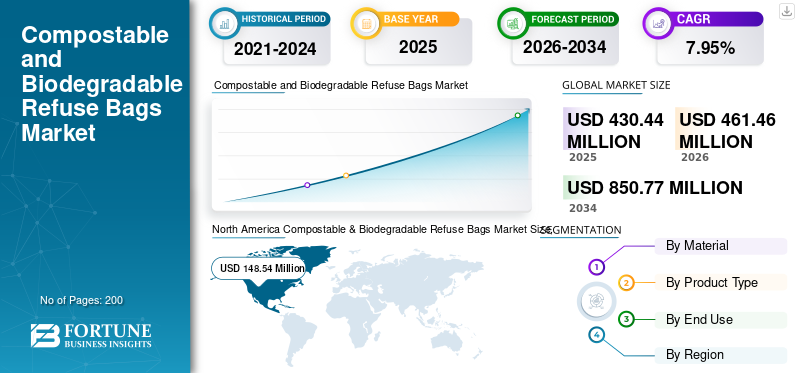
The global compostable & biodegradable refuse bags market size was valued at USD 430.44 million in 2025. The market is projected to grow from USD 461.46 million in 2026 to USD 850.77 million by 2034, exhibiting a CAGR of 7.95% during the forecast period. North America dominated the compostable and biodegradable refuse bags market with a market share of 34.50% in 2025.
The global market includes the manufacturing and distribution of refuse bags created from substances such as starch-based polymers, PLA (polylactic acid), PBAT, and various other bio-based or biodegradable resins. Growing regulatory limitations on single-use plastics, along with a heightened preference among consumers and businesses for sustainable waste management solutions, are driving the widespread adoption of the product in municipalities, retail, and food service sectors worldwide.
Key industry players, such as Mondi, BASF SE, and Cedo Ltd., operating in the market, are focusing on developing innovative products and conducting R&D to expand their sustainable product portfolios.
Download Free sample to learn more about this report.
Compostable and Biodegradable Refuse Bags Market Key Takeaways
 Global Market Size & Forecast
- 2025 Market Size: USD 430.44 million
- 2026 Market Size: USD 461.46 million
- 2034 Forecast Market Size: USD 850.77 million
- CAGR: 7.95% from 2026–2034
 Market Share
- North America dominated the compostable & biodegradable refuse bags market with a 34.50% share in 2025.
- The starch blends segment is expected to grow at a CAGR of 8.08% over the forecast period.
- The roll-form bags segment is projected to grow at a CAGR of 8.00% over the forecast period.
 Key Regional Highlights
North America
North America led the market with a valuation of USD 148.54 million in 2025.
Asia Pacific
Asia Pacific ranked second with a market valuation of USD 123.36 million in 2025.
Europe
Europe reached USD 74.12 million in 2025 and is projected to grow at a CAGR of 7.60%.
U.S.
The market reached approximately USD 116.53 million in 2025, accounting for roughly 27.07% of global sales.
Japan
The market reached approximately USD 23.20 million in 2025, representing roughly 5.39% of global revenues.
Read More

COMPOSTABLE & BIODEGRADABLE REFUSE BAGS MARKET TRENDS
Shift Toward Premium and Certified Products Is a Key Trend Observed in the Market
A significant trend in the global market is the shift toward premium, certified products that comply with established compostability standards such as EN 13432 and ASTM D6400. Purchasers, especially municipalities and large commercial entities, are increasingly favoring verified performance claims over cheaper options. This shift has resulted in a heightened demand for eco-friendly bags that offer improved strength, leak resistance, and controlled degradation timelines. Brands are also focusing on transparency in labeling and obtaining third-party certifications to foster trust among consumers. Furthermore, the incorporation of bio-based additives and multilayer film technologies is enhancing product durability, making these bags more competitive with traditional plastics in terms of functionality and reliability.
MARKET DYNAMICS
MARKET DRIVERS
Download Free sample to learn more about this report.
Stringent Environmental Regulations and Plastic Bans Are Driving Market Growth
The main catalyst for the market is the increasing enforcement of strict environmental regulations aimed at reducing plastic waste and promoting sustainable alternatives. Governments across various regions are enacting bans or imposing fees on single-use plastics, encouraging the adoption of compostable substitutes in applications such as organic waste collection and retail carry bags. These regulatory measures are encouraging municipalities, retailers, and food service providers to move toward biodegradable waste bags. Extended Producer Responsibility (EPR) policies are encouraging manufacturers to utilize sustainable materials. This regulatory pressure, along with heightened environmental consciousness among consumers, is greatly boosting demand and hastening the transition from traditional polyethylene-based garbage bags to environmentally friendly alternatives.
MARKET RESTRAINTS
High Cost Compared to Conventional Plastics Hampers Market Growth
A notable constraint in the market is the relatively elevated production cost compared with traditional plastic bags. Materials derived from biological sources, such as PLA and PBAT, tend to be more expensive and susceptible to supply fluctuations, which in turn increases the overall product price. Additionally, the requirement for specialized processing technologies and compliance with certification standards further adds to manufacturing expenses. In price-sensitive markets, particularly in developing regions, this disparity in costs obstructs widespread acceptance. End users often prioritize cost-effectiveness over sustainability, especially in large-scale waste management operations, which slows the uptake of compostable alternatives despite the fact that environmental awareness continues to grow.
MARKET OPPORTUNITIES
Expansion of Organic Waste Collection Systems to Offer Potential Growth Opportunities
The swift growth of organic waste collection and composting infrastructure offers a considerable opportunity for the compostable & biodegradable refuse bags market growth. Governments and local authorities are progressively implementing separate collection systems for food and green waste to minimize reliance on landfills and enhance recycling rates. Compostable refuse bags play a crucial role in these systems, as they can be disposed of alongside organic waste without the need for separation. This generates substantial demand from residential, commercial, and institutional sectors. Moreover, collaborations between bag manufacturers and waste management firms are developing to provide certified compostable liners, thereby supporting circular economy initiatives and facilitating scalable implementation within urban waste management programs.
MARKET CHALLENGES
Limited Composting Infrastructure and Mismanagement Pose a Critical Challenge to Market Growth
A significant challenge confronting the market is the restricted availability of industrial composting facilities, coupled with insufficient waste segregation practices in numerous areas. Compostable bags require specific conditions for effective degradation, which are not consistently found in typical landfill settings. In regions that lack adequate infrastructure, these bags may fail to decompose as intended, thereby reducing their environmental advantages. Moreover, consumer misunderstanding regarding the terms "biodegradable" and "compostable" frequently results in improper disposal practices. This mismanagement diminishes the efficacy of compostable waste solutions and can create skepticism among stakeholders, creating an obstacle to widespread adoption, even in the face of rising production and regulatory backing.
Segmentation Analysis
By Material
Scalable Feedstock Supply, Certification Compliance, and Balanced Performance to Drive the Growth of the PLA Segment
Based on material, the market is divided into polylactic acid (PLA), polybutylene adipate terephthalate (PBAT), polyhydroxyalkanoates (PHA), polybutylene succinate (PBS), starch blends, and others.
Polylactic Acid (PLA) segment is expected to account for the largest compostable & biodegradable refuse bags market share, due to its strong compliance with regulatory standards and its commercial scalability. Derived from renewable resources such as corn starch and sugarcane, PLA enjoys a relatively stable and scalable supply of feedstock compared to other biopolymers. It is certified under international compostability standards, making it a favored option for manufacturers focused on compliance-driven markets. Furthermore, PLA provides a well-balanced mix of strength, processability, and transparency, allowing for the production of high-quality bags suitable for both residential and commercial waste applications. Its compatibility with blending materials such as PBAT further enhances its flexibility and durability, contributing to its widespread use.
The starch blends segment is expected to grow at a CAGR of 8.08% over the forecast period.
By Product Type
Cost-Efficient Manufacturing and Broad Applicability Boosted the Flat Bags Segment Growth
Based on product type, the market is segmented into drawstring bags, flat bags, star-sealed bags, roll-form bags, and others.
In 2025, the flat bags segment dominated the global market. Flat bags remain the preferred option in the market, primarily due to their simple design, which facilitates economical large-scale production and broad applicability across multiple end-use settings. Their uncomplicated, seal-based construction utilizes less material and involves fewer manufacturing processes than drawstring or star-sealed alternatives, thereby lowering overall production expenses. This characteristic renders them particularly appealing to municipalities, businesses, and bulk consumers where cost considerations are paramount. Furthermore, flat bags offer versatility and are suitable for a diverse array of bin types and waste volumes, supporting both organic and general waste collection. Their convenience of storage, transportation, and dispensing further strengthens their status as the preferred choice in high-volume waste management operations.
The roll-form bags segment is projected to grow at a CAGR of 8.00% over the forecast period.
By End Use
To know how our report can help streamline your business, Speak to Analyst
Steady Household Waste Generation and Regulatory Support Along With Increasing Eco-Awareness to Drive the Residential Segment Growth
Based on end use, the market is segmented into residential, commercial, and industrial.
The residential segment is expected to hold a dominant market share over the forecast period. The residential sector leads the market for compostable and biodegradable refuse bags, primarily due to the significant volume and regularity of waste produced by households, which generates a steady and ongoing demand. Governments and local authorities are increasingly focusing on households through initiatives such as waste segregation requirements and bans on plastic, promoting the adoption of compostable liners for the collection of organic waste. Furthermore, the growing environmental consciousness among consumers is influencing their preference for sustainable options in daily use. The availability of compostable bags in supermarkets and online retail platforms further facilitates their adoption. In comparison to commercial and industrial users, households constitute a larger and more diverse customer base, resulting in greater overall consumption and supporting the segment’s leading market share.
The commercial segment is projected to grow at a CAGR of 8.15% over the forecast period.
Compostable & Biodegradable Refuse Bags Market Regional Outlook
By geography, the market is categorized into Europe, North America, Asia Pacific, Latin America, and the Middle East & Africa.
North America
North America Compostable & Biodegradable Refuse Bags Market Size, 2025 (USD Million)
To get more information on the regional analysis of this market, Download Free sample
North America held the dominant market share in 2024, valued at USD 138.48 million, and maintained its leading position, reaching USD 148.54 million in 2025. In North America, the market is propelled by robust regulatory frameworks, municipal composting initiatives, and institutional procurement policies. Cities are progressively requiring compostable liners for the collection of organic waste, while corporate sustainability commitments are hastening the adoption across the retail and food service sectors. Additionally, high consumer awareness and their readiness to pay a premium for sustainable products continue to support consistent market demand.
U.S. Compostable & Biodegradable Refuse Bags Market
Based on North America's strong contribution and the U.S. dominance within the region, the U.S. market reached around USD 116.53 million in 2025, accounting for roughly 27.07% of global sales. The market is influenced by state-specific regulations on plastic bag restrictions and initiatives that encourage the use of compostable alternatives, especially in California and New York. Major retailers and food chains are actively transitioning to certified compostable bags in order to fulfill their ESG objectives, while the ongoing expansion of curbside organic waste collection programs is further stimulating household-level consumption.
Europe
Europe is projected to grow at a CAGR of 7.60% during the forecast period, the third-highest among regions. The market reached a valuation of USD 74.12 million in 2025. Growth in Europe is largely influenced by rigorous environmental impact, regulations, and robust circular economy frameworks. The requirement for mandatory organic waste separation in numerous countries, along with extensive industrial composting facilities, facilitates high levels of adoption. In addition, stringent certification standards guarantee product quality, while a heightened awareness of environmental issues among consumers bolsters the demand for sustainable waste bags.
U.K. Compostable & Biodegradable Refuse Bags Market
The U.K. market stood at USD 14.08 million in 2025, representing approximately 3.27% of global revenues.
Germany Compostable & Biodegradable Refuse Bags Market
Germany's market reached approximately USD 15.98 million in 2025, equivalent to around 3.71% of global sales.
Asia Pacific
Asia Pacific reached USD 123.36 million in 2025, securing the position of the second-largest region in the market. In the region, swift urbanization and increasing waste production are significant factors, bolstered by governmental efforts to mitigate plastic pollution. Nations such as China and India are gradually enacting restrictions on traditional plastics, promoting the use of biodegradable substitutes.
Japan Compostable & Biodegradable Refuse Bags Market
The Japanese market in 2025 reached around USD 23.20 million, accounting for roughly 5.39% of global revenues. Japan's market is propelled by its meticulously organized waste segregation system and a robust commitment to environmental stewardship. Consumers have become familiar with stringent disposal methods, leading to an increased demand for specialized refuse bags. Innovations in biodegradable materials, along with elevated product quality standards, further promote the use of biodegradable materials and acceptance in both residential and commercial markets.
China Compostable & Biodegradable Refuse Bags Market
China's market is projected to be one of the largest worldwide, with 2025 revenues standing at around USD 39.46 million, representing roughly 9.17% of global sales.
India Compostable & Biodegradable Refuse Bags Market
The Indian market stood at around USD 33.06 million in 2025, accounting for roughly 7.68% of the Asia Pacific markets.
Latin America
The Latin America region is expected to witness moderate growth in this market during the forecast period. The Latin American market reached a valuation of USD 52.70 million in 2025. In Latin America, the market is steadily growing as a result of new plastic regulations and heightened concerns regarding urban waste management. An increase in environmental awareness is anticipated to bolster product demand in the coming years.
Middle East & Africa
In the Middle East & Africa, South Africa reached USD 8.48 million in 2025. The MEA region is experiencing steady growth, propelled by government initiatives focused on sustainability and reforms in waste management, especially within the Gulf nations. Large-scale events and smart city initiatives are promoting the utilization of environmentally friendly materials. Nevertheless, inadequate infrastructure and a lack of consumer awareness in certain regions of Africa are likely to hinder product adoption.
Saudi Arabia Compostable & Biodegradable Refuse Bags Market
The Saudi Arabian market reached approximately USD 11.62 million in 2025, accounting for roughly 2.70% of global revenues.
COMPETITIVE LANDSCAPE
Key Industry Players
Key Players Focus on Expanding New Products to Boost Their Market Shares
The global market has a semi-consolidated structure, with prominent players including Mondi, BASF SE, and Cedo Ltd. The significant market shares of these packaging companies are due to numerous strategic initiatives, including collaborations among operating entities to advance research.
- For instance, in March 2026, Mondi declared the enhancement of its sustainable packaging range by introducing new compostable refuse bag solutions aimed at municipal organic waste collection throughout Europe. The company has made investments to upgrade its bio-based film production capabilities, with an emphasis on enhancing mechanical strength and ensuring compliance with compostability certification.
Other notable players in the global market include BioBag International AS, Walki Group, and Sphere Group. These companies are expected to prioritize new product launches, strategic partnerships, and collaborations to increase their global market shares during the forecast period.
LIST OF KEY COMPOSTABLE & BIODEGRADABLE REFUSE BAGS COMPANIES PROFILED
- Mondi (U.K.)
- BASF SE (Germany)
- Cedo Ltd. (U.K.)
- BioBag International AS (Norway)
- Walki Group (Finland)
- Sphere Group (France)
- TERDEX GmbH (Germany)
- The Biodegradable Bag Company Ltd (U.K.)
- QuickPack Haushalt + Hygiene GmbH (Germany)
- RKW Group (Germany)
- Cortec Corporation (U.S.)
- XingYuan Packaging Co., Ltd. (China)
- Orizon Biomaterials (Brazil)
- DevPrakash BioGreen (India)
- Uniearth Global (India)
KEY INDUSTRY DEVELOPMENTS
- January 2026: BASF SE increased its production capacity for Ecoflex and Ecovio biopolymers in Asia to meet the growing demand for compostable bags. This expansion aims to assist manufacturers of refuse and organic waste bags by providing high-performance biodegradable materials.
- October 2025: BioBag International broadened its footprint in North America by establishing new distribution partnerships that focus on enhancing the supply of compostable waste bags for both residential and commercial applications. The company also launched upgraded product variants with higher load-bearing capacity and superior seal integrity, specifically tailored for food waste collection initiatives.
- July 2025: Walki Group introduced a new series of high-performance compostable films designed for refuse bags, aimed at both retail and industrial waste management sectors. This innovation emphasizes multi-layer structures that improve durability while adhering to compostability standards. Additionally, Walki invested in expanding its extrusion coating capabilities in Europe to address the rising demand fueled by regulatory changes and sustainability commitments.
- April 2025: Sphere Group revealed its purchase of a biodegradable packaging producer and an Italian company, Romagnasac, to bolster its market presence in compostable trash bags. This acquisition increases Sphere’s manufacturing capabilities and broadens its clientele within the municipal and retail industries.
- November 2024: RKW Group unveiled a new series of compostable waste bags specifically designed for robust use, especially for commercial and industrial waste. These items feature enhanced polymer blends that boost tear strength and load capacity. This introduction responds to the growing need for high-quality biodegradable options in industries beyond just residential applications.
REPORT COVERAGE
The compostable & biodegradable refuse bags market analysis includes a comprehensive study of market size & forecast across all market segments included in the report. It includes details on the market dynamics and market trends expected to drive the market over the forecast period. It provides information on key aspects, including technological advancements, pipeline candidates, the regulatory environment, and product launches. Additionally, it details partnerships, mergers & acquisitions, and key industry developments, as well as their prevalence by key regions. The global market research report also provides a detailed competitive landscape, including market share and profiles of key operating players.
Request for Customization to gain extensive market insights.
Report Scope & Segmentation
| ATTRIBUTE | DETAILS |
| Study Period | 2021-2034 |
| Base Year | 2025 |
| Estimated Year | 2026 |
| Forecast Period | 2026-2034 |
| Historical Period | 2021-2024 |
| Growth Rate | CAGR of 7.95% from 2026 to 2034 |
| Unit | Value (USD Million) |
| Segmentation | By Material, Product Type, End Use, and Region |
| By Material |
|
| By Product Type |
|
| By End Use |
|
| By Region |
|
Frequently Asked Questions
According to Fortune Business Insights, the global market value stood at USD 430.44 million in 2025 and is projected to reach USD 850.77 million by 2034.
In 2025, the region stood at USD 148.54 million.
The market is expected to grow at a CAGR of 7.95% over the forecast period.
By material, the polylactic acid (PLA) segment is expected to lead the market.
Stringent environmental regulations and plastic bans are the key factors driving market growth.
Mondi, BASF SE, and Cedo Ltd. are the major players in the global market.
North America dominated the market in 2025.



- 2021-2034
- 2025
- 2021-2024
- 200
-
(Offer valid till 15th Oct 2026)
Get 30-60 hrs Free Customization
Expand Regional and Country Coverage, Segments Analysis, Company Profiles, Competitive Benchmarking, and End-user Insights.






Related Reports
-
US +1 833 909 2966 ( Toll Free )
-
Get In Touch With Us