Computational Photography Market Size, Share & Industry Analysis by Product (Smartphone Cameras, Digital Cameras, Machine Vision, and AR/VR/Immersive Imaging Devices), By Architecture (Single- and Dual-Lens Camera, 16-Lens Camera, and Others), By Vertical (Security & Surveillance, Automotive, Consumer Electronics, Industrial, Healthcare, Media, Entertainment & Content Creation, and Others), By Application (3D Imaging, Virtual Reality, Augmented Reality, Mixed Reality, Standard Digital Imaging, and Others), and Regional Forecast, 2026–2034
 Download Free Sample
COMPUTATIONAL PHOTOGRAPHY MARKET SIZE AND FUTURE OUTLOOK
 Listen to Audio Version
The global computational photography market size was valued at USD 17.40 billion in 2025 and is projected to grow from USD 19.99 billion in 2026 to USD 60.66 billion by 2034, exhibiting a CAGR of 14.90% during the forecast period. Asia Pacific dominated the computational photography market with a market share of 43.50% in 2025.
Computational photography merges imaging methods with algorithms to enhance and alter digital images. It employs software-based techniques to boost image quality, create innovative photographic effects, and maximize camera efficiency. The rising popularity of smartphones equipped with sophisticated camera features is a key factor driving market growth. As users increasingly depend on their smartphones for capturing images, there is a heightened demand for computational photography functionalities such as HDR, portrait mode, and night mode. This trend fosters the advancement and incorporation of cutting-edge photography technologies into mobile devices, spurring market growth.
The major players in this industry are Apple, Samsung Electronics, Google (Alphabet), Huawei, Xiaomi, BBK Electronics, Sony Corporation, Nokia (HMD Global), Lenovo, and LG Electronics.
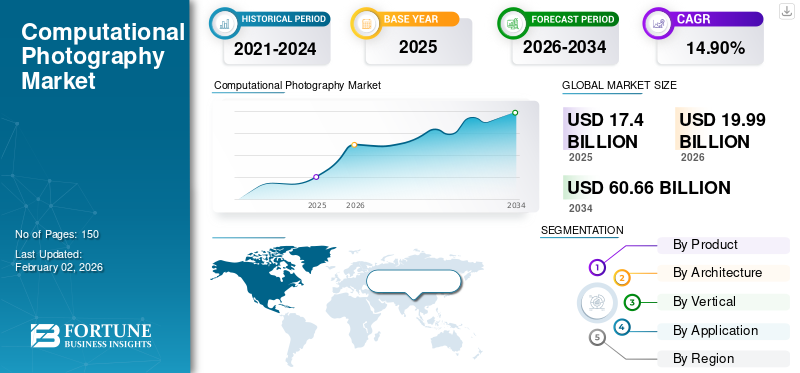
Download Free sample to learn more about this report.
COMPUTATIONAL PHOTOGRAPHY MARKET KEY TAKEAWAYS
 Market Size & Forecast
- 2025 Market Size: USD 17.40 billion
- 2026 Market Size: USD 19.99 billion
- 2034 Forecast Market Size: USD 60.66 billion
- CAGR: 14.90% from 2026–2034
 Market Share
- Asia Pacific dominated the computational photography market with a market share of 43.50% in 2025.
- The smartphone cameras segment is projected to dominate the computational photography market, accounting for 37.95% of the global market share in 2026.
- The single- and dual-lens camera segment is projected to reach the market, contributing 36.52% globally in 2026.
 Key Regional Highlights
North America
North America recorded a market size of USD 4.72 billion in 2025, capturing 27.10% of the global market share, and is projected to reach USD 5.38 billion in 2026.
Europe
In 2025, Europe represented USD 3.23 billion, accounting for 18.60% of the worldwide market, and is projected to grow to USD 3.7 billion in 2026.
Asia Pacific
The Asia Pacific market generated USD 7.56 billion in 2025, representing 43.50% of the global market landscape, and is expected to reach USD 8.8 billion in 2026.
U.S.
The U.S. is expected to register a valuation of USD 3.55 billion and USD 0.87 billion respectively in 2025.
Japan
The Japan market is projected to reach USD 1.95 billion by 2026.
Read More

IMPACT OF GENERATIVE AI
Creative Potential of Generative AI to Augur Well for Market Expansion
Generative AI is amplifying computational photography by enabling ultra-realistic image enhancement, low-light recovery, and super-resolution beyond hardware limits. It introduces creative possibilities such as scene relighting, background editing, and personalized aesthetics in real time. In professional domains, it supports medical imaging, surveillance, and automotive vision through synthetic data and clearer reconstruction. Over the next five years, this convergence will drive smarter cameras, AR/VR experiences, and AI-powered medical diagnostics.
IMPACT OF RECIPROCAL TARRIFFS
Reciprocal tariffs, where countries impose equal duties on each other’s goods, can disrupt trade flows by raising import costs and reducing competitiveness. They often trigger retaliatory trade wars, hurting exporters and increasing consumer prices. While they may protect domestic industries in the short term, they can strain global supply chains and slow economic growth. Long-term, reciprocal tariffs risk reducing investment, innovation, and market access, particularly in sectors reliant on international trade.
MARKET DYNAMICS
Market Drivers
Rising Demand for Smartphones and Cameras to Aid Market Growth
Smartphones, due to their advanced camera capabilities, are significant contributors to the field of computational photography. Mobile photography has gained immense importance, featuring advancements such as HDR, night mode, enhancements in portrait photography, and real-time image processing. These capabilities rely on complex computational methods that sequentially analyze multiple frames and then merge them to create an image that surpasses any single filtered frame. These aspects are anticipated to drive computational photography market growth over the coming years.
Market Restraints
High Cost Associated with Technology Implementation to Hinder Market Expansion
Despite the expansion of the computational photography industry, the significant expenses linked to the creation and execution of sophisticated imaging technology continue to pose a major obstacle. The development of cutting-edge hardware and software demands substantial resources that are primarily available to a limited number of devices, which impedes widespread adoption.
Market Opportunities
AI-Based Imaging to Speed up the Adoption of Computational Photography
Computational photography has experienced significant transformation with the introduction of artificial intelligence, leading to the widespread adoption of AI-driven imaging technologies. Key features encompass scene identification, automatic exposure settings, and AI-enhanced image correction, all designed to deliver high-quality photos with minimal user involvement. As reported by the National Institute of Standards and Technology, AI technologies can boost productivity by up to 40% in areas related to imaging.
Computational Photography Market Trends
Strong Demand for Sustainability and Green Tech to Emerge as a Key Market Trend
The sustainability and green tech trend refers to the global push toward environmentally responsible products, processes, and investments. Rising climate concerns, stricter regulations, and consumer demand are driving industries to adopt renewable energy, electric vehicles (EVs), energy-efficient devices, and circular economy practices (recycling, reuse, eco-design). Companies that align with sustainability goals reduce environmental impact and also gain a competitive advantage, investor interest, and long-term cost savings.
Download Free sample to learn more about this report.
SEGMENTATION ANALYSIS
By Product
Increasing Consumer Appetite for Superior Imaging Features to Drive Smartphone Cameras Segment
Based on product, the market is segmented into smartphone cameras, digital cameras, machine vision, and AR/VR/immersive imaging devices.
By share, the smartphone cameras segment is projected to dominate the computational photography market, accounting for 37.95% of the global market share in 2026 driven by continuous innovation and an increasing consumer appetite for superior imaging features in smartphone cameras. Producers are implementing sophisticated computational methods, including multi-frame fusion, machine learning-driven image enhancement, and computational bokeh, to enhance image quality, optimize low-light performance, and elevate the overall user experience.
- The machine vision segment will achieve the highest compound annual growth rate (CAGR) of 17.66% during the forecast period.
By Architecture
Increasing Popularity for Improved Imaging Fueled the Expansion of Single- and Dual-lens Cameras
Based on architecture, the market is segmented into single- and dual-lens camera, 16-lens camera, and others.
The single- and dual-lens camera segment is projected to reach the market, contributing 36.52% globally in 2026. The segment is expected to lead with a 37.6% share in 2025. The rising popularity of these cameras is driven by the advancement of smartphone cameras, including models such as the iPhone XS, iPhone X, Google Pixel, and others, that feature single and dual-lens camera systems for enhanced imaging. The inclusion of multiple lenses has allowed manufacturers to introduce new functionalities such as zoom, improved HDR, portrait modes, 3D capabilities, and photography in low-light conditions.
- The others segment will achieve the highest compound annual growth rate (CAGR) of 17.51% during the forecast period.
By Vertical
Increasing Benefits and a Mature Market for Smartphone Users Boosted the Expansion of the Consumer Electronics Vertical
Based on vertical, the market is segmented into security & surveillance, automotive, consumer electronics, industrial, healthcare, media, entertainment & content creation, and others.
By share, the consumer electronics segment is projected to reach the market for 38.36% of the global market share in 2026. The segment is expected to lead with a 38.7% share in 2025. Computational imaging has quickly become commonplace in consumer electronics, especially in mobile devices and smart cameras with advantages such as enhanced low-light capabilities and optimized dynamic range. According to Digital Camera World, in 2023, the average person had around 2,100 photos stored on their smartphone.
- The healthcare segment will achieve the highest compound annual growth rate (CAGR) of 18.24% during the forecast period.
By Application
3D Imaging Dominated the Market Due to its Extensive Range of Applications and Surging Demand for Immersive Experiences
Based on application, the market is categorized into 3D imaging, virtual reality, augmented reality, mixed reality, standard digital imaging, and others.
The 3D imaging segment was the major segment in 2024. In 2025, the segment is anticipated to dominate with a 28.7% share owing to its wide range of applications and increasing demand for immersive experiences. With the progress of technology, 3D imaging methods such as depth mapping, structured light, and stereo vision are becoming increasingly accessible and effective, allowing for applications in augmented reality, virtual reality, gaming, healthcare, automotive, and entertainment.
- The mixed reality segment is anticipated to grow at the highest CAGR of 19.08% during the forecast period.
To know how our report can help streamline your business, Speak to Analyst
COMPUTATIONAL PHOTOGRAPHY MARKET REGIONAL OUTLOOK
By region, the market is divided into North America, Europe, South America, the Middle East & Africa, and Asia Pacific.
Asia Pacific Computational Photography Market Size, 2025 (USD Billion)
To get more information on the regional analysis of this market, Download Free sample
Asia Pacific
The Asia Pacific market generated USD 7.56 billion in 2025, representing 43.50% of the global market landscape, and is expected to reach USD 8.8 billion in 2026. The dominance can primarily be linked to significant elements such as the rise in smartphone usage, increasing disposable incomes, and advancements in technological infrastructure in nations such as China, India, and South Korea. Additionally, government initiatives aimed at fostering digital innovation and technological progress contribute to the swift growth of the region. The Japan market is projected to reach USD 1.95 billion by 2026, the China market is estimated to reach USD 3.20 billion by 2026, and the India market is projected to reach USD 1.21 billion by 2026.
To know how our report can help streamline your business, Speak to Analyst
North America
North America recorded a market size of USD 4.72 billion in 2025, capturing 27.10% of the global market share, and is projected to reach USD 5.38 billion in 2026. North America boasts a strong technological infrastructure, widespread consumer demand for advanced digital devices, and considerable investments in research and development. As the demand for smartphones, augmented reality, virtual reality, and other immersive technologies continues to grow, North America is likely to witness an uptick in the implementation of computational photography solutions. Backed by these factors, countries including the U.S. and Canada are expected to register a valuation of USD 3.55 billion and USD 0.87 billion respectively in 2025. After North America, the Europe market is estimated to touch a value of USD 3.23 billion in 2025, holding the third-largest position in the global market.
Europe
In 2025, Europe represented USD 3.23 billion, accounting for 18.60% of the worldwide market, and is projected to grow to USD 3.7 billion in 2026.
Middle East & Africa and South America
The Middle East & Africa and South America regions would witness moderate growth in this market over the forecast period. Middle East & Africa accounted for USD 1.24 billion in 2025, representing 7.10% of the global market share, and is projected to reach USD 1.4 billion in 2026. The South American market in 2025 is set to record USD 0.64 billion in its valuation. Countries such as Brazil and Argentina are seeing growing AI research, startup activity, and infrastructure. The quality of education in engineering plus government policy support helps build local innovation capabilities. In the Middle East & Africa, the GCC is anticipated to record a value of USD 1.24 billion in 2025. Big regional strategies such as Saudi Vision 2030, UAE AI Strategy 2031, and digital government transformation programs are catalyzing infrastructure growth, funding, and favorable regulation.
Latin America
In 2025, Latin America held 3.70% of the global market, reaching a valuation of USD 0.65 billion, and is projected to grow to USD 0.72 billion in 2026.
COMPETITIVE LANDSCAPE
KEY INDUSTRY PLAYERS
Leading Players to Adopt Strategic Strategies for Expanding their Business Reach
Notable industry players are offering computational photography solutions to provide users with improved image quality, post-capture flexibility, and enhanced functionality. They concentrate on forging contracts with local and small businesses for expanding their businesses. Such initiatives, including investments, collaborations, and mergers & acquisitions, are likely to create an escalation in product demand.
List of Key Computational Photography Companies Studied (including but not limited to):
- Apple (U.S.)
- Samsung Electronics (South Korea)
- Google (Alphabet) (U.S.)
- Huawei (China)
- Xiaomi (China)
- BBK Electronics (China)
- Sony Corporation (Japan)
- Nokia (HMD Global) (Finland)
- Lenovo (U.S.)
- LG Electronics (South Korea)
- Honor (China)
- Qualcomm (U.S.)
- MediaTek (Taiwan)
- Pelican Imaging (U.S.)
- Nikon Corporation (Japan)
- Micron Technology (U.S.)
- NVIDIA (U.S.)
- Infineon Technologies AG (Germany)
- Renesas Electronics Corporation (Japan)
- Applied Materials, Inc. (U.S.)
KEY INDUSTRY DEVELOPMENTS:
- June 2025: Vexcel Imaging announced three new UltraCam aerial imaging systems named Osprey 4.2, Dragon 4.2, and Merlin 5.0. These all are using Sony’s new IMX811 sensor.
- November 2023: Insta360 launched the Ace and Ace Pro, two new action cameras developed in collaboration with Leica. The cameras have been designed to deliver exceptional image quality through a combination of hardware and computational photography, powered by artificial intelligence.
- November 2023: OPPO and Hasselblad revealed that their three-year partnership would lead to the release of a sequel to the HyperTone Camera Systems in 2024. This announcement, made at Paris Photo 2023, marks a significant advancement in the collaboration between OPPO and Hasselblad, which began with the Find X5 series.
- November 2023: Sony Electronics finished the second phase of testing for its in-camera authenticity technology alongside the Associated Press. This digital signature embedded in the camera enables the production of a birth certificate for photos, confirming the content's source.
- January 2022: Xperi introduced a single-camera system designed for monitoring drivers and occupancy. The DTS AutoSense technology advances the capabilities for detecting drivers and passengers using just one camera, while also reducing costs associated with system integration, calibration, and installation.
INVESTMENT ANALYSIS AND OPPORTUNITIES
The market for computational photography presents significant investment opportunities, fueled by an increase in smartphone use, the integration of AI and machine learning, and expansion into industries beyond consumer markets such as healthcare, automotive, and security. There are prospects in AI-enhanced imaging algorithms, innovation in sensors, the merging of augmented and virtual reality, and advancements in medical imaging. Collaborations among hardware, software, and AI companies will pave the way for the next phase of growth.
REPORT COVERAGE
The report provides a detailed analysis of the market and focuses on key aspects, such as leading companies, product/types, and the leading end-use of the product. Besides, it offers insights into the market trends and highlights key industry developments. In addition to the factors mentioned above, the report encompasses several factors that have contributed to the market's growth in recent years.
Request for Customization to gain extensive market insights.
REPORT SCOPE & SEGMENTATION
| ATTRIBUTE | DETAILS |
| Study Period | 2021-2034 |
| Base Year | 2025 |
| Estimated Year | 2026 |
| Forecast Period | 2026-2034 |
| Historical Period | 2021-2024 |
| Growth Rate | CAGR of 14.90% from 2026 to 2034 |
| Unit | Value (USD Billion) |
| Segmentation |
By Product
By Architecture
By Vertical
By Application
By Region
|
Frequently Asked Questions
According to a study by Fortune Business Insights, the market is projected to reach a valuation of USD 60.66 billion by 2034.
In 2025, the market was valued at USD 17.40 billion.
The market is projected to record a CAGR of 14.90% during the forecast period.
By vertical, the consumer electronics segment led the market in 2024.
The rising demand for smartphones and cameras is a key factor aiding market growth.
Apple, Samsung Electronics, Google (Alphabet), Huawei, Xiaomi, BBK Electronics, Sony Corporation, Nokia (HMD Global), Lenovo, and LG Electronics are the top players in the market.
Asia Pacific held the highest market share in 2024.
By application, the mixed reality segment is expected to record the highest CAGR during the forecast period.



- 2021-2034
- 2025
- 2021-2024
- 150
Get 30-60 hrs Free Customization
Expand Regional and Country Coverage, Segments Analysis, Company Profiles, Competitive Benchmarking, and End-user Insights.




















Related Reports
-
US +1 833 909 2966 ( Toll Free )
-
Get In Touch With Us