Container Homes Market Size, Share & Industry Analysis, By Type (Fixed and Movable), By Architecture Type (Tiny House, Duplex/Bungalow, and Multistory Building/Apartments), By End-user (Residential, Commercial, and Industrial), and Regional Forecast, 2026-2034
 Download Free Sample
KEY MARKET INSIGHTS
 Listen to Audio Version
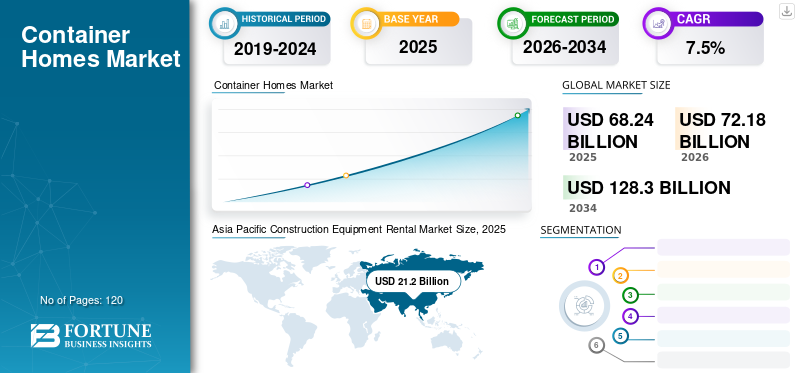
The global container homes market size was valued at USD 68.24 billion in 2025 and is projected to grow from USD 72.18 billion in 2026 to USD 128.3 billion by 2034, exhibiting a CAGR of 7.5% during the forecast period. The container homes market in the U.S. is projected to grow significantly, reaching an estimated value of USD 42.67 Bn by 2032, driven by the demand of innovative architectural design across U.S. North America dominated the global market with a share of 37.1% in 2025.
Container homes, built from repurposed shipping containers, are gaining momentum as affordable, eco-friendly, and modular housing alternatives. Their growing appeal lies in rapid construction, lower material costs, and flexible architectural possibilities, particularly for residential use and temporary housing in urban and rural areas.
A shipping container home is a dwelling made of steel shipping containers (large reusable intermodal containers) that transport goods. These types of homes are used to move goods across the world. They are designed to fit on trucks, trains, and ships and are mostly uniform in size and shape. Due to this uniformity, they are deployed for building interesting custom homes.
The pandemic has adversely affected the entire construction industry, including this market. The manufacturers in the industry do not require concrete but other raw materials such as steel, iron, glass, and other hardware accessories such as nuts and bolts. The pandemic has severely disrupted this supply chain, delaying many projects. Contractors and other equipment manufacturers are finding it difficult to maintain social distancing. The factory-made segment of the market falls into this category and was impacted due to COVID-19 restrictions. Workforce shortages and complete lockdowns in various countries slowed or halted activity on the ground, directly affecting the profitability of ongoing operations.
According to brokerages and companies developing prefabricated homes, the demand for well-equipped homes is soaring due to increased demand for post-COVID-19 farmhouses. With most states restricting concrete construction on farmland, homeowners opt for prefabricated homes with all amenities, further driving the market growth.
Easy to lift, secure, and assemble, container houses are gaining popularity all over the world. These houses are built using environment-friendly materials. Recently, there has been a significant increase in the demand for affordable housing structures. Using second-hand shipping containers to build prefabricated homes is an ongoing trend in the global construction industry. Besides, modular buildings are slowly making inroads with many builders and contractors in developing countries.
Download Free sample to learn more about this report.
Container Homes Market Key Takeaways
 Market Size & Forecast
- 2025 Market Size: USD 68.24 billion
- 2026 Market Size: USD 72.18 billion
- 2034 Forecast Market Size: USD 128.30 billion
- CAGR: 7.5% from 2026–2034
 Market Share
- North America dominated the market with a 37.10% share in 2025.
- The Fixed Homes segment is projected to hold 56.41% of the market in 2026.
- The Residential Houses segment is expected to account for 51.33% of the market in 2026.
 Key Regional Highlights
Asia Pacific
Asia Pacific reached USD 21.20 billion in 2025 and is expected to grow to USD 22.42 billion in 2026.
North America
North America valued at USD 25.33 billion in 2025 and projected to reach USD 26.97 billion in 2026.
Europe
Europe Accounted for USD 15.23 billion in 2025 and is projected to reach USD 16.05 billion in 2026.
U.S.
U.S. market is projected to reach USD 15.95 billion by 2026 and USD 42.67 billion by 2032.
Japan
Container homes market is projected to reach USD 6.28 billion by 2026.
Read More

Container Homes Market Trends
Growing Demand for Innovative Architectural Design to Bolster the Market Growth
Container homes are gaining traction as a new form of sustainable living. About 14 million unused containers in the world are currently being explored in creative ways to make homes for many. The pandemic has pushed people to take more interest in DIY (do-it-yourself) developments in designing, decorating, and home building.
Several architectural design possibilities are being explored for the interior of these homes. These include walls made from glass, wooden accents, splashes of greenery, getaway cabins, spiral staircase, shipping container guesthouse, and others. These sustainable designs add a greater sense of open space and style. Further, they also aid in reducing electricity bills and other house-related expenses, accelerating the market growth.
Download Free sample to learn more about this report.
Container Homes Market Growth Factors
Sustainability & Cost-effectiveness Container Homes Strengthen the Market Growth
The ecology of container homes has a great impact on the market in many ways. First, consumer awareness of the environment is growing. People are increasingly looking for sustainable and eco-friendly housing options and container homes are paving the way to meet their preferences.
- For instance, Edmonton-based Honomobo utilizes modern building techniques, highly efficient heating/cooling systems, and high-grade insulation to create efficient and environmentally friendly homes.
The use of recycled materials also contributes to cost efficiency, making container homes an attractive option for those looking for an affordable and environmentally friendly living solution. The container home market continues to grow as sustainability becomes a key decision-making factor. In addition, the modular nature of container homes allows for energy efficient designs with features such as good insulation, natural ventilation, and solar panels. This increases its overall appeal, especially for those looking to reduce their carbon footprint.
The cost efficiency of container homes is a major factor contributing to their popularity and impact on the housing market. Container homes offer a cost-effective alternative to traditional construction methods and this affordability has several implications for the market.
Container homes are often more budget-friendly than traditional homes, which makes them an attractive option for individuals or families looking for affordable housing solutions. This is particularly appealing in regions where housing costs are high and people are seeking more cost-effective alternatives.
- For instance, Honomobo came up with HO5+ that features a living space of 1530 sq. ft. Built from five 40ft shipping containers, this single-level house is a solar photovoltaic that could save huge sums on electricity bills.
The eco-friendliness and cost-effectiveness of container homes has played an important role in shaping the market, influencing purchasing decisions. As environmental concerns continue to grow, the demand for sustainable housing options such as container homes will continue to expand.
RESTRAINING FACTORS
Limited Life Span & High Corrosive State to Hinder the Market Growth
A high potential for corrosion is limiting the growth of the market. The lifespan of a container house is extremely reliant on the climate where the sea container is positioned. In coastal areas, these houses erode faster due to a large amount of salt in the air.
The life expectancy of a heavily used container house is around 10-15 years with good maintenance. Infrequently used container homes can be used for up to 25 years, after which they can no longer be used. The reliance of container type of houses on climatic issues and high susceptibility to corrosion is restraining the market growth.
Container Homes Market Segmentation Analysis
By Type Analysis
Fixed Segment to Depict Considerable Growth Due to Cost Effectiveness
Based on type, the market is classified into fixed and movable.
Fixed homes come with pre-installed foundations, utilities, and appliances. The fixed segment is expected to record appreciable growth over the forecast period. These houses are cost-effective compared to other types of prefabricated houses as they do not require additional assembly. In 2026, the Fixed segment is projected to lead the market with a 56.41% share.
Movable container houses are made from standard shipping containers. These can be assembled on-site by crane or dismantled and reassembled as required. These prefabricated homes offer a flexible option for people who need to move frequently for work or other reasons but want a comfortable, affordable, and permanent living space.
By Architecture Type Analysis
Tiny Houses to Witness Significant Rise Owing to Surging Demand for Cheaper Alternatives
Based on architecture type, the market is divided into tiny house, duplex/bungalow, and multistory building/apartments.
The rising demand for tiny house in housing construction reflects the growing need for sustainability and cheaper alternatives. The segment is set to register considerable expansion over the forecast period. These houses are convenient to carry. The demand for small container houses, which are easy to construct and move, is growing rapidly. A pool of individuals and families opt for a less common lifestyle by choosing tiny homes on wheels. These provide people with the opportunity to own a home.
- In 2026, the tiny house segment is projected to lead the market with a 44.4% share.
Bungalows are likely to record considerable growth in the coming years. These container houses are easy to modify and can be combined with 20ft and 40ft containers to build a house. Multiple containers can be combined to create a larger house with a living room, dining room, additional bedrooms, upstairs, and even a container guest house.
Multistory buildings are expected to register slow growth over the forecast period. Space issues and rising house prices in most major cities worldwide are driving the growth of the multistory container house market. These houses save space as they use old shipping containers to build houses and occupy much less space than traditional houses.
By End-user Analysis
To know how our report can help streamline your business, Speak to Analyst
Residential Houses to Register Major Expansion Due to Higher Demand
Based on end-user, the market is divided into residential, commercial, and industrial.
Residential container home rentals are becoming increasingly popular for various leisure activities. Some prefer guests to stay together under one roof. People rent them out to host get-togethers, camps, and outdoor parties. These houses are also suitable as vacation homes and cabins at sea, with basic amenities such as beds, bathroom facilities, and kitchens. In 2026, the Residential houses segment is projected to lead the market with a 51.33% share.
The commercial and industrial segments are set to record substantial demand during the forecast period. In these sectors, container homes are moderately gaining significance. These homes are being used for recreational & emergency or nursing, proving to be cost-effective and space effective.
REGIONAL INSIGHTS
Based on geography, the market is segmented into five major regions, North America, Europe, Asia Pacific, the Middle East & Africa, and Latin America.
Asia Pacific Construction Equipment Rental Market Size, 2025 (USD Billion)
To get more information on the regional analysis of this market, Download Free sample
North America
North America recorded a market size of USD 25.33 billion in 2025, capturing 37.10% of the global market share, and is projected to reach USD 26.97 billion in 2026. Companies in the region are increasingly using Artificial Intelligence (AI) in container house manufacturing to develop better designs. They use AI to identify and solve design problems before the manufacturing process begins. AI is an essential sketching platform that helps create many innovative layouts and designs. This allows companies to reduce manufacturing costs and time and improve design security. Using artificial intelligence, customers can also associate the size of the space with the exact number of products and devices that fit in the space, increasing the container homes market share in North America.
In the U.S., the penetration rate of container type of housing is very high. The utilization of constructed housing using containers can be tracked in eight regional clusters, including Maine, Vermont, New Hampshire, Massachusetts, Connecticut, Rhode Island, and New York, with modular housing and dormitories in the country accounting for more than 22%. Various regulatory bodies regulate this market in the U.S., and obtaining a permit to build container housing is a complex process. This is on account of specific zoning codes and building codes. Major end-users for the residential container industry in this country include education, office, hospitality, and multifamily housing. The U.S. market is projected to reach USD 15.95 billion by 2026.
To know how our report can help streamline your business, Speak to Analyst
Asia Pacific
The Asia Pacific market generated USD 21.2 billion in 2025, representing 31.10% of the global market landscape, and is expected to reach USD 22.42 billion in 2026. Asia Pacific is expected to be a promising container housing market in terms of revenue from 2022 to 2029 as living conditions improve and investments in new housing developments increase. This is attributed to the fact that it is a highly industrialized region with favorable socio-economic conditions. The growth in this market in this region is driven by factors such as availability of used containers and reduced construction costs. With many decommissioned containers on the market, they are readily available for container house construction. They are tougher, more durable, and available in shapes and sizes best suited for building applications. Therefore, their construction takes less time than traditional construction. The Japan market is projected to reach USD 6.28 billion by 2026. The China market is projected to reach USD 8.12 billion by 2026. The India market is projected to reach USD 4.40 billion by 2026.
Europe
In 2025, Europe represented USD 15.23 billion, accounting for 22.30% of the worldwide market, and is projected to grow to USD 16.05 billion in 2026. The Europe market is projected to have modest growth with a significant upsurge in the coming years. The growth in Europe can be attributed to factors such as rising construction quality standards requiring higher quality materials during construction and increase in residential projects in various regions. The UK market is projected to reach USD 4.09 billion by 2026. The Germany market is projected to reach USD 4.87 billion by 2026.
Middle East & Africa and Latin America
The Middle East & Africa and Latin America regions are likely to have a moderate growth in terms of revenue. Middle East & Africa accounted for USD 2.3 billion in 2025, representing 3.40% of the global market share, and is projected to reach USD 2.37 billion in 2026. Demand for container housing in the regions is expected to be driven by the need for sustainable housing solutions. In 2025, Latin America held 6.10% of the global market, reaching a valuation of USD 4.18 billion, and is projected to grow to USD 4.37 billion in 2026.
KEY INDUSTRY PLAYERS
Companies are Emphasizing on Technological Advancements & Upgrading Products to Gain Strong Foothold
Portable Space Ltd, SEA BOX, Inc., Anderco Pte Ltd, IQ Container Homes, Almar Container Group, Royal Wolf, ELA Container GmbH, CONTAINEX Container-Handelsgesellschaft m.b.H, Champion Prefabs, E-Pack Polymers Private Limited, PKG Container International (M), and SAMAN POS India Pvt Ltd are recognized as major manufacturers of modular containers. Most companies featured in the report focused on expansion, investment, acquisition, supply focus, portfolio expansion, and brand development to consolidate their market position.
LIST OF TOP CONTAINER HOMES COMPANIES:
- Portable Space Ltd (U.K.)
- SEA BOX, Inc. (U.S.)
- Anderco Pte Ltd (Singapore)
- HONOMOBO (Canada)
- Almar Container Group (South Africa)
- Royal Wolf (Australia)
- ELA Container GmbH (Germany)
- SG Blocks, Inc. (U.S.)
- Supertech Industries (UAE)
- Temohousing (Netherlands)
KEY INDUSTRY DEVELOPMENTS:
- July 2023: In response to the housing crisis, the city of Austin, Texas, passed an ordinance facilitating the construction of container homes, aiming to offer affordable housing solutions for all.
- April 2023: ModPOD Living, a prominent modular homes provider from England, inaugurated its new factory in Oregon.
- March 2023: The Container Home Company introduced a new line of prefabricated container homes to address the growing global demand.
- November 2022: BOB’s Container, a prominent container home provider, partnered with Thrive Mortgage to offer more comprehensive financing solutions for their home renovation and development projects.
- July 2021: Portables Spaces launched an affordable range of flat-pack kiosks for pubs, restaurants, and event organizers.
REPORT COVERAGE
Request for Customization to gain extensive market insights.
The research report provides a detailed analysis of the market based on various segments - type, application, and end-user. It provides information about leading companies, their business overview, and the leading applications of their products. Besides, it offers insights into the competitive landscape, SWOT analysis, and current market trends and highlights the key drivers and restraints. In addition to the aforementioned factors, the report encompasses several factors that have contributed to the market growth in recent years.
Report Scope & Segmentation
|
ATTRIBUTE |
DETAILS |
|
Study Period |
2021-2034 |
|
Base Year |
2025 |
|
Estimated Year |
2026 |
|
Forecast Period |
2026-2034 |
|
Historical Period |
2021-2024 |
|
Growth Rate |
CAGR of 7.5% over 2026 to 2034 |
|
Unit |
Value (USD Billion) |
|
Segmentation
|
By Type
|
|
By Architecture Type
|
|
|
By End-user
|
|
|
By Region
|
Frequently Asked Questions
Fortune Business Insights says that the market was valued at USD 68.24 billion in 2025.
In 2034, the market is expected to be valued at USD 128.3 billion.
The global market is estimated to exhibit a noteworthy CAGR of 7.5% over the forecast period.
North America is expected to hold a major share in the market. The regional market size stood at USD 25.33 billion in 2025.
By architecture type, tiny house is expected to be the leading segment in the market during the forecast period.
The increasing inclination toward energy-efficient container home construction is the key driver reinforcing the market growth.
Portable Space Ltd, SEA BOX, Inc., Anderco Pte Ltd, HONOMOBO, Almar Container Group, ELA Container GmbH, SG Blocks, Inc., Supertech Industries, and Temohousing are some of the leading companies in the market.
Based on end-user, the residential segment is expected to drive the market.
The major players constitute approximately 25%-35% market share, which is majorly owed to their brand image and presence in multiple regions.


- 2021-2034
- 2025
- 2021-2024
- 120
Get 30-60 hrs Free Customization
Expand Regional and Country Coverage, Segments Analysis, Company Profiles, Competitive Benchmarking, and End-user Insights.















Related Reports
-
US +1 833 909 2966 ( Toll Free )
-
Get In Touch With Us