Content Intelligence Market Size, Share & Industry Analysis, By Deployment (On-premise, Cloud, and Hybrid), By Enterprise Type (Large Enterprises and Small and Medium-sized Enterprises), By Application (Content Analytics, Audience Segmentation, Campaign Optimization, and Competitor Analysis), By End-Use Vertical (Media & Entertainment, Marketing and Advertising, Retail & e-Commerce, Healthcare, Education, and Others), and Regional Forecast, 2026–2034
 Download Free Sample
KEY MARKET INSIGHTS
 Listen to Audio Version
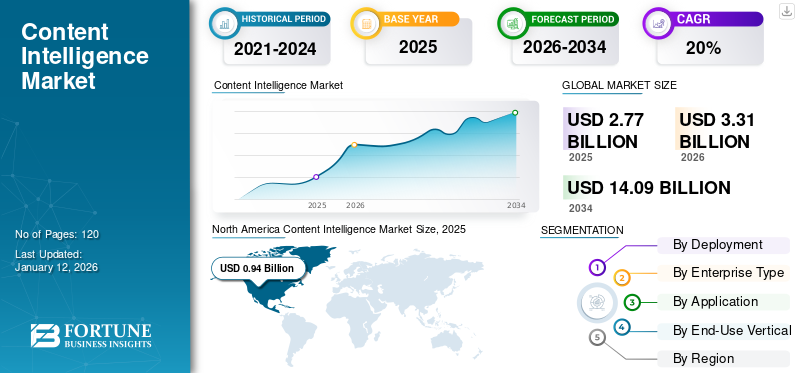
The global content intelligence market size was valued at USD 2.77 billion in 2025 and is projected to grow from USD 3.31 billion in 2026 to USD 14.09 billion by 2034, exhibiting a CAGR of 19.80% during the forecast period. North America dominated the global market with a share of 34.00% in 2025.
Content intelligence refers to the use of artificial intelligence (AI) and machine learning (ML) technologies to analyze, optimize, and enhance content creation, distribution, and performance. It helps create personalized content by analyzing user data and preferences. According to a study by Epsilon, around 80% of customers purchase products when brands offer personalized experiences. By automating repetitive tasks and optimizing content strategies, companies can reduce costs and increase ROI. According to a report by Accenture, AI technologies could increase business productivity by up to 40%.
Personalized and optimized content leads to higher conversion rates. A study by MarketingProfs found that personalized content can result in conversion rates that are six times higher. The solution allows for real-time adjustments based on performance data, enhancing the effectiveness of campaigns. Adobe's Digital Trends report shows that real-time marketing can increase customer engagement by 60%.
Download Free sample to learn more about this report.
Content Intelligence Market Key Takeaways
 Global Market Size & Forecast
- 2025 Market Size: USD 2.77 billion
- 2026 Market Size: USD 3.31 billion
- 2034 Forecast Market Size: USD 14.09 billion
- CAGR: 19.80% from 2026–2034
 Market Share
- North America dominated the content intelligence market with a 34.00% share in 2025.
- The cloud segment is anticipated to capture 44.44% of the market share in 2026.
- The large enterprises segment is expected to attain 52.51% of the market share in 2026.
 Key Regional Highlights
North America
North America generated USD 0.94 billion in 2025 and is projected to reach USD 1.1 billion in 2026.
Asia Pacific
Asia Pacific accounted for USD 0.7 billion in 2025 and is projected to grow to USD 0.87 billion in 2026.
Europe
Europe contributed 22.90% of the global market in 2025, valued at USD 0.63 billion, and is expected to reach USD 0.75 billion in 2026.
U.S.
U.S. The content intelligence market is estimated to reach USD 0.71 billion in 2026.
Japan
Japan The content intelligence market is expected to reach USD 0.17 billion in 2026.
Read More

IMPACT OF GENERATIVE AI
Adoption of Generative AI for Streamlining Content Creation is Expected to Drive Market Growth
Generative AI is a category of artificial intelligence in which AI models can generate human-like text, graphics, audio, and videos. By utilizing neural networks, these models analyze existing data patterns to generate fresh and unique content. This technology, illustrated by models, such as ChatGPT and DALL-E, offers marketers a powerful tool to streamline content creation, enhance creativity, and deliver personalized experiences.
Generative AI enables the rapid production of high-quality content, allowing businesses to scale their content efforts without proportional increases in resources. AI can generate various types of content, including articles, social media posts, and multimedia content. A study by Adobe found that 61% of marketers consider AI crucial for creating more personalized content across different formats. Generative AI can produce highly personalized content based on user data, preferences, and behavior. According to industry experts, personalization powered by AI can boost sales by 10%-15%.
Download Free sample to learn more about this report.
MARKET DYNAMICS
Content Intelligence Market Trends
Popularity of Hyper Personalized Content will Act as a Key Trend
Hyper personalized content refers to the advanced level of personalization that leverages real-time data, AI, and ML to deliver highly relevant content tailored according to individual preferences. Hyper personalization uses a wide range of data points, including browsing history, purchase behavior, social media activity, and real-time interactions. This detailed data enables tools to craft content that resonates with individual users. By analyzing user behavior patterns, the platforms can predict future actions and preferences, allowing for dynamic content delivery. According to Salesforce, 76% of consumers expect companies to understand their needs and expectations. Hyper-personalization involves delivering content that adapts in real time based on user interactions. For instance, a website can change its content layout, product recommendations, or messaging format depending on the user's current behavior and past interactions.
These tools track user interactions across channels and create a unified customer profile, enabling personalized experiences throughout the customer journey. According to a report by Google, omni-channel strategies drive 80% higher store visits. By delivering highly relevant and personalized content, hyper-personalization significantly boosts user engagement. HubSpot reported that personalized calls-to-action perform 202% better than generic ones. Hyper-personalization fosters stronger customer relationships by making users feel understood and valued. According to an Accenture report, 81% of consumers want brands to understand them and know when to approach them. Use case of hyper personalized content includes:
- Streaming Services: Platforms, including Netflix and Spotify, use hyper personalization to suggest content based on viewing or listening habits, significantly enhancing user satisfaction and retention.
- Healthcare: Hyper personalized content in healthcare can provide tailored wellness advice, medication reminders, and health tips based on individual patient data and history.
Thus, the popularity of hyper personalized content will bring in opportunities for content intelligence market growth.
Market Drivers
Increase in Digital Content Consumption to Boost Market Growth
The surge in digital content consumption is significantly driving the market demand. As users consume vast amounts of content across multiple platforms and formats, businesses face challenges in managing, optimizing, and delivering content that resonates with their audiences. Industry experts project that the global digital content market will reach USD 1.6 trillion by 2027, driven by increased online content consumption. These platforms help organizations analyze content performance and user engagement, allowing them to refine their strategies for better outcomes.
Consumers engage with various content formats, including articles, videos, podcasts, infographics, and social media posts. A report by Cisco predicts that by 2025, video will account for 82% of all internet traffic, highlighting the need for content to optimize different formats. These tools enable businesses to track and analyze content performance across different channels, ensuring a cohesive and optimized content strategy. With the explosion of digital content, competition for user attention is increasing. Businesses are ensuring that their content stands out in a crowded digital landscape. It helps to analyze competitors, identify content gaps, and optimize strategies for maximum impact.
Therefore, an increase in digital content consumption is driving market growth.
Market Restraints
Challenges Associated With Data Privacy Can Hamper Market Growth
The increasing focus on data privacy laws, such as the General Data Protection Regulation (GDPR) in Europe, the California Consumer Privacy Act (CCPA), and other data protection regulations pose a significant restraint for market growth. These laws limit the collection, storage, and usage of personal data, which is crucial for content. Consumers are becoming more aware of how their data is used, leading to heightened sensitivity around privacy. A survey by industry experts found that 79% of Americans are concerned about how companies use their data. This growing concern can reduce user willingness to share data, limiting the effectiveness of these tools.
Market Opportunities
Increasing Demand for Multilingual Content to Create Lucrative Opportunities for Market Players
In the current globalized and interconnected world, businesses increasingly need to communicate with diverse audiences across regions and languages. The demand for multilingual content is surging as companies aim to engage international customers, enhance user experiences, and expand into new markets. Companies expanding into international markets require content in multiple languages to engage local audiences effectively.
According to industry experts, around 76% of online consumers prefer to buy products with information in their native language. The solution provides automated language translation and cultural adaptation tools, enabling companies to scale operations globally while maintaining relevance. E-commerce growth in emerging countries has amplified the demand for multilingual product descriptions, reviews, and advertisements. As per industry experts, around 60% of global e-commerce shoppers rarely buy from English-only websites.
Many countries have regulatory requirements mandating content in local languages, especially in sectors such as healthcare, finance, and government. For instance, Canada requires official content in both English and French. Companies across the globe ensure that translated content adheres to local legal and cultural norms to avoid misunderstandings or compliance issues. The solutions integrate compliance checkers and multilingual legal templates to help businesses meet regional regulations efficiently. Thus, increasing demand for multilingual content is expected to create lucrative opportunities for key vendors operating in the market.
SEGMENTATION ANALYSIS
By Deployment
Adoption of Cloud Solution for Optimizing Content is Driving the Segmental Growth
Based on the deployment type, the market is segmented into cloud, on-premise, and hybrid.
Among these, the cloud segment segment is projected to dominate the market with a 44.44% share in 2026. Cloud-based solutions leverage the scalability, flexibility, and power of cloud computing to enhance the way businesses analyze, manage, and optimize content. Cloud-based solutions process vast amounts of data in real time, providing quick, actionable insights. The cloud segment is anticipated to capture 44.44% of the market share in 2026.
Hybrid deployment is estimated to grow with the highest CAGR of 28.30% during the forecast period. A hybrid model allows teams to access data and content seamlessly, regardless of their location, while maintaining robust access controls. The hybrid model offers redundancy by storing data and applications in both on-premise and cloud environments and minimizing downtime risks.
By Enterprise Type
Rapid Adoption of Content Intelligence by Large Enterprises to Manage Vast Amount of Content Boosted Segment Growth
Based on enterprise type, the market is bifurcated into large enterprises and small and medium-sized enterprises.
Large enterprises captured a leading market share in 2024. Large enterprises operate in complex, fast-paced environments where managing vast amounts of content, ensuring audience engagement, and staying ahead of competitors is difficult. Content analysis tools offer advanced technologies powered by AI, machine learning, and analytics to help enterprises create, distribute, and optimize content at scale. Large enterprises segment is expected to attain 52.51% of the market share in 2026.
Small and medium-sized enterprises are expected to register the highest CAGR of 26.70% during the forecast period. These tools help SMEs maximize their marketing budgets by identifying high-performing strategies and eliminating inefficiencies. SMEs often have limited budgets, and content analysis ensures resources are spent on tactics that drive results.
By Application
Adoption of Content Analytics to Track Content Boosted Segment Growth
By application, the market is segmented into content analytics, audience segmentation, campaign optimization, and competitor analysis.
Among these, content analytics dominated the market share by 54.29% in 2026 and is estimated to grow with the highest CAGR during the forecast period. Content analytics allows organizations to track how different pieces of content perform across platforms. Metrics, such as page views, time spent on a page, bounce rate, and social shares, provide a clear picture of content that resonates with the audience. According to HubSpot, businesses that analyze their content performance regularly see a 13% higher ROI on their content marketing efforts.
Campaign optimization is expected to grow significantly during the forecast period. With these tools, marketers can monitor campaign performance in real time and make necessary adjustments. Metrics such as click-through rates (CTR), engagement, and bounce rates help identify and address inefficiencies.
By End-Use Vertical
To know how our report can help streamline your business, Speak to Analyst
Media & Entertainment to Lead the Market Owing to Rising Adoption of Content Intelligence for Analyzing Audience Behavior And Preferences
End-Use vertical has been further segmented into media & entertainment, marketing & advertising, retail & e-commerce, healthcare, education and others.
Among these, media & entertainment dominated the market in 2024 and is estimated to grow with the highest CAGR during the forecast period. The solution helps media companies analyze audience behavior and preferences to deliver hyper-personalized experiences. As per Accenture, around 80% of viewers say they are more likely to watch content that aligns with their interests. Platforms, including Netflix, use AI-driven content recommendations to retain subscribers and maintain a 75% content discovery rate through personalized suggestions. With content analysis, media companies can keep audiences engaged through personalized notifications, curated playlists, and interactive features. Media & entertainment segment is projected to hold 42.86% of the market share in 2026, and likely to exhibit a CAGR of 26.10% during the forecast period.
Moreover, education is expected to grow significantly over the forecast period, as it enables educators to tailor learning materials according to individual student’s preferences based on their learning styles, preferences, and progress. As per RAND Corporation, students in personalized learning environments achieve 23% higher academic results compared to traditional methods. The solution improves accessibility by automatically generating subtitles, translations, and alternative formats for educational content.
CONTENT INTELLIGENCE MARKET REGIONAL OUTLOOK
The market is geographically studied across North America, South America, Europe, the Middle East & Africa, and Asia Pacific and each region is further studied across countries.
North America
North America Content Intelligence Market Size, 2025 (USD Billion)
To get more information on the regional analysis of this market, Download Free sample
The North America market generated USD 0.94 billion in 2025, representing 34.00% of the global market landscape, and is expected to reach USD 1.1 billion in 2026. This is primarily attributed to the rising adoption of digital transformation products and services by the leading players and government initiatives. The region’s well-established digital framework facilitates the seamless integration of these tools, enabling organizations to harness AI and ML capabilities effectively. Companies in the region prioritize innovation and are adopting the solutions, leveraging data-driven insights to enhance their content strategies and customer engagement.
In the U.S., the market is expected to experience a strong growth rate during the forecast period due to the increasing demand for personalized content. With the rise of advanced data analytics and artificial intelligence (AI), businesses can analyze vast amounts of consumer data and target audiences more effectively. This allows them to create dynamic, customized content for specific groups or even individual users. The U.S. market size is estimated to hit USD 0.71 billion in 2026.
Businesses in the U.S. are leveraging AI-driven tools to analyze customer behavior in real time and serve personalized content across platforms, improving engagement and conversion rates. The U.S. digital landscape is highly competitive, with numerous brands vying for consumer attention. Personalized content helps businesses stand out and engage audiences more effectively, ultimately driving higher conversion rates. As per industry experts, personalized email campaigns improve click-through rates by 14% and conversion rates by 10%.
Asia Pacific
Asia Pacific accounted for USD 0.7 billion in 2025, representing 25.20% of the global market share, and is projected to reach USD 0.87 billion in 2026. The Asia Pacific region is expected to grow with the second-highest CAGR of 25.20% during the forecast period, owing to the widespread availability of affordable smartphones and lower data costs that have enhanced internet access across Asia Pacific. This increased connectivity has led to a surge in digital content consumption, prompting companies to adopt solutions to optimize user engagement across multiple devices. The market in China is likely to be USD 0.29 billion in 2026. Japan’s market size is expected to hit USD 0.17 billion and Indian market is projected to reach USD 0.11 billion in 2026.
Europe
Europe contributed 22.90% to the global market in 2025, with a valuation of USD 0.63 billion, and is projected to reach USD 0.75 billion in 2026, as European businesses are increasingly adopting tools for content analysis to enhance their content marketing strategies. According to industry experts, in 2023, around 42% of businesses in Europe reported using AI to drive content strategy, up from 30% in 2020. The market in U.K. is likely to be USD 0.10 billion in 2026. Germany’s market size is expected to hit USD 0.11 billion in 2026 and France market is projected to reach USD 0.13 billion in 2025.
Middle East & Africa
In 2025, Middle East & Africa held 10.60% of the global market, reaching a valuation of USD 0.29 billion, and is projected to grow to USD 0.36 billion in 2026. The region is experiencing a surge in digital consumers, with a significant rise in internet penetration and mobile device usage. This shift is prompting businesses to adopt the solution to understand their needs and engage their digital audiences. The GCC market size is estimated to hit 0.11 billion in 2025.
South America
The South American market is likely to register a steady growth rate over the forecast period. South America is embracing these tools across various sectors, driven by digital transformation efforts, increased digital consumption, and sector-specific applications.
Latin America
Latin America contributed approximately USD 0.2 billion to the global market in 2025, accounting for 7.30% share, and is expected to reach USD 0.24 billion in 2026.
Competitive Landscape
Key Industry Players
Market Players Opt for Merger & Acquisition Strategies to Expand Their Presence
Key players in the market are adopting various business strategies to enhance their market presence and capitalize on emerging opportunities. Companies are integrating AI and machine learning into their analytics platforms to enhance data analysis and content optimization. Players are expanding their operations into emerging markets to tap into new customer bases. Companies are investing in research and development to innovate and improve their offerings and stay competitive in the market.
List of Key Content Intelligence Companies Profiled:
- Adobe (U.S.)
- M-Files (Finland)
- OpenText Corporation (Canada)
- Curata (U.S.)
- ABBYY (U.S.)
- Scoop.it (U.S.)
- Emplifi (U.S.)
- Semrush (U.S.)
- Laserfiche (U.S.)
- Cisco (U.S.)
- OneSpot, Inc. (U.S.)
- Content360 Ltd. (U.K.)
- Smartlogic (U.S.)
…and more
KEY INDUSTRY DEVELOPMENTS:
- October 2024 – Adobe launched Content Authenticity, a new free web app for creators. Creators apply Content Credentials in their work to protect the content from unauthorized use and ensure creators receive attribution.
- September 2024 – Adobe launched new tools within Adobe Experience Cloud to help brands personalize and measure AI-generated content.
- April 2024 – Laserfiche announced the availability of new generative AI-powered document summarization in Laserfiche Cloud.
- February 2023 – M-Files acquired Ment to provide comprehensive end-to-end solutions for document automation, management, and collaboration.
- March 2023 – ChapsVision acquired QWAM Content Intelligence. The acquisition aimed to establish and strengthen ChapVision's position in the market.
INVESTMENT ANALYSIS AND OPPORTUNITIES
SMEs operating in the content intelligence market are securing funds in order to speed up and enhance their ecosystem. The sector is attracting significant venture capital investments. For instance, in September 2024, Spanish startup Loud Intelligence raised over USD 1.04 million in a seed funding round, supported by Demium Capital, Encomenda Capital Partners, and several business angels. This funding aims to enhance their AI-driven contextual advertising platform. Different established companies are also investing in content analysis. For example, Adobe has expanded its Adobe Experience Cloud with AI features to improve digital experiences, reflecting a strategic move to integrate into its offerings.
REPORT COVERAGE
The market research report provides a detailed market analysis. It focuses on key points, such as leading companies, offerings, and applications. Besides this, the report offers an understanding of the latest market trends and highlights key industry developments. In addition to the above-mentioned factors, the report contains several factors that have contributed to the growth of the market in recent years.
Request for Customization to gain extensive market insights.
REPORT SCOPE & SEGMENTATION
|
ATTRIBUTE |
DETAILS |
|
Study Period |
2021-2034 |
|
Base Year |
2025 |
|
Estimated Year |
2025 |
|
Forecast Period |
2026-2034 |
|
Historical Period |
2021-2024 |
|
Growth Rate |
CAGR of 19.80% from 2026 to 2034 |
|
Unit |
Value (USD Billion) |
|
Segmentation |
By Deployment
By Enterprise Type
By Application
By End-Use Vertical
By Region
|
|
Companies Profiled in the Report |
Adobe (U.S.), M-Files (Finland), OpenText Corporation (Canada), Curata (U.S.), ABBYY (U.S.), Scoop.it (U.S.), Semrush (U.S.), Laserfiche (U.S.), Cisco (U.S.), Content360 Ltd (U.K.), and Others. |
Frequently Asked Questions
The market is projected to reach USD 14.09 billion by 2034.
In 2026, the market was valued at USD 3.31 billion.
The market is projected to grow at a CAGR of 19.80% during the forecast period.
The content analytics is expected to lead the market in terms of market share.
Increase in digital content consumption to boost market growth.
Adobe, M-Files, Curata, OpenText Corporation, ABBYY, and Semrursh are the top players in the market.
North America is expected to hold the highest market share.
By end-use vertical, the media & entertainment sector is expected to grow with the highest CAGR during the forecast period.



- 2021-2034
- 2025
- 2021-2024
- 120
Get 30-60 hrs Free Customization
Expand Regional and Country Coverage, Segments Analysis, Company Profiles, Competitive Benchmarking, and End-user Insights.




















Related Reports
-
US +1 833 909 2966 ( Toll Free )
-
Get In Touch With Us