Ride-Hailing Market Size, Share & Industry Analysis, By Service Type (E-hailing and Car Sharing), By Vehicle Type (Two-wheelers, Hatchback & Sedan, and SUV), By Booking Mode (Mobile Applications and Web-based Platforms), By End User (Individual Consumers and Corporate/ Business Users), and Regional Forecast, 2026–2034
 Download Free Sample
(Offer valid till 30th Sep 2026)

Ride-Hailing Market Overview
 Listen to Audio Version
The global ride-hailing market size was valued at USD 284.74 billion in 2025 and is projected to grow from USD 315.49 billion in 2026 to USD 716.64 billion by 2034, exhibiting a CAGR of 10.8% during the forecast period. Asia Pacific dominated the ride-hailing market with a market share of 49.34% in 2025.
The global ride-hailing market refers to the industry of digital platforms that connect passengers with drivers via mobile applications for on-demand transportation services. It includes services such as car rides, bike taxis, and carpooling, typically priced dynamically. The market is driven by urbanization, smartphone penetration, and convenience, and encompasses key players operating across multiple regions, offering both individual and shared mobility as a service solution. Cost-effectiveness compared to car ownership, traffic congestion, and supportive digital payment systems further boost adoption, while expansion into new cities and service innovations continue to accelerate market growth.
Major players in the market include Uber, Lyft, Didi Chuxing, Grab, Bolt, and Ola, competing through platform innovation, dynamic pricing, geographic expansion, and service diversification. These ride hailing companies focus on user experience, driver incentives, and integration of digital payments and AI-based route optimization to strengthen their market position.
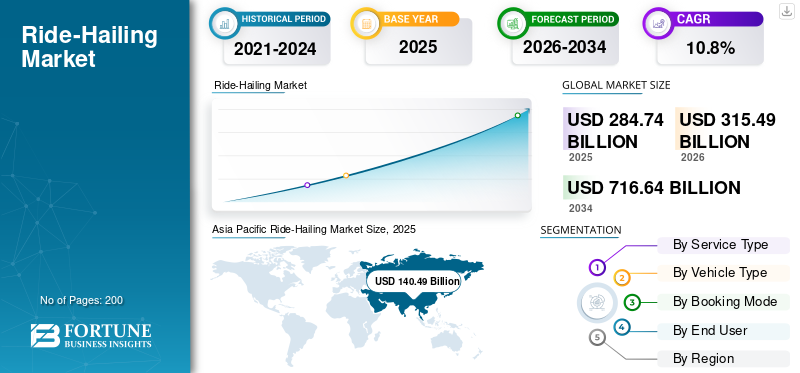
Download Free sample to learn more about this report.
Ride-Hailing Market Key Takeaways
 Market Size & Forecast
- 2025 Market Size: USD 284.74 billion
- 2026 Market Size: USD 315.49 billion
- 2034 Forecast Market Size: USD 716.64 billion
- CAGR: 10.8% from 2026–2034
 Market Share
- Asia Pacific dominated the ride-hailing market with a 49.34% share in 2025.
- The SUV segment is projected to grow at a CAGR of 10.1% over the forecast period.
- The web-based platforms segment is projected to grow at a CAGR of 9.1% over the forecast period.
 Key Regional Highlights
Asia Pacific
Led the market due to rapid urbanization, rising smartphone usage, and expanding digital mobility adoption.
North America
Held the second-largest share, supported by advanced digital infrastructure and growing electric mobility integration
Europe
Ranked third, driven by shared mobility trends, environmental policies, and public transport connectivity.
U.S
Estimated at USD 62.48 billion in 2026, supported by strong consumer adoption and premium ride demand.
Japan
Estimated at USD 9.57 billion in 2026, driven by tourism growth, regulatory support, and app-based mobility use.
Read More

RIDE-HAILING MARKET TRENDS
Expansion into Multi-Modal and Super App Ecosystems as a Key Market Trend
A notable trend in the market is the evolution of platforms into multi-modal mobility providers and super apps. Companies are expanding beyond traditional ride services to include bike-sharing, e-scooters, public transit integration, and even delivery services. This diversification allows users to access multiple transportation options within a single platform, improving convenience, and customer retention. Integration with food delivery, payments, and other digital services enhances user engagement and creates additional revenue streams. The super app model is particularly prominent in Asia Pacific markets, where companies aim to become comprehensive digital ecosystems. This trend reflects a broader shift toward integrated urban mobility solutions.
MARKET DYNAMICS
MARKET DRIVERS
Download Free sample to learn more about this report.
Rising Urbanization and Digital Adoption to Drive Ride-Hailing Demand
Rapid urbanization coupled with increasing smartphone penetration is significantly driving the global ride-hailing market growth. As more people migrate to urban centers, the demand for ride hailing services for convenient, flexible, and cost-effective transportation solutions rises. Ride-hailing platforms leverage mobile applications, GPS tracking, and digital payment systems to offer seamless mobility experiences. The widespread availability of affordable smartphones and internet connectivity has further enabled user adoption across both developed and emerging economies. Additionally, changing consumer preferences away from vehicle ownership toward shared mobility contribute to sustained demand. These factors collectively strengthen the reliance on ride-hailing services as a primary mode of urban transportation.
MARKET RESTRAINTS
Regulatory Uncertainties and Compliance Costs to Restrain Market Expansion
The market faces significant restraints due to evolving regulatory frameworks and compliance requirements across different regions. Governments are increasingly imposing stricter rules related to driver classification, licensing, safety standards, and fare regulations. These policies often vary widely across countries and even cities, creating operational complexities for service providers. Compliance with local labor laws, including mandates around driver benefits and employment status, can increase operational costs. Additionally, restrictions on surge pricing and caps on the number of vehicles can limit revenue potential. Such regulatory challenges may hinder rapid expansion, reduce profitability, and create barriers for new entrants seeking to establish themselves in the market.
MARKET OPPORTUNITIES
Integration of Electric Vehicles and Sustainable Mobility to Create Growth Opportunities
The growing emphasis on sustainability and reduction of carbon emissions presents significant opportunities for ride-hailing companies. Many platforms are actively transitioning toward Electric Vehicles (EVs) to align with environmental regulations and corporate sustainability goals. Partnerships with EV manufacturers, charging infrastructure providers, and government initiatives are accelerating this shift. Electrification not only reduces operational emissions but can also lower long-term fuel and maintenance costs for drivers. Additionally, customers are increasingly favoring eco-friendly transportation options, creating demand for green ride services. This transition enables companies to differentiate their offerings, enhance brand perception, and tap into government incentives supporting clean mobility solutions globally.
MARKET CHALLENGES
Driver Retention and Earnings Stability to Pose Operational Challenges
One of the major challenges in the market is maintaining a stable and satisfied driver base. Drivers often face fluctuating earnings due to dynamic pricing, platform commissions, and varying demand patterns. High competition among platforms can lead to aggressive incentive structures, which may not be sustainable in the long term. Additionally, concerns around job security, lack of benefits, and rising operational costs such as fuel and vehicle maintenance contribute to driver dissatisfaction. High driver turnover can affect service availability, customer experience, and operational efficiency. Addressing these concerns requires platforms to balance profitability with fair compensation and improved working conditions.
Segmentation Analysis
By Service Type
High Convenience and On-Demand Mobility to Propel E-hailing Segmental Dominance
Based on service type, the market is categorized into e-hailing and car sharing.
The e-hailing segment dominates the ride-hailing market share due to its widespread adoption driven by convenience, real-time availability, and extensive geographic coverage. Consumers prefer on-demand ride services over traditional transport modes, especially in urban areas with high smartphone penetration. Integration of digital payments, route optimization, and dynamic pricing enhances user experience and operational efficiency. Strong fleet availability and continuous platform improvements further sustain high trip volumes globally.
The car sharing segment is projected to grow at a CAGR of 8.9% over the forecast period. Rising cost consciousness, environmental awareness, and preference for asset-light mobility solutions are encouraging users to opt for shared vehicle access, particularly in urban and semi-urban regions.
By Vehicle Type
High Urban Affordability and Fleet Utilization to Propel Hatchback & Sedan Segmental Dominance
Based on vehicle type, the market is categorized into two-wheelers, hatchback & sedan, and SUV.
The hatchback and sedan segment dominates the market due to its strong presence in urban mobility and ride-hailing fleets. These vehicles offer optimal balance between cost, fuel efficiency, and passenger comfort, making them the preferred choice for both drivers and operators. High availability, lower acquisition and maintenance costs, and suitability for short-distance urban travel ensure consistent utilization rates. Their widespread adoption across emerging and developed markets further strengthens their leading position.
The SUV segment is projected to grow at a CAGR of 10.1% over the forecast period. Increasing consumer preference for spacious, premium ride experiences, along with rising demand for intercity and long-distance travel, is driving the adoption of SUVs across ride-hailing platforms globally.
To know how our report can help streamline your business, Speak to Analyst
By Booking Mode
Seamless User Experience and Real-Time Accessibility to Propel Mobile Applications Segmental Dominance
Based on booking mode, the market is categorized into mobile applications and web-based platforms.
The mobile applications segment dominates the market owing to widespread smartphone penetration and the convenience of instant booking. Users benefit from real-time tracking, integrated payments, and personalized features, enhancing overall experience. Ride-hailing platforms prioritize app-based ecosystems for scalability and customer engagement. Continuous advancements in app interfaces, AI-based route optimization, and promotional incentives further strengthen adoption, making mobile apps the primary booking channel globally.
The web-based platforms segment is projected to grow at a CAGR of 9.1% over the forecast period. Increasing accessibility in regions with limited app usage and preference for desktop-based bookings among corporate users support steady growth in this segment.
By End User
Rising Frequency of Daily Commutes and Personal Mobility Needs to Propel Individual Consumers Segmental Dominance
Based on end user, the market is categorized into individual consumers and corporate/business user.
The individual consumers segment dominates the market due to the high frequency of daily travel for work, education, and personal activities. Ride-hailing offers a convenient and cost-effective alternative to vehicle ownership, especially in densely populated urban areas. Easy access through mobile applications, flexible pricing, and availability across multiple locations drive consistent usage. Additionally, changing consumer preferences toward shared mobility and reduced reliance on personal vehicles further support strong demand from individual users globally.
The corporate/business users segment is projected to grow at a CAGR of 8.8% over the forecast period. Increasing adoption of ride-hailing for employee transportation, business travel, and expense management solutions is driving demand among enterprises seeking efficient and scalable mobility options.
Ride-Hailing Market Regional Outlook
By geography, the market is categorized into Europe, North America, Asia Pacific, Latin America, and Middle East & Africa.
Asia Pacific
Asia Pacific Ride-Hailing Market Size, 2025 (USD Billion)
To get more information on the regional analysis of this market, Download Free sample
Asia Pacific dominates the ride-hailing market due to its large population base, rapid urbanization, and increasing smartphone penetration. China, India, and Southeast Asian nations witness high demand for affordable and convenient mobility solutions. Expanding middle-class population, rising traffic congestion, and limited parking infrastructure further boost adoption. Strong presence of major players and super app ecosystems enhances accessibility. Additionally, supportive digital payment infrastructure and government initiatives promoting shared mobility contribute to sustained regional market leadership.
China Ride-Hailing Market
China’s market is estimated at around USD 81.67 billion in 2026, driven by massive urban populations, super app ecosystems, high digital payment penetration, and strong domestic platform dominance supporting large-scale operations.
Japan Ride-Hailing Market
The Japanese market is estimated at around USD 9.57 billion in 2026, supported by gradual regulatory easing, growing tourism, aging population needs, and increasing adoption of app-based taxi and mobility services.
North America
North America holds the second-largest market share and is projected to grow at a CAGR of 9.9% over the forecast period. High consumer awareness, strong digital infrastructure, and widespread adoption of app-based services drive market growth. The presence of leading ride-hailing companies and continuous innovation in pricing, safety, and service offerings further strengthen demand. Corporate usage, airport transfers, and premium ride services contribute significantly. Additionally, increasing focus on electric mobility integration supports long-term expansion.
U.S. Ride-Hailing Market
The U.S. market is estimated at around USD 62.48 billion in 2026, fueled by high consumer adoption, advanced digital infrastructure, strong presence of major players, and increasing corporate and premium ride usage.
Europe
Europe represents the third-largest market, supported by well-established urban transport systems and increasing adoption of shared mobility. Stringent environmental regulations and emphasis on reducing carbon emissions encourage the use of ride-hailing and shared transport services. Demand is particularly strong in major cities where congestion and parking constraints are prominent. Integration with public transport and growth of electric ride-hailing fleets further enhance market expansion. However, regulatory complexities across countries shape the pace of growth in the region.
U.K. Ride-Hailing Market
The U.K. market is estimated at around USD 11.90 billion in 2026, driven by strong urban demand, high smartphone penetration, and growing preference for app-based mobility, supported by regulatory clarity and expanding EV-based ride services.
Germany Ride-Hailing Market
The German market is estimated at around USD 7.28 billion in 2026, supported by increasing adoption of shared mobility, integration with public transport, and rising demand for sustainable and efficient urban transportation solutions.
Middle East & Africa
The Middle East & Africa region is witnessing steady growth due to increasing urbanization and improving digital infrastructure. Expanding metropolitan cities and growing tourism sectors drive demand for convenient transportation services. Rising smartphone penetration and adoption of digital payment systems support market expansion. Government initiatives to modernize transport systems and encourage private mobility solutions further contribute to growth. However, uneven infrastructure development and regulatory variations across countries may impact the pace of adoption in certain areas.
UAE Ride-Hailing Market
The UAE market is estimated at around USD 8.84 billion in 2026 supported by luxury mobility demand, smart city developments, rising tourism activities, and increasing government focus on sustainable and technology-enabled transportation infrastructure
Latin America
Latin America is experiencing growing demand for ride-hailing services due to increasing urban population and inadequate public transport systems in several cities. Consumers prefer ride-hailing as a cost-effective and flexible mobility solution. Brazil and Mexico are key contributors to regional growth, supported by rising smartphone usage and digital payments adoption. Additionally, economic factors encouraging shared mobility over vehicle ownership further drive demand. Market expansion is supported by continuous platform penetration into secondary cities.
Mexico Ride-Hailing Market
The Mexico market is estimated at around USD 4.75 billion in 2026, driven by expanding urban populations, affordable ride-sharing services, increasing smartphone accessibility, and growing consumer preference for convenient alternatives to traditional transportation systems.
COMPETITIVE LANDSCAPE
Key Industry Players
Technology-Driven Innovation and Strategic Expansion Intensifying Market Competition
The global ride-hailing market is highly competitive, characterized by the presence of major international players such as Uber, Lyft, Didi Chuxing, Grab, and Ola, along with several regional and local operators. These companies compete on pricing strategies, service availability, geographic expansion, and user experience. Strong investments in technology, including AI-based route optimization, dynamic pricing algorithms, and app interface enhancements, play a crucial role in differentiating offerings. Additionally, partnerships with automotive OEMs, payment providers, and mobility startups further strengthen competitive positioning.
Market participants are increasingly focusing on diversification of services, including carpooling, micro-mobility, and delivery integration, to expand revenue streams. Regional players often gain an edge by tailoring services to local preferences and regulatory environments. Competitive intensity is further heightened by driver incentives, loyalty programs, and promotional pricing strategies aimed at customer retention. Moreover, companies are investing in electric vehicle adoption and autonomous vehicle driving technologies to gain long-term advantages and align with sustainability goals.
LIST OF KEY RIDE-HAILING MARKET COMPANIES PROFILED IN REPORT
- Uber Technologies Inc.(U.S.)
- Lyft Inc.(U.S.)
- Didi Chuxing (China)
- Grab Holdings Inc. (Singapore)
- Bolt Technology OÜ (Estonia)
- ANI Technologies Pvt Ltd (Ola) (India)
- GoTo Group (Gojek) (Indonesia)
- Cabify (Maxi Mobility) (Spain)
- inDrive (SUOL Innovations Ltd.) (U.S.)
- Gett Group (U.K.)
KEY INDUSTRY DEVELOPMENTS
- March 2026: Uber partnered with Rivian to deploy up to 50,000 autonomous robotaxis, investing over USD 1.25 billion to scale autonomous mobility solutions across major cities.
- February 2026: Uber announced a USD 100 million investment in EV charging infrastructure to support robotaxi fleets and accelerate its transition toward electric and autonomous mobility.
- February 2026: India launched Bharat Taxi, a government-backed ride-hailing platform offering zero-commission and surge-free pricing to compete with Uber and Ola. The initiative aims to improve driver earnings, ensure fair pricing for passengers, and promote a more regulated and transparent ride-hailing ecosystem across the country.
- January 2026: Uber, Lucid, and Nuro unveiled a global robotaxi program at CES, highlighting significant advancements in autonomous ride-hailing technologies. The collaboration focuses on integrating electric vehicles with self-driving systems to enhance safety, reduce operational costs, and scale next-generation mobility solutions across major global cities over the coming years.
- December 2025: Uber and Lyft announced partnerships with Baidu to deploy autonomous robotaxis in London, marking expansion into European self-driving mobility trials. This collaboration aims to accelerate commercialization of autonomous ride services while aligning with regional regulations and enhancing urban transportation efficiency.
- December 2025: Uber and WeRide launched fully driverless robotaxi operations in Abu Dhabi, expanding autonomous services in the Middle East. The deployment supports smart city initiatives and showcases the region’s growing role as a testing ground for advanced mobility technologies and innovation.
- July 2025: Uber partnered with Wayve to launch Level-4 autonomous vehicle trials in the U.K., strengthening its AI-driven mobility initiatives. The partnership focuses on real-world testing of self-driving systems in complex urban environments, aiming to accelerate the adoption of safe and scalable autonomous ride-hailing solutions.
REPORT COVERAGE
The global ride-hailing market analysis provides an in-depth study of market size & forecast by all the market segments included in the report. It includes details on the market dynamics and market trends expected to drive the market during the forecast period. It offers information on the technological advancements, new product launches, key industry developments, and details on partnerships, mergers & acquisitions. The market research report also encompasses a detailed competitive landscape, including market share and profiles of key operating players.
Request for Customization to gain extensive market insights.
Report Scope & Segmentation
| ATTRIBUTE | DETAILS |
| Study Period | 2021-2034 |
| Base Year | 2025 |
| Estimated Year | 2026 |
| Forecast Period | 2026-2034 |
| Historical Period | 2021-2024 |
| Growth Rate | CAGR of 10.8% from 2026-2034 |
| Unit | Value (USD Billion) |
| Segmentation | By Service Type, By Vehicle Type , By Booking Mode , By End User, By Service Mode, and By Region |
| By Service Type |
|
| By Vehicle Type |
|
| By Booking Mode |
|
| By End User |
|
| By Region |
|
Frequently Asked Questions
Fortune Business Insights says that the global market value stood at USD 284.74 billion in 2025 and is projected to reach USD 716.64 billion by 2034.
In 2025, the Asia Pacific’s market value stood at USD 140.49 billion.
The market is expected to exhibit a CAGR of 10.8% during the forecast period of 2026-2034
The hatchback & sedan segment is leading the market by vehicle type.
Rising urbanization and digital adoption to drive ride-hailing demand.
Asia Pacific held the largest market share in 2025.



- 2021-2034
- 2025
- 2021-2024
- 200
-
(Offer valid till 30th Sep 2026)
Get 30-60 hrs Free Customization
Expand Regional and Country Coverage, Segments Analysis, Company Profiles, Competitive Benchmarking, and End-user Insights.




















Related Reports
-
US +1 833 909 2966 ( Toll Free )
-
Get In Touch With Us