CRISPR Therapeutics Market Size, Share & Industry Analysis, By Product (CASGEVY and Others), By Indication (Sickle Cell Disease, Transfusion-Dependent Beta Thalassemia, and Others), By Age Group (Pediatric and Adult), By End User (Hospitals, Specialty Treatment Centers, and Others), and Regional Forecast, 2026-2034
 Download Free Sample
CRISPR Therapeutics Market Size and Future Outlook
 Listen to Audio Version
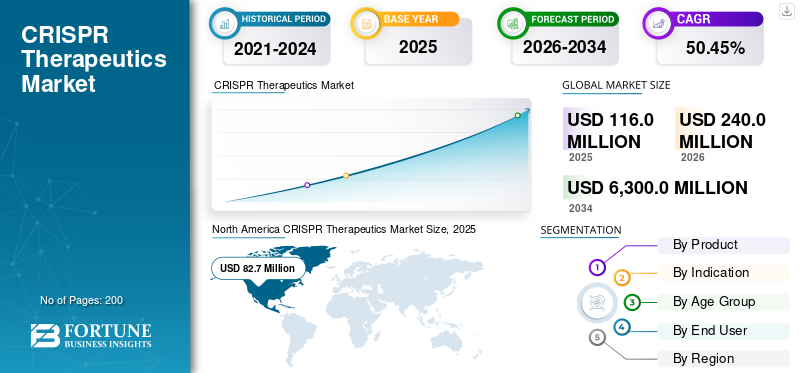
The global CRISPR therapeutics market size was valued at USD 116.0 million in 2025 and is projected to grow from USD 240.0 million in 2026 to USD 6,300.0 million by 2034, exhibiting a CAGR of 50.45% during the forecast period. North America dominated the crispr therapeutics market with a market share of 71.29% in 2025.
The global CRISPR therapeutics market aims to treat diseases by editing genes directly at the DNA level, offering a more targeted approach than conventional symptom-control therapies. The market is growing due to the commercial rollout of CASGEVY, the first approved CRISPR-based therapy, along with expanding regulatory approvals across various countries. Additionally, the global market growth is further supported by rising clinical progress in vivo gene-editing programs, broader industry investment in one-time curative therapies, improving delivery platforms, and expansion of CRISPR research beyond rare blood disorders.
Key players consist of Vertex Pharmaceuticals, CRISPR Therapeutics, Intellia Therapeutics, among others. These companies are focusing on ex vivo and in vivo CRISPR editing platforms, one-time gene-editing therapies for hematology and rare diseases, liver-targeted delivery systems, and next-generation base-editing approaches.
Download Free sample to learn more about this report.
CRISPR THERAPEUTICS MARKET KEY TAKEAWAYS
 Market Size & Forecast
- 2025 Market Size: USD 116.0 Million
- 2026 Market Size: USD 240.0 Million
- 2034 Forecast Market Size: USD 6,300.0 Million
- CAGR: 50.45% from 2026–2034
 Market Share
- North America dominated the CRISPR therapeutics market with a 71.29% share in 2025.
- The CASGEVY segment held the largest market share in 2025.
- The sickle cell disease segment accounted for the largest market share in 2025.
 Key Regional Highlights
North America
North America reached USD 82.7 million in 2025, maintaining its dominant market position.
Europe
Europe is projected to expand at a CAGR of 51.75% during the forecast period.
Asia Pacific
Asia Pacific is expected to register the fastest regional growth over the forecast period.
U.S.
The market is estimated at USD 146.9 million in 2026, accounting for 61.2% of global revenue.
Japan
Asia Pacific is expected to witness strong growth, supported by expanding adoption of advanced gene therapies across key countries including Japan.
Read More

CRISPR THERAPEUTICS MARKET TRENDS
Advancements in Gene-Editing Technologies is a Notable Market Trend
Developments in gene editing technologies is a significant trend in the global market. Recent editing techniques such as base editing, advanced CRISPR systems, and enhanced delivery methods are enabling more accurate and possibly safer gene corrections. This matters as improved precision can minimize unnecessary modifications and broaden the application of CRISPR treatments beyond just a handful of uncommon conditions. As technology advances, businesses are transitioning from initial proof-of-concept initiatives to wider clinical development and possible commercial application. These advancements are also aiding developers in addressing liver, cardiovascular, metabolic, and genetic disorders through single-dose therapies. Consequently, the market is transitioning from a singular approved product foundation to a more varied pipeline. These factors are supporting the overall global CRISPR therapeutics market growth.
- For instance, in March 2026, Beam Therapeutics announced the strong Phase 1/2 data for BEAM-302 in alpha-1 antitrypsin deficiency and said the program would advance toward pivotal development.
MARKET DYNAMICS
MARKET DRIVERS
Download Free sample to learn more about this report.
Increasing Clinical Trials Targeting Rare Genetic Diseases is Propelling Market Growth
The rise in clinical trials focused on rare genetic disorders is a major market driver for the global market growth. Uncommon genetic conditions frequently have few treatment alternatives, making them a significant concentration for gene-editing firms. This is fostering market expansion since CRISPR technologies provide the possibility of single treatments targeting the fundamental genetic causes of diseases. As an increasing number of companies advance rare-disease programs from initial research to human trials, confidence in the clinical and commercial viability of CRISPR therapies is growing. These trials are also assisting companies in producing safety and efficacy data more rapidly in clearly defined patient groups. Consequently, this is drawing increased investment, collaborations, and regulatory focus toward the market. All these factors cumulatively drive the overall market growth.
- For instance, in September 2025, Intellia Therapeutics announced that lonvoguran ziclumeran for hereditary angioedema, a rare genetic disease has completed enrollment in the global Phase 3 HAELO study with topline data expected in the first half of 2026.
MARKET RESTRAINTS
High Cost of Treatment to Hamper Market Growth
High cost of treatment is a major restraint in the global CRISPR therapeutics market. These therapies are expensive as they involve personalized cell collection, complex gene editing, specialized manufacturing, conditioning chemotherapy, hospital-based infusion, and long-term follow-up. This raises the total treatment burden for both healthcare systems and patients, even when the therapy is given only once. Due to this, market expansion depends heavily on reimbursement approvals, treatment-center readiness, and payer negotiations, which can slow adoption. The high upfront cost also limits access in price-sensitive and developing markets, where advanced gene-editing infrastructure is still limited. As a result, even approved products may scale gradually rather than rapidly. This results in limiting the market growth to certain extent.
- For example, in September 2025, Vertex’s reimbursement agreement for CASGEVY in Italy was announced which shows that commercial access for CRISPR therapies often requires country-specific payment negotiations before broader uptake can happen.
MARKET OPPORTUNITIES
Increasing Regulatory Support for Innovative Therapies to Offer Market Growth Opportunities
The growing regulatory support for innovative treatments presents a significant market opportunity in the global CRISPR therapeutics sector. With regulators increasingly receptive to innovative gene-editing therapies, companies are able to advance promising products through development and evaluation with improved guidance and expedited routes. This generates a supportive atmosphere for CRISPR developers, as uncommon and highly unmet medical needs frequently meet the criteria for special regulatory status. This support can diminish development uncertainty, boost investor confidence, and motivate companies to broaden their pipelines into new indications. It additionally assists smaller and mid-sized biotech companies in moving cutting-edge gene-editing initiatives nearer to market launch. With the increasing clinical benefits of CRISPR therapies, favorable regulatory structures are expected to provide more opportunities for approvals and label expansions.
- For instance, in December 2024, CRISPR Therapeutics’ CTX112 received the U.S. FDA Regenerative Medicine Advanced Therapy (RMAT) designation for relapsed or refractory follicular lymphoma and marginal zone lymphoma.
MARKET CHALLENGES
Ethical Concerns Related to Gene Editing to Pose a Challenge to Market Growth
Ethical issues concerning gene editing pose a significant obstacle in the global industry. While the majority of approved and pipeline products concentrate on somatic editing, the wider discussion concerning the misuse of gene editing, long-lasting safety, informed consent, and potential future germline applications persists in fostering public and regulatory sensitivity. This is significant for the market as ethical issues can delay clinical progress, raise oversight demands, and lead regulators to be more careful during assessments. They may also influence patient willingness and investor trust, particularly for first-in-class treatments. As businesses broaden CRISPR to new applications, they need to demonstrate not only effectiveness but also robust ethical oversight and clear risk management. The WHO emphasizes that editing the human genome presents significant ethical concerns and necessitates strong regulatory frameworks. All the factors cumulatively affect the market growth.
- For instance, in May 2025, major scientific and industry groups called for a 10-year moratorium on germline gene editing, highlighting continuing concern over ethically controversial uses of CRISPR even as therapeutic programs advance.
Segmentation Analysis
By Product
Regulatory Approvals and Commercial Expansion to Propel CASGEVY Segmental Growth
In terms of product, the market is divided into CASGEVY and others.
The CASGEVY segment captured the largest global CRISPR therapeutics market share. It is the first approved CRISPR/Cas9 gene-edited therapy and currently represents the only commercially approved product base in the market, which supports its dominance in the market. In addition, increasing activation of authorized treatment centers, reimbursement progress in major markets, and growing physician confidence in one-time curative therapy are supporting wider adoption.
- For instance, in December 2025, Vertex unveiled new information regarding CASGEVY, announcing that over 45 approved treatment centers had been launched globally and that there was an increasing demand for the therapy among patients.
The others segment is anticipated to rise with a CAGR of 154.35% over the forecast period.
To know how our report can help streamline your business, Speak to Analyst
By Indication
Higher Disease Burden and Faster Commercial Uptake Led to Sickle Cell Disease Segmental Dominance
On the basis of indication, the market is divided into transfusion-dependent beta thalassemia, sickle cell disease, and others.
The sickle cell disease segment accounted for the largest market share in 2025. This segment has a broader treated patient population for CRISPR-mediated therapy and has demonstrated greater initial commercial interest. The segment's expansion is being fueled by the substantial disease burden, recurring vaso-occlusive crises, and the necessity for long-lasting treatment alternatives beyond ongoing supportive care. Moreover, heightened referral of qualifying patients to approved treatment facilities and growing awareness of single-use gene-edited therapies are boosting segment demand. Due to the frequent hospitalizations and ongoing complications experienced by patients with sickle cell disease, physicians and healthcare systems are increasingly focused on transformative treatments including CASGEVY.
- For instance, in December 2025, Vertex reported that more than 65 patients had already had cell collection initiated for CASGEVY globally, mainly driven by uptake in sickle cell disease.
The others segment is expected to grow at the fastest CAGR of 98.92% over the forecast period.
By Age Group
Higher Treatment Eligibility and Greater Commercial Focus Supported Segment’s Leading Position
In terms of age group, the market is divided into adult and pediatric.
The adult segment captured the highest share of the global market in 2025 as most currently treated patients and commercially active gene-editing programs are focused on adults. The segment’s expansion is aided by the earlier identification of serious inherited conditions in adults, improved treatment qualifications, and quicker referrals of adult patients to accredited treatment facilities. Moreover, adult patients are more frequently involved in initial commercial launches and clinical growth initiatives, which is driving greater adoption.
For instance, in September 2025, Intellia Therapeutics announced completion of enrollment in the global Phase 3 HAELO study of lonvoguran ziclumeran (NTLA-2002) for hereditary angioedema, a trial conducted in adult patients.
The pediatric segment is anticipated to rise with a CAGR of 54.04% over the forecast period.
By End User
Specialized Treatment Infrastructure and Higher Patient Management Capacity Propelled Hospitals Segmental Growth
Based on end user, the market is segmented into hospitals, specialty treatment centers, and others.
In 2025, the hospitals segment held the leading position in the global market. The segment’s dominance is supported by the fact that CRISPR therapies including CASGEVY require complex treatment steps that are mainly handled in advanced hospital settings. These therapies involve stem cell collection, conditioning, infusion, and close post-treatment monitoring, which increases dependence on hospitals with specialized transplant and hematology teams. In addition, hospitals are the main sites being authorized to administer these products, which is supporting stronger patient flow through this segment.
For instance, in May 2025, Nationwide Children’s Hospital announced that it delivered its first infusion of CASGEVY for a patient with sickle cell disease.
In addition, specialty treatment centers are projected to witness 56.03% growth rate during the forecast period.
CRISPR Therapeutics Market Regional Outlook
Based on region, the market is separated into North America, Asia Pacific, Latin America, Europe, and the Middle East & Africa.
North America
North America CRISPR Therapeutics Market Size, 2025 (USD Million)
To get more information on the regional analysis of this market, Download Free sample
North America reached USD 7.2 million in 2024 and led the global market. In 2025, the region continued to hold its leading position, with USD 82.7 million. The region is growing due to early commercial adoption of CASGEVY, strong regulatory support, advanced transplant and gene-therapy infrastructure, and the presence of leading developers in the region. It also benefits from faster patient referral to authorized treatment centers and continued pipeline progress in rare and genetic diseases.
U.S. CRISPR Therapeutics Market
The U.S. market dominated the North American market and can be analytically approximated at around USD 146.9 million in 2026, accounting for roughly 61.2 % of global market.
Europe
Europe’s market size is anticipated to grow at 51.75% CAGR during the forecast period. Europe is growing owing to wider regulatory access through the European Commission approval of CASGEVY, rising reimbursement agreements, and the presence of established rare-disease treatment centers.
U.K. CRISPR Therapeutics Market
The U.K. market is estimated at around USD 9.9 million in 2026, representing roughly 4.1% of global revenues.
Germany CRISPR Therapeutics Market
Germany’s market size is projected to reach approximately USD 8.9 million in 2026, equivalent to around 3.7% of global sales.
Asia Pacific
Asia Pacific’s market is expected to grow at the fastest rate owing to its large patient base for inherited blood disorders, increasing interest in advanced cell and gene therapies, and gradual improvement in specialized treatment infrastructure. The region also has long-term potential as companies expand global filing plans and broader international commercialization strategies.
Latin America and Middle East & Africa
The Middle East & Africa and Latin America are set to grow with a notable rate throughout the forecast period. Prominent factors such as unmet need in rare genetic diseases, improving awareness of one-time curative therapies, and the expansion efforts of global gene-editing companies are propelling the market growth in the Latin America region. Middle East & Africa is growing owing to the regulatory approvals and reimbursement discussions for CASGEVY in selected Gulf countries, creating an early access base. The region also benefits from government-backed support for innovative therapies and the concentration of treatment access in a few well-funded healthcare systems.
GCC CRISPR Therapeutics Market
The GCC market is projected to reach approximately USD 7.9 million by 2026, representing about 3.3% of global revenues.
COMPETITIVE LANDSCAPE
Key Industry Players
Robust Commercial Leadership and Advancing Clinical Pipelines of Key Companies Strengthened their Market Position
The global CRISPR therapeutics market represents a highly concentrated market structure. Prominent players such as Vertex Pharmaceuticals Incorporated, CRISPR Therapeutics, Intellia Therapeutics, Inc., and Beam Therapeutics hold an important position in the market due to their commercial presence, pipeline depth, and gene-editing platform capabilities. Vertex and CRISPR Therapeutics have established strong leadership through CASGEVY, while Intellia is strengthening its position through late-stage in vivo development in hereditary angioedema.
- For instance, in February 2026, Beam Therapeutics announced a USD 500 million strategic financing facility with Sixth Street to support the potential launch of risto-cel in sickle cell disease.
Additional prominent players include Verve Therapeutics, Editas Medicine, and others. These companies are emphasizing clinical execution, financing strength, and strategic partnerships to improve their long-term competitive position in the global market.
LIST OF KEY CRISPR THERAPEUTICS COMPANIES PROFILED IN REPORT
- Vertex Pharmaceuticals Incorporated (U.S.)
- Intellia Therapeutics, Inc. (U.S.)
- Beam Therapeutics (U.S.)
- Eli Lilly and Company (Verve Therapeutics, Inc.) (U.S.)
- CRISPR Therapeutics (Switzerland)
- Editas Medicine (U.S.)
KEY INDUSTRY DEVELOPMENTS
- March 2026: Intellia announced that the U.S. FDA removed the clinical hold on the MAGNITUDE Phase 3 trial of nexiguran ziclumeran (nex-z) for ATTR-CM, supporting further late-stage development.
- February 2026: Beam announced the expansion of its liver-targeted genetic disease franchise with BEAM-304 for phenylketonuria (PKU), broadening its in vivo base-editing pipeline.
- January 2026: Vertex announced a reimbursement agreement in England for CASGEVY for eligible patients with sickle cell disease and transfusion-dependent beta thalassemia, expanding funded patient access in a major market.
- September 2025: CRISPR Therapeutics and Sirius announced the first patient dosed in the Phase 2 trial of SRSD107 for thromboembolic disorders in Europe.
- May 2025: CRISPR Therapeutics entered a strategic multi-target collaboration with Sirius Therapeutics to develop and commercialize novel siRNA therapies, expanding beyond core CRISPR editing into broader gene-based medicine.
REPORT COVERAGE
The global CRISPR therapeutics market analysis encompasses an extensive examination of the market size and projections for all market segments featured in the report. It provides information on the market dynamics and trends that are anticipated to propel the market during the forecast period. It offers insights into crucial elements, such as innovations in products, the regulatory landscape, pipeline analysis, and the introduction of new products. Furthermore, it outlines collaborations, mergers & acquisitions, along with significant advancements in the industry within the market. The global market forecast report additionally offers a comprehensive competitive landscape with details on market share and profiles of major active participants.
Request for Customization to gain extensive market insights.
Report Scope & Segmentation
| ATTRIBUTE | DETAILS |
| Study Period | 2021-2034 |
| Base Year | 2025 |
| Estimated Year | 2026 |
| Forecast Period | 2026-2034 |
| Historical Period | 2021-2024 |
| Growth Rate | CAGR of 50.45% from 2026-2034 |
| Unit | Value (USD Million) |
| Segmentation | By Product, Indication, Age Group, End User, and Region |
| By Product |
|
| By Indication |
|
| By Age Group |
|
| By End User |
|
| By Region |
|
Frequently Asked Questions
According to Fortune Business Insights, the global market value stood at USD 116.0 million in 2025 and is projected to reach USD 6,300.0 million by 2034.
In 2025, the North America’s market value stood at USD 82.7 million.
The market is expected to exhibit a CAGR of 50.45% during the forecast period of 2026-2034.
By product, the CASGEVY segment is expected to lead the market.
Rising clinical progress in in vivo gene-editing programs, broader industry investment in one-time curative therapies, improving delivery platforms, and expansion of CRISPR research are key driving factors for the global market expansion.
Vertex Pharmaceuticals Incorporated, Intellia Therapeutics, Inc., and Beam Therapeutics are some of the top players in the market.
North America held the largest market share in 2025.



- 2021-2034
- 2025
- 2021-2024
- 200
Get 30-60 hrs Free Customization
Expand Regional and Country Coverage, Segments Analysis, Company Profiles, Competitive Benchmarking, and End-user Insights.













.webp)






-
US +1 833 909 2966 ( Toll Free )
-
Get In Touch With Us