Critical Care Drugs Market Size, Share & Industry Analysis, By Drug Class (Anti-infectives, Sedatives & Hypnotics, Anticoagulants, Vasopressors, Opioid Analgesics, General Anesthetics), By Indication (Sepsis & Septic Shock, Respiratory Failure & ARDS, Cardiac Emergencies, Trauma & Post-surgical Care, Infections & Pneumonia), By Type (Branded, Generics), By Route of Administration (Intravenous, Inhalation, Oral/Enteral, Intramuscular/Subcutaneous), By Age Group (Adults, Geriatric, Pediatric, & Neonatal), By Distribution Channel (Pharmacies, Drug Stores), and Regional Forecast, 2026-2034
 Download Free Sample
Critical Care Drugs Market Size and Future Outlook
 Listen to Audio Version
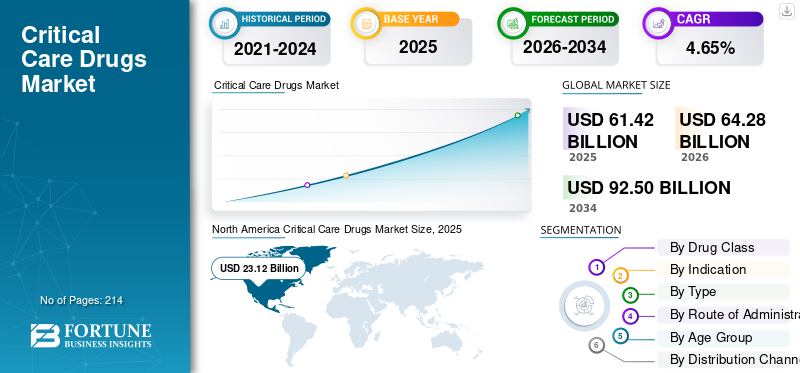
The global critical care drugs market size was valued at USD 61.42 billion in 2025. The market is projected to grow from USD 64.28 billion in 2026 to USD 92.50 billion by 2034, exhibiting a CAGR of 4.65% during the forecast period. North America dominated the critical care drugs market with a market share of 37.64% in 2025.
The global market includes medications used for the treatment and management of life-threatening conditions in intensive care units, emergency rooms, surgical theaters, and acute hospital environments. The market is propelled by the increasing incidence of sepsis, septic shock, respiratory failure, serious infections, trauma, cardiac emergencies, and neurological crises, which necessitate fast-acting medications such as anti-infectives, sedatives, vasopressors, anticoagulants, opioid analgesics, anesthetics, and neuromuscular blockers. Furthermore, the demand is additionally reinforced by the prevalent use of injectable and intravenous formulations in ICUs, where rapid drug action, precise dose control, and hospital-based delivery are vital for patient stabilization.
Key market players in the global market consist of Pfizer Inc., Fresenius Kabi AG, Baxter, Hikma Pharmaceuticals, Teva, and Sandoz. Their competitive positioning is supported by strong sterile injectable portfolios, broad hospital distribution networks, established critical care drug supply capabilities, and continued focus on ready-to-use formulations, generic injectables, anti-infectives, anesthesia drugs, and ICU-focused therapies.
Download Free sample to learn more about this report.
Critical Care Drugs Market Key Takeaways
 Global Market Size & Forecast
- 2025 Market Size: USD 61.42 billion
- 2026 Market Size: USD 64.28 billion
- 2034 Forecast Market Size: USD 92.50 billion
- CAGR: 4.65% from 2026–2034
 Market Share
- North America dominated the critical care drugs market with a 37.64% share in 2025.
- The vasopressors segment is projected to grow at a CAGR of 4.19% during the forecast period.
- The cardiac emergencies segment is expected to grow at a CAGR of 5.08% during the forecast period.
 Key Regional Highlights
North America
North America maintained its leading position with a market value of USD 23.12 billion in 2025.
Asia Pacific
Asia Pacific is projected to reach a market value of USD 15.70 billion in 2026.
Europe
Europe is anticipated to grow at a CAGR of 3.89% during the forecast period.
U.S.
The market is estimated to reach USD 21.97 billion in 2026.
Japan
The market is projected to reach USD 3.02 billion in 2026.
Read More

CRITICAL CARE DRUGS MARKET TRENDS
Shift Toward Ready-To-Use Injectables is a Remarkable Market Trend
Hospitals are progressively moving toward ready-to-use, prefilled, and premixed injectable medications to enhance speed, safety, and dependability in critical care environments. In intensive care units and emergency rooms, medications such as vasopressors, sedatives, anesthetics, anti-infectives, and analgesics frequently require immediate availability, allowing little time for manual compounding or dilution. Pre-prepared formats minimize preparation time, decrease the likelihood of dosing or dilution mistakes, and facilitate quicker delivery in cases of sepsis, shock, trauma, and cardiac crises. This trend is also being driven by the operational needs of hospital pharmacies, as drug shortages and staffing challenges have increased demand for standardized, manufacturer-prepared formulations. Consequently, pharmaceutical companies are expanding their portfolios of premix bags and ready-to-use syringes for frequently utilized critical care drugs, which enhances product differentiation in the market. These factors are supporting the overall global critical care drugs market growth during the forecast period.
- For instance, in May 2024, Long Grove Pharmaceuticals launched a ready-to-use premix of norepinephrine in 0.9% sodium chloride injection, a vasopressor widely used in critical care. The company stated that the product offers a 24-month room-temperature shelf life and adds a new supply source for the fragile critical care supply chain, helping hospital pharmacies focus resources on urgent patient needs.
MARKET DYNAMICS
MARKET DRIVERS
Download Free sample to learn more about this report.
Rising Burden of Sepsis and Septic Shock is Propelling Market Growth
The increasing prevalence of sepsis and septic shock significantly influences the global critical care drugs market, as these ailments necessitate prompt ICU treatment and swift medication response. Patients experiencing septic shock typically require broad-spectrum intravenous antibiotics to fight infection, vasopressors such as norepinephrine or vasopressin to maintain blood pressure, sedatives and analgesics for those on ventilation, and anticoagulants or supportive medications to address complications. Due to the rapid progression of sepsis to organ failure and death, hospitals have a high demand for critical care medications that can be quickly administered in emergency and intensive care environments. The significant global disease burden raises the demand for trustworthy supplies of sterile injectables, premixed vasopressors, and specialized therapies targeting sepsis. This makes sepsis and septic shock among the key clinical drivers of repeated hospital purchases of essential critical care medications.
- For instance, in April 2024, AdrenoMed AG announced that the U.S. FDA granted Fast Track designation to enibarcimab, its first-in-class monoclonal antibody candidate for the treatment of septic shock.
MARKET RESTRAINTS
Frequent Shortages of Sterile Injectable Drugs to Hamper Market Growth
Regular shortages of sterile injectable medications significantly hinder the global critical care drugs market, as intensive care unit treatments rely heavily on consistent availability of antibiotics, vasopressors, sedatives, opioids, anticoagulants, anesthetics, and neuromuscular blockers. These medications necessitate intricate sterile production, stringent quality assurance, and a reliable supply of raw materials. As a result, even minor disruptions in manufacturing can significantly affect hospital supply. Furthermore, many critical care injectables are established generic products with slim profit margins, which can limit producers’ incentives to invest in backup resources, resulting in ongoing supply shortages. For hospitals, these shortages may postpone procedures, necessitate the use of unfamiliar alternatives, elevate pharmacy workload, and heighten the risk of medication errors. This directly limits market growth as demand stays elevated, yet inconsistent product availability hampers sales consistency and patient access.
- For example, in January 2025, the U.S. Government Accountability Office (GAO) reported that drug shortages most commonly affect sterile injectable drugs critical to hospital care and cancer treatment, and that pandemic-related supply chain vulnerabilities contributed to worsening these shortages.
MARKET OPPORTUNITIES
Growing ICU Admissions for Respiratory Failure and ARDS to Offer Market Growth Opportunities
Growing ICU admissions for respiratory failure, acute respiratory distress syndrome (ARDS), severe pneumonia, and ventilator-associated complications create a strong opportunity for the global market. These patients often require multiple drug classes at the same time, including sedatives, opioid analgesics, neuromuscular blockers, anti-infectives, anticoagulants, and inhaled or IV supportive therapies. As ARDS patients usually need mechanical ventilation and continuous monitoring, hospitals depend on reliable access to drugs that support ventilation, infection control, inflammation management, and hemodynamic stability. This creates an opportunity for companies to develop advanced ICU-focused therapies, ready-to-administer formulations, and drugs targeting severe lung inflammation. The opportunity is especially strong as ARDS still has limited pharmacological treatment options, so new therapies that can improve outcomes in critically ill respiratory patients may gain strong demand from hospitals.
- For instance, in June 2024, InflaRx N.V. announced that its drug GOHIBIC/vilobelimab was selected for the first BARDA-sponsored clinical trial to evaluate novel host-directed therapeutics for ARDS. The trial focuses on hospitalized ARDS patients and highlights the growing opportunity for targeted critical care drugs in severe respiratory failure management.
MARKET CHALLENGES
Medication Safety and Dosing-Error Risks Present a Key Challenge to Market Growth
Medication safety and the risk of dosing errors continue to be significant challenges for the global market, as ICU medications often involve potent therapies that need quick administration, weight-adjusted dosing, infusion titration, and patient supervision. Medications such as vasopressors, opioids, sedatives, anticoagulants, neuromuscular blockers, and intravenous adrenergic agents possess limited safety margins. Thus, even minor mistakes in preparation, dilution, or pump programming can result in significant harm to patients. As a result, hospitals may be cautious about adopting new formulations unless they align with current safety protocols, pharmacy workflows, and electronic medication systems. It also heightens the demand for pre-prepared items, barcode verification, dosage standardization, employee training, and pharmacist supervision, thereby increasing operational complexity. Consequently, drug safety issues may hinder product acceptance and raise compliance requirements for firms providing essential care medications.
- For instance, in January 2024, ISMP/ECRI updated its High-Alert Medications in Acute Care Settings list, highlighting that while high-alert medicines may not be associated with more frequent errors, errors involving these medications can result in severe patient harm or fatalities.
Segmentation Analysis
By Drug Class
Widespread Use of Anti-infective Therapies in Clinically ill Patients Supported Segment Growth
In terms of drug class, the market is divided into anti-infectives, sedatives & hypnotics, anticoagulants, vasopressors, opioid analgesics, general anesthetics, neuromuscular blockers, and others.
The anti-infectives segment captured the largest global critical care drugs market share in 2025. The segment’s dominance is due to the fact that anti-infectives are widely used for critically ill patients who are highly exposed to severe bacterial, fungal, hospital-acquired, and ventilator-associated infections. Demand is further supported by the growing need for broad-spectrum and reserve antibiotics in patients with antimicrobial resistance or in patients with limited treatment options. Moreover, anti-infectives are used across a wider patient pool and are often administered in the early treatment process, often on an empirical basis, and as part of combination therapy regimens. As a result, anti-infectives remain a major revenue contributor within the market.
- For instance, in February 2025, AbbVie announced that the U.S. FDA approved EMBLAVEO for adults with complicated intra-abdominal infections with limited or no treatment options, including infections caused by Gram-negative bacteria.
The vasopressors segment is anticipated to grow at a CAGR of 4.19% over the forecast period.
To know how our report can help streamline your business, Speak to Analyst
By Indication
Sepsis & Septic Shock Segment Dominated Due to Growing Need for Early Treatment to Prevent Organ Failure
On the basis of indication, the market is divided into sepsis & septic shock, respiratory failure & ARDS, cardiac emergencies, trauma & post-surgical care, severe infections & pneumonia, neurological emergencies, and others.
The sepsis & septic shock segment accounted for the largest global critical care drugs market share in 2025. The segment’s dominance can be attributed to the fact that these conditions are among the most frequent and life-threatening reasons for ICU admission. The segment’s growth is further supported by high mortality risk, rapid disease progression, and the need for early treatment to prevent organ failure. Therefore, the consistent hospital demand for anti-infectives and hemodynamic support drugs keeps sepsis & septic shock as the leading indication within the market. Furthermore, the segment is set to hold a 28.6% share in 2026.
- For instance, in May 2024, Long Grove Pharmaceuticals launched Premix Vasopressin in sodium chloride injection in various concentrations to support critical care hospital pharmacies. Vasopressin is used in critical hypotensive shock, including septic shock.
The cardiac emergencies segment is growing at a CAGR of 5.08% over the forecast period.
By Type
High Use of Established ICU Drugs and Cost-driven Hospital Procurement Led to Generics Segment Dominance
Based on type, the market is classified into generics and branded.
The generics segment dominated the global market in 2025. The segment’s growth is driven by its high volume procurement of critical care products and affordability for low-income communities. Moreover, generics allow hospitals to manage large ICU drug consumption while controlling pharmacy budgets. Their dominance is also supported by the strong availability of sterile injectable generics from various companies. Furthermore, the segment is set to hold a 59.9% share in 2026.
- For instance, in April 2025, Avenacy launched Propofol Injectable Emulsion, USP in the U.S. as a therapeutic generic equivalent to Diprivan, approved by the U.S. FDA.
The branded segment is anticipated to rise with a CAGR of 3.96% over the forecast period.
By Route of Administration
Broad Use of Sterile Injectables Supported Intravenous Segment Expansion
In terms of route of administration, the market is divided into intravenous, inhalation, oral/enteral, intramuscular/subcutaneous, and others.
The intravenous segment captured the highest share of the global market in 2025. It remains the preferred route for major life-threatening conditions such as sepsis, septic shock, respiratory failure, cardiac emergencies, trauma, and post-surgical complications. The segment is also supported by the broad use of sterile injectables and infusion-based treatments. Additionally, a strong product portfolio of intravenous drugs offered by various companies also boosts the segment’s growth. Furthermore, the segment is set to hold an 81.4% share in 2026.
- For instance, in July 2025, Hikma Pharmaceuticals received U.S. FDA approval for TYZAVAN (Vancomycin Injection, USP), a ready-to-infuse intravenous formulation of vancomycin for time-critical treatment, including sepsis-related hospital infections.
The oral/enteral segment is anticipated to rise with a CAGR of 4.26% over the forecast period.
By Age Group
Greater Exposure to Severe Health Disorders Supported the Adults Segment’s Growth
On the basis of age group, the market is divided into adult, geriatric, pediatric, and neonatal.
The adult segment captured the highest share of the global market in 2025. This group has higher exposure to sepsis, severe infections, trauma, cardiac emergencies, respiratory failure, post-surgical complications, and chronic disease-related critical illnesses. Adult patients also receive a wide range of critical care drugs, including anti-infectives, vasopressors, sedatives, anticoagulants, opioid analgesics, anesthetics, and neuromuscular blockers. Compared with pediatric and neonatal patients, adult treatment protocols cover a broader drug portfolio and larger dosing volumes, which increases overall drug consumption. The segment is further supported by rising surgical volumes, antimicrobial resistance, and increasing hospital admissions for severe infection-related complications. Furthermore, the segment is set to hold 49.4% share in 2026.
- For instance, in April 2024, Basilea Pharmaceutica announced that the U.S. FDA approved ZEVTERA (ceftobiprole medocaril sodium for injection) for the treatment of adult patients with Staphylococcus aureus bloodstream infections, including right-sided infective endocarditis, and adult patients with acute bacterial skin and skin structure infections.
The geriatric segment is anticipated to rise with a CAGR of 5.44% over the forecast period.
By Distribution Channel
Direct ICU Procurement and Immediate Drug Availability Needs Supported the Drug Stores & Retail Pharmacies Segment’s Dominance
Based on distribution channel, the market is segmented into hospital pharmacies, online pharmacies, drug stores & retail pharmacies, and others.
In 2025, the hospital pharmacies segment held the leading position in the global market, as most critical care drugs are administered within hospitals, especially in ICUs, emergency departments, operating rooms, and high-dependency units. Moreover, hospital pharmacies are better positioned to manage sterile injectables, crash-cart medicines, infusion drugs, and high-alert medications used in life-threatening situations. Their role is also increasing as hospitals focus on medication safety, inventory control, shortage management, and ready-to-use injectable adoption. Furthermore, the segment is set to hold 85.5% share in 2026.
- For instance, in May 2024, ASHP reported that hospital and health-system pharmacies are increasingly using technology and expanding pharmacy technician roles to improve medication safety and allow pharmacists to focus more on direct patient care.
In addition, online pharmacies are projected to witness a growth rate of 6.46% during the forecast period.
Critical Care Drugs Market Regional Outlook
By geography, the market is divided into North America, Latin America, Asia Pacific, Europe, and the Middle East & Africa.
North America
North America Critical Care Drugs Market Size, 2025 (USD Billion)
To get more information on the regional analysis of this market, Download Free sample
The North American market reached USD 22.21 billion in 2024 and led the global market. In 2025, the region maintained its leading position, with USD 23.12 billion. North America is expected to remain a major market during the forecast period due to high ICU utilization, strong hospital pharmacy systems, advanced emergency care infrastructure, and high adoption of sterile injectable drugs.
U.S. Critical Care Drugs Market
The U.S. market dominated the North American market and can be analytically approximated at around USD 21.97 billion in 2026, accounting for roughly 34.2% of the global market.
Europe
Europe market is anticipated to grow at a CAGR of 3.89% during the forecast period. Europe’s growth is supported by well-established hospital systems, high critical care standards, and strong demand for generic injectables and branded hospital anti-infectives. In addition, the region has a large aging population, which increases the risk of sepsis, severe infections, respiratory failure, cardiovascular emergencies, and post-operative ICU admissions, thereby driving market growth.
U.K Critical Care Drugs Market
The U.K.’s market is estimated to reach around USD 2.93 billion in 2026, representing roughly 4.6% of global revenues.
Germany Critical Care Drugs Market
Germany market is projected to reach approximately USD 3.91 billion in 2026, equivalent to around 6.1% of global sales.
Asia Pacific
The Asia Pacific drugs market is expected to reach a valuation of USD 15.70 billion in 2026. The region is expected to witness strong growth due to expanding hospital infrastructure, increasing ICU bed capacity, rising surgical volumes, and growing access to emergency and intensive care services. The region also has a high burden of severe infections, sepsis, pneumonia, trauma, and antimicrobial resistance, which increases demand for anti-infectives, sedatives, vasopressors, analgesics, and anticoagulants.
Japan Critical Care Drugs Market
The Japanese market is likely to reach around USD 3.02 billion in 2026, accounting for roughly 4.7% of global revenues.
China Critical Care Drugs Market
China’s market is projected to reach around USD 5.48 billion in 2026, representing roughly 8.5% of global sales.
India Critical Care Drugs Market
The Indian market in 2026 is estimated to reach around USD 2.56 billion, accounting for roughly 4.0% of global revenues.
Latin America and Middle East & Africa
The Middle East & Africa and Latin America regions are likely to witness a slower growth throughout the forecast period. The market in Latin America is projected to attain a valuation of USD 4.19 billion in 2026. Prominent factors such as improving hospital access, rising treatment of severe infections, higher emergency admissions, and increasing use of generic critical care injectables are boosting market growth in these regions.
In the Middle East and Africa region, the GCC market is projected to reach approximately USD 1.49 billion in 2026, representing about 2.3% of worldwide revenues.
COMPETITIVE LANDSCAPE
Key Industry Players
Major Players Focus on Anti-Infective Launches to Strengthen Their Market Presence
The global critical care drugs market shows a semi-fragmented structure with the presence of both well-established and emerging players in the market. Key companies include Pfizer Inc., Fresenius Kabi AG, Baxter, Hikma Pharmaceuticals, Teva, and Sandoz Inc. These companies are competing through broad ICU drug portfolios of various drug classes. Their market position is supported by hospital distribution networks, sterile injectable manufacturing capacity, ready-to-use formulations, and supply reliability for high-volume emergency medicines.
Additional key contributors include Hikma Pharmaceuticals, Teva Pharmaceutical Industries Ltd., and Viatris Inc. These companies are focusing on generic injectable expansion, premix formulations, anti-infective launches, and hospital pharmacy partnerships to strengthen their market presence.
- For instance, in December 2024, Endo launched ADRENALIN, a ready-to-use premixed bag, the first FDA-approved manufacturer-prepared epinephrine premixed IV bag.
LIST OF KEY CRITICAL CARE DRUGS COMPANIES PROFILED
- Pfizer Inc. (U.S.)
- Fresenius Kabi AG (Germany)
- Baxter (U.S.)
- Hikma Pharmaceuticals PLC (U.K.)
- Teva Pharmaceutical Industries Ltd. (Israel)
- Sandoz Inc. (Switzerland)
- Viatris Inc. (U.S.)
- AbbVie Inc. (U.S.)
- GSK (U.K.)
- Merck & Co., Inc. (U.S.)
KEY INDUSTRY DEVELOPMENTS
- May 2026: Braun launched Rocuronium Bromide Injection in a room-temperature-stable prefilled syringe.
- May 2025: Avenacy launched Doxycycline for Injection, USP in the U.S. market as a therapeutic generic equivalent for DOXY 100. The launch strengthened Avenacy’s critical injectable antibiotic portfolio and supports treatment access for severe bacterial infections managed in hospitals.
- March 2025: Biocon Pharma received the U.S. FDA approval for Norepinephrine Bitartrate Injection USP in a 4 mg/4 mL single-dose vial.
- December 2024: Fresenius Kabi launched Epinephrine Injection, USP, the first generic version of epinephrine 1 mg/1 mL vial in the U.S. Epinephrine is used for hypotension associated with septic shock and emergency allergic reactions.
- September 2024: Hikma completed the acquisition of Xellia Pharmaceuticals’ U.S. finished dosage form business and related assets. The acquisition added differentiated products, pipeline assets, and manufacturing capabilities in anti-infectives and other critical care therapies.
REPORT COVERAGE
The global critical care drugs market analysis encompasses an extensive examination of the market size and projections for all market segments featured in the report. It provides information on the market dynamics and trends that are anticipated to propel the market during the forecast period. It offers insights into crucial elements, such as innovations in products, the regulatory landscape, pipeline analysis, and the introduction of new products. Furthermore, it outlines collaborations, mergers & acquisitions, along with significant advancements in the industry within the market. The global market forecast report additionally offers a comprehensive competitive landscape with details on market share and profiles of major active participants.
Request for Customization to gain extensive market insights.
Report Scope & Segmentation
| ATTRIBUTE | DETAILS |
| Study Period | 2021-2034 |
| Base Year | 2025 |
| Estimated Year | 2026 |
| Forecast Period | 2026-2034 |
| Historical Period | 2021-2024 |
| Growth Rate | CAGR of 4.65% from 2026 to 2034 |
| Unit | Value (USD Billion) |
| Segmentation | By Drug Class, Indication, Type, Route of Administration, Age Group, Distribution Channel, and Region |
| By Drug Class |
|
| By Indication |
|
| By Type |
|
| By Route of Administration |
|
| By Age Group |
|
| By Distribution Channel |
|
| By Region |
|
Frequently Asked Questions
According to Fortune Business Insights, the global market value stood at USD 61.42 billion in 2025 and is projected to reach USD 92.50 billion by 2034.
In 2025, the market value stood at USD 23.12 billion.
The market is expected to exhibit a CAGR of 4.65% during the forecast period.
By drug class, the anti-infectives segment led the market.
Rising burden of sepsis and septic shock, high prevalence of severe infections and antimicrobial resistance, and growing ICU admissions for respiratory failure and ARDS are the key factors driving market expansion.
Pfizer, Fresenius Kabi, Baxter, Hikma Pharmaceuticals, Teva, and Sandoz are some of the top players in the global market.
North America dominated the market.



- 2021-2034
- 2025
- 2021-2024
- 214
Get 30-60 hrs Free Customization
Expand Regional and Country Coverage, Segments Analysis, Company Profiles, Competitive Benchmarking, and End-user Insights.













.webp)






Related Reports
-
US +1 833 909 2966 ( Toll Free )
-
Get In Touch With Us