Custom Antibody Market Size, Share & Industry Analysis, By Service (Antibody Design and Development, Antibody Production & Purification, Antibody Fragmentation & Labelling, and Others), By Antibody Type (Monoclonal Antibodies (mAbs), Polyclonal Antibodies (pAbs), Recombinant Antibodies, and Others), By Source (Mice, Rabbit, and Others), By Application (Therapeutics, Diagnostics, and Research), By End User (Pharmaceutical & Biotechnology Companies, CROs & CDMOs, Academic & Research Institutes, and Others), and Regional Forecast, 2026-2034
 Download Free Sample
Custom Antibody Market Size and Future Outlook
 Listen to Audio Version
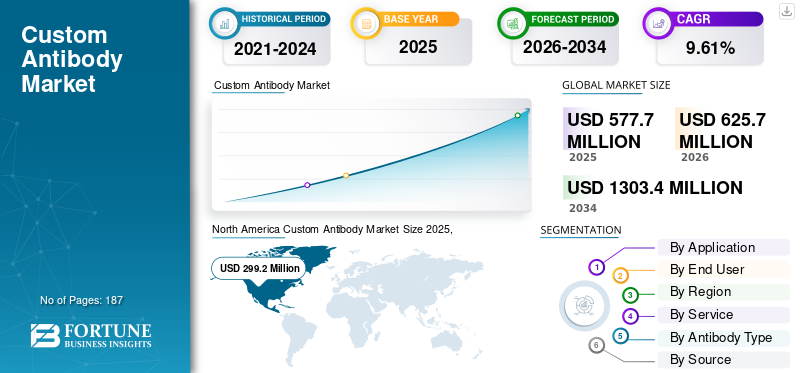
The global custom antibody market size was valued at USD 577.7 million in 2025. The market is projected to grow from USD 625.7 million in 2026 to USD 1,303.4 million by 2034, exhibiting a CAGR of 9.61% during the forecast period. North America dominated the global custom antibody market with a market share of 51.79% in 2025.
Custom antibodies are laboratory-generated antibodies that are specifically created to recognize a particular antigen chosen by the researcher or customer. Unlike catalog antibodies, custom antibodies are designed, developed, and validated on demand for a unique target. This market is expected to grow at a significant rate over the study period, driven by increasing investments in biologics and antibody therapeutics by biopharmaceutical companies globally. In addition, various key players are focusing on strategic activities such as collaboration and acquisitions to enhance their competitive edge in the market.
Furthermore, the market is dominated by several key players, with Thermo Fisher Scientific Inc., Bio Rad Laboratories Inc., and others occupying the leading positions. Advanced technology integration and strengthening product offerings through collaborations further enhance the position of these companies in the global market.
Download Free sample to learn more about this report.
Custom Antibody Market Key Takeaways
 Global Market Size & Forecast
- 2025 Market Size: USD 577.7 Million
- 2026 Market Size: USD 625.7 Million
- 2034 Forecast Market Size: USD 1,303.4 Million
- CAGR: 9.61% from 2026–2034
 Market Share
- North America dominated the custom antibody market with a 51.79% share in 2025.
- The antibody production & purification segment held the largest market share in 2025.
- The monoclonal antibodies (mAbs) segment is projected to account for 46.7% of the market in 2026.
 Key Regional Highlights
North America
North America accounted for USD 299.2 million in 2025, representing 51.79% of the global market.
Europe
Europe is projected to reach USD 161.4 million in 2026, supported by rising demand for antibody therapeutics.
Asia Pacific
Asia Pacific is expected to reach USD 100.1 million in 2026, driven by expanding biopharmaceutical research.
U.S.
The market is projected to reach USD 309.1 million by 2026, supported by strong R&D investment and a robust biotechnology ecosystem.
Japan
The market is expected to witness steady growth, supported by increasing biologics research and antibody development activities.
Read More

MARKET DYNAMICS
MARKET DRIVERS
Increasing Investments in Biologics and Antibody Therapeutics to Boost Market Growth
Increasing investments in biologics and antibody therapeutics are one of the prominent factors driving the global custom antibody market growth. In recent years, biopharmaceutical companies have rapidly expanded their pipelines of monoclonal antibodies, bispecific antibodies, antibody-drug conjugates, and recombinant antibodies, which, in turn, has increased the demand for custom antibody services. As more therapies move into preclinical and clinical stages, demand rises for highly specific, high-affinity custom antibodies to support target identification, biomarker studies, and mechanism-of-action analysis. Additionally, the expansion of manufacturing capabilities by key players also boosts the market growth.
- For instance, in February 2025, Alloy Therapeutics Inc. announced a multi-year collaboration with Pfizer Inc. for the development of a new antibody-discovery platform designed to uncover “potent, specific, and effective antibodies” against challenging targets.
MARKET RESTRAINTS
High Cost and Long Development Timelines to Restrict Market Expansion Opportunity
One of the most significant challenges restraining the market growth is the high cost and long development timelines associated with custom antibody development and manufacturing. Custom antibody development, especially monoclonal and recombinant antibodies, requires immunization cycles, sequencing and engineering, and multiple rounds of affinity maturation and validation, resulting in lengthy workflows. As a result, the market is expected to experience limited growth to some extent due to increased costs.
- For instance, according to an article published in July 2025 by Green Mountain Antibodies, typical custom monoclonal antibody development typically requires 12-24 weeks (3-6 months).
MARKET OPPORTUNITIES
Expansion of Recombinant and Engineering Antibodies to Offer Lucrative Growth Opportunities
The global market is rapidly shifting from traditional animal-derived antibodies toward recombinant and engineered antibody formats. This is anticipated to create strong growth opportunities in the market. This can be attributed to factors such as superior reproducibility & lot-to-lot consistency of recombinant antibodies, increasing preference toward these formats, and rising demand in diagnostics. To capture this, operating players have undertaken various strategic initiatives in recent years.
- For instance, in June 2024, Abcam expanded its recombinant antibody discovery platform, integrating high-throughput phage display selection, next-generation sequencing, and AI-guided antigen design to accelerate custom recombinant antibody development for biopharma and diagnostic companies.
MARKET CHALLENGES
Regulatory Complexity for Therapeutic and Diagnostic Applications Poses a Significant Challenge for Market Growth
One of the major challenges in the global market is the regulatory complexity for therapeutic and diagnostic applications. The development of custom antibodies for diagnostic and therapeutic applications requires compliance with stringent regulatory frameworks imposed by regulatory agencies such as the U.S. FDA or EMA. This creates significant pressure on custom antibody service providers to maintain various parameters such as extensive documentation, GMP production, and others. Additionally, smaller providers often lack the infrastructure and workforce to meet these standards, limiting their market growth.
-
For example, the U.S. FDA has strengthened requirements for in-vitro diagnostic (IVD) components, including antibodies used in ELISA and rapid-test kits.
Custom Antibody Market Trends
Rising Outsourcing to Specialized Contract Service Providers is a Prominent Market Trend
The global market is witnessing a strong shift toward outsourcing antibody development services, which has emerged as one of the most prominent trends in the market. Pharmaceutical and biotechnology companies are increasingly outsourcing antibody-discovery, engineering, and production services to specialized contract research/contract development organizations (CROs/CDMOs). This is owing to the complexity of modern antibody formats, the requirement of a reduction in internal capital investment, accelerated timelines, and other factors.
- For instance, in January 2025, Samsung Biologics and LigaChem Biosciences, a Korea-based biopharmaceutical development company, expanded their partnership to provide antibody-drug conjugate (ADC) services.
Download Free sample to learn more about this report.
Segmentation Analysis
By Service
Antibody Production & Purification Segment Led Market Due to Rising Need for High-purity Recombinant Antibodies
Based on the service, the market is classified into antibody design and development, antibody production & purification, antibody fragmentation & labelling, and others.
The antibody production & purification segment held the largest global custom antibody market share in 2025. It is the most resource-intensive, high-value, and universally required stage of the antibody development workflow. Additionally, the market demand is increasingly shifting toward high-purity recombinant antibodies, in turn supporting the segment growth. Moreover, the operating players are focusing on expanding their production capacities.
- For instance, in June 2024, Sino Biological, Inc. announced a major expansion of its large-scale recombinant antibody production and purification facilities in both China and the U.S.
On the other hand, the antibody fragmentation & labelling segment is the second fastest-growing segment with a 10.12% CAGR during the forecast period.
To know how our report can help streamline your business, Speak to Analyst
By Antibody Type
Monoclonal Antibodies (mAbs) Commanded Market Due to Their Increasing Usage in Therapeutic Applications
In terms of antibody type, the market is categorized into monoclonal antibodies (mAbs), polyclonal antibodies (pAbs), recombinant antibodies, and others.
In 2025, the monoclonal antibodies (mAbs) segment held the largest market share. In 2026, the segment is anticipated to dominate with a 46.7% share. The segment dominated the market, owing to its various advantages such as high specificity & consistency, scalability, versatility, and regulatory acceptance, along with strong adoption in therapeutics and biologics. Additionally, the rapidly expanding pipeline of mAbs further supports the segment growth.
- For instance, in April 2024, GenScript expanded its monoclonal antibody generation and recombinant mAb expression platform, owing to the increasing demand from biologics and immunodiagnostics developers.
The recombinant antibodies segment is expected to grow at a CAGR of 11.81% over the forecast period.
By Source
Mice Segment Led Market Due to Its Increased Usage as a Host System in Various Applications
On the basis of the source, the market is divided into mice, rabbit, and others.
In 2025, the mice segment held the dominating position in the global market. In 2026, the segment is anticipated to dominate with a 54.3% share. This can be attributed to the widespread usage of mice as a host system in various applications. Their dominance lies in biological suitability, established workflows, regulatory familiarity, and decades of optimization in hybridoma and recombinant platforms. In addition, operating players are also focusing on enhancing their platforms to support their expanding applications.
- For instance, in January 2024, Regeneron announced enhancements to its VelocImmune mouse platform, stating that it remained the primary source of discovery antibodies for its internal and partnered therapeutic programs.
The rabbit segment is expected to grow at a CAGR of 10.48% over the forecast period.
By Application
High Dependency on High-Specificity Antibodies Boosted Diagnostics Segment Growth
In terms of application, the market is categorized into therapeutics, diagnostics, and research.
The diagnostics segment captured the leading share of the market in 2025. In 2026, the segment is anticipated to dominate with a 39.6% share. This dominance is primarily attributed to factors such as diagnostic technologies that rely heavily on high-specificity, reproducible, and assay-grade antibodies, making them the largest and most stable source of demand for custom antibody development and production. Additionally, the rapid expansion of point-of-care testing also boosted the segment growth.
- For instance, in February 2024, Sino Biological expanded its recombinant antibody production specifically to supply global diagnostic manufacturers.
The therapeutics segment is expected to grow at a CAGR of 10.14% over the forecast period.
By End User
Increasing Focus on Innovative Therapeutic Development to Drive Pharmaceutical & Biotechnology Companies’ Segmental Growth
In terms of end user, the market is categorized into pharmaceutical & biotechnology companies, CROs & CDMOs, academic & research institutes, and others.
The pharmaceutical & biotechnology companies segment accounted for the largest share of the global market in 2025 and is expected to maintain its dominance in 2026 with an estimated 37.7% share. This leading position is primarily driven by the extensive use of custom antibodies in research and therapeutic development. Their expanding biologics pipelines, especially in oncology, immunology, cell/gene therapy, and infectious diseases, require specialized, high-affinity custom antibodies for screening, mechanism-of-action studies, and biomarker research.
- For instance, in July 2024, AbCellera Biologics Inc. announced an expansion of its collaboration with Eli Lilly and Company to discover therapeutic antibodies for immunology, cardiovascular disease, and neuroscience.
The CROs & CDMOs segment is expected to grow at a CAGR of 12.64% over the forecast period.
Custom Antibody Market Regional Outlook
By geography, the market is categorized into Europe, North America, Asia Pacific, Latin America, and the Middle East & Africa.
North America
North America held the dominant share in 2024, valuing at USD 267.8 million, and also maintained the leading share in 2025, with USD 299.2 million. Key factors contributing to regional dominance include a strong biopharmaceutical & biotechnology industry, coupled with high adoption of recombinant & engineered antibodies by companies. North America is the fastest adopter of advanced technologies, which in turn supports market growth.
In 2026, the U.S. market is estimated to reach USD 309.1 million. The U.S. is leading the North American market, owing to factors such as strong R&D funding and federal investments, a supportive regulatory scenario, and a strong presence of leading CROs, CDMOs, and antibody technology providers. Additionally, strategic initiatives undertaken by key operating players also support the market growth over the study period.
North America Custom Antibody Market Size 2025,(USD Million)
To get more information on the regional analysis of this market, Download Free sample
Europe
Europe is projected to record a growth rate of 9.39%, which is the second highest among all regions, and reach a valuation of USD 161.4 million by 2026. This can be attributed to the increasing focus of pharmaceutical companies on antibody therapeutics in the region, leading to growing demand for custom antibody services. Backed by these factors, countries including U.K. anticipates to record the valuation of USD 36.1 million, Germany to record USD 33.0 million, and France to record USD 25.9 million in 2026.
Asia Pacific
The market in Asia Pacific is estimated to reach USD 100.1 million in 2026 and secure the position of the third-largest region in the market. In the region, India and China are both estimated to reach USD 17.8 and USD 18.4 million, respectively in 2026.
Latin America and Middle East & Africa
The Latin America and Middle East & Africa regions would witness a reasonable growth in this market space in the coming years. The Latin America market is set to reach a valuation of USD 24.4 million by 2026. Increasing research and development activities in these regions are expected to drive growth in these regions further. In the Middle East & Africa, the GCC is set to reach a value of USD 7.2 million by 2026.
COMPETITIVE LANDSCAPE
Key Industry Players
Strategic Collaborations and Technology Innovation Strengthen Leadership of Key Players
The global custom antibody market is moderately consolidated, with a mix of multinational life-science suppliers and specialized antibody-engineering firms holding substantial market share. These companies maintain leadership through advanced antibody engineering platforms, recombinant technology adoption, automation, and integrated discovery-to-production service models. Their competitive position is reinforced by a broad geographic presence, established relationships with pharmaceutical, biotechnology, and diagnostic companies, and a strong commitment to portfolio expansion through both internal R&D and external partnerships.
Companies such as Thermo Fisher Scientific Inc., Abcam plc, GenScript, Bio-Rad Laboratories Inc., and Sino Biological, Inc. remain among the most prominent market players. These companies continue to strengthen their market position through investments in recombinant antibody technologies, AI-enabled antigen design, and expansion of antibody engineering platforms to support growing demand for high-specificity, high-reproducibility custom antibodies across therapeutic, diagnostic, and research applications.
- For instance, in October 2023, GenScript expanded its Beacon-enabled single B-cell antibody discovery platform, enabling faster generation of high-affinity monoclonal and recombinant antibodies to support biopharma discovery workflows.
Apart from this, other prominent players, ProteoGenix, RayBiotech, R&D Systems, Enzo Life Sciences, Vector Laboratories (Absolute Antibody), and others are investing in specialized engineering services to expand their competitive footprint and offer differentiated value to customers.
LIST OF KEY CUSTOM ANTIBODY COMPANIES PROFILED:
- Danaher (U.S.)
- Thermo Fisher Scientific Inc. (U.S.)
- GenScript (U.S.)
- Enzo Life Sciences, Inc. (U.S.)
- R&D Systems, Inc. (U.S.)
- RayBiotech, Inc. (U.S.)
- ProteoGenix (France)
- Vector Laboratories, Inc. (U.S.)
- Sino Biological, Inc. (China)
KEY INDUSTRY DEVELOPMENTS
- May 2025: Spice Biotechnologies and AbTherx, Inc. signed a multi-program antibody discovery collaboration to build next-generation immunotherapy antibodies.
- April 2025: BigHat Biosciences and Eli Lilly and Company collaborated to design and discover next-generation therapeutic antibodies via AI/ML and synthetic biology.
- February 2025: BionTech completed the acquisition of Biotheus, a clinical-stage biotechnology company to support oncology strategy and bispecific antibody candidate development.
- January 2025: AbbVie and Simcere Zaiming partnered for the development of a novel trispecific antibody candidate in multiple myeloma.
- December 2024: WuXi Biologics signed a service agreement with Sino Biopharm to provide integrated discovery services (including antibody generation and lead optimization) for a first-in-class monoclonal antibody against an undisclosed target.
REPORT COVERAGE
The global custom antibody market analysis provides n comprehensive study of market size & forecast by all the market segments included in the report. It includes details on the market dynamics and market trends expected to drive the market over the forecast period. It also provides overviews of technological advancements, product development, key industry developments, mergers & acquisitions, and strategic insights into market growth. The market forecast report also encompasses a detailed competitive landscape with information on market share and profiles of key operating players.
Request for Customization to gain extensive market insights.
Report Scope & Segmentation
| Attribute | Details |
| Study Period | 2021-2034 |
| Base Year | 2025 |
| Forecast Period | 2026-2034 |
| Historical Period | 2021-2024 |
| Growth Rate | CAGR of 9.61% from 2026-2034 |
| Unit | Value (USD Million) |
| Segmentation | ByService, Antibody Type, Source, Application, End User, and Region |
| By Service |
|
| By Antibody Type |
|
| By Source |
|
| By Application |
|
| By End User |
|
| By Region |
|
Frequently Asked Questions
Fortune Business Insights says that the global market value stood at USD 577.7 million in 2025 and is projected to reach USD 1,303.4 million by 2034
In 2025, the market value stood at USD 299.2 million.
The market is expected to exhibit a CAGR of 9.61% during the forecast period of 2026-2034.
The monoclonal antibodies (mAbs) segment led the market in terms of antibody type
Increasing investments in biologics and antibody therapeutics, coupled with advances in antibody engineering, are anticipated to drive market growth.
Thermo Fisher Scientific Inc., Bio‑Rad Laboratories, Inc., and GenScript are some of the prominent players in the market.
North America dominated the market in 2025.



- 2021-2034
- 2025
- 2021-2024
- 187
Get 30-60 hrs Free Customization
Expand Regional and Country Coverage, Segments Analysis, Company Profiles, Competitive Benchmarking, and End-user Insights.













.webp)






Related Reports
-
US +1 833 909 2966 ( Toll Free )
-
Get In Touch With Us