Data Center Infrastructure Management Software Market Size, Share & Industry Analysis, By Deployment (Cloud-based, On-premise, and Hybrid), By Application (Asset & Inventory Management, Power Management, Cooling & Environmental Management, Capacity Planning, Monitoring & Alerting, Workflow & Change Management, and Others), By Data Center Type (Enterprise Data Centers, Colocation Data Centers, Hyperscale Data Centers, Edge Data Centers, and Others), and Regional Forecast, 2026 – 2034
 Download Free Sample
DATA CENTER INFRASTRUCTURE MANAGEMENT SOFTWARE MARKET SIZE AND FUTURE OUTLOOK
 Listen to Audio Version
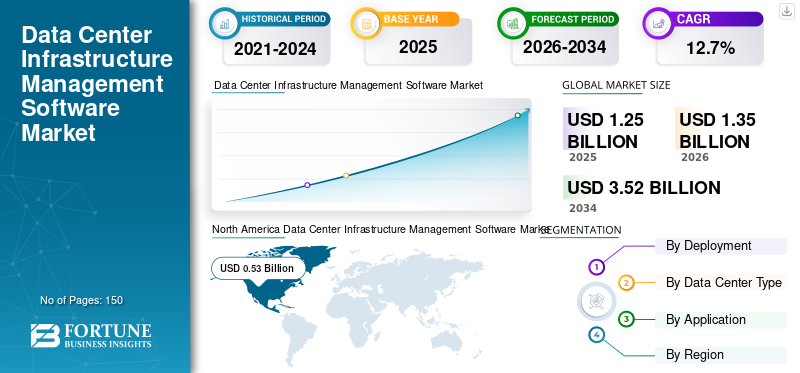
The data center infrastructure management software market size was valued at USD 1.25 billion in 2025. The market is projected to grow from USD 1.35 billion in 2026 to USD 3.52 billion by 2034, exhibiting a CAGR of 12.7% during the forecast period. North America dominated the data center infrastructure management software market with a market share of 42.4% in 2025.
Data Center Infrastructure Management (DCIM) software are advanced platforms that help data center operators monitor, manage, and optimize critical infrastructure such as power systems, cooling equipment, racks, servers, sensors, cabling, and facility assets. Unlike traditional spreadsheets, standalone monitoring tools, or basic building management systems, DCIM platforms provide centralized visibility into real-time infrastructure performance, capacity availability, asset utilization, environmental conditions, and operational risks across enterprise, colocation, hyperscale, and edge data centers.
The rapid expansion of AI-ready data centers, colocation facilities, hyperscale campuses, and distributed edge sites is driving demand for intelligent infrastructure management solutions. Operators are investing in DCIM software to improve uptime, reduce energy waste, track rack-level power usage, optimize cooling performance, forecast capacity, and manage complex multi-site environments. As data centers become more power-intensive and operationally complex, DCIM platforms are becoming essential for balancing efficiency, reliability, scalability, and sustainability.
Key players such as Schneider Electric SE, Vertiv Holdings Co, Sunbird Inc., and FNT Software GmbH are strengthening their DCIM offerings through cloud-based monitoring, predictive analytics, power and cooling optimization, asset lifecycle management, and integration with facility and IT systems. These vendors focus on delivering platforms that support real-time visibility, capacity planning, energy analytics, sustainability reporting, and automated infrastructure management for modern data center environments.
Download Free sample to learn more about this report.
Data Center Infrastructure Management Software Market
 Market Size & Forecast
- 2025 Market Size: USD 1.25 billion
- 2026 Market Size: USD 1.35 billion
- 2034 Forecast Market Size: USD 3.52 billion
- CAGR: 12.7% from 2026–2034
 Market Share
- North America dominated the data center infrastructure management software market with a 42.4% share in 2025.
- The Hybrid deployment segment held the largest share at 53.7% in 2025.
- The Power Management segment accounted for the highest share of 25.4% in 2025.
 Key Regional Highlights
North America
North America Led the global market due to its mature data center ecosystem and strong hyperscale and colocation presence.
Europe
Europe Reached USD 0.33 billion in 2025 and is projected to grow at a 10.9% CAGR during the forecast period.
Asia Pacific
Asia Pacific Expected to register the fastest growth, driven by increasing cloud adoption, AI workloads, and enterprise digitalization.
U.S.
U.S. The market was valued at approximately USD 0.43 billion in 2025, supported by major hyperscale data center hubs.
Japan
Japan The market was valued at approximately USD 0.05 billion in 2025, driven by ongoing investments in advanced data center infrastructure.
Read More

IMPACT OF ARTIFICIAL INTELLIGENCE
AI-Powered Predictive Monitoring Enhances Data Center Efficiency and Drives Market Growth
The growing use of AI in data center infrastructure management software is shifting the platforms from basic monitoring tools toward intelligent operational control systems. AI-enabled DCIM can analyze large volumes of real-time data from power systems, cooling units, sensors, racks, and facility equipment to identify abnormal patterns, predict failures, and recommend corrective actions before downtime occurs. For instance,
- Google has highlighted that AI infrastructure is pushing data centers toward advanced power distribution and liquid cooling, including the need to support 1 MW IT racks, which increases the importance of real-time infrastructure visibility and software-led control.
- Dell Technologies also introduced AI Factory infrastructure with integrated rack-scale systems, liquid cooling, scalable power management, and high-density compute capabilities, showing how AI-ready data centers require stronger software coordination across power, cooling, assets, and capacity.
- Eaton’s 2025 launch of an 800 VDC power architecture for AI factories further shows that AI data centers are moving toward more complex power designs, creating demand for DCIM platforms that can monitor electrical loads, cooling performance, and operational risk across high-density facilities.
As a result, AI is positively impacting the market by increasing demand for predictive monitoring, automated alerts, capacity forecasting, energy optimization, digital twin-based planning, and intelligent power and cooling management across hyper-scale, colocation, and enterprise data centers.
DATA CENTER INFRASTRUCTURE MANAGEMENT SOFTWARE MARKET TREND
Rising Focus on Power, Cooling, and Energy-efficiency Analytics is Key Market Trend
The rising focus on power, cooling, and energy-efficiency analytics is emerging as a major trend in the market. Data centers are facing higher electricity consumption, advanced rack densities, and greater cooling complexity driven by AI, cloud computing, and hyper-scale expansion. For instance,
- According to the International Energy Agency, data centers consumed around 415 TWh of electricity in 2024, representing about 1.5% of global electricity consumption, and their electricity use is projected to more than double to around 945 TWh by 2030, with AI being the most significant growth driver.
This is increasing demand for DCIM platforms that can provide real-time visibility into rack-level power consumption, UPS and PDU load, cooling performance, temperature, humidity, airflow, and overall energy efficiency.
Data center operators are also under pressure to improve efficiency while managing power constraints and higher operating costs.
- Uptime Institute’s 2025 survey highlights that operators are facing rising costs, worsening power constraints, and challenges in meeting AI-related power and density requirements. In this environment, DCIM software is moving from basic monitoring and asset tracking toward advanced analytics that help operators identify stranded power, optimize cooling loads, reduce energy waste, forecast capacity, and improve PUE performance.
This trend is particularly strong across colocation and hyper-scale facilities, where inefficient power or cooling management can directly affect uptime, customer service levels, and operating margins.
MARKET DYNAMICS
MARKET DRIVERS
Download Free sample to learn more about this report.
AI Workload Growth Increasing Demand for Advanced Infrastructure Monitoring Needs Drives Market Growth
The rapid growth of AI workloads is driving data center infrastructure management software market growth, as AI-ready facilities require much higher power density, tighter thermal control, and continuous operational visibility. For instance,
- NVIDIA’s GB200 NVL72 system is a rack-scale, liquid-cooled architecture with 72 Blackwell GPUs, demonstrating how AI infrastructure is moving toward dense, integrated compute environments that require precise power and cooling supervision.
- Blackwell-based racks can require around 120 kW per rack, far above traditional enterprise rack loads, creating a greater risk of power imbalance, overheating, and capacity bottlenecks.
- In June 2025, Schneider Electric launched new data center solutions for high-density AI clusters, noting that organizations are facing rack power densities of 1 MW or more, reinforcing the need for stronger real-time monitoring and infrastructure control.
As AI deployments expand across hyperscale, colocation, and enterprise facilities, DCIM platforms are becoming essential for monitoring rack-level power, liquid cooling performance, asset health, environmental conditions, and available capacity. This enables operators to prevent overloads, reduce downtime risk, optimize cooling, and manage high-density AI infrastructure more efficiently.
MARKET RESTRAINTS
Data Security and Compliance Concerns in Cloud-based DCIM to Restrain Market Growth
Data security and compliance concerns are expected to restrain the adoption of cloud-based and hybrid DCIM platforms, especially among highly regulated data center operators. DCIM software manages sensitive operational information, including rack layouts, asset inventory, power loads, cooling performance, alarms, facility workflows, and infrastructure capacity, making it a critical system for data center operations. For instance,
- IBM reported that 40% of breaches in 2024 involved data stored across multiple environments, including public cloud, private cloud, and on-premises systems, and that these breaches cost more than USD 5 million on average and took the longest to identify and contain.
This increases caution among BFSI, government, defense, healthcare, and colocation operators, as any exposure of infrastructure data can create security, operational, and compliance risks.
- In Europe, the NIS2 Directive has strengthened cybersecurity risk-management requirements for critical entities and networks, increasing pressure on operators to carefully assess third-party cloud platforms before adoption.
- Moreover, Uptime Institute’s 2025 outage analysis highlighted that modern data center architectures face rising external risks, including cybersecurity incidents and third-party software issues, further reinforcing operator hesitation toward fully cloud-based DCIM deployment.
As a result, many regulated and mission-critical facilities continue to prefer on-premise or tightly controlled hybrid DCIM models, which can slow the broader shift toward cloud-based DCIM solutions.
MARKET OPPORTUNITIES
Increasing Colocation and Hyperscale Data Center Investments to Create Growth Opportunities
Increasing investments in colocation and hyperscale data centers are expected to create strong growth opportunities for the market. Colocation providers and hyperscale operators manage large, high-density, and multi-site facilities where real-time visibility into power, cooling, asset inventory, capacity, and alarms is critical for operational continuity.
- CBRE reported that demand continued to outpace new supply across global data center hubs in 2025, while the global weighted-average data center vacancy rate declined to 6.6% in Q1 2025, indicating tight capacity availability and strong demand for new infrastructure.
- The same report also highlighted that demand from hyperscalers and cloud service providers drove record leasing activity in Q1 2025, supported by AI adoption and persistent power constraints.
This directly increases the need for DCIM platforms that can help operators optimize available capacity, monitor rack-level power, manage cooling loads, and reduce operational risks. Major company-level investments further offer beneficial market opportunities. In September 2025, Microsoft announced a new wave of purpose-built data centers and infrastructure investments to support AI workloads and cloud services, including its Fairwater AI data center in Wisconsin.
- Equinix also reported strong third-quarter 2025 results and indicated sustained momentum into 2026, while separate industry coverage noted that Equinix planned to add around 900 MW of data center capacity in high-demand markets such as Amsterdam, London, Chicago, Toronto, and Johannesburg.
As colocation and hyperscale facilities expand, operators will increasingly require advanced DCIM solutions for tenant-level asset tracking, power and cooling optimization, capacity forecasting, sustainability reporting, and centralized multi-site monitoring, creating a favorable opportunity for DCIM software vendors.
Segmentation Analysis
By Data Center Type
Colocation Data Centers Lead Market Driven by Multi-Tenant Infrastructure and Capacity Management Needs
Based on data center type, the market is categorized into enterprise data centers, colocation data centers, hyperscale data centers, edge data centers, and others.
Colocation data centers held the majority of the data center infrastructure management software market share. In 2025, the segment dominated with a 33.4% share, as facilities manage multiple customers, racks, cages, power circuits, cooling zones, and service-level commitments within the same site, making real-time infrastructure visibility essential. DCIM helps colocation operators track tenant assets, monitor rack-level power usage, plan available space and capacity, and maintain uptime across multi-site operations. Rising enterprise outsourcing, demand for cloud-adjacent infrastructure, and the expansion of third-party data center facilities further support higher DCIM adoption in this segment.
Hyperscale data centers segment is expected to witness the highest CAGR of 16.2% during the forecast period.
To know how our report can help streamline your business, Speak to Analyst
By Deployment
Hybrid Deployment Segment Dominates Due to Secure Local Control and Remote Monitoring Flexibility
Based on deployment, the market is segmented into cloud-based, on-premise, and hybrid.
Hybrid segment held the majority share. In 2025, the segment held a 53.7% of share as DCIM software is closely connected to critical data center systems such as power, cooling, PDUs, UPS, sensors, and building management platforms, which many operators prefer to control on-premises. At the same time, operators increasingly need cloud-based dashboards for remote monitoring, multi-site visibility, analytics, reporting, and centralized alerts. Hybrid deployment benefits data centers by securing local control for mission-critical infrastructure and offering flexible cloud access for operational visibility.
Cloud-based segment is expected to witness the highest CAGR of 17.4% during the forecast period.
By Application
Power Management Segment Dominates Owing to Rising Energy Demand and High-Density Data Center Operations
Based on application, the market is categorized into asset & inventory management, power management, cooling & environmental management, capacity planning, monitoring & alerting, workflow & change management, and others.
Power management held the majority share of the market. In 2025, the segment held a share of 25.4% as power availability and energy consumption are now the most critical challenges for data center operators. DCIM software helps operators monitor rack-level power usage, UPS load, PDU performance, circuit capacity, energy consumption, and stranded power in real time. This is especially important as AI workloads and high-density racks increase electricity demand and the risk of overloads or downtime. Colocation and hyperscale facilities also need accurate power visibility for capacity planning, customer billing, and operational efficiency.
Others segment is expected to witness the highest CAGR of 15.0% during the forecast period.
Data Center Infrastructure Management Software Market Regional Outlook
By region, the market is categorized into North America, South America, Europe, and Middle East & Africa, and Asia Pacific.
North America
North America Data Center Infrastructure Management Software Market Size, 2025 (USD Billion)
To get more information on the regional analysis of this market, Download Free sample
North America holds the majority market share due to its mature data center ecosystem, strong hyperscale and colocation presence, and high adoption of advanced infrastructure management tools. The U.S. leads the region with large data center hubs such as Northern Virginia, Dallas, Phoenix, Chicago, Silicon Valley, and Atlanta, where operators require DCIM platforms for power monitoring, cooling optimization, asset tracking, and capacity planning. Growing AI and cloud workloads are further increasing rack density and operational complexity, making real-time infrastructure visibility more critical.
- According to CBRE, the vacancy rate in North America’s primary data center sectors fell to a record low of 1.4% at year-end 2025, while 5,994.4 MW of new capacity was under construction, showing strong demand and continued infrastructure expansion.
This high concentration of large, power-intensive, multi-site facilities supports stronger DCIM adoption than in other regions. Therefore, North America dominates the market as data center operators increasingly invest in software to improve uptime, energy efficiency, and infrastructure utilization.
North America market held the largest market at USD 0.53 billion in 2025.
U.S. Data Center Infrastructure Management Software Market
Given North America’s strong contribution, the U.S. market was at around USD 0.43 billion in 2025, accounting for roughly 34.4% of sales.
Europe
Europe is projected to grow at a CAGR of 10.9% over the coming years and reached a valuation of USD 0.33 billion in 2025, due to its mature data center ecosystem, strong colocation base, and consistent demand from cloud, enterprise, telecom, and financial service users. Growth is further supported by rising need for energy efficiency, sustainability reporting, power monitoring, and capacity optimization across major hubs such as London, Frankfurt, Amsterdam, Paris, and Dublin.
U.K. Data Center Infrastructure Management Software Market
The U.K. market in 2025 was valued at around USD 0.06 billion, representing roughly 4.8% of global revenues.
Germany Data Center Infrastructure Management Software Market
Germany’s market reached USD 0.06 billion in 2025, equivalent to around 4.8% of global sales.
Asia Pacific
Asia Pacific is expected to grow at the highest CAGR and reach a valuation of USD 0.28 billion by 2025. The region is witnessing strong growth in cloud adoption, AI workloads, e-commerce, 5G, fintech, and enterprise digitalization, which is increasing the need for DCIM software to manage power, cooling, assets, and capacity.
- Jones Lang LaSall (JLL) reported that Asia Pacific data center expansion is expected to add 24 GW of capacity between 2025 and 2030, including colocation, hyperscale self-build, and on-premise capacity.
This large capacity addition will increase operational complexity and drive higher adoption of DCIM platforms across new and expanding facilities. Therefore, Asia Pacific is expected to grow faster than mature regions such as North America and Europe.
Japan Data Center Infrastructure Management Software Market
The Japan market in 2025 was valued at around USD 0.05 billion, accounting for roughly 4.0% of global revenues.
China Data Center Infrastructure Management Software Market
China’s market is projected to be one of the largest worldwide and its 2025 revenues reached at USD 0.07 billion, representing roughly 5.6% of global sales.
India Data Center Infrastructure Management Software Market
The India market in 2025 was at around USD 0.03 billion, accounting for roughly 2.4% of global market sales.
South America and Middle East & Africa
The Middle East & Africa region is expected to grow at the second-highest CAGR in the market. This is due to rapid data center investments across GCC, South Africa, Israel, Egypt, and other emerging digital hubs. This growth is supported by sovereign cloud initiatives, smart city projects, AI infrastructure, data localization, and rising enterprise cloud adoption. Hot climate conditions also increase the need for DCIM software to monitor cooling performance, energy use, and infrastructure reliability.
South America is expected to grow at a stable CAGR, due to gradual expansion of colocation, cloud, and enterprise data center infrastructure in Brazil, Chile, Colombia, and Argentina. DCIM adoption will rise as operators need better power monitoring, asset tracking, and capacity planning.
GCC Data Center Infrastructure Management Software Market
The GCC market reached USD 0.03 billion in 2025, representing roughly 2.4% of global revenues.
COMPETITIVE LANDSCAPE
Key Industry Players
Key Industry Players Focus on Innovation and Strategic Expansion to Sustain Market Competition
Key players in the market are enhancing their platforms to support the rising need for real-time visibility, energy optimization, predictive monitoring, and capacity planning across modern data centers. Leading companies are focusing on cloud-based DCIM, AI-enabled analytics, power and cooling optimization, asset lifecycle management, and integration with facility and IT systems to improve operational efficiency. Vendors are also expanding their solutions to support colocation, hyperscale, enterprise, and edge data center environments, where infrastructure complexity and uptime requirements are increasing.
LIST OF KEY DATA CENTER INFRASTRUCTURE MANAGEMENT SOFTWARE COMPANIES PROFILED
- Schneider Electric SE (France)
- Vertiv Holdings Co (U.S.)
- Carrier (U.S.)
- Sunbird Inc. (U.S.)
- FNT Software Gmbh (Germany)
- Raritan Inc. (U.S.)
- Legrand SA (France)
- Eaton Corporation (Ireland)
- ABB Ltd (Switzerland)
- Delta Electronics Inc. (Taiwan)
- Hyperview Technologies Inc. (Canada)
- Modius, Inc. (U.S.)
- Cormant Technologies (Philippines)
KEY INDUSTRY DEVELOPMENTS
- December 2025: Sunbird Software announced the general availability of dcTrack Release 9.3, its latest DCIM Operations software release. The update reinforces Sunbird’s positioning as a pure-play DCIM vendor focused on fast deployment, ease of use, and complete infrastructure management.
- November 2025: Nlyte Software, a part of Carrier Global Corporation, launched Nlyte Software Version 16, described as a next-generation DCIM release. The new version includes executive dashboards, enhanced protocol support, and expanded sustainability reporting.
- September 2025: Eaton announced a collaboration with Autodesk to deliver AI-powered digital energy twins and software tools for building and data center infrastructure. The collaboration focuses on improving building lifecycle management and enhancing electrical system design, construction, and operation through BIM integration and digital energy twin technology.
- September 2025: FNT Software introduced a rack-based pricing model for its DCIM software in the U.S. market. The model links software pricing to the number of racks in a data center, making the offering better aligned with customer infrastructure scale.
- August 2025: Vertiv acquired Waylay NV, a Belgium-based software company, to strengthen its AI-enabled data center monitoring and optimization capabilities. Vertiv plans to integrate Waylay’s AI-powered software into its data center power and cooling systems to improve operational visibility, predictive management, and efficiency.
- July 2025: Modius partnered with Mitsubishi Heavy Industries to enhance data center energy management using Modius’ OpenData DCIM platform. The partnership aims to integrate Modius’ DCIM capabilities with MHI’s power, cooling, and control technologies to improve visibility, operational efficiency, and energy consumption.
- April 2025: CircuitMeter and Hyperview announced a strategic partnership to integrate real-time energy metering and analytics with Hyperview’s cloud-based DCIM platform. The collaboration is intended to provide circuit-level energy insights for data centers and mission-critical facilities. This development supports the market trend toward cloud-based DCIM platforms with stronger energy intelligence, cost reduction, and sustainability tracking capabilities.
REPORT COVERAGE
The report provides a comprehensive analysis of the industry, focusing on key market players and the overall competitive landscape. It offers valuable insights into current market trends, technological advancements, and significant industry developments. The report further examines key growth drivers, restraints, opportunities, and challenges influencing market expansion.
Request for Customization to gain extensive market insights.
Report Scope & Segmentation
| ATTRIBUTE | DETAILS |
| Study Period | 2021-2034 |
| Base Year | 2025 |
| Estimated Year | 2026 |
| Forecast Period | 2026-2034 |
| Historical Period | 2021-2024 |
| Growth Rate | CAGR of 12.7% from 2026-2034 |
| Unit | Value (USD Billion) |
| Segmentation | By Deployment, Application, Data Center Type, and Region |
| By Deployment |
|
| By Application |
|
| By Data Center Type |
|
| By Region |
|
Frequently Asked Questions
According to Fortune Business Insights, the global market value stood at USD 1.25 billion in 2025 and is projected to reach USD 3.52 billion by 2034.
In 2025, the North America market value stood at USD 0.53 billion.
The market is expected to grow at a CAGR of 12.7% over the forecast period of 2026-2034.
By data center type, the colocation data centers segment is expected to lead the market.
AI workload growth increasing demand for advanced infrastructure monitoring needs drives market growth.
Schneider Electric SE, Vertiv Holdings Co, Sunbird Inc., and FNT Software GmbH are the major players in the global market.
North America dominated the market in 2025.



- 2021-2034
- 2025
- 2021-2024
- 150
Get 30-60 hrs Free Customization
Expand Regional and Country Coverage, Segments Analysis, Company Profiles, Competitive Benchmarking, and End-user Insights.




















Related Reports
-
US +1 833 909 2966 ( Toll Free )
-
Get In Touch With Us