Decentralized Power Generation Market Size, Share & Industry Analysis, By Technology (Solar PV, Battery Energy Storage Systems (BESS), Combined Heat & Power (CHP) Systems, Fuel Cells, Biomass/Biogas Power Systems, and Others), By Grid Connection (Grid-Connected and Off-Grid), By Application (Distributed Generation, Backup Power, Microgrids, Remote Electrification, EV Charging Infrastructure, and Others), By End User (Residential, Commercial, Industrial, Utilities, and Others), and Regional Forecast, 2026-2034
 Download Free Sample
Decentralized Power Generation Market Size and Future Outlook
 Listen to Audio Version
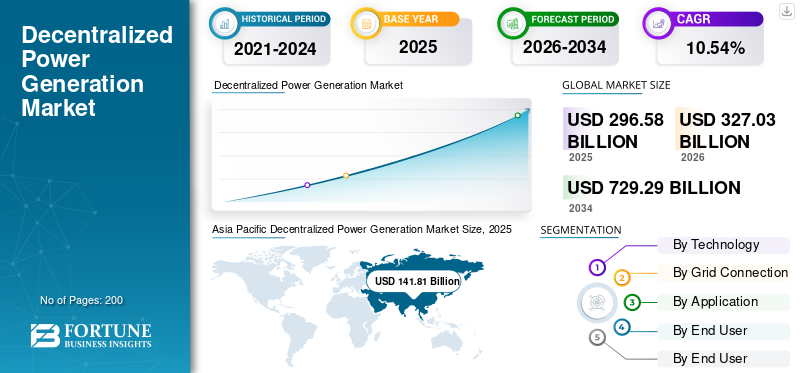
The global decentralized power generation market size was valued at USD 296.58 billion in 2025. The market is projected to grow from USD 327.03 billion in 2026 to USD 729.29 billion by 2034, exhibiting a CAGR of 10.54% during the forecast period. Asia Pacific dominated the decentralized power generation market with a market share of 47.82% in 2025.
Decentralized power generation refers to the production of electricity from small-scale energy systems located close to the point of consumption, reducing the reliance on centralized power plants and long-distance transmission infrastructure. The market encompasses technologies such as distributed solar photovoltaic (PV) systems, battery energy storage systems (BESS), combined heat and power systems, fuel cells, biomass and biogas power plants, and microgrids.
The growing concerns regarding energy security, grid resilience, carbon emissions, and electricity access are accelerating the deployment of decentralized energy solutions worldwide. These systems offer advantages such as lower transmission losses, improved power reliability, enhanced renewable energy integration, and greater energy independence for residential, commercial, industrial, and utility users. Advancements in digital energy management, smart grid technology, and distributed energy resource (DER) platforms are driving the market expansion.
- For instance, in March 2026, Siemens expanded its decentralized energy networks portfolio by deploying advanced microgrid and distributed energy management solutions for industrial and commercial facilities across Europe and North America. The initiative focused on integrating solar PV, battery energy storage systems (BESS), and intelligent grid control platforms to improve energy resilience and reduce carbon emissions. The expansion strengthened Siemens' position in decentralized power generation by enabling customers to optimize on-site energy production, storage, and consumption through digital energy management technologies.
Leading companies operating in the global industry include Siemens AG, Schneider Electric SE, and ABB Ltd. Siemens AG (Germany) is a global technology company specializing in electrification, automation, digitalization, and smart infrastructure solutions. Through its distributed energy, microgrid, grid management, and energy storage offerings, Siemens enables the deployment of decentralized systems for utilities, commercial facilities, industrial sites, and communities.
Download Free sample to learn more about this report.
Decentralized Power Generation Market Key Takeaways
 Global Market Size & Forecast
- 2025 Market Size: USD 296.58 billion
- 2026 Market Size: USD 327.03 billion
- 2034 Forecast Market Size: USD 729.29 billion
- CAGR: 10.54% from 2026–2034
 Market Share
- Asia Pacific dominated the market with a 47.82% share, valued at USD 141.81 billion in 2025.
- Distributed Generation segment accounted for 39.40% of the market in 2025.
- Solar PV segment accounted for 38.14% of the market in 2025.
 Key Regional Highlights
North America
The market reached USD 66.78 billion in 2025, driven by distributed solar-plus-storage systems and virtual power plants.
Asia Pacific
The market reached USD 141.81 billion in 2025, supported by strong investments in distributed solar PV and battery storage.
Europe
The market reached USD 59.02 billion in 2025, driven by energy communities and self-consumption solar projects.
U.S.
The market reached USD 56.12 billion in 2025, supported by widespread deployment of distributed energy systems.
Japan
The market reached USD 17.39 billion in 2025, driven by growing rooftop solar PV and residential battery storage adoption.
Read More

DECENTRALIZED POWER GENERATION MARKET TRENDS
Rising Investments in Distributed Renewable Energy and Energy Storage Systems is a Key Market Trend
The increasing deployment of distributed renewable energy systems and battery energy storage solutions is a major factor driving the market growth. Governments, utilities, businesses, and households are investing heavily in rooftop solar PV, community solar projects, distributed wind systems, and behind-the-meter energy storage to reduce electricity costs and improve energy resilience. The declining costs of solar distributed generation modules and battery technologies have significantly enhanced the economic viability of decentralized power systems.
In addition, growing concerns over grid reliability, extreme weather events, and power outages are encouraging consumers and businesses to adopt localized energy production. Many countries are also introducing supportive policies such as net metering, feed-in tariffs, tax incentives, and energy transition programs to accelerate distributed energy deployment.
MARKET DYNAMICS
MARKET DRIVERS
Download Free sample to learn more about this report.
Growing Demand for Energy Resilience and Grid Independence to Drive Market Expansion
The increasing need for energy resilience and grid independence is emerging as a significant driver for the decentralized power generation market growth. The rising occurrences of extreme weather events, aging transmission infrastructure, cyber threats, and grid congestion have highlighted the vulnerabilities associated with centralized power systems. As a result, businesses, industries, critical facilities, and residential consumers are increasingly investing in localized power generation solutions that can operate independently or in conjunction with the main grid.
Decentralized power systems, including microgrids, distributed solar installations, fuel cells, and battery storage solutions, provide enhanced reliability by ensuring a continuous power supply during grid outages and disruptions. Industrial facilities, data centers, healthcare institutions, military installations, and commercial establishments are particularly prioritizing resilient energy infrastructure to minimize operational downtime and financial losses. These factors are anticipated to drive the market growth during the forecast period.
MARKET RESTRAINTS
Grid Interconnection Complexities and Distribution Network Constraints to Hamper the Market
One of the key restraints affecting the market is the increasing challenge of integrating large volumes of distributed energy resources into existing distribution networks. Many electricity grids were originally designed for one-way power flow from centralized generation facilities to end users, making them less suitable for accommodating bidirectional power flows from distributed solar, battery storage, and other decentralized energy assets. As decentralized installations continue to grow, utilities face challenges related to voltage fluctuations, reverse power flow, frequency regulation, transformer overloading, and distribution network congestion.
MARKET OPPORTUNITIES
Expansion of Virtual Power Plants (VPPs) and Grid-Interactive Distributed Energy Resources to Create New Revenue Opportunities
The rapid emergence of Virtual Power Plants (VPPs) presents a significant growth opportunity for the market. VPPs aggregate distributed energy resources such as rooftop solar PV, battery storage systems, electric vehicles, fuel cells, and smart appliances into a coordinated network capable of supplying electricity and grid services. As power systems integrate larger shares of variable renewable energy, utilities increasingly require flexible distributed resources to balance supply and demand.
According to the International Energy Agency (IEA), the global battery storage capacity additions exceeded 70 GW in 2024, creating a substantial foundation for VPP participation. In the U.S., several utility-led VPP programs already aggregate tens of thousands of residential battery systems, while Australia operates some of the world's largest residential VPP networks.
MARKET CHALLENGES
Managing Bidirectional Power Flows and Real-Time Grid Coordination to Pose Challenges for Industry Growth
One of the most significant challenges in the market is the increasing complexity of managing millions of distributed energy assets connected to electricity networks. Unlike conventional centralized systems, decentralized power generation introduces bidirectional electricity flows as consumers become producers through rooftop solar, battery storage, and other distributed generation technologies. This creates operational challenges for utilities in maintaining voltage stability, frequency control, load balancing, and network visibility.
Segmentation Analysis
By Technology
Solar PV Segment Dominated the Market Due to the Widespread Distributed Solar Deployment
Based on technology, the market is classified into solar PV, Battery Energy Storage Systems (BESS), Combined Heat & Power (CHP) Systems, fuel cells, biomass/biogas power systems, and others.
In 2025, the solar PV segment dominated the global market, accounting for a share of 38.14%. The technology can be deployed rapidly with relatively low installation complexity and modular capacity expansion. The technology benefits from extensive global manufacturing capacity, mature supply chains, and declining module and inverter costs, making it economically viable across diverse geographic regions. Rooftop solar installations have become a primary source of decentralized electricity generation in countries such as China, India, Australia, Germany, and the U.S. Additionally, net-metering programs, self-consumption models, and community solar projects have accelerated adoption among households and businesses.
The Battery Energy Storage Systems (BESS) segment is expected to grow at a CAGR of 12.79% during the analysis period.
To know how our report can help streamline your business, Speak to Analyst
By Grid Connection
Grid-Connected Segment Dominated the Market Owing to Established Grid Infrastructure in Major Countries
Based on grid connection, the market is classified into grid-connected and off-grid.
In 2025, the grid-connected segment dominated the global market share. The grid-connected systems enable residential, commercial, and industrial customers to export excess electricity generated from solar PV, CHP systems, fuel cells, and battery storage assets back to the grid through net-metering, feed-in tariff, and power purchase mechanisms. In major markets such as Germany, the U.S., China, Japan, and Australia, most decentralized energy projects are connected to distribution networks due to favorable interconnection frameworks and mature grid infrastructure.
The off-grid segment is expected to grow at the highest CAGR of 11.85% during the analysis period.
By Application
Distributed Generation Segment Led the Market Impelled by Escalating Consumption of Electricity
On the basis of application, the market is classified into distributed generation, backup power, microgrids, remote electrification, EV charging infrastructure, and others.
In 2025, the distributed generation segment dominated the global decentralized power generation market share, accounting for a share of 39.40%. The segment encompasses rooftop solar PV systems, commercial and industrial captive power plants, CHP units, fuel cells, and distributed renewable energy installations that directly serve local electricity demand. The large-scale adoption has been driven by increasing electricity consumption from commercial buildings, manufacturing facilities, data centers, healthcare institutions, and residential consumers seeking onsite power generation capabilities.
The EV charging infrastructure segment is expected to grow at a CAGR of 14.04% over the forecast period.
By End User
Residential Segment Dominated the Market due to High Installations
On the basis of end user, the market is classified into residential, commercial, industrial, utilities, and others.
In 2025, the residential segment dominated the global market, accounting for a value of 35.54%. Households represent the largest customer base for distributed energy systems, particularly in countries such as Australia, Germany, the U.S., Japan, and China, where favorable net-metering mechanisms, self-consumption models, and residential solar incentives have accelerated installations. The segment has also benefited from increasing electricity tariffs, encouraging homeowners to generate a greater portion of their electricity onsite.
The utilities segment is expected to grow at a CAGR of 12.77% during the projection period.
Decentralized Power Generation Market Regional Outlook
By geography, the market is categorized into North America, Europe, Asia Pacific, Latin America, and the Middle East & Africa.
Asia Pacific
Asia Pacific Decentralized Power Generation Market Size, 2025 (USD Billion)
To get more information on the regional analysis of this market, Download Free sample
Asia Pacific accounted for the highest market share, reaching USD 141.81 billion in 2025. Asia Pacific is the largest market globally, led by substantial investments in distributed solar PV, community energy systems, and behind-the-meter battery storage across China, India, Japan, Australia, and South Korea.
India Decentralized Power Generation Market
The India market accounted for roughly 8.71% of global revenues and was valued at USD 25.83 billion in 2025. India is emerging as a key market, driven by rapid growth in rooftop solar installations, solar-powered agricultural feeders, and distributed renewable power generation projects. The country is witnessing the increasing deployment of solar-plus-storage systems and microgrids to support industrial facilities, telecom infrastructure, and rural electrification programs.
China Decentralized Power Generation Market
The China market represents roughly 20.03% of the global market. In 2025, the market touched a valuation of 59.39 USD billion.
Japan Decentralized Power Generation Market
The Japan market reached a value of around USD 17.39 billion in 2025, accounting for roughly 5.86% of global revenues.
North America
The North America market was valued at USD 66.78 billion in 2025 and is poised to hold a significant share in 2026 with a valuation of USD 73.11 billion. The large-scale deployment of distributed solar-plus-storage systems, utility-backed virtual power plants, and commercial microgrid projects is driving the demand for decentralized generation of power in North America.
U.S. Decentralized Power Generation Market
Based on North America’s strong contribution and the U.S. dominance within the region, the U.S. market reached a value of around USD 56.12 billion in 2025, accounting for roughly 18.92% of the global market size.
Europe
The Europe market accounted for the third-highest market share and reached a valuation of USD 59.02 billion in 2025. The regional market is projected to record a growth rate of 8.95% over the forecast period. The Europe market is being driven by the rapid growth of energy communities, distributed battery storage, and self-consumption solar projects across Germany, the U.K., France, Italy, and the Netherlands.
Germany Decentralized Power Generation Market
The Germany market touched a valuation of around USD 16.12 billion in 2025 and is estimated to reach around USD 17.36 billion in 2026, representing roughly 5.44% of the global revenues. Germany remains the largest market in Europe, supported by one of the world's largest installed bases of rooftop solar PV and residential battery storage systems. The country has witnessed the strong adoption of prosumer models, where households and businesses generate, store, and manage their own electricity through integrated solar-plus-storage solutions.
Latin America
The Latin America market reached a valuation of USD 17.00 billion in 2025 and is expected to witness moderate growth in the long term. Latin America is experiencing the growing product adoption, particularly in Brazil, Chile, and Mexico, where distributed solar installations are expanding across commercial and industrial facilities.
Brazil Decentralized Power Generation Market
The Brazil market reached a value of around USD 9.68 billion in 2025, representing roughly 3.26% of the market.
Middle East & Africa
The Middle East & Africa market touched a valuation of USD 11.97 billion in 2025 and is expected to witness significant growth during the forecast period. The regional market is witnessing the increasing deployment of decentralized power systems to address grid limitations and rising electricity demand in remote locations.
GCC Decentralized Power Generation Market
The GCC market hit a value of USD 5.62 billion in 2025, representing roughly 1.89% of the global market.
COMPETITIVE LANDSCAPE
Key Industry Players
Major Players to Expand their Market Share via Partnerships, Business Expansion, and Technological Advancements
The global decentralized power generation market holds a consolidated market structure, comprising prominent players such as Siemens AG, Schneider Electric SE, and ABB Ltd. Companies operating in the market are deploying targeted growth strategies centered on strengthening their technical capabilities, product portfolios, expansion of manufacturing presence, and other areas.
- For instance, in January 2026, Schneider Electric enhanced its EcoStruxure Microgrid solutions with advanced AI-driven energy management capabilities for decentralized power applications. The initiative supports the integration of distributed renewable energy resources, battery storage, EV charging infrastructure, and backup power systems.
Other key players in the global market include General Electric Company, Hitachi Energy Ltd., and Honeywell International Inc. These companies are expected to prioritize the rollout of new products and joining forces with other participants to enhance their global market share during the forecast period.
LIST OF KEY DECENTRALIZED POWER GENERATION COMPANIES PROFILED
- Siemens AG (Germany)
- Honeywell International Inc. (U.S.)
- Schneider Electric SE (France)
- Bloom Energy Corporation (U.S.)
- ABB Ltd. (Switzerland)
- Enphase Energy, Inc. (U.S.)
- General Electric Company (U.S.)
- Hitachi Energy Ltd. (Switzerland)
- Tesla, Inc. (U.S.)
- Wärtsilä Corporation (Finland)
- Cummins Inc. (U.S.)
- Mitsubishi Electric Corporation (Japan)
KEY INDUSTRY DEVELOPMENTS
- May 2026: Enphase Energy expanded its residential decentralized power offerings through the deployment of next-generation microinverters, battery storage systems, and home energy management software. The initiative allows homeowners to maximize the self-consumption of solar energy while enhancing backup power capabilities during grid outages.
- April 2026: Wärtsilä announced a hybrid decentralized power project combining solar generation, battery energy storage, and intelligent energy management systems. The project was designed to improve grid flexibility and support renewable energy integration for utility and industrial customers. Wärtsilä’s technology platform enables optimized energy dispatch and improved reliability in distributed power networks.
- February 2026: Tesla expanded its Virtual Power Plant (VPP) initiatives by connecting residential solar PV systems and Powerwall battery installations into aggregated distributed energy networks. The initiative allows homeowners to participate in grid services while enhancing local energy resilience. By leveraging distributed energy storage and intelligent energy management software, Tesla supports decentralized power generation and grid stabilization.
- October 2025: Bloom Energy expanded the deployment of its solid oxide fuel cell technology for decentralized power generation across data centers, healthcare facilities, and industrial sites. The initiative focused on providing reliable, low-emission onsite electricity generation independent of centralized grid infrastructure. Bloom's fuel cell systems offer high efficiency and continuous power supply, supporting customers seeking enhanced energy security and sustainability.
- August 2025: Honeywell launched an advanced distributed energy optimization platform aimed at commercial and industrial facilities. The solution integrates onsite generation assets, energy storage systems, and building energy controls to improve energy efficiency and resilience. The platform uses real-time analytics and automation to optimize energy flows and reduce operating costs.
REPORT COVERAGE
The global decentralized power generation market analysis provides an in-depth study of the market size and forecast by all the market segments included in the report. It includes details on the market dynamics and trends expected to drive the market over the forecast period. It offers information on technological advancements, new product launches, key industry developments, and details on partnerships, mergers, and acquisitions. The market research report also encompasses a detailed competitive landscape with information on the market share and profiles of key operating players.
Request for Customization to gain extensive market insights.
Report Scope & Segmentation
| ATTRIBUTE | DETAILS |
| Study Period | 2021-2034 |
| Base Year | 2025 |
| Estimated Year | 2026 |
| Forecast Period | 2026-2034 |
| Historical Period | 2021-2024 |
| Growth Rate | CAGR of 10.54% from 2026 to 2034 |
| Unit | Value (USD Billion) |
| Segmentation | By Technology, Grid Connection, Application, End User, and Region |
| By Technology |
|
| By Grid Connection |
|
| By Application |
|
| By End User |
|
| By Region |
|
Frequently Asked Questions
Fortune Business Insights says that the global market value stood at USD 296.58 billion in 2025 and is projected to reach USD 729.29 billion by 2034.
In 2025, the Asia Pacific market value stood at USD 141.81 billion.
The market is expected to exhibit a CAGR of 10.54% during the forecast period of 2026-2034.
The solar PV segment led the market by technology in 2025.
The rising adoption of distributed renewable energy systems, battery energy storage, microgrids, and the growing need for energy resilience and grid flexibility are the key factors driving the market.
Siemens AG, Schneider Electric SE, and ABB Ltd. are the prominent players in the market.
Asia Pacific dominated the market in 2025.
The increasing deployment of virtual power plants (VPPs), energy communities, smart energy management systems, and favorable regulatory frameworks are expected to accelerate product adoption.



- 2021-2034
- 2025
- 2021-2024
- 200
Get 30-60 hrs Free Customization
Expand Regional and Country Coverage, Segments Analysis, Company Profiles, Competitive Benchmarking, and End-user Insights.



















Related Reports
-
US +1 833 909 2966 ( Toll Free )
-
Get In Touch With Us