Dedicated Flexible Office Spaces Market Size, Share & Industry Analysis, By Application (Large Enterprises, SMSEs, and Startups/Freelancers), By Industry (IT/ITES, BFSI, Retail & Consumer, and Others), and Regional Forecast, 2026-2034
 Download Free Sample
(Offer valid till 15th Oct 2026)

KEY MARKET INSIGHTS
 Listen to Audio Version
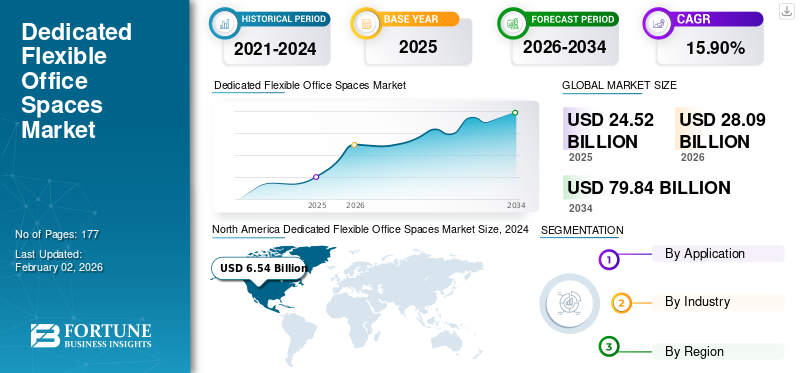
The global dedicated flexible office spaces market size was valued at USD 24.52 billion in 2025. The market is projected to grow from USD 28.09 billion in 2026 to USD 79.84 billion by 2034, exhibiting a CAGR of 15.90% during the forecast period. North America dominated the dedicated flexible office spaces market with a market share of 34.48% in 2024.
Dedicated desk spaces are private workstations provided to employees. Small, medium, and large businesses rent out dedicated spaces for coworking. The benefit of dedicated spaces is the work flexibility provided to employees, which increases the productivity of the team and avoids any distractions at the workplace. Hybrid working has revolutionized the market growth post-pandemic. Small and medium-scale businesses consider renting dedicated spaces as cost-effective compared to owning office space, which propels the demand for flexible offices. The growing demand for dedicated spaces by startups and SMEs is due to the changing work culture in offices and the increasing real estate prices in many countries. In addition, using dedicated spaces also increases team productivity, strengthening market expansion. For instance, according to the data published by the instant group’s annual report in 2022, in Melbourne, the occupancy rate of flexible offices reached around 70% in 2022, which showed an increase of 6% from 2021. On the other hand, in Sydney, the occupancy rates of flex were recorded as the highest, ~80%, in Australia in 2022.
Key market players in the market include WeWork Companies, Newmark, IWG, Industrious, and Desana. These players are emphasizing on adding new amenities and services, such as health and fitness clubs, private offices, cafeterias, conference rooms, and event spaces, which is assisting opeartors to attract new members and retain existing once.
Download Free sample to learn more about this report.
DEDICATED FLEXIBLE OFFICE SPACES MARKET KEY TAKEAWAYS
 Global Market Size & Forecast
- 2025 Market Size: USD 24.52 billion
- 2026 Market Size: USD 28.09 billion
- 2034 Forecast Market Size: USD 79.84 billion
- CAGR: 15.90% from 2026-2034
 Market Share
- North America dominated the dedicated flexible office spaces market with a market share of 34.48% in 2024.
- Large enterprises segment is projected to grow at the fastest CAGR.
- SMEs segment dominated the market, supported by rising hybrid work adoption.
 Key Regional Highlights
North America
North America dominated the dedicated flexible office spaces market with a value of USD 6.54 billion in 2024.
Europe
Europe emerged as the second-largest market, supported by increasing digitalization and commercial real estate development.
Asia Pacific
Asia Pacific held a considerable market share and is projected to grow at the highest CAGR during the forecast period.
U.S.
The U.S. market witnessed strong growth, driven by the expanding adoption of co-working and hybrid workspaces.
Japan
Japan is a key contributor to the Asia Pacific market, supported by the expansion of flexible workspace providers.
Read More

MARKET DYNAMICS
MARKET DRIVERS
Growing Construction of Commercial Spaces to Fuel Market Growth
The rising construction of commercial spaces significantly boosts the dedicated flexible office space market growth. As new buildings emerge, they offer modern infrastructure that is ideal for flexible workspace providers to establish operations. Businesses increasingly prefer flexible offices to reduce long-term lease commitments and adapt to changing workforce dynamics. These newly built commercial hubs often feature prime locations, advanced amenities, and sustainable designs, making them attractive for flexible workspace setups. Additionally, urban expansion and mixed-use developments create opportunities for integrating flexible offices close to residential and retail zones, enhancing work-life balance. This synergy between real estate development and changing workplace needs is driving demand for dedicated, flexible offices, making them a vital component of modern commercial ecosystems.
Download Free sample to learn more about this report.
MARKET RESTRAINTS
Heightened Risk of Theft or Unauthorized Use of Confidential Information Due to Shared Co-Working Space to Obstruct Market Expansion
Greater vulnerability to theft or misuse of sensitive information resulting from the shared environment of co-working spaces creates security and trust concerns among potential users, which restricts market growth. In a shared workspace, multiple individuals and organizations operate nearby, often without strict access controls or dedicated IT infrastructure. This increases the chances of data breaches, unauthorized access to files, or even physical theft of devices and files. For companies in sectors such as finance, legal, healthcare, or tech, where data security is paramount, these risks may outweigh the benefits of flexible office arrangements and hinder market growth.
MARKET OPPORTUNITIES
Inclination Toward Outsourcing Services to Offer Numerous Growth Opportunities
The inclination toward outsourcing services can increase the demand for the flexible office market. Companies that outsource certain functions, such as customer support, IT services, or HR, may need temporary workspaces for their outsourced teams. Flexible office spaces provide a convenient and adaptable solution for hosting these teams on a short-term basis, driving the demand of the overall market.
Companies that are outsourcing services may need to hold meetings, training sessions, or workshops with their outsourcing partners. Dedicated flexible office spaces offer well-equipped meeting rooms and collaborative areas, making them ideal venues for such activities. Moreover, outsourcing often involves partnering with service providers in different geographic regions. Therefore, businesses may require dedicated flexible office spaces in those regions to facilitate coordination, training, and collaboration with their outsourced teams. This can propel the demand for flexible offices near outsourcing hubs.
DEDICATED FLEXIBLE OFFICE SPACE MARKET TRENDS
Growing Shift Towards Remote and Hybrid Work Culture Combined with Digital Nomad Lifestyle
The widespread adoption of remote and hybrid work models, combined with the rise of the digital nomad lifestyle is a new trend among professionals and that enbales them to work from anywhere in the world which is fueling demand for flexible office spaces. Companies are downsizing traditional offices and favoring agile, short-term leases to accommodate a distributed workforce. Digital nomads seek professional, well-equipped environments, for productivity and networking, further driving growth. Flexible workspaces offer essential amenties, collaborative settings, and cost-effective solutions, making them attractive for both businesses and independent professionals. This convergence is transforming commercial real estate, positioning flexible office as a key pillar of the modern workplace.
Segmentation Analysis
By Application
Intensifying Hybrid Work Culture Assisted SMEs Segment Growth
Based on application, the market is segmented into large enterprises, SMEs, and startups/freelancers.
The SMEs (small and medium enterprises) segment held the highest dedicated flexible office spaces market share. SMEs contribute to economic development, employment, and technological innovation globally. The rise of a hybrid working culture post-pandemic has boosted the demand for flexible office spaces globally. Flexible office providers offer pay-as-you-go services to all businesses. Thus, the corporate landscape for SMEs as businesses is no longer chained to traditional office leases is boosting market growth.
The large enterprises segment is poised to grow at the fastest CAGR over the forecast period. With the changing trend in work culture, several large organizations such as Facebook, HSBC, IBM, and Microsoft have shifted to dedicated flexible office spaces to enhance team member efficiency post-pandemic. The interest of large enterprises adopting flexible office spaces compared to traditional ones is the flexibility that the companies can provide to their employees, along with high affordability. Co-working space operators provide a more affordable alternative for giant office campuses, leading the segment’s growth.
By Industry
Comfort, Durability, and Eco-Friendliness of IT/ITES Industry Boosted Segment Growth
Based on the industry, the market is segmented into IT/ITES, BFSI, retail & consumer, and others.
The IT/ITES segment contributed the highest market share in 2024. The industry is a major driver behind technological innovation as it is making communication easily accessible and faster globally. Some major IT companies, including Microsoft, IBM, Cognizant, Infosys, and Accenture, among others, started virtual offices and adopted a flexible office working culture post-pandemic for their team members' well-being. According to the figure, 20% of tech companies use on-demand spaces, and 40% of companies use flexible space on a monthly or annual basis. Moreover, various IT companies have moved toward hybrid working by using new tools and technologies to make virtual meetings easier and cater to employees' demand for more flexible working models.
The BFSI industry is gaining traction and is anticipated to expand at the fastest CAGR over the coming years. The companies operating in the BFSI sector, such as BNY Mellon, HSBC, Citigroup, and others, opt for a hybrid work culture for their employees, especially post-pandemic. Citigroup has 65,000 employees in its U.S. office for two days a week, and they follow a “work-from-anywhere” policy for employees in certain roles and locations. Furthermore, according to a report by Build Remote, a U.S.-based company, 77% of fortune 100 companies have opted for a hybrid or work-from-anywhere working model for lower capital expenditure in traditional office spaces, which is boosting market growth.
Dedicated Flexible Office Spaces Market Regional Outlook
By geography, the market is categorized into North America, Europe, Asia Pacific, South America, and the Middle East & Africa.
North America
North America Dedicated Flexible Office Spaces Market Size, 2024 (USD Billion)
To get more information on the regional analysis of this market, Download Free sample
North America dominated the global market in 2024. The rise in the necessity for work flexibility by employees in the region, combined with the increasing number of on-demand flexible office spaces that provide different office spaces for co-working to hybrid models at economical prices, has contributed to the exponential growth in the flexible office market. For instance, in June 2023, International Workspace Group (IWG), a Switzerland-based company, opened its new co-working site in Hamburg, New York, due to the increased demand for flexible workspaces in the country.
The flexible office market growth has been dynamic in the U.S., especially in New York, California, and Texas, due to an increase in the number of flexible space operators. The growing trend of co-working and hybrid working culture in small, medium, and large enterprises in the U.S. boosts the market growth. According to a report by Co-working insights, in 2021, the U.S. had the highest number of co-working spaces globally.
Europe
Europe is the second-largest market for dedicated office workspaces. A rapid growth in digitization and a rise in the commercial real estate market are significant factors boosting market growth in Europe. Various flex space providers invest in integrated technological solution platforms for businesses that provide effective management of space for employees, which is a significant factor propelling market growth. For instance, in March 2022, Instant Works, a London-based flexible workspace provider, announced its merger with key digital assets from International Workplace Group (IWG), including EasyOffices.com, Meetingo.com, and Worka. This platform will enable Instant Works to consolidate more than 25,000 workspaces and provide a range of services, including office bookings, consulting, and on-demand offices.
Asia Pacific
Asia Pacific accounted for a considerable market share and is projected to grow at the highest CAGR during the assessment period. The region is one of the largest flexible workspace markets due to a growing working population in Asian countries. Moreover, the rising number of flexible workspace providers in Asian countries, including India, China, Japan, Australia, Singapore, and others, owing to the growth in the real estate industry, amplifies market growth. Further, the increasing number of freelancers and startups drives the demand for all-access flexible co-working spaces. An article published by the Times of India cited that the number of recognized startups in India rose from just 471 in 2016 to 72,993 in 2022, which amplified the industry expansion.
South America and Middle East & Africa
The markets in South America and the Middle East & Africa are projected to experience notable growth owing to the rise in the number of working professional population in South American countries such as Brazil and Argentina, and the availability of remote and hybrid work culture in companies. According to a report by the Instant Group, a U.K.-based real estate company, the five largest flexible office spaces in Latin America are in Brazil, Chile, Colombia, Mexico, and Peru. Furthermore, the rise in startups, entrepreneurship, and the growing number of small and medium enterprises in the region will likely strengthen market growth.
COMPETITIVE LANDSCAPE
Key Industry Players
Workspace Designs & Amenities Integrated with Technology by Market Players to Stay Competitive in Market
The global market is expanding as the competition among players is growing fierce. Companies are differentiating themselves through strategic targeting, premium locations, and value-added services, along with technology-integrated, well-designed, and equipped spaces. Few of the players are focusing on niche segments, such as startups, creatives, or large enterprises, tailoring offerings to specific needs. Prime locations in business hubs enhance appeal, while modern, well-designed offices with amenities, including wellness centers, cafes, and ergonomic workstations, improve user experience.
Furthermore, some key players are tapping into the opportunities as urban expansion and mixed-use developments create growth prospects for integrating dedicated flexible office spaces close to residential and retail zones, enhancing work-lif e balance. This synergy between real estate development and changing workplace needs is amplifying growth potential for key competitors and driving market growth.
LIST OF KEY DEDICATED FLEXIBLE OFFICE SPACES COMPANIES PROFILED
- Industrious (U.S.)
- Newmark (England)
- IWG (Switzerland)
- WeWork Companies LLC (U.S.)
- Desana (Scotland)
- LiquidSpace (U.S.)
- Flex by JLL (U.S.)
- SmartWorks (India)
- ServCorp (Australia)
- Hubble (England)
KEY INDUSTRY DEVELOPMENTS
- January 2025: Bootstart, provider of tailored co-working spaces & office solutions, has generated USD 1.75 million in fundraising in 2024, aimed at establishing new centers in Pune, Mumbai, Bengaluru, and Nagpur, upgrading current facilities, investing in technology and systems, and increasing spending on marketing to improve brand visibility.
- January 2025: CBRE Group, a commercial real estate services and investments company, acquired the remaining 60% stake in Industrious National Management Company, a flexible workspace provider, for USD 400 million. This acquisition is part of CBRE’s strategy to strengthen its position in the flexible space industry and better serve the changing demands of the office real estate.
- January 2025: A real estate technology provider, Yardi, announced the acquisition of Hubble (U.K.) and Deskpass (U.S.) to fulfill the rising and diverse needs of workspace users. These acquisitions highlight Yardi’s commitment to aligning commercial buildings with the increasingly agile needs of office users.
- May 2024: THE BOARDROOM, a Mumbai-based co-working company, revealed its expansion in Pune, where it acquired 36,000 sq ft of office space, adding around 800 seats. The Pride Gateway & SBC (Sadanand Business Center) offices offer a plethora of modern amenities, an inspiring environment that fosters creativity and productivity, and collaborative workspaces, creating an exciting new work experience.
- October 2023: The Instant Group, a global marketplace for flexible workspace, expanded its footprint in the Asia Pacific region with the opening of a new office in Bangalore, India. On the back of strong demand from clients and partners, the company is planning to extend the breadth of flexible products and services, including increasing lead generation for the flexible offices in prime Indian city markets and provision of managed office services to enterprise clients.
Request for Customization to gain extensive market insights.
Report Scope & Segmentation
|
ATTRIBUTE |
DETAILS |
|
Study Period |
2021-2034 |
|
Base Year |
2025 |
|
Estimated Year |
2026 |
|
Forecast Period |
2026-2034 |
|
Historical Period |
2021-2024 |
|
Growth Rate |
CAGR of 15.90% from 2026-2034 |
|
Unit |
Value (USD Billion) |
|
Segmentation |
By Industry
|
|
By Region
|
Frequently Asked Questions
Fortune Business Insights says that the global market value stood at USD 28.09 billion in 2026 and is projected to reach USD 79.84 billion by 2034.
In 2025, the market value stood at USD 24.52 billion.
The dedicated flexible office spaces market is expected to grow at a CAGR of 15.90% during the assessment period.
The small-medium enterprises (SMEs) segment led the market by application.
The growing popularity of small businesses and freelancers, and expanding commercial real estate, drive the growth of the dedicated flexible office spaces market.
International Workspace Group (IWG), WeWork, Industrious Office, Flex by JLL, and ServoCorp are the top players in the market.
North America dominated the market in 2024.
Emerging trends such as hotel-style co-working space, technology-enabled workstations, a new era of remote working, and more landlords entering the co-working space are expected to uplift service demand and favor increased adoption.



- 2021-2034
- 2025
- 2021-2024
- 177
-
(Offer valid till 15th Oct 2026)
Get 30-60 hrs Free Customization
Expand Regional and Country Coverage, Segments Analysis, Company Profiles, Competitive Benchmarking, and End-user Insights.



















Related Reports
-
US +1 833 909 2966 ( Toll Free )
-
Get In Touch With Us