DEXA Equipment Market Size, Share & Industry Analysis, By Product Type (Central DEXA Systems and Peripheral DEXA Systems), By Portability (Standalone and Portable), By Application (Osteoporosis & Osteopenia Diagnosis, Body Composition Analysis, Fracture Risk Assessment, Pediatric Bone Density Assessment, and Others), By End-user (Hospitals, Diagnostic Imaging Centers, Academic & Research Institutes, and Others), and Regional Forecast, 2026-2034
 Download Free Sample
DEXA Equipment Market Size and Future Outlook
 Listen to Audio Version
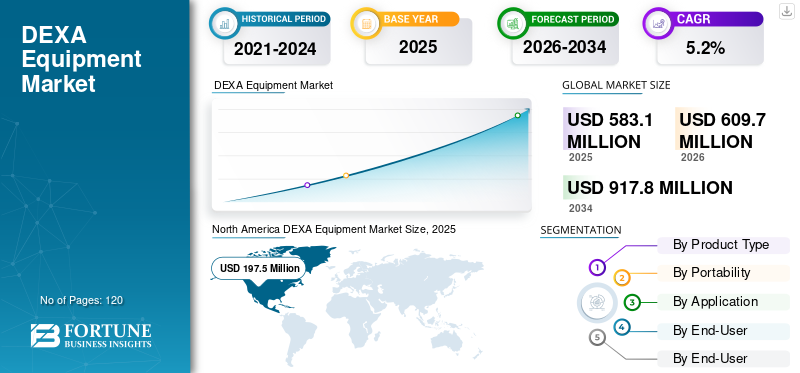
The global DEXA equipment market size was valued at USD 583.1 million in 2025. The market is projected to grow from USD 609.7 million in 2026 to USD 917.8 million by 2034, exhibiting a CAGR of 5.2% during the forecast period. North America dominated the DEXA equipment market with a market share of 33.87% in 2025.
DEXA equipment is used to measure bone mineral density and helps doctors assess bone health and fracture risk. It is the most commonly used to diagnose osteoporosis and osteopenia and can also support body composition checks in some settings. The market growth is attributed to the surging prevalence of bone-health problems, aging populations, and longer life expectancy. Moreover, rising awareness about bone health amongst post-menopausal women and older men is also projected to have a positive impact on market growth. Furthermore, increasing emphasis on preventive testing and chronic disease management is also estimated to accelerate market growth.
- For instance, in October 2024, Pharmed Limited announced the launch of India Bone Health initiative on World Osteoporosis Day. The new initiative is launched with an aim to deal with the growing bone health issues and concern of osteoporosis across India.
Furthermore, many pivotal industry players, such as Hologic, Inc., GE HealthCare Technologies Inc., FUJIFILM Holdings Corporation, and Diagnostic Medical Systems Group (DMS Imaging), are focusing on the development of numerous innovative technologies to offer better products with enhanced efficiency and accuracy.
Download Free sample to learn more about this report.
DEXA EQUIPMENT MARKET KEY TAKEAWAYS
 Market Size & Forecast
- 2025 Market Size: USD 583.1 million
- 2026 Market Size: USD 609.7 million
- 2034 Forecast Market Size: USD 917.8 million
- CAGR: 5.20% from 2026–2034
 Market Share
- North America dominated the DEXA equipment market with a market share of 33.87% in 2025.
- The peripheral DEXA systems segment is anticipated to rise at a CAGR of 6.8% over the forecast period.
- The portable DEXA systems segment is anticipated to rise with a CAGR of 6.1% over the forecast period.
 Key Regional Highlights
North America
North America held the dominant share in 2024, valuing at USD 189.5 million, and also maintained the leading share in 2025, with USD 197.5 million.
Europe
Europe is projected to record a growth rate of 4.7% over the forecast period, and reach a valuation of USD 176.8 million by 2026.
Asia Pacific
The Asia Pacific market is estimated to reach USD 151.0 million in 2026 and secure the position of the third-largest region in the market.
U.S.
The U.S. market can be analytically approximated at around USD 175.7 million in 2026, accounting for roughly 28.8% of global sales.
Japan
The Japan market is estimated to reach around USD 26.2 million in 2026, accounting for roughly 4.3% of global revenues.
Read More

DEXA EQUIPMENT MARKET TRENDS
More Focus on Preventive Bone Health Checks is one of the Important Trends
The market is witnessing a rising emphasis on preventive care with an aim to avoid health issues in the future. Due to this trend, DEXA testing is gradually shifting to preventive bone health checkups. People want preventive health services and physicians want simple ways to identify risk before fractures occur. In addition, hospitals and imaging networks are also promoting bone health as part of broader preventive screening programs. This trend supports the steady demand for DEXA equipment as it is a recognized method for bone density testing and long-term monitoring.
- For instance, in January 2026, DexaFit Scottsdale announced the launch of its new DEXA scan service for people in Scottsdale and nearby communities. The step was taken to provide the expanded access of health assessments as a part of preventive healthcare program.
MARKET DYNAMICS
MARKET DRIVERS
Download Free sample to learn more about this report.
Rising Screening for Bone Health to Accelerate Market Growth
The soaring screening for bone health is prominently driving the global DEXA equipment market growth. More people are getting screened for bone weakness before fractures happen. In addition, healthcare professionals are increasingly recommending bone density checks for older adults and people at higher risk, as early diagnosis helps prevent serious fractures and long recovery times. Moreover, hospitals and diagnostic centers adopt DEXA equipment to support routine testing, follow-up monitoring, and treatment decisions. Awareness campaigns and routine preventive care are also pushing more patients toward bone density testing.
- For instance, in September 2023, the collaboration of Fujitsu Limited and iSurgery Co., Ltd. announced the launch of new bone health program in Japan. The aim behind this program is to detect risk of osteoporosis and other bone anomalies.
MARKET RESTRAINTS
Limited Access in Smaller Facilities to Deter Market Growth
DEXA systems are not available everywhere. Many smaller clinics and low-resource hospitals may not purchase DEXA equipment due to budget limits, space constraints, or lower patient volumes. Some facilities depend on referrals to larger centers, which can delay diagnosis and reduce screening rates. In addition, trained staff and regular maintenance are needed to run imaging equipment smoothly. These factors can slow adoption, particularly in regions where healthcare spending and diagnostic infrastructure are still developing.
MARKET OPPORTUNITIES
Adding Bone Quality Insights to Standard DXA to Offer Lucrative Growth Opportunities
Technological advancements and integration of new innovations in standard DXA systems for in-detailed analysis is estimated to offer lucrative opportunities for market growth. Beyond bone density, providers increasingly want clearer insight into overall fracture risk. In addition, software add-ons that analyze DXA data and produce more detailed bone health reports can help clinics improve decision-making without changing the scanning workflow. This creates an opportunity for device makers and software partners to offer integrated solutions that fit into normal patient pathways.
- For instance, in August 2025, NeuroSpine Center of Wisconsin announced the launch of state-of-the-art DXA scanner with TBS technology. The new system offers advanced bone density and body composition analysis for long-term wellness.
MARKET CHALLENGES
Patient Follow-Up and Repeat Testing Gaps to Pose a Critical Challenge to Market Growth
A major challenge is ensuring follow-up after the first scan. Many patients do not return for repeat testing, especially if they feel fine or do not understand the importance of monitoring. In addition, missed follow-ups reduce the clinical value of screening programs and can limit equipment utilization. Hospitals and imaging centers must educate patients, coordinate referrals, and maintain reminder systems.
Segmentation Analysis
By Product Type
Higher Emphasis on Osteoporosis Detection to Boost Central DEXA Systems Segment Growth
Based on product type, the market is divided into central DEXA systems and peripheral DEXA systems.
The central DEXA systems segment is anticipated to account for the largest DEXA equipment market share. The high segment growth is attributed to the rising emphasis on osteoporosis detection, focus on long-term monitoring, and technological advancements. In addition, hospitals and large diagnostic centers prefer them as they support higher patient throughput and standard reporting. Moreover, central systems also fit common clinical pathways. Hence, physicians are familiar with the results and how to interpret them.
The peripheral DEXA systems segment is anticipated to rise at a CAGR of 6.8% over the forecast period.
To know how our report can help streamline your business, Speak to Analyst
By Portability
Rising Preference for Fixed Installations to Accelerate Standalone Systems Segment Growth
Based on portability, the market is segmented into standalone and portable.
In 2025, the standalone segment dominated the global market. Standalone systems lead as hospitals and diagnostic centers prefer stable, fixed installations that are easy to operate daily. A standalone setup typically supports consistent workflows, standard positioning, and repeatable results, important for monitoring patients over time. Moreover, the introduction of new products is also projected to augment segment growth during the forecast period.
- For instance, in August 2025, Aurora Spine Corporation announced launch of its new DEXA-L system. The new standalone device is developed to analyze bone density matched implants.
The portable DEXA systems segment is anticipated to rise with a CAGR of 6.1% over the forecast period.
By Application
Osteoporosis & Osteopenia Diagnosis Segment Led the Market Owing to High Emphasis on Disease Detection
Based on application, the market is segmented into osteoporosis & osteopenia diagnosis, body composition analysis, fracture risk assessment, pediatric bone density assessment, and others.
In 2025, the osteoporosis & osteopenia diagnosis segment dominated the global market. The market is witnessing higher emphasis on detection of osteoporosis and osteopenia. Moreover, there is a considerable prevalence of these conditions amongst older adults, leading to higher number of DEXA adoption. In addition, the DEXA systems are also widely used to identify low bone density early and to track treatment progress over time. These factors are likely to have positive impact on the segment growth.
The body composition analysis segment is anticipated to rise with a CAGR of 6.3% over the forecast period.
By End-User
Higher Number of Scans in the Hospitals to Accelerate Segment Growth
Based on end-user, the market is segmented into hospitals, diagnostic imaging centers, academic & research institutes, and others.
In 2025, the hospitals segment held highest market share. Hospitals hold a high market share as they manage large patient volumes, provide specialist care, and run structured screening and follow-up programs. In addition, hospitals are equipped to handle fracture cases, orthopedic care, and chronic disease patients who need bone health monitoring. Moreover, hospitals are more likely to invest in imaging rooms, trained staff, and service contracts, which supports smooth equipment operation. Since many referrals originate in hospital systems and many tests are performed in hospital-linked imaging units, hospitals remain the largest end-user segment in the market. Furthermore, the segment is set to hold 48.3% share in 2026.
In addition, the diagnostic imaging centers segment is projected to grow at a CAGR of 5.8% during the study period.
DEXA Equipment Market Regional Outlook
By geography, the market is categorized into Europe, North America, Asia Pacific, Latin America, and the Middle East & Africa.
North America
North America DEXA Equipment Market Size, 2025 (USD Million)
To get more information on the regional analysis of this market, Download Free sample
North America held the dominant share in 2024, valuing at USD 189.5 million, and also maintained the leading share in 2025, with USD 197.5 million. The regional market is expected to increase due to higher prevalence of osteoporosis and technological advancements in DEXA systems.
U.S. DEXA Equipment Market
Based on North America’s strong contribution and the U.S. dominance within the region, the U.S. market can be analytically approximated at around USD 175.7 million in 2026, accounting for roughly 28.8% of global sales.
Europe
Europe is projected to record a growth rate of 4.7% over the forecast period, and reach a valuation of USD 176.8 million by 2026. The region is estimated to witness considerable market growth due to increasing number of product launches and rising emphasis on preventive care.
U.K. DEXA Equipment Market
The U.K. market is estimated to hit around USD 28.7 million in 2026, representing roughly 4.7% of global revenues.
Germany DEXA Equipment Market
The Germany market is projected to reach approximately USD 39.7 million in 2026, equivalent to around 6.5% of global sales.
Asia Pacific
The Asia Pacific market is estimated to reach USD 151.0 million in 2026 and secure the position of the third-largest region in the market. The market growth is attributed to the rising awareness about DEXA technology and strategic developments by market players.
Japan DEXA Equipment Market
The Japan market is estimated to reach around USD 26.2 million in 2026, accounting for roughly 4.3% of global revenues.
China DEXA Equipment Market
China’s market is projected to be one of the largest worldwide, with 2026 revenues estimated at around USD 50.1 million, representing roughly 8.2% of global sales.
India DEXA Equipment Market
In 2026, the India market is estimated to touch around USD 33.5 million, accounting for roughly 5.5% of global revenues.
Latin America and Middle East & Africa
The Latin America and Middle East & Africa regions are expected to witness moderate growth in this market during the forecast period. The Latin America market is set to reach a valuation of USD 44.7 million in 2026. In the Middle East & Africa, the GCC is set to reach a value of USD 11.6 million in 2026.
South Africa DEXA Equipment Market
The South Africa market is projected to reach around USD 4.8 million in 2026, representing roughly 0.78% of global revenues.
COMPETITIVE LANDSCAPE
Key Industry Players
Technological Advancements and Rising Number of Collaborations by Key Players to Boost Market Progress
The global DEXA equipment market holds a semi-consolidated market structure, constituting prominent players such as Hologic, Inc., GE HealthCare Technologies Inc., FUJIFILM Holdings Corporation, and Diagnostic Medical Systems Group (DMS Imaging). The significant global market share of these companies is due to numerous strategic activities, including technological advancements and distribution collaborations.
- For instance, in February 2024, FUJIFILM India announced the installation of its powerful FDX Visionary-DR, a DEXA system at Center for Sports Injury in Delhi, India.
Other significant players in the global market comprise Swissray International, Inc., OsteoSys Co., Ltd., Scanflex Healthcare AB, Medonica Co. LTD, and BeamMed Ltd. These participants are anticipated to prioritize partnerships to enhance their global market share over the analysis period.
LIST OF KEY DEXA EQUIPMENT COMPANIES PROFILED
- Hologic, Inc. (U.S.)
- GE HealthCare Technologies Inc. (U.S.)
- FUJIFILM Holdings Corporation (Japan)
- Diagnostic Medical Systems Group (DMS Imaging) (France)
- Swissray International, Inc. (Taiwan)
- OsteoSys Co., Ltd. (South Korea)
- Scanflex Healthcare AB (Sweden)
- Medonica Co. LTD (South Korea)
- BeamMed Ltd. (Israel)
- Shenzhen XRAY Electric Co., Ltd. (China)
- Ningbo Xingaoyi Magnetism Co., Ltd. (China)
KEY INDUSTRY DEVELOPMENTS
- July 2025: Medimaps Group S.A. signed a strategic collaboration with National Spine Health Foundation to provide analysis about TBS, for assessing bone fragility.
- May 2025: SimonMed announced the launch of its new DEXA + TBS system, a next-gen bone health screening that combines bone density and bone quality analysis.
- February 2025: HeartLung Technologies and SimonMed Imaging entered into a strategic collaboration for the development of advanced DEX equipment for detection of osteopenia.
- August 2024: OSTEOSYS CO., LTD, received EU approval for its DXA system. The step will help the company to expand its presence in Europe market.
- December 2021: Active Life Scientific Inc. received FDA approval for its new system for measuring bone and bone tissue health.
REPORT COVERAGE
The global DEXA equipment market analysis includes a comprehensive study of the market size & forecast by all the market segments included in the report. It includes details on the market dynamics and market trends expected to drive the market over the forecast period. It provides information on key aspects, including an overview of technological advancements, the regulatory environment, and product launches. Additionally, it details partnerships, mergers & acquisitions, as well as key industry developments and investments by key regions. The global market research report also provides a depth competitive landscape with information on the market share and profiles of key operating players.
Request for Customization to gain extensive market insights.
Report Scope & Segmentation
| ATTRIBUTE | DETAILS |
| Study Period | 2021-2034 |
| Base Year | 2025 |
| Estimated Year | 2026 |
| Forecast Period | 2026-2034 |
| Historical Period | 2021-2024 |
| Growth Rate | CAGR of 5.2% from 2026-2034 |
| Unit | Value (USD Million) |
| Segmentation | By Product Type, Portability, Application, End-User, and Region |
| By Product Type |
|
| By Portability |
|
| By Application |
|
| By End-User |
|
| By Region |
|
Frequently Asked Questions
According to Fortune Business Insights, the global market value stood at USD 583.1 million in 2025 and is projected to reach USD 917.8 million by 2034.
In 2025, North Americas market value stood at USD 197.5 million.
The market is expected to exhibit a CAGR of 5.2% during the forecast period of 2026-2034.
By product type, the central DEXA systems segment is expected to lead the market.
The rising prevalence of bone disorders and aging population are key factors driving market expansion.
Hologic, Inc., GE HealthCare Technologies Inc., FUJIFILM Holdings Corporation, and Diagnostic Medical Systems Group (DMS Imaging) are the major players in the global market.
North America dominated the market in 2025.



- 2021-2034
- 2025
- 2021-2024
- 120
Get 30-60 hrs Free Customization
Expand Regional and Country Coverage, Segments Analysis, Company Profiles, Competitive Benchmarking, and End-user Insights.













.webp)






Related Reports
-
US +1 833 909 2966 ( Toll Free )
-
Get In Touch With Us