Digital Camera Battery Market Size, Share & Industry Analysis, By Type (Primary Battery, Secondary Battery), By Battery Chemistry (Lithium-ion, Nickel Metal Hydride, Others), By Camera Type (Interchangeable Lens Camera, Built-in Lens Camera), and Regional Forecast, 2026-2034
 Download Free Sample
KEY MARKET INSIGHTS
 Listen to Audio Version
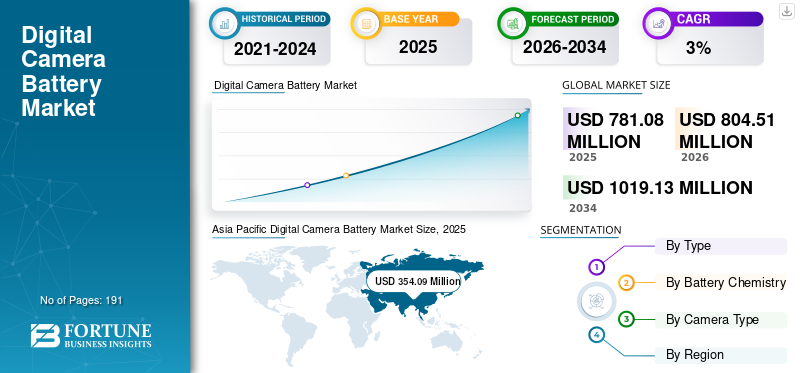
The global digital camera battery market size was valued at USD 781.08 million in 2025 and is projected to grow from USD 804.51 million in 2026 to USD 1019.13 million by 2034, exhibiting a CAGR of 3.0% during the forecast period. Asia Pacific dominated the global market with a share of 45.33% in 2025. The digital camera battery market in the U.S. is projected to grow significantly driven by the rising demand for pocket and SLR cameras in the professionals and quality seeker.
The global COVID-19 pandemic has been unprecedented and staggering, with digital camera battery experiencing lower-than-anticipated demand across all regions compared to the pre-pandemic levels. Based on our analysis, the global digital camera battery market exhibited a steep decline of -8.0% in 2020 as compared to 2019.
Digital camera battery powers digital cameras such as DSLRs, compact, mirrorless cameras, and others. Digital cameras generally use rechargeable lithium-ion batteries. However, other chemistries such as nickel metal hydride, nickel cadmium, zinc-carbon, alkaline, primary lithium, and nickel-zinc are also used widely to power digital cameras. Many digital camera manufacturers produce batteries that are equipped to power their specific products.
Download Free sample to learn more about this report.
Digital Camera Battery Market KEY TAKEAWAYS
 Market Size & Forecast
- 2025 Market Size: USD 781.08 Million
- 2026 Market Size: USD 804.51 Million
- 2034 Forecast Market Size: USD 1,019.13 Million
- CAGR: 3.0% from 2026–2034
 Market Share
- Asia Pacific dominated the digital camera battery market with a 45.33% share in 2025.
- The lithium-ion segment dominated the market.
- The interchangeable lens camera segment accounted for the largest market share.
 Key Regional Highlights
Asia Pacific
Dominated the market due to rapid urbanization, high internet penetration, and increasing digital camera adoption.
Europe
Growth is supported by battery regulations, sustainability initiatives, and demand for cleaner battery technologies.
North America
Growth is driven by high internet penetration, increasing demand for digital cameras, and strong consumer adoption.
U.S.
The digital camera battery market is projected to reach USD 197.13 million by 2032.
Japan
The market is supported by strong camera manufacturing and growing demand for rechargeable lithium-ion batteries.
Read More

Digital Camera Battery Market Trends
Increased Product Adoption in Digital Cameras due to Low Battery Prices
Various battery types, such as lithium-ion batteries, nickel metal hydride batteries, nickel cadmium batteries, alkaline batteries, zinc carbon batteries, and others, power digital cameras.
Over the years, there has been a significant decline in the prices of lithium-ion batteries. This has led to an increase in lithium-ion battery usage. The rechargeable nature of these batteries, along with their lower weight-power ratio, has propelled their adoption in the market.
Nickel metal hydride batteries are comparatively cheaper than lithium-ion batteries, enhancing their adoption for consumers with lower budgets. According to Epec, LLC, Ni-MH batteries cost less than 50% of a lithium-ion battery for the final battery pack's production price. The Ni-MH batteries cost less than 75% of a lithium-ion battery in the R&D cost. Similarly, the low battery prices of alkaline batteries are a significant driver for their adoption in digital cameras. Alkaline batteries are very economical use-and-throw batteries.
The low prices of various battery chemistries and the reduced costs of lithium-ion batteries are anticipated to surge the demand for digital camera battery in the forecast period.
Download Free sample to learn more about this report.
DRIVING FACTORS
Increasing Demand for Low-weight Cameras to Enhance Digital Camera Battery Market Growth
The growing use of high-speed cameras in the entertainment & media and sports industries is the key factor driving the demand for digital cameras. Action photography has enhanced the demand for low-weight digital cameras. The increasing usage of social media platforms, such as Instagram, has developed the scope for photography among many users across the globe, many of whom take images using professional digital cameras to be uploaded to the app instead of just taking pictures through their phones.
Generally, low-weight cameras are preferred for easy capturing of photographs. The growing technological advancements in developing low-weight batteries are anticipated to drive their adoption in digital cameras.
According to the Office of Energy Efficiency & Renewable Energy, U.S., cobalt can account for almost 20% of the weight of the cathode in lithium-ion batteries. Recognizing copper's weak supply chain and weight constraints, industry players are exerting R&D efforts and investments to develop lithium-ion batteries with low or no copper content. These efforts are anticipated to enhance lithium-ion battery adoption in the digital camera industry.
In August 2021, Elinchrom introduced a portable, battery-powered off-camera flash called Elinchrom ONE. The low weight of this product can be attributed to its internal Li-ion rechargeable battery that has the ability of 725 full-power flashes on a single charge.
Increasing Consumer Conscience to Boost Adoption of Rechargeable Batteries
The demand for the rechargeable secondary batteries is predominantly driven by a shift in consumer inclination toward secondary batteries due to their greater energy efficiency, reduced waste production, and rechargeability using simple chargers.
Moreover, enhanced R&D activities in material sciences have enabled manufacturers to improve the performance of lithium-ion batteries, enhancing their demand. The trend of battery technological development has been uneven, ranging from periods of stagnation to significant breakthroughs. The inception of the idea of a battery-charged (wireless) device is indeed as old as the computer and cable tools themselves. The shift from heavy acid batteries to compact, light, and significantly more efficient nickel/metal (NiMH) batteries has been persistent. The introduction of lithium-ion technology was one of the key advancements.
In May 2020, Fujifilm launched India's FUJIFILM X-T4 mirrorless digital camera. This camera runs on a large-capacity rechargeable lithium-ion battery called the NP-W235. The NP-W235 battery has a high capacity of approximately 1.5 times that of an NP-W126S battery, one of the superior quality batteries launched in the past. The NP-W235 battery lasts for around 500 frames per charge in the normal mode and almost 600 frames per charge in the economy mode.
Hence, the growing traction toward rechargeable batteries is an important trend in the global market.
RESTRAINING FACTOR
Industry Growth Affected on Account of Declining Digital Camera Sales
Global digital camera shipments have been declining sales since the last decade. Major digital camera companies have recorded a decline in fluctuating sales in the past few years. According to the Camera & Imaging Products Association, the global sales of digital cameras dropped by 93% in 2021 compared to 2011.
This decline can be majorly attributed to the enhancement of the quality of cameras in smartphones. Smartphone cameras are being equipped with various features such as the usage of AI and computational photography. However, they have lower quality when compared to DSLRs and cannot directly substitute them. The growth of smartphone camera capabilities is anticipated to adversely affect the adoption of compact digital cameras.
With reduced adoption of digital cameras, there has been a massive drop in the production of these cameras, leading to an even greater reduction in digital camera battery demand.
The reduction of digital camera adoption is anticipated to hinder the demand for digital camera battery.
SEGMENTATION ANALYSIS
By Type Analysis
To know how our report can help streamline your business, Speak to Analyst
Secondary Battery Segment to Hold Significant Share Owing to High Adoption
Based on type, the global market is segmented into secondary battery and primary battery. The secondary battery segment is dominant in the market as most digital cameras use rechargeable lithium-ion batteries from manufacturers.
The primary battery segment is slowly diminishing owing to enhanced consumer conscience in the market. The lack of recycling initiatives for disposable batteries also adversely affects the segmental market.
By Battery Chemistry Analysis
Lithium-ion Battery Segment to Dominate the Market Due to Reducing Cost
Based on battery chemistry, the global market is segmented into lithium-ion, nickel-metal-hydride, and others.
The lithium-ion segment is dominant in the market as most digital camera manufacturers make cameras that use lithium-ion batteries. Their rechargeable nature further propels segmental growth.
Ni-MH batteries are rechargeable and are found in cellphones, cordless power tools, digital cameras, and two-way radios. The U.S. Environmental Protection Agency has set up regulations for the safe disposal of these batteries due to the harmful effects in case of improper disposal techniques.
By Camera Type Analysis
Interchangeable Lens Camera Segment to Proliferate Due to Rising Utilization in High-Resolution Photography
By camera type, the global market is segmented into interchangeable lens camera and built-in lens camera. The interchangeable lens camera segment is expected to account for a higher market share as, presently, most digital cameras are powered by rechargeable batteries. OEMs or digital camera manufacturers generally provide these batteries with the camera purchase. According to the Camera & Imaging Products Association, globally, 5,330,282 cameras with interchangeable lenses were produced in 2021, of which 2,216,698 were single lens reflex cameras, and 3,113,584 were mirrorless cameras.
The built-in lens camera segment is expected to grow slowly in the forecast period owing to the lesser adoption of these cameras due to the use of smartphones. According to the Camera & Imaging Products Association, 3,006,491 cameras with built-in lenses will be produced globally in 2021.
REGIONAL ANALYSIS
North America
Asia Pacific Digital Camera Battery Market Size, 2025 (USD Million)
To get more information on the regional analysis of this market, Download Free sample
The market has been fragmented into five major regions, including North America, Latin America, Asia Pacific, Europe, and the Middle East & Africa. The Asia Pacific dominated the market in 2021 and is anticipated to be a market leader in the forecast period. Asia Pacific is one of the fastest developing regions in the world due to rapid urbanization and industrialization. The growing urbanization and high internet penetration rate surge the demand for digital cameras for social media use in Asia Pacific. According to Internet World Stats, as of January 31st, 2021, the Asian subcontinent has more than 50% of the world's internet users. Furthermore, the Oceania/Australia region has 70.1% internet penetration rate among the population, which has grown more than 300% from 2000 to 2022.
Europe
Europe has been at the forefront of cleaner fuel usage to reduce carbon emissions and toxic waste to enhance pollution control. This has led the region to develop various laws to restrict the use of toxic chemicals in batteries. In June 2022, it was announced that the European Commission is considering categorizing lithium as toxic. This might obstruct the EU's aims to produce a local battery constituents’ supply chain.
North America
According to the Digital 2022 Overview Report, published by Hootsuite and We Are Social, the number of internet users as a percentage of North America’s total population was 92%, with the U.S. having 92% and Canada around 96.5%, as of January 2022. Additionally, the U.S. Digital Camera Battery Market is predicted to grow significantly, reaching an estimated value of USD 197.13 million by 2032.
Rest of The World
The Latin America market is expected to grow with a healthy CAGR during the forecast period. The main drivers driving the market are the region's improved economic conditions and falling lithium-ion battery prices. According to the Digital 2022 Overview Report, published by Hootsuite and We Are Social, Central America, Southern America, and the Caribbean, respectively, have 73%, 79%, and 55% active social media users as a percentage of the total population in the regions.
The Middle East & Africa market is anticipated to progress moderately during the forecast timeframe. The market in the Middle East & Africa is being propelled by decreasing lithium-ion battery prices and rising sales of portable electronic devices and digital cameras in the region.
KEY INDUSTRY PLAYERS
Canon Inc. and Sony Electronics Ltd. to Dominate the Industry Landscape
The current digital camera battery market is dominated by many companies providing a wide range of digital camera batteries at local and global levels across the value chain. Numerous companies are actively operating across different regions to cater to the customers' specific demands. However, major digital camera manufacturers also produce batteries for their particular cameras. Consumers have a high adoption of these batteries owing to their compatibility with the cameras. The key digital camera battery companies operating in the global market are Canon Inc., Duracell Inc., Nikon Corporation, Panasonic Corporation, Sony Electronics Inc., Samsung, Energizer, Fujifilm, RICOH Imaging Company Ltd., Olympus Corporation, and others.
LIST OF KEY COMPANIES PROFILED:
- Canon Inc. (Japan)
- Duracell Inc. (U.S.)
- Nikon Corporation (Japan)
- Panasonic Corporation (Japan)
- Sony Electronics Inc. (Japan)
- Samsung (South Korea)
- Energizer Holdings Inc. (U.S.)
- Fujifilm (Japan)
- RICOH Imaging Company Ltd. (Japan)
- OM Digital Solutions Corporation (Japan)
KEY INDUSTRY DEVELOPMENTS:
- July 2022 – RICOH IMAGING COMPANY, LTD. announced the unveiling of the stand-alone model of the RICOH GR IIIx Urban Edition. The product was earlier available under the RICOH GR IIIx Urban Edition Special Limited Kit.
- April 2022 – Ricoh and Ricoh Imaging announced that Ricoh won the iF DESIGN AWARD 2022 for the RICOH GR IIIx, a digital camera by the company, in the “Product” category.
- May 2022 – RICOH IMAGING COMPANY, LTD. announced the RICOH WG-80 digital compact camera launch. The camera is powered by a Rechargeable D-LI92 lithium-ion battery, with approximately 300 shots battery life for still applications, and approx. 260 min battery life for playback applications.
- November 2021 – Fujifilm launched the mirrorless digital camera, FUJIFILM X-T30 II. The device provides premium image quality while being lightweight and compact. It utilizes the NP-W126S Li-ion battery.
- December 2021 – Samsung SDI announced that it launched its battery brand PRiMX. Samsung SDI is to promote the super-gap technology strategy by launching a brand that conveys the company’s identity.
REPORT COVERAGE
The global digital camera battery market research report gives an in-depth assessment of the global market and offers valuable insights, facts, industry-related information, and historical data. Several methodologies and approaches are adopted to make meaningful assumptions and views. Furthermore, the report offers a detailed analysis and information per market segment, helping readers get a comprehensive global industry overview.
Request for Customization to gain extensive market insights.
REPORT SCOPE & SEGMENTATION
|
ATTRIBUTE |
DETAILS |
|
Study Period |
2021-2034 |
|
Base Year |
2025 |
|
Estimated Year |
2026 |
|
Forecast Period |
2026-2034 |
|
Historical Period |
2021-2024 |
|
Unit |
Value (USD Million) |
|
Segmentation |
By Type, Battery Chemistry, Camera Type, and Region |
|
Segmentation |
By Type
|
|
By Battery Chemistry
|
|
|
By Camera Type
|
|
|
By Region
|
Frequently Asked Questions
Fortune Business Insights says that the global industry size was USD 781.08 million in 2025 and is expected to reach USD 1019.13 million by 2034.
In 2025, the Asia Pacific market value stood at USD 354.09 million.
The market is growing at a CAGR of 3.0% and will exhibit steady growth over the forecast period (2026-2034).
The secondary battery segment is anticipated to hold a significant market share across all types and will dominate the market during the forecast period.
Increasing demand for low-weight cameras is the key factor driving the market growth.
Canon Inc. and Sony Electronics Ltd. are the key participants operating in the market.
Asia Pacific dominated the market share of 45.33% in 2025.
Low-weight cameras are preferred for easy capturing of photographs. The growing technological advancements in developing low-weight batteries are anticipated to drive their adoption in digital cameras, impelling industry expansion over the forecast period.



- 2021-2034
- 2025
- 2021-2024
- 191
Get 30-60 hrs Free Customization
Expand Regional and Country Coverage, Segments Analysis, Company Profiles, Competitive Benchmarking, and End-user Insights.



















Related Reports
-
US +1 833 909 2966 ( Toll Free )
-
Get In Touch With Us