Distillation Systems Market Size, Share & Industry Analysis, By Type (Batch Distillation Systems, Continuous Distillation Systems, Fractional Distillation Systems, Steam Distillation Systems, Vacuum Distillation Systems, and Others), By Component (Distillation Columns, Reboilers, Condensers, Heat Exchangers, Control Systems & Automation, and Ancillary Equipment), By End User (Oil & Gas, Chemicals, Pharmaceuticals & Biotech, Food & Beverages, Water & Wastewater, and Others) and Regional Forecast, 2026-2034
 Download Free Sample
Distillation Systems Market Size and Future Outlook
 Listen to Audio Version
The global distillation systems market size was valued at USD 5.09 billion in 2025 and is projected to grow from USD 5.31 billion in 2026 to USD 7.86 billion by 2034, exhibiting a CAGR of 5.0% during the forecast period. Asia Pacific dominated the distillation systems market with a market share of 38.31% in 2025.
Growing demand for specialty and high-purity chemicals, pharmaceutical and biotech manufacturing, increasing biofuel production, and rising wastewater treatment in industrial facilities are significantly driving the expansion of the industry. Stringent emission regulations and environmental policies are expected to further support the demand for energy-efficient distillation systems. These systems are witnessing high demand in the food and beverages, petrochemicals, and refinery sectors due to the growing need for separation processes such as fractional and extractive distillation.
- For instance, in October 2025, Dangote Group announced plans to expand refinery capacity to develop the world’s largest crude distillation systems.
Key players such as Sulzer AG, GEA Group, Alfa Laval, and Linde Engineering are focusing on strategic collaboration and acquisitions of domestic players to strengthen their market position.
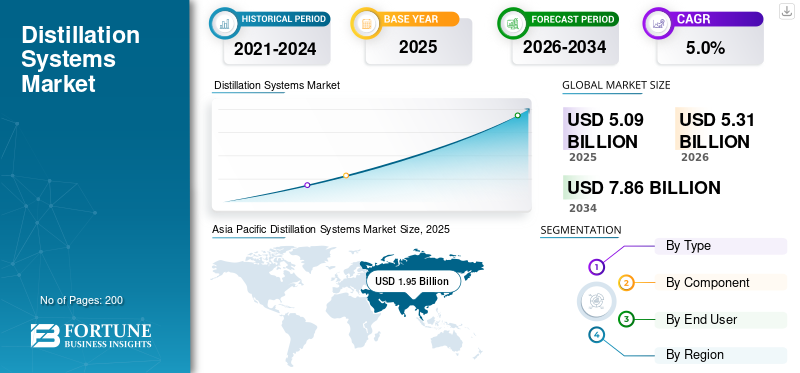
Download Free sample to learn more about this report.
Distillation Systems Market KEY TAKEAWAYS
 Market Size & Forecast
- 2025 Market Size: USD 5.09 billion
- 2026 Market Size: USD 5.31 billion
- 2034 Forecast Market Size: USD 7.86 billion
- CAGR: 5.0% from 2026–2034
 Market Share
- Asia Pacific dominated the distillation systems market with a 38.31% share in 2025.
- The continuous distillation systems segment accounted for the largest market share.
- The distillation columns segment held the leading share by component.
 Key Regional Highlights
Asia Pacific
Asia Pacific Largest and fastest-growing region, driven by rapid industrialization and refinery expansion.
North America
North America Growth is supported by advanced industrial infrastructure and increasing automation adoption.
Europe
Europe Market expansion is driven by sustainability initiatives and energy-efficient distillation technologies.
U.S.
U.S. Strong refining, chemical, and pharmaceutical industries continue to drive demand for advanced distillation systems.
Japan
Japan Demand is supported by high-precision manufacturing and advanced process automation across industrial sectors.
Read More

DISTILLATION SYSTEMS MARKET TRENDS
Adoption of Modular & Skid-Mounted Distillation Systems to Bolster Market Growth
Modular and skid-mounted distillation systems are gaining strong market traction, driven by the need for flexibility, cost efficiency, and faster deployment across industries. These pre-engineered and factory-assembled systems can be transported and installed easily on-site, significantly reducing construction time, while minimizing capital expenditure and the need for extensive on-site fabrication and labor. Industries such as biofuels, specialty chemicals, and pharmaceuticals increasingly prefer modular systems due to their scalability, allowing capacity expansion in phases rather than large upfront investments. The rise of decentralized and small-to-mid scale production facilities is also supporting demand, as compact systems are more practical than large distillation columns. Modular units also support easy relocation and reusability, making them attractive for temporary or pilot-scale operations. The push toward sustainability and energy efficiency is encouraging the adoption of modular systems, as these systems are often designed to optimize energy consumption and reduce waste generation.
- For example, in June 2024, Triveni Engineering & Industries acquired majority stake in Sir Shadi Lal Enterprises to support integration of ethanol distillation capacity.
MARKET DYNAMICS
MARKET DRIVERS
Download Free sample to learn more about this report.
Increasing Expansion of Oil Refining & Petrochemical Capacity to Drive Market Growth
The expansion of oil refining and petrochemical capacity is a major structural driver for the market, as distillation remains the backbone of hydrocarbon separation processes. Refineries rely on crude distillation units and vacuum distillation units to separate crude oil into usable fractions such as gasoline, diesel, and petrochemical feedstocks. The growing demand for petrochemical derivatives (plastics, polymers, and specialty chemicals) is encouraging refiners to integrate downstream units, which require more sophisticated and high-efficiency distillation systems.
- For instance, in December 2025, Ruby Capital acquired Eden Mill distillery to scale its production and meet rising regional demand.
MARKET RESTRAINTS
Emergence of Alternative Technologies to Limit Market Growth
Although distillation has traditionally been the dominant separation method, industries are increasingly exploring non-thermal technologies that can achieve similar or better results at lower energy costs. This shift is gradually reducing dependence on conventional distillation systems across several end-use sectors. At the same time, demand for compact and modular separation solutions is witnessing strong growth. Membrane and hybrid systems require less space and can be easily integrated into existing plants, unlike large distillation columns, which involve heavy infrastructure and high installation complexity.
MARKET OPPORTUNITIES
Expansion of Sustainable Bio-refinery to Bring Large Market Opportunities
The convergence of green distillation technologies and the expansion of biorefineries are creating significant long-term opportunities for the distillation systems market. As industries transition toward low-carbon operations, there is increasing emphasis on energy-efficient distillation solutions such as mechanical vapor recompression (MVR), thermally integrated columns, and multi-effect distillation. These technologies help reduce energy consumption, making them highly attractive in sustainability-driven industrial environments. In addition, the increasing number of government mandates and incentives promoting renewable fuels and sustainable chemical production, particularly across regions such as Europe, North America, and India, is encouraging investments in new bio-refinery projects and the modernization of existing facilities with greener technologies.
MARKET CHALLENGES
Rising Challenges with Legacy Infrastructure and Retrofitting to Limit Market Growth
The integration and retrofitting of the product in existing plants represent a significant hurdle for the market, particularly in mature industrial regions with extensive legacy infrastructure. Many refineries, chemical plants, and distilleries continue to operate aging distillation units that were not designed to modern energy efficiency standards or digital control systems. Distillation columns are deeply embedded within plant operations, and modifying them may require changes to upstream and downstream units, utilities, and piping networks. This increases technical complexity and project risk for facility operators.
Segmentation Analysis
By Type
Continuous Distillation Systems Segment Dominates the Market Owing to Its Critical Role in Various Industries
Based on type, the market is divided into batch distillation systems, continuous distillation systems, fractional distillation systems, steam distillation systems, vacuum distillation systems, and others.
The continuous distillation systems segment captures the dominant distillation systems market share due to their critical role in large-scale, continuous processing industries such as oil & gas, petrochemicals, and bulk chemicals. These systems are designed to operate non-stop over extended periods, making them highly efficient and suitable for handling high-volume production requirements. In industries such as crude oil refining, continuous distillation units (CDUs) and vacuum distillation units (VDUs) are fundamental processes, forming the backbone of refinery operations. Their ability to deliver consistent product quality, higher throughput, and improved operational efficiency makes them indispensable in large industrial setups.
Vacuum distillation systems are witnessing the highest growth rate of about 6.5%, driven by increasing demand for processing heat-sensitive and high-boiling-point materials. The rising focus on high-purity and specialty chemical production, along with the expansion of petrochemical refining capacities, is significantly boosting demand for vacuum distillation. Additionally, advancements in energy-efficient vacuum technologies and process optimization are making these systems more attractive from both operational and cost perspectives.
- For instance, in December 2024, Godavari Biorefineries invested about USD 15.21 million in a grain-based ethanol distillery.
To know how our report can help streamline your business, Speak to Analyst
By Component
Distillation Columns Segment Dominates the Market Owing to Huge Demand for In-house Infrastructure
Based on component, the market is segmented into distillation columns, reboilers, condensers, heat exchangers, control systems & automation, and ancillary equipment.
Distillation columns account for the largest share of the market, as they form the core component of any distillation process. Regardless of the type of system, batch, continuous, or vacuum, the column is the primary unit where the actual separation of components takes place, making it indispensable across all end-use industries. These columns are typically large, capital-intensive, and highly engineered structures, especially in applications such as oil refining, petrochemicals, and large-scale chemical manufacturing.
Control systems & automation are expected to witness the highest growth rate of about 6.9%, driven by the increasing shift toward digitalization and Industry 4.0 practices. Modern distillation processes require precise control over parameters such as temperature, pressure, and flow rates to ensure optimal separation efficiency, energy savings, and product quality.
By End User
Oil and Gas to Dominate the Distillation Systems Market Owing to Refinery Upgrades and New Infrastructure Development
Based on end user, the market is segmented into oil & gas, chemicals, pharmaceuticals & biotech, food & beverages, water & wastewater, and others.
The oil & gas industry dominates the market, primarily due to its extensive reliance on large-scale distillation processes for crude oil refining and petrochemical production. Distillation units such as crude distillation units (CDUs) and vacuum distillation units (VDUs) are fundamental to refining operations, making them one of the most capital-intensive and indispensable assets in the industry. Continuous investments in refinery upgrades, capacity expansions, and petrochemical integration projects further strengthen the dominance of this segment.
The pharmaceuticals & biotech segment is expected to witness the highest growth rate of about 6.4%, driven by the increasing demand for high-purity products, active pharmaceutical ingredients (APIs), and advanced drug formulations. Distillation plays a critical role in solvent recovery, purification, and separation of sensitive compounds, where precision and quality are paramount.
Distillation Systems Market Regional Outlook
By geography, the market is categorized into Europe, North America, Asia Pacific, South America, and the Middle East & Africa.
North America
Asia Pacific Distillation Systems Market Size, 2025 (USD Billion)
To get more information on the regional analysis of this market, Download Free sample
The market in North America is driven by its mature technology and advanced industrial base. The region includes extensive refining and chemical processing infrastructure. Increasing adoption of automation and digitalization, with industries investing in AI-enabled control systems and process optimization to improve efficiency and reduce operational costs. Additionally, the region’s strong presence in pharmaceutical manufacturing and specialty chemicals is boosting demand for high-purity distillation systems. Stringent environmental regulations are pushing industries to adopt energy-efficient and low-emission distillation technologies, supporting steady market growth.
U.S. Distillation Systems Market
The U.S. market is characterized by a mature yet innovation-driven industrial landscape, supported by strong demand from the oil & gas, chemicals, and pharmaceutical sectors. A key driving factor is the country’s extensive refining capacity and shale oil production, which necessitate continuous upgrades and optimization of distillation units. The increasing adoption of automation, digitalization, and AI-based process control is further enhancing operational efficiency across industries.
Europe
Europe’s market is characterized by a strong focus on sustainability and energy efficiency. The region is witnessing increasing adoption of advanced distillation systems such as heat-integrated and low-energy systems to comply with strict environmental regulations and carbon reduction targets. Growth is further supported by the presence of a robust chemical and specialty chemicals industry, particularly in countries such as Germany, France, and the BENELUX region. Additionally, Europe has a well-established pharmaceutical sector, which drives demand for high-precision and automated distillation systems. The push toward a circular economy, including solvent recovery and recycling, is also a key factor contributing to market expansion in the region.
U.K. Distillation Systems Market
The U.K.’s market will reach a value of USD 0.12 billion by 2026, representing roughly 2.2% of global revenues.
Germany Distillation Systems Market
Germany’s market will reach USD 0.21 billion by 2026, equivalent to around 4.0% of the global sales.
Asia Pacific
Asia Pacific is the fastest-growing market and holds the largest share, driven by rapid industrialization and infrastructure development. Countries such as China, India, and Southeast Asian nations are heavily investing in new refineries, petrochemical complexes, and chemical manufacturing facilities, leading to strong demand for large-scale distillation systems. The region also benefits from the expansion of pharmaceutical production and contract manufacturing, particularly in India and China. Additionally, the growing focus on biofuel production (especially ethanol) is driving demand for distillation systems. Increasing urbanization and industrial activity are also boosting the need for water treatment and wastewater recycling, further supporting market growth.
India Distillation Systems Market
The Indian market is expected to reach USD 0.32 billion by 2026, accounting for roughly 6.1% of the global sales.
China Distillation Systems Market
China’s market is projected to remain dominant in the Asia Pacific region in 2026 with revenues reaching USD 0.81 billion, representing roughly 15.3% of global sales.
ASEAN Distillation Systems Market
The ASEAN market in 2026 will reach a value of USD 0.33 billion, accounting for roughly 6.2% of global revenues.
South America
South America’s market is driven by a combination of biofuel production and moderate oil & gas expansion. Brazil plays a crucial role due to its leadership in ethanol production, where distillation is a key process, making biofuels a major growth driver in the region. Additionally, countries such as Argentina are investing in oil & gas exploration and refining, contributing to demand for distillation systems. The region also has a growing food & beverage industry, particularly in alcohol production, which further supports market growth.
Brazil Distillation Systems Market
The Brazilian market will reach USD 0.23 billion by 2026, representing roughly 4.3% of the global sales.
Middle East & Africa
The market in the Middle East & Africa is primarily driven by large-scale investments in the oil & gas and petrochemical sectors, particularly in GCC countries such as Saudi Arabia and the UAE. The region is witnessing the development of mega refinery and integrated petrochemical projects, which require high-capacity distillation systems. Additionally, increasing focus on water desalination and wastewater treatment, especially in water-scarce regions, is contributing to the demand for distillation technologies.
GCC Distillation Systems Market
The GCC market will reach USD 0.35 billion by 2026, representing roughly 6.6% of the global sales.
COMPETITIVE LANDSCAPE
Key Industry Players
Strategic Collaboration and Advanced Product Launch to Propel the Market Penetration
Key players in the market are adopting a combination of technology-driven and market expansion strategies to strengthen their competitive position. A key focus is on developing energy-efficient and low-carbon distillation solutions to reduce operational costs and meet sustainability goals. Several companies are also expanding into high-growth industries such as pharmaceuticals, biotechnology, and water treatment, reducing reliance on traditional oil & gas sectors. The growing demand for flexibility has led to the development of modular and skid-mounted systems, allowing faster deployment and scalability.
- For instance, in October 2024, Bacardi invested in Scottish distilleries, including the installation of advanced distillation technologies.
LIST OF KEY DISTILLATION SYSTEMS MARKET COMPANIES PROFILED
- Sulzer Ltd. (Switzerland)
- Koch-Glitsch (U.S.)
- GEA Group AG (Germany)
- Alfa Laval (Sweden)
- Technip Energies (France)
- Linde Engineering (Germany)
- SPX Flow, Inc. (U.S.)
- AMETEK Process Instruments (U.S.)
- Praj Industries (India)
- Babcock & Wilcox Enterprises, Inc. (S.)
KEY INDUSTRY DEVELOPMENTS
- September 2025: Linde Plc commissioned a cryogenic air separation unit utilizing advanced distillation for industrial gases.
- March 2025: Alfa Laval introduced an advanced energy-efficient distillation column system with enhanced heat integration features.
- January 2025: Sulzer launched next-generation structured packing for distillation columns to improve mass transfer efficiency.
- November 2024: GEA Group announced its portfolio of modular distillation systems for the food, beverage, and ethanol industries.
- October 2024: Koch-Glitsch introduced advanced column internals for distillation towers to optimize capacity and efficiency.
REPORT COVERAGE
The global distillation systems market analysis includes a comprehensive study of the market size & forecast by all the market segments included in the report. It includes details on the market dynamics and market trends expected to drive the demand for distillation systems over the forecast period. It provides information on key aspects, including an overview of technological advancements, the regulatory environment, and product launches. Additionally, it details partnerships, mergers & acquisitions, and key industry developments and prevalence by key regions. The global market research report also provides a detailed competitive landscape with information on the market share and profiles of key operating players.
Request for Customization to gain extensive market insights.
Report Scope & Segmentation
| ATTRIBUTE | DETAILS |
| Study Period | 2021-2034 |
| Base Year | 2025 |
| Estimated Year | 2026 |
| Forecast Period | 2026-2034 |
| Historical Period | 2021-2024 |
| Growth Rate | CAGR of 5.0% from 2026 to 2034 |
| Unit | Value (USD Billion) |
| Segmentation | By Type, Component, End User, and Region |
| By Type |
|
| By Component |
|
| By End User |
|
| By Region |
|
Frequently Asked Questions
According to Fortune Business Insights, the global market value stood at USD 5.09 billion in 2025 and is projected to reach USD 7.86 billion by 2034.
In 2025, the market value stood at USD 1.95 billion.
The market is expected to exhibit a CAGR of 5.0% during the forecast period.
By type, the continuous distillation system segment dominates the market.
Increasing expansion of oil refining & petrochemical capacity is a key factor driving the market.
Sulzer Ltd., Alfa Laval, Linde Plc, and GEA Group are the top players in the global market.
Asia Pacific dominates the market.



- 2021-2034
- 2025
- 2021-2024
- 200
Get 30-60 hrs Free Customization
Expand Regional and Country Coverage, Segments Analysis, Company Profiles, Competitive Benchmarking, and End-user Insights.















Related Reports
-
US +1 833 909 2966 ( Toll Free )
-
Get In Touch With Us