Distributed Fiber Optic Sensor Market Size, Share & Industry Analysis, By Function (Acoustic/ Vibration Sensing, Temperature Sensing), By Technology (Rayleigh Effect, Raman Effect), By Application, By Vertical, and Regional Forecast, 2026-2034
 Download Free Sample
Distributed Fiber Optic Sensor Market
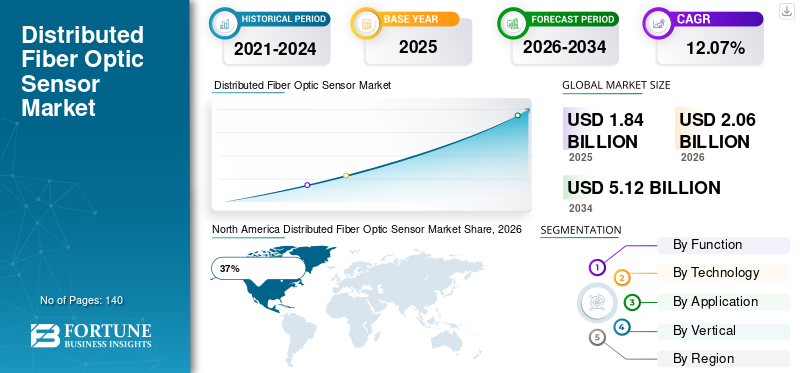
The global distributed fiber optic sensor market size was valued at USD 1.84 billion in 2025. The market is projected to grow from USD 2.06 billion in 2026 to USD 5.12 billion by 2034, exhibiting a CAGR of 12.07% during the forecast period.

The distributed fiber optic sensor market is expanding rapidly due to increasing demand for real-time monitoring systems across oil and gas, power transmission, transportation, and infrastructure sectors. Distributed sensing technologies provide continuous monitoring capabilities for temperature, vibration, strain, and acoustic changes over long distances, making them highly effective for industrial safety and asset management applications. The distributed fiber optic sensor market Report highlights growing adoption of smart infrastructure solutions and predictive maintenance technologies across industrial facilities. Rising investment in pipeline security, railway monitoring, and perimeter surveillance systems is further supporting distributed fiber optic sensor market Growth globally. Advancements in optical communication technologies and high-performance sensing fibers are also strengthening Distributed Fiber Optic Sensor Industry Analysis across industrial automation environments.
The USA distributed fiber optic sensor market remains a major contributor to global industry expansion because of increasing investment in oil pipeline monitoring, smart grid infrastructure, and critical asset security systems. More than 38% of energy infrastructure operators across the country are integrating distributed sensing technologies for real-time operational monitoring and fault detection. Transportation authorities are increasingly deploying fiber optic sensing systems for railway safety, tunnel monitoring, and bridge condition analysis. Defense and border security applications are also supporting strong market demand throughout the United States. The distributed fiber optic sensor market outlook remains positive because industrial operators continue investing in predictive maintenance systems and advanced remote monitoring technologies.
Download Free sample to learn more about this report.
Distributed Fiber Optic Sensor Market Key Takeaways
 Global Market Size & Forecast
- 2025 Market Size: USD 1.84 Billion
- 2026 Market Size: USD 2.06 Billion
- 2034 Forecast Market Size: USD 5.12 Billion
- CAGR: 12.07% from 2026-2034
 Market Share
- North America dominated with a revenue share of 37% in 2025.
- Acoustic and vibration sensing led by function with a 58% market share.
- Rayleigh effect led by technology with a 44% market share.
 Key Regional Highlights
North America
North America held the largest regional share at 37%, supported by strong adoption across energy and critical infrastructure.
Europe
Europe accounted for 29% of the market, driven by demand for infrastructure monitoring and industrial safety.
Asia-Pacific
Asia-Pacific represented 25% of the market, supported by expanding energy, transportation, and industrial infrastructure.
U.S.
The U.S. remains a key market due to increasing deployment in pipelines, utilities, railways, and security.
Japan
Japan is a notable Asia-Pacific market, supported by advanced infrastructure monitoring and industrial sensing applications.
Read More

Distributed Fiber Optic Sensor Market Latest Trends
The distributed fiber optic sensor market is witnessing significant transformation due to rising industrial automation and increasing deployment of smart monitoring infrastructure across critical industries. Distributed acoustic sensing and distributed temperature sensing technologies are becoming increasingly important for oil and gas pipeline monitoring, railway surveillance, and power cable diagnostics. Industrial operators are adopting fiber optic sensing systems because they provide continuous real-time monitoring over extended distances with high operational accuracy. Artificial intelligence integration and cloud-based analytics platforms are further improving predictive maintenance efficiency and fault detection capabilities.
Download Free sample to learn more about this report.
Infrastructure modernization projects across transportation and energy sectors are increasing demand for distributed sensing technologies capable of monitoring structural integrity and operational performance. Smart city projects are also supporting deployment of fiber optic sensing systems for traffic management, perimeter security, and utility infrastructure monitoring. The distributed fiber optic sensor market Research Report highlights increasing use of Raman scattering and Brillouin scattering technologies for high-precision temperature and strain analysis.
Distributed Fiber Optic Sensor Market Dynamics
DRIVER
Rising Demand for Real-time Infrastructure Monitoring Systems.
Increasing need for continuous monitoring and predictive maintenance across industrial infrastructure is significantly driving distributed fiber optic sensor market Growth worldwide. Oil pipelines, power transmission networks, transportation systems, and industrial facilities require advanced sensing technologies capable of detecting temperature fluctuations, vibration patterns, and structural stress in real time. Distributed fiber optic sensors provide high operational reliability and long-distance coverage, making them ideal for critical infrastructure applications. Governments and private organizations are investing heavily in smart infrastructure modernization projects to improve operational safety and reduce maintenance costs. The distributed fiber optic sensor market Analysis highlights growing deployment of distributed acoustic sensing systems for perimeter security, railway safety monitoring, and underground cable diagnostics across industrial sectors globally.
RESTRAINT
High Installation and Deployment Costs.
The distributed fiber optic sensor market faces significant restraints because advanced sensing systems require high installation expenses and specialized technical expertise. Fiber optic monitoring infrastructure involves complex deployment procedures, optical network integration, and precision calibration systems, increasing operational costs for industrial users. Small and medium enterprises often face budget limitations that restrict adoption of advanced distributed sensing technologies. Harsh environmental conditions and maintenance requirements may also increase operational complexity in industrial environments such as offshore oil platforms and underground utility networks. Compatibility issues between existing infrastructure and new sensing systems further limit deployment across aging industrial facilities. The distributed fiber optic sensor market Forecast indicates that cost-related challenges and technical integration barriers may slow adoption across developing industrial economies.
OPPORTUNITY
Expansion of Smart City and Smart Grid Projects.
Rapid development of smart city infrastructure and intelligent power transmission systems is creating substantial distributed fiber optic sensor market opportunities globally. Governments and utility operators are investing heavily in real-time monitoring systems for bridges, tunnels, railways, pipelines, and electrical transmission networks. Fiber optic sensing technologies provide continuous operational visibility and improve infrastructure reliability through predictive analytics and automated fault detection. Renewable energy projects and smart grid modernization programs are further increasing demand for advanced sensing solutions capable of monitoring temperature variations and structural conditions. The Distributed Fiber Optic Sensor Industry Analysis highlights rising integration of distributed sensing technologies within urban infrastructure, traffic management systems, and industrial automation networks across developed and emerging economies.
CHALLENGE
Data Management and Signal Processing Complexity.
Managing large volumes of real-time sensing data remains a major challenge within the distributed fiber optic sensor market. Industrial operators deploying distributed sensing systems across long-distance infrastructure networks must process continuous streams of temperature, vibration, and acoustic information with high precision and reliability. Advanced signal processing algorithms and cloud-based analytics systems are required to convert raw optical data into actionable operational insights. Cybersecurity concerns associated with remote monitoring systems also create additional complexity for industrial operators managing critical infrastructure assets. Skilled workforce shortages in fiber optic system integration and maintenance further impact operational efficiency. The distributed fiber optic sensor market Research Report highlights increasing demand for AI-driven analytics platforms and automated monitoring software to address growing data processing challenges across industrial sensing applications.
Distributed Fiber Optic Sensor Market Segmentation
By Function
Acoustic and vibration sensing accounts for 58% of the global distributed fiber optic sensor market share because industrial operators increasingly require continuous monitoring of pipelines, railways, borders, and critical infrastructure assets. Distributed acoustic sensing technologies detect vibration patterns and movement activity over long distances, enabling rapid fault detection and perimeter security monitoring. Oil and gas companies widely use vibration sensing systems for leak detection and intrusion monitoring across pipeline networks. Railway operators are also deploying acoustic sensing technologies for track condition monitoring and operational safety management.
Temperature sensing represents 42% of the global distributed fiber optic sensor market share due to growing demand for thermal monitoring across energy infrastructure, industrial facilities, and power transmission systems. Distributed temperature sensing technologies provide continuous thermal profiling over extended distances, improving operational visibility and fault prevention capabilities. Power utilities increasingly use fiber optic temperature monitoring systems for underground cable diagnostics and transformer condition analysis. Oil refineries, chemical plants, and manufacturing facilities also depend on thermal sensing systems to detect overheating and maintain industrial safety standards.worldwide.
To know how our report can help streamline your business, Speak to Analyst
By Technology
The Rayleigh effect segment accounts for 44% of the global distributed fiber optic sensor market share because this technology is widely used for distributed acoustic sensing and vibration monitoring applications across critical infrastructure environments. Oil and gas operators remain major end users of Rayleigh-based sensing systems for pipeline surveillance, leak detection, and perimeter intrusion monitoring. Transportation authorities increasingly deploy Rayleigh effect technologies for railway track monitoring, tunnel protection, and structural vibration analysis. Defense and border security agencies also use these systems for real-time intrusion detection and surveillance operations across sensitive installations.
The Raman effect segment represents 36% of the global distributed fiber optic sensor market share because Raman scattering technology provides highly accurate distributed temperature sensing capabilities for industrial and utility applications. Power transmission companies are major end users because Raman-based sensing systems help monitor underground cable temperatures, transformer performance, and electrical infrastructure stability. Oil refineries and chemical processing facilities also deploy Raman effect sensing technologies for thermal profiling and fire detection across hazardous industrial environments. Utility operators increasingly use distributed temperature sensing systems for renewable energy infrastructure and smart grid management applications.
By Application
The application segment contributes 34% of the global distributed fiber optic sensor market share because distributed sensing technologies are increasingly integrated into industrial monitoring, infrastructure management, and security systems. Oil and gas companies remain key end users due to rising deployment of distributed acoustic sensing systems for pipeline integrity monitoring and drilling operation analysis. Railway authorities increasingly use fiber optic sensing systems for rail track condition monitoring, tunnel safety assessment, and operational risk management. Utility providers also represent important end users because distributed sensing systems improve smart grid monitoring and underground cable diagnostics.
By Vertical
The vertical segment accounts for 30% of the global distributed fiber optic sensor market share because multiple industries are integrating fiber optic sensing technologies into critical operational infrastructure. Energy and utility sectors remain dominant end users due to increasing investment in smart grids, power transmission monitoring, and pipeline security systems. Transportation and railway industries are adopting distributed sensing technologies for structural monitoring, railway safety management, and tunnel infrastructure protection. Telecommunications operators also use fiber optic sensing systems for network infrastructure monitoring and fault detection.
Distributed Fiber Optic Sensor Market Regional Outlook
North America
North America Distributed Fiber Optic Sensor Market Share, 2026 (%)
To get more information on the regional analysis of this market, Download Free sample
North America dominates the distributed fiber optic sensor market with 37% market share because of rising investment in oil pipeline monitoring, smart grid infrastructure, and industrial automation systems. Energy companies throughout the region increasingly deploy distributed acoustic sensing and distributed temperature sensing technologies to improve operational visibility and infrastructure protection. Pipeline leak detection, power cable monitoring, and railway safety applications remain major contributors to regional market demand. Industrial operators are investing heavily in predictive maintenance systems and AI-driven monitoring platforms to strengthen operational efficiency and reduce infrastructure downtime. The United States represents the largest contributor within the region due to extensive oil and gas infrastructure and growing deployment of smart transportation systems. Canada is also witnessing rising demand for distributed sensing technologies across mining operations and utility infrastructure projects. Transportation authorities increasingly use fiber optic monitoring systems for tunnel safety analysis and railway track condition monitoring.
Europe
Europe accounts for 29% of the global distributed fiber optic sensor market share because of increasing infrastructure modernization and strong focus on industrial safety systems. Railway monitoring, tunnel surveillance, and smart utility infrastructure remain major application areas across the region. Energy operators increasingly use distributed sensing technologies for pipeline monitoring, renewable energy integration, and underground cable diagnostics. Governments are investing heavily in smart city projects and intelligent transportation systems that require advanced real-time monitoring capabilities. Western European countries remain major contributors because of strong industrial automation infrastructure and advanced telecommunications networks. Distributed acoustic sensing systems are becoming increasingly important for border security and transportation management applications. Manufacturing facilities across Europe are also integrating fiber optic sensing technologies into predictive maintenance programs to improve operational reliability.
Germany Distributed Fiber Optic Sensor Market
Germany represents 31% of the European distributed fiber optic sensor market share because of advanced industrial automation capabilities and strong manufacturing infrastructure. Energy companies and transportation authorities increasingly deploy distributed sensing technologies for smart grid management, railway safety monitoring, and tunnel infrastructure analysis. Industrial facilities are investing heavily in predictive maintenance systems and real-time equipment monitoring technologies to improve operational productivity and reduce downtime risks. The country’s strong engineering sector continues supporting development of advanced fiber optic sensing technologies across industrial automation environments. Automotive manufacturing facilities and utility infrastructure operators also remain key end users of distributed sensing systems. The distributed fiber optic sensor market Forecast for Germany remains positive due to increasing smart infrastructure investment and expansion of industrial digitalization projects.
United Kingdom Distributed Fiber Optic Sensor Market
The United Kingdom contributes 24% of the European distributed fiber optic sensor market share due to increasing deployment of smart transportation infrastructure and advanced energy monitoring systems. Railway authorities across the country are adopting distributed acoustic sensing technologies for track safety analysis and operational monitoring. Utility companies increasingly use distributed temperature sensing systems for underground cable management and infrastructure protection. Oil and gas facilities in offshore environments also remain significant users of fiber optic monitoring technologies for predictive maintenance and operational safety management. Industrial operators are investing in cloud-connected sensing platforms and AI-based analytics systems to improve infrastructure reliability. The distributed fiber optic sensor market Research Report highlights rising demand for cybersecurity-enabled sensing systems and automated infrastructure monitoring technologies throughout the United Kingdom.
Asia-Pacific
Asia-Pacific holds 25% of the global distributed fiber optic sensor market share because of rapid industrialization, expanding energy infrastructure, and increasing smart city investments. Countries including China, Japan, India, and South Korea are investing heavily in transportation modernization, utility infrastructure, and industrial automation systems. Distributed temperature sensing and distributed acoustic sensing technologies are becoming increasingly important for power transmission monitoring, railway safety management, and industrial process control applications. Industrial facilities throughout Asia-Pacific are increasingly adopting predictive maintenance systems and remote monitoring technologies to improve operational productivity. Renewable energy projects and smart utility networks are also driving demand for advanced fiber optic sensing systems. Governments are strengthening infrastructure safety regulations and investing in digital monitoring solutions for urban development projects. The distributed fiber optic sensor market Outlook highlights rising deployment of AI-integrated sensing technologies and cloud-based industrial monitoring platforms across Asia-Pacific infrastructure sectors.
Japan Distributed Fiber Optic Sensor Market
Japan accounts for 21% of the Asia-Pacific distributed fiber optic sensor market share because of advanced industrial automation and strong investment in smart infrastructure technologies. Transportation authorities increasingly use distributed sensing systems for railway monitoring, tunnel safety management, and earthquake detection applications. Utility companies are also deploying temperature sensing systems for smart grid monitoring and underground cable diagnostics. Industrial manufacturers across Japan continue investing in predictive maintenance technologies and high-precision monitoring systems to improve production efficiency and operational safety. Fiber optic sensing technologies are also gaining importance across robotics and advanced manufacturing environments. The Distributed Fiber Optic Sensor Industry Analysis highlights increasing integration of AI-driven signal processing technologies within Japanese industrial monitoring systems.
China Distributed Fiber Optic Sensor Market
China represents 24% of the Asia-Pacific distributed fiber optic sensor market share because of rapid infrastructure expansion and increasing industrial automation investments. Power utilities, oil and gas operators, and transportation authorities are deploying distributed sensing technologies for pipeline monitoring, railway infrastructure analysis, and smart city development projects. Manufacturing facilities increasingly use fiber optic sensing systems for predictive maintenance and equipment performance monitoring. Government investments in intelligent transportation systems and industrial digitalization projects continue strengthening market demand throughout the country. Renewable energy infrastructure and telecommunications network expansion are also supporting increased deployment of distributed temperature sensing systems. The distributed fiber optic sensor market Insights landscape highlights growing domestic production capabilities and rising adoption of cloud-based industrial monitoring platforms across China.
Rest of World
Rest of World accounts for 9% of the global distributed fiber optic sensor market share because of increasing investment in industrial safety systems and energy infrastructure modernization. Middle Eastern oil and gas operators are major users of distributed acoustic sensing technologies for pipeline leak detection and perimeter security monitoring. Latin American utility companies increasingly deploy distributed temperature sensing systems for power transmission monitoring and infrastructure protection. Mining operations and industrial facilities across Africa are also adopting fiber optic sensing technologies to improve equipment monitoring and operational safety management. Governments across emerging economies are investing in smart transportation systems and utility infrastructure modernization projects. The distributed fiber optic sensor market Outlook highlights increasing adoption of predictive maintenance technologies and cloud-based monitoring systems throughout developing industrial markets.
List of Top Distributed Fiber Optic Sensor Companies
- Schlumberger Limited
- Halliburton
- Yokogawa Electric Corporation
- OFS Fitel, LLC
- Omnisens SA
- Brugg Kable AG
- AP Sensing GmbH
- Baker Hughes Company
- Silixa Ltd
- Luna Innovations Inc.
Top Two Companies with Highest Market Share
- Schlumberger Limited – 19% market share
- Halliburton – 15% market share
Investment Analysis and Opportunities
The distributed fiber optic sensor market is attracting strong investment activity due to increasing demand for infrastructure monitoring, industrial automation, and predictive maintenance systems. Energy companies, transportation authorities, and utility operators are investing heavily in distributed acoustic sensing and temperature sensing technologies to improve operational reliability and infrastructure safety. Governments across developed and emerging economies are funding smart city projects, railway modernization programs, and power grid digitalization initiatives that require advanced sensing capabilities.
Industrial operators are also investing in AI-integrated analytics platforms and cloud-based monitoring systems to improve fault detection and predictive maintenance efficiency. Renewable energy infrastructure projects and intelligent transportation systems continue creating major distributed fiber optic sensor market Opportunities globally. Manufacturers are expanding production capabilities and developing high-performance sensing fibers to meet growing industrial demand. The distributed fiber optic sensor market Research Report highlights increasing collaboration between telecommunications providers, industrial automation companies, and infrastructure management organizations to strengthen deployment of advanced distributed sensing technologies across multiple industry verticals.
New Product Development
Innovation within the distributed fiber optic sensor market is increasingly focused on high-performance sensing fibers, AI-driven analytics systems, and compact monitoring devices. Manufacturers are developing advanced distributed acoustic sensing systems capable of detecting small vibration changes with improved operational accuracy. Temperature sensing technologies with enhanced thermal resolution and long-distance monitoring capabilities are also gaining significant attention across energy and industrial applications.
Companies are investing in cloud-enabled sensing platforms and real-time analytics software that improve predictive maintenance and infrastructure management efficiency. Cybersecurity-enabled monitoring systems are becoming increasingly important for protecting critical infrastructure networks from operational disruptions. Portable fiber optic monitoring units and modular sensing architectures are also supporting easier deployment across industrial facilities and transportation systems. The Distributed Fiber Optic Sensor Industry Report highlights growing development of smart sensing networks integrated with artificial intelligence and machine learning algorithms for automated infrastructure monitoring and predictive diagnostics.
Five Recent Developments (2023-2025)
- In 2023, Yokogawa Electric Corporation expanded distributed temperature sensing solutions for smart utility infrastructure projects.
- In 2023, AP Sensing GmbH introduced upgraded distributed acoustic sensing systems for railway monitoring applications.
- In 2024, Baker Hughes Company strengthened pipeline monitoring technologies for offshore oil and gas infrastructure.
- In 2024, Luna Innovations Inc. launched advanced cloud-connected sensing analytics platforms for industrial monitoring systems.
- In 2025, Halliburton expanded fiber optic sensing deployment across intelligent well monitoring operations.
Report Coverage of Distributed Fiber Optic Sensor Market
The distributed fiber optic sensor market report provides comprehensive analysis of industrial monitoring technologies, infrastructure safety systems, and predictive maintenance solutions across energy, transportation, utilities, and industrial automation sectors. The report evaluates distributed acoustic sensing, distributed temperature sensing, Raman effect technologies, and cloud-based sensing analytics platforms influencing global market expansion. Detailed segmentation analysis covers sensing technologies, industrial applications, and vertical-specific infrastructure monitoring trends.
Request for Customization to gain extensive market insights.
Regional analysis within the distributed fiber optic sensor market research report examines North America, Europe, Asia-Pacific, and Rest of World markets, highlighting industrial automation investment trends, infrastructure modernization projects, and utility monitoring developments. The report also evaluates competitive strategies among leading companies focusing on advanced sensing fibers, AI-integrated monitoring systems, and predictive analytics technologies. Investment activity, product innovation, cybersecurity integration, and smart infrastructure deployment strategies are further analyzed to provide detailed distributed fiber optic sensor market Insights for industrial operators, energy companies, transportation authorities, utility providers, and technology manufacturers operating within the global sensing technology industry.
Frequently Asked Questions
Fortune Business Insights says that the global market value stood at USD 1.84 billion in 2025 and is projected to reach USD 5.12 billion by 2034.
The market is expected to exhibit a CAGR of 12.07% during the forecast period of 2025-2034.
Acoustic and vibration sensing was the leading function segment, accounting for 58% of the market, driven by growing demand for continuous monitoring of pipelines, railways, borders, and critical infrastructure.
Key players include Schlumberger Limited, Halliburton, Yokogawa Electric Corporation, OFS Fitel, LLC, Omnisens SA, and Brugg Kable AG.
Major trends include rising adoption of distributed acoustic/temperature sensing and AI-powered analytics, alongside growing demand for smart infrastructure and predictive maintenance. North America dominated the market with a 37% share.



- 2021-2034
- 2025
- 2021-2024
- 140
-

(Offer valid till 15th Sep 2026)
Get 30-60 hrs Free Customization
Expand Regional and Country Coverage, Segments Analysis, Company Profiles, Competitive Benchmarking, and End-user Insights.




















-
US +1 833 909 2966 ( Toll Free )
-
Get In Touch With Us