Dried Apricots Market Size, Share & Industry Analysis, By Product Form (Whole Dried Apricots, Halved Dried Apricots, Diced/Sliced, and Paste/Puree), By Nature (Conventional and Organic), By End Use (Retail Snacking, Bakery & Confectionery, Breakfast Cereals & Dairy Inclusions, Foodservice/HoReCa, and Industrial/Ingredient Use), and Regional Forecast, 2026-2034
 Download Free Sample
(Offer valid till 31st Oct 2026)

Dried Apricots Market Size and Future Outlook
 Listen to Audio Version
The global dried apricots market size was valued at USD 1.99 billion in 2025. The market is projected to grow from USD 2.09 billion in 2026 to USD 3.16 billion by 2034, exhibiting a CAGR of 5.32% during the forecast period. Europe dominated the dried apricots market with a market share of 37.68% in 2025.
Dried apricots are processed fruit items developed by dehydrating fresh apricots to minimize moisture content while preserving flavor and nutrients. This item is produced via a controlled mechanical or sun drying technique, resulting in unsulfured or sulfur-treated apricots. Nutritionally, apricots are a rich source of beta carotene and potassium, and are also high in dietary fiber. With respect to applications, it is either consumed as a snack or utilized as an ingredient in granola, breakfast cereals, and dairy products. Geographically, Iran, Uzbekistan, and Turkey are the major producers of apricots.
Companies such as Chelmer Foods, Red River Foods Incorporated, and Royal Nut Company are key players in this market. New product launches are a pivotal strategy adopted by key market players to improve their position.
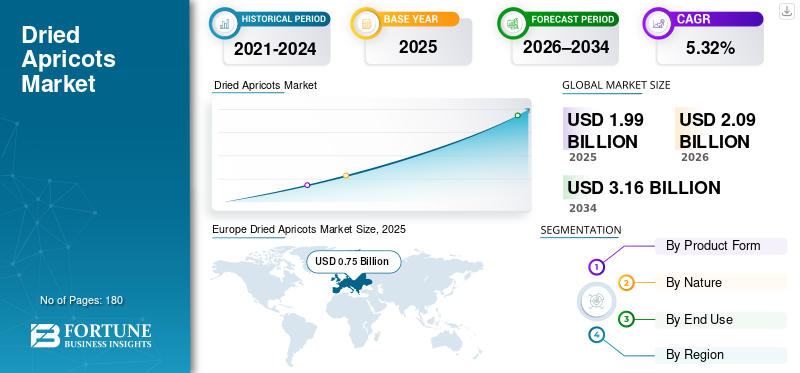
Download Free sample to learn more about this report.
Dried Apricots Market Takeaways
 Global Market Size & Forecast
- 2025 Market Size: USD 1.99 billion
- 2026 Market Size: USD 2.09 billion
- 2034 Forecast Market Size: USD 3.16 billion
- CAGR: 5.32% from 2026–2034
 Market Share
- Europe dominated the dried apricots market with a 37.68% share in 2025.
- The organic segment is projected to grow at the highest CAGR of 5.63% during the forecast period.
- The halved dried apricots segment is projected to expand at a 5.25% CAGR over the forecast period.
 Key Regional Highlights
North America
The market reached USD 0.31 billion in 2025, supported by increasing demand for healthy snacks and functional food ingredients.
Europe
The market reached USD 0.75 billion in 2025 and is expected to maintain steady growth, supported by strong consumer demand for healthy dried fruit products.
Asia Pacific
The market was valued at USD 0.56 billion in 2025, with China and India driving regional demand through rising consumption and expanding food processing industries.
U.S.
The market was valued at approximately USD 0.25 billion in 2025, accounting for around 12.54% of global sales, driven by strong demand for nutritious snack products.
Japan
The dried apricots market was estimated at USD 0.06 billion in 2025, supported by growing consumer preference for premium dried fruit and health-focused diets.
Read More

DRIED APRICOTS MARKET TRENDS
Increasing Inclination toward Snacking is the Prominent Trend
The global market is witnessing a growing, evolving trend toward snacking, closely associated with changing eating habits and busy lifestyles. In this modern era, most consumers are focusing on replacing regular meals with frequent or smaller snacks, creating high demand for ready-to-eat or portable items. Dried apricots align well with this trend owing to their ease of consumption and prolonged shelf life. This dried fruit is available in portion-controlled packs, single-serve sachets, and resealable pouches for fitness activities and travel. Such formats minimize waste and improve convenience, which entice consumer attention. Moreover, especially for retailers, compact packaging fuels impulse purchases, specifically in online retail channels and convenience stores.
Download Free sample to learn more about this report.
MARKET DYNAMICS
MARKET DRIVERS
Rising Nutrition and Health Awareness Drives the Consumption of Dried Apricots
The surging awareness of the role of a balanced diet in preventing lifestyle-related ailments is a key driver fueling the intake of natural/nutrient-dense items. Most consumers are actively seeking items that provide additional health advantages beyond regular calories, such as improved heart health and digestive support. To fulfill this demand, individuals can opt for apricots, which are high in iron, potassium, and fiber, making them appealing to health-conscious consumers. Moreover, many individuals are trying to cut down on their intake of ultra-processed snacks that contain artificial additives and refined sugars, which increases reliance on dried fruits. Along with this, the surging interest in whole-food or plant based diets further fuels overall demand for dried apricots.
MARKET RESTRAINTS
High Reliance on Weather Conditions Hinders the Industry’s Momentum
One of the key obstacles in the dried apricots market growth is surging dependency on climatic conditions. The production of dried apricots is susceptible to climatic conditions such as drought, hail, irregular rainfall, and frost in major producing regions, including Iran, Turkey, and Uzbekistan. Even limited-duration frost in key countries can result in a year-on-year production drop, directly hampering raw component availability for drying. Moreover, heat stress and high temperatures negatively affect color retention and accelerate fruit maturation during the drying process. Additionally, excessive rainfall is another factor that impedes the industry’s growth. Heavy rainfall, especially near harvest season, increases the risk of spoilage and pest pressure, fueling the chances of rejection of apricots while grading and sorting, inhibiting the global dried apricots market growth.
MARKET OPPORTUNITY
Technological Advancements to Open New Growth Possibilities
The adoption of advanced technologies in the apricot sector creates lucrative growth opportunities. To minimize carbon footprints and energy costs, most processors use hybrid solar drying technologies that combine gas/electric heating with solar energy. These systems are highly preferred in key producing countries with high solar exposure. Technological upgradation in automated grading and machine vision enhances quality consistency, and efficiency. Moreover, modern controlled sulfurization systems are being adopted, especially for sulfur-treated apricots, which assures color preservation and precise dosage application. Additionally, advancements in controlled-atmosphere storage and post-harvest cold storage help stabilize apricots’ quality prior to drying.
Segmentation Analysis
By Product Form
Whole Dried Apricots Segment Dominated the Market Due to Superior Shelf Life
Based on product form, the market is divided into whole dried apricots, halved dried apricots, diced/sliced, and paste/puree.
The whole dried apricot led the global market in 2025. In comparison to other forms, whole apricots have an extended shelf life and preserve most of their natural texture. This form of apricots is primarily perceived as more natural and less processed than pureed/diced forms. Moreover, it requires minimal processing, which minimizes energy use and labor costs. Additionally, whole form offers high flexibility for both foodservice operators and consumers, further driving the segment’s growth.
The halved dried apricots are projected to grow at a CAGR of 5.25% over the forecast period.
To know how our report can help streamline your business, Speak to Analyst
By Nature
Conventional Segment Led the Market due to Its Cost-Effectiveness
Depending on nature, the market is bifurcated into conventional and organic.
In 2025, the conventional segment led the global industry due to their low price. Compared with organic apricots, traditional apricots are cultivated at a lower cost, which is essential in a price-sensitive industry. Regular dried fruit has minimal defect rates and better size uniformity than organic items. Moreover, it has a prolonged shelf life and better storage stability, which adds value to its growth. Additionally, regular apricots don’t require significant investment, especially in certifications, further reducing complexity.
The organic segment is projected to grow at a high CAGR of 5.63% over the forecast period.
By End Use
Retail Snacking Segment Led the Market Owing to its Longer Shelf Life
Based on end use, the market is segmented into retail snacking, bakery & confectionery, breakfast cereals & dairy inclusions, foodservice/HoReCa, and industrial/ingredient use.
Retail snacking dominated the global industry in 2025. This segment gains advantage from frequent consumption occasions in comparison to the bakery and foodservice. Most individuals purchase snacks from retail outlets that can be consumed multiple times/daily while traveling or between meals. Moreover, retail formats have strong control over portion size, allowing consumers to effectively manage their calorie intake. Additionally, these products have a longer shelf life than foodservice offerings and bakery products.
The bakery & confectionery segment is projected to grow at a high CAGR of 5.24% over the forecast period.
Dried Apricots Market Regional Outlook
By geography, the market is categorized into Europe, North America, Asia Pacific, South America, and the Middle East & Africa.
Europe
Europe Dried Apricots Market Size, 2025 (USD Billion)
To get more information on the regional analysis of this market, Download Free sample
Europe reached USD 0.75 billion in 2025, recording a growth rate of 4.55% in the coming years. The growing consumer preference for functional foods and the surging health benefits of apricots are boosting the region’s growth.
Germany Dried Apricots Market
The market in 2025 reached around USD 0.14 billion, representing roughly 6.98% of the global market revenues.
U.K. Dried Apricots Market
The U.K. reached approximately USD 0.11 billion in 2025, equivalent to around 5.45% of the global market sales.
Asia Pacific
Asia Pacific reached a valuation of USD 0.56 billion in 2025 and secures the second position. In the region, India and China reached USD 0.09 billion and USD 0.20 billion, respectively, in 2025.
India Dried Apricots Market
The Indian market in 2025 reached around USD 0.09 billion, accounting for roughly 4.59% of the global market revenues. The surging demand for natural ingredients in the foodservice sector and the evolving retail industry are driving factors in the regional market.
China Dried Apricots Market
China's market is projected to be one of the largest worldwide, with revenues stood at around USD 0.20 billion in 2025, representing roughly 10.02% of the global market sales.
Japan Dried Apricots Market
The Japanese market in 2025 is estimated at around USD 0.06 billion, accounting for approximately 3.09% of the global market revenues.
North America
North America market reached a valuation of USD 0.31 billion in 2025 in the global market. The market in the region is expected to grow due to the augmented demand for organic dried apricots and the expansion of the B2B sector. Moreover, the increasing health & wellness awareness and new product launches are other key factors bolstering regional growth.
U.S. Dried Apricots Market:
Based on North America’s strong contribution and the U.S. dominance within the region, the U.S. market can be analytically approximated at around USD 0.25 billion in 2025, accounting for roughly 12.54% of global sales.
South America and the Middle East & Africa
The South America and Middle East & Africa regions are expected to witness moderate growth in this market during the forecast period. The South America market is set to reach a valuation of USD 0.10 billion in 2025. The growing number of apricot producers and robust e-commerce network are expected to drive the regional growth. The Middle East and Africa market reached a valuation of USD 0.27 billion in 2025.
South Africa Dried Apricots Market
The market in South Africa reached around USD 0.03 billion in 2025, representing roughly 1.48% of global revenues.
COMPETITIVE LANDSCAPE
Key Industry Players
New Product Launches Help the Firms to Improve Their Market Position
The market exhibits a fragmented structure, with intense competition among market players operating in this segment. In this market, key companies are primarily adopting new product launches as the main strategy. Via this approach, players can cater to rising consumer demands and enhance their brand image.
LIST OF KEY DRIED APRICOTS COMPANIES PROFILED
- Sunsweet Growers, Inc. (U.S.)
- Whitworths (U.K.)
- RDM International (Turkey)
- Sun-Maid Growers of California (U.S.)
- Anatolia AS (Turkey)
- Bergin Fruit and Nut Company (U.S.)
- Traina Foods, Inc. (U.S.)
- Chelmer Foods (U.K.)
- Red River Foods Incorporated (U.S.)
- Royal Nut Company (Australia)
KEY INDUSTRY DEVELOPMENTS
- September 2025: The Food and Agriculture Organization of the United Nations, a government agency, and Nexigol Mushovir, a consulting company, organized a seminar “Promoting the Sustainable Development and Competitiveness of the Apricot Value Chain in Tajikistan.” This event was organized with support from Tajikistan’s Ministry of Agriculture and the Export Agency.
- February 2025: The Turkish Dried Fruits Sectoral Board, a government association, announced the launch of Turkish dried fruits, which include pistachios, apricots, and figs. All the dried fruits were launched in India through a campaign.
REPORT COVERAGE
Request for Customization to gain extensive market insights.
Report Scope & Segmentation
|
ATTRIBUTE |
DETAILS |
|
Study Period |
2021-2034 |
|
Base Year |
2025 |
|
Estimated Year |
2026 |
|
Forecast Period |
2026-2034 |
|
Historical Period |
2021-2024 |
|
Growth Rate |
CAGR of 5.32% from 2026-2034 |
|
Unit |
Value (USD Billion) |
|
Segmentation |
By Product Form, Nature, End Use, and Region |
|
By Product Form |
· Whole Dried Apricots · Halved Dried Apricots · Diced/Sliced · Paste/Puree |
|
By Nature |
· Conventional · Organic |
|
By End Use |
· Retail Snacking · Bakery & Confectionery · Breakfast Cereals & Dairy Inclusions · Foodservice/HoReCa · Industrial/Ingredient Use |
|
By Geography |
North America (By Product Form, Nature, End Use, and Country) o U.S. (By Nature) o Canada (By Nature) o Mexico (By Nature) Europe (By Product Form, Nature, End Use, and Country) o Germany (By Nature) o U.K. (By Nature) o Spain (By Nature) o France (By Nature) o Italy (By Nature) o Rest of Europe (By Nature) Asia Pacific (By Product Form, Nature, End Use, and Country) o China (By Nature) o India (By Nature) o Australia (By Nature) o Japan (By Nature) o Rest of the Asia Pacific (By Nature) South America (By Product Form, Nature, End Use, and Country) o Brazil (By Nature) o Argentina (By Nature) o Rest of South America (By Nature) Middle East and Africa (By Product Form, Nature, End Use, and Country) o South Africa (By Nature) o UAE (By Nature) o Rest of Middle East & Africa (By Nature) |
Frequently Asked Questions
Fortune Business Insights says that the global market value stood at USD 1.99 billion in 2025 and is projected to reach USD 3.16 billion by 2034.
In 2025, the market value stood at USD 0.75 billion.
The market is expected to exhibit a CAGR of 5.32% during the forecast period (2026-2034).
By nature, the conventional segment led the global market in 2025.
Rising nutrition and health awareness is the key factor driving the market.
Chelmer Foods, Red River Foods Incorporated, and Royal Nut Company are among the key players in the dried apricots market.
Europe held the largest market share in 2025.
Increasing inclination toward snacking is the major market trend.



- 2021-2034
- 2025
- 2021-2024
- 180
-
(Offer valid till 31st Oct 2026)
Get 30-60 hrs Free Customization
Expand Regional and Country Coverage, Segments Analysis, Company Profiles, Competitive Benchmarking, and End-user Insights.




















Related Reports
-
US +1 833 909 2966 ( Toll Free )
-
Get In Touch With Us