Drone Camera Market Size, Share & Industry Analysis, By Type (RGB/EO (visible), Thermal/IR, Multispectral, Hyperspectral, Low-light / NIR (Night-Optimized Visible), and Hybrid Payloads), By Resolution (Up to 12 MP, 12–20 MP, 20–48 MP, and 48 MP and above), By Application (Perimeter Security & Border Management, Combat and Combat Support Missions, Situational Awareness, Disaster Management & First Responders, Surveying, and Others), By UAV Class (Micro UAVs (Below 2 Kg), Mini UAVs (2-20 Kg), Small UAVs (20-50 Kg), and Tactical UAVs), By End User, and Regional Forecast, 2026-2034
 Download Free Sample
(Offer valid till 15th Oct 2026)

KEY MARKET INSIGHTS
 Listen to Audio Version
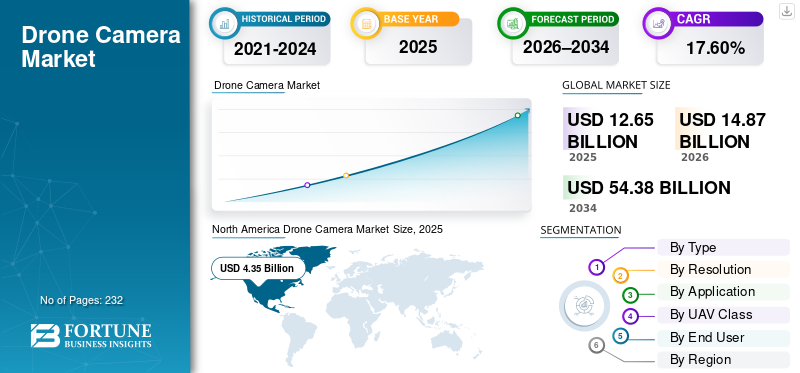
The global drone camera market size was valued at USD 12.65 billion in 2025 and is projected to grow from USD 14.87 billion in 2026 to USD 54.38 billion by 2034, exhibiting a CAGR of 17.60% during the forecast period. North America dominated the Drone camera market with a 34.39% market share in 2025. The industry growth is driven by aerial imaging expansion, defense applications, and technological advancements in drone technology.
The drone camera market encompasses high-definition, thermal, and multispectral imaging systems integrated into Unmanned Aerial Vehicles (UAVs) for aerial capture. These cameras enable photography, videography, surveillance, agriculture monitoring, infrastructure inspection, and emergency response applications. Growth is propelled by technological advancements such as AI-powered aerial imaging, rising demand for precision in filming and farming, and expanded use in security and mapping.
Key players include DJI, which leads with Mavic series drones featuring 4K cameras and obstacle avoidance for videography, Autel Robotics, which offers Evo models with stabilized high-resolution sensors for photographers, Skydio, developing autonomous X10 drones for enterprise inspections, and others.
Download Free sample to learn more about this report.
DRONE CAMERA MARKET KEY TAKEAWAYS
 Global Market Size & Forecast
- 2025 Market Size: USD 12.65 billion
- 2026 Market Size: USD 14.87 billion
- 2034 Forecast Market Size: USD 54.38 billion
- CAGR: 17.6% from 2026–2034
 Market Share
- North America dominated the market with a 34.39% share in 2025.
- The RGB/EO (Visible) segment held the largest market share by type.
- The Defense & Intelligence Organizations segment dominated the market by end user.
 Key Regional Highlights
North America
The market reached USD 4.35 billion in 2025 and is projected to grow further, driven by commercial drone adoption, defense investments, and favorable FAA regulations.
Asia Pacific
The market is projected to reach USD 4.49 billion in 2026, supported by strong demand across agriculture, surveillance, and infrastructure applications.
Europe
The market is expected to reach USD 3.27 billion in 2026, expanding at a 18.07% CAGR through increasing adoption in public safety, environmental monitoring, and smart city projects.
U.S.
The market is projected to reach USD 3.24 billion by 2026, driven by FAA approvals, defense investments, and autonomous drone innovations.
Japan
The market is projected to reach USD 0.78 billion by 2026, supported by precision agriculture, disaster response applications, and regulatory reforms.
Read More

Drone Camera Market Trends
Real-Time Image Analysis and Obstacle Avoidance Technology is a Market Trend
Real-time image analysis and obstacle avoidance represent the latest trends in drone camera technology, powered by AI and edge computing for onboard processing. Real-time analysis enables drones to instantly perform object detection, identify anomalies, and provide data insights during flights, supporting applications such as disaster assessment, crop monitoring, and security surveillance without cloud delays. Obstacle avoidance uses high-speed LiDAR sensors, intelligent algorithms, and sensor fusion to map environments, predict collisions, and execute evasive maneuvers in complex spaces. Furthermore, these advancements enhance autonomy, safety, and efficiency in industries such as agriculture, construction, and inspections.
The global drone camera market is experiencing accelerated expansion driven by increasing demand for drones across commercial, industrial, and defense applications. The drone camera market size is growing steadily as organizations adopt drones equipped with high-resolution cameras for advanced aerial imaging and data capture. This shift reflects a broader transition toward automated monitoring, surveillance, and analytics-driven decision-making.
Technological advancements are reshaping the global drone camera market, particularly in sensor miniaturization, image processing, and real-time data transmission. High-resolution image capabilities are becoming a standard requirement across sectors such as public safety, agriculture, and infrastructure inspection. As a result, the drone camera market share is increasingly concentrated among providers offering integrated hardware and software solutions.
The defense sector remains a major contributor to drone camera market growth. Governments are deploying drones equipped with thermal and multispectral imaging systems for surveillance, reconnaissance, and combat support missions. These applications require high-performance cameras capable of operating in diverse environmental conditions, reinforcing demand for advanced payload technologies.
Commercial adoption continues to expand, particularly in crop monitoring, construction, and environmental assessment. Enterprises are integrating drone technology into operational workflows to improve efficiency and reduce costs. North America remains a leading region, supported by strong regulatory frameworks and early adoption of advanced drone systems. Drone camera market trends indicate a shift toward intelligent imaging systems, combining artificial intelligence with high-resolution cameras to enable automated analytics. This evolution is expected to drive sustained growth rate improvements and redefine competitive positioning across the global drone camera market.
Download Free sample to learn more about this report.
Key Market Dynamics
Market Drivers
Surging Adoption Across the Agriculture Sector is Anticipated to Drive Market Growth
Surging adoption of drone cameras in agriculture drives the drone camera market growth by enabling precision farming through multispectral and thermal imaging for crop health assessment, revealing stress from pests, diseases, or nutrient deficiencies early. Farmers leverage aerial views to optimize irrigation by mapping soil moisture variations, applying fertilizers and pesticides selectively to reduce waste, and monitoring growth patterns across vast fields efficiently. This technology supports livestock tracking, field surveying for drainage and topography, and environmental conservation efforts, including erosion control, enhancing resource management, and sustainability without labor-intensive ground inspections.
The drone camera market growth is primarily driven by rising demand for drones across commercial, industrial, and defense applications. Organizations are increasingly adopting drones equipped with high-resolution cameras to enhance aerial imaging capabilities and operational efficiency. This demand is particularly strong in sectors such as infrastructure inspection, agriculture, and public safety, where real-time visual intelligence is critical.
Technological advancements in drone technology are significantly improving camera performance. Innovations in sensor design, image stabilization, and data transmission enable high-resolution image capture under complex conditions. These improvements are expanding use cases and accelerating adoption across both enterprise and government sectors. The defense sector remains a major growth driver. Military forces are deploying advanced drone cameras for surveillance, reconnaissance, and combat support missions. These applications require reliable imaging systems capable of operating in low-visibility and high-risk environments, driving demand for thermal and multispectral cameras.
Increasing use of drones for crop monitoring is also contributing to market expansion. Farmers are leveraging drone-based aerial imaging to assess crop health, optimize resource allocation, and improve yield outcomes. This trend supports broader adoption in precision agriculture. Additionally, regulatory support in regions such as North America is facilitating wider deployment. Clear guidelines for drone operations are encouraging enterprises to integrate drone cameras into routine workflows, reinforcing sustained drone camera market growth.
Market Restraints
Stringent Regulatory In No-Fly Zones Is a Market Restraint
Stringent regulations on no-fly zones restrain the drone camera market by prohibiting operations near airports, military installations, international borders, and densely populated areas to safeguard air traffic, national security, and public privacy. For instance, in India, the DGCA enforces color-coded airspace via the Digital Sky platform, designating red zones as complete no-fly areas requiring central government approval, yellow zones needing prior air traffic control permission, and restricting flights over sensitive sites without unique identification numbers or flight plans. These rules demand remote pilot certifications, real-time tracking, and compliance checks before each flight, delaying deployments and limiting commercial applications such as agriculture surveillance and inspections in urban vicinities.
The drone camera market faces several constraints related to regulatory complexity, operational limitations, and cost considerations. Airspace regulations remain a primary barrier, particularly for beyond visual line of sight operations. Compliance requirements vary across regions, creating uncertainty for commercial deployments and limiting the scalability of drone-based aerial imaging solutions.
High initial investment costs also restrict adoption among small and medium enterprises. Advanced drones equipped with high-resolution cameras and specialized sensors require significant capital expenditure. Additional costs related to maintenance, training, and software integration further increase total ownership expenses, impacting overall drone camera market size expansion.
Privacy and data security concerns present additional challenges. The use of drone cameras for surveillance and public safety raises regulatory scrutiny and public resistance. Organizations must implement strict data governance frameworks, which can increase operational complexity and slow adoption rates. Technical limitations, including battery life and payload constraints, affect operational efficiency. Limited flight duration restricts coverage area, particularly for large-scale surveying and monitoring applications. Environmental factors such as weather conditions can also impact performance and reliability.
Furthermore, supply chain disruptions and component shortages may affect production timelines. Dependence on specialized imaging sensors and electronic components increases vulnerability to global supply fluctuations, constraining consistent drone camera market growth.
Market Opportunities
Emerging Uses in Environmental Conservation Create New Market Opportunities
Emerging uses of drone cameras in environmental conservation present significant market opportunities by enabling non-invasive wildlife population surveys, habitat mapping, and tracking of endangered species through high-resolution and thermal imaging without disturbing natural behaviors. These HD cameras detect deforestation patterns, monitor forest health for disease or pest outbreaks, and assess erosion or vegetation regrowth via multispectral sensors, supporting restoration projects in remote areas. Applications extend to water quality analysis, pollution tracking, coastal ecosystem surveillance, and anti-poaching patrols with night-vision capabilities, aiding rapid response and sustainable management across diverse ecosystems.
The drone camera market presents substantial opportunities driven by expanding use cases and increasing demand for drones across multiple sectors. Growth in aerial imaging applications, particularly in infrastructure inspection and environmental monitoring, is creating new revenue streams. Organizations are adopting drones equipped with high-resolution cameras to improve efficiency, reduce operational costs, and enhance data accuracy.
The defense sector offers significant long-term opportunities. Governments are investing in advanced drone technology for surveillance, reconnaissance, and combat support missions. This creates sustained demand for high-performance imaging systems capable of operating in diverse and challenging environments. Integration of thermal, hyperspectral, and low-light cameras further enhances operational capabilities.
Agriculture remains a high-growth opportunity area, particularly for crop monitoring and precision farming. Drones equipped with multispectral and high-resolution image sensors enable farmers to optimize irrigation, detect disease, and improve yield management. This application is expanding rapidly across both developed and emerging markets.
Urban development and smart city initiatives are also driving demand. Drone cameras are increasingly used for mapping, construction monitoring, and public safety operations. These applications support efficient planning and real-time situational awareness. Additionally, advancements in autonomous flight systems are unlocking new opportunities. Fully automated drones reduce reliance on skilled operators, enabling scalable deployment and accelerating overall drone camera market growth.
Market Challenges
Operator Certification Processes Present a Major Market Challenge
Operator certification processes present a major market challenge in the drone camera sector by imposing rigorous training, examinations, and documentation requirements that delay commercial operations. In India, aspiring pilots must complete courses at DGCA-approved Remote Pilot Training Organizations, pass online assessments, and secure Remote Pilot Certificates valid for ten years, alongside mandatory drone registration on the Digital Sky platform. Varying global standards, such as FAA Part 107 in the U.S., requiring aeronautical knowledge tests, create inconsistencies that burden multinational operators with repeated compliance efforts and high training costs. These hurdles limit workforce scalability and accessibility for small enterprises seeking to deploy camera-equipped drones.
Market Segmentation Analysis
By Type
Versatility in Applications to Boost RGB/EO (visible) Segmental Growth
Based on type, the market is segmented into RGB/EO (visible), thermal/IR, multispectral, hyperspectral, low-light / NIR (night-optimized visible), and hybrid payloads.
RGB/EO (Visible)
The RGB/EO (visible) segment is anticipated to account for the largest drone camera market share as these types of cameras are highly versatile and also serve as the primary tool for high resolution in aerial photography, real estate, video production, construction monitoring, agricultural mapping, and others.
RGB/EO cameras dominate the drone camera market share due to their versatility and cost efficiency. These systems support high-resolution image capture for aerial imaging, mapping, and inspection tasks. Widely adopted drones in construction, agriculture, and public safety rely on visible spectrum imaging for routine operations. Continuous improvements in sensor quality and stabilization enhance performance. This segment contributes significantly to the drone camera market size, driven by broad commercial adoption.
Thermal/IR
Thermal and infrared cameras are critical for applications requiring visibility in low-light or obscured conditions. These systems are extensively used in the defense sector, public safety, and industrial inspection. Drones equipped with thermal imaging enable the detection of heat signatures, supporting surveillance, firefighting, and search operations. Demand is increasing due to expanding use in critical infrastructure monitoring, contributing to strong drone camera market growth.
Multispectral
Multispectral cameras are gaining traction in agriculture, particularly for crop monitoring and environmental analysis. These systems capture data across multiple wavelengths, enabling precise assessment of vegetation health and soil conditions. Adoption is driven by the need for data-driven decision-making in precision farming. This segment is expanding steadily, supported by increasing demand for drones in agricultural applications.
Hyperspectral
The hyperspectral segment is anticipated to rise with a CAGR of 18.30% over the forecast period. Hyperspectral imaging represents an advanced segment with high analytical capability. These cameras capture detailed spectral information, supporting applications in environmental monitoring, mineral exploration, and defense. Although adoption remains limited due to cost, the segment offers strong long-term growth potential as technological advancements reduce complexity and improve affordability.
Low-light / NIR (Night-Optimized Visible)
Low-light and near-infrared cameras are designed for night operations and challenging visibility conditions. These systems are widely used in surveillance, security, and defense applications. Improvements in sensor sensitivity and image processing are enhancing performance, supporting broader adoption across public safety and commercial sectors.
Hybrid Payloads
Hybrid payloads integrate multiple camera types within a single system, enabling comprehensive data capture. These configurations are increasingly preferred for complex missions requiring combined imaging capabilities. Demand is rising across defense, disaster management, and advanced surveying applications. Hybrid systems enhance operational efficiency and represent a key trend in the global drone camera market.
By Resolution
High Affordability Boosted 12–20 MP Segment Growth
Based on resolution, the market is segmented into Up to 12 MP, 12–20 MP, 20–48 MP, and 48 MP and above.
Up to 12 MP
Cameras with resolution up to 12 megapixels are widely used in entry-level and basic commercial applications. These systems support standard aerial imaging tasks, including monitoring and inspection. Their affordability drives adoption among SMEs and service providers. While contributing to unit volume, this segment accounts for a smaller share of the overall drone camera market size due to lower pricing.
12–20 MP
In 2025, the 12–20 MP segment dominated the global market as drones with integrated 12-20 MP cameras are frequently less expensive than those with specialist or ultra-high resolution cameras, such as expensive 32 MP or above multispectral or LiDAR systems.
The 12 to 20 megapixel segment represents a balance between performance and cost. These cameras are commonly used in professional applications such as surveying and mapping. Improved image clarity and reliability support broader enterprise adoption. This segment contributes significantly to drone camera market growth as demand for mid-range solutions increases.
20–48 MP
High-resolution cameras within the 20 to 48 megapixel range are increasingly preferred for advanced applications. These systems deliver detailed imagery suitable for infrastructure inspection, urban planning, and precision agriculture. Enterprises prioritize this segment for its ability to generate high-resolution image data, supporting analytics-driven decision-making. This category is expanding rapidly within the global drone camera market.
48 MP and Above
The 48 MP and above segment is projected to grow at a high CAGR of 19.07% over the forecast period. Ultra-high-resolution cameras above 48 megapixels represent the premium segment. These systems are used in specialized applications requiring exceptional image quality and detail. Adoption is driven by defense, research, and high-precision surveying requirements. Although volumes are limited, this segment contributes disproportionately to revenue and influences overall drone camera market share dynamics.
By Application
Crucial Role in Modern Warfare & ISR to Boost Combat and Combat Support Missions Segment Growth
Based on application, the market is segmented into perimeter security & border management, combat and combat support missions, situational awareness, disaster management & first responders, surveying, mapping & monitoring, precision agricultural management, power station management, asset & operations management, emergency medical logistics, and others.
Perimeter Security & Border Management
Drone cameras are widely used in perimeter security and border management for continuous surveillance and threat detection. High-resolution cameras and thermal imaging enable real-time monitoring across large areas. Governments are increasingly deploying drones equipped with advanced imaging systems to enhance situational awareness. This segment contributes significantly to drone camera market growth.
Combat and Combat Support Missions
The combat and combat support missions segment is anticipated to witness a dominating market share over the forecast period. Combat drones use radar pods, laser-guided weapons, and Electro-Optical/Infrared (EO/IR) cameras for real-time intelligence, surveillance, and reconnaissance (ISR) and have critical role which boosts the segmental growth.
The defense sector drives demand for drone cameras in combat and support missions. These systems provide critical intelligence, surveillance, and reconnaissance capabilities. Advanced imaging technologies, including thermal and multispectral cameras, support operations in complex environments. This segment represents a high-value contributor to the global drone camera market.
Situational Awareness
Situational awareness applications span public safety, disaster response, and infrastructure monitoring. Drone cameras provide real-time visual data, enabling faster decision-making. High-resolution image capabilities and live data transmission enhance operational efficiency. This segment is expanding as organizations increasingly adopt drones for monitoring and emergency response.
Disaster Management & First Responders
Drone cameras play a crucial role in disaster management and emergency response. These systems enable rapid assessment of affected areas, supporting rescue and recovery operations. Thermal and low-light cameras enhance visibility in challenging conditions. Increasing focus on public safety is driving adoption within this segment.
Surveying
Surveying applications rely heavily on drone-based aerial imaging for mapping and data collection. High-resolution cameras and multispectral systems enable accurate measurement and analysis. Adoption is strong across construction, mining, and agriculture. This segment contributes significantly to the drone camera market size.
Asset & Operations Management Segment
The asset & operations management segment is projected to grow at a high CAGR of 17.85% over the forecast period.
By UAV Class
High Surveillance and Payload Capacity to Boost Tactical UAVs (MALE & HALE) Segment Growth
Based on UAV class, the market is segmented into micro UAVs (below 2 Kg), mini UAVs (2-20 Kg), small UAVs (20-50 Kg), and tactical UAVs (MALE & HALE).
Micro UAVs (Below 2 Kg)
Micro UAVs are widely adopted due to regulatory flexibility and ease of operation. These platforms support basic aerial imaging tasks and are commonly used in commercial and recreational applications. Their lower payload capacity limits advanced camera integration, but affordability drives high unit volumes within the drone camera market.
Mini UAVs (2–20 Kg)
Mini UAVs represent the core commercial segment, balancing payload capacity and operational efficiency. These platforms support integration of high-resolution cameras and multispectral sensors. Widely used in agriculture, inspection, and surveying, this segment contributes significantly to the drone camera market size and growth.
Small UAVs (20–50 Kg)
The small UAVs (20-50 Kg) segment is projected to grow at a high CAGR of 17.73% over the forecast period. Small UAVs are designed for more demanding applications requiring higher payload capacity and extended flight duration. These systems are used in industrial inspection, defense, and large-scale surveying. Adoption is driven by performance requirements and advanced imaging capabilities.
Tactical UAVs
The tactical UAVs (MALE & HALE) segment is anticipated to witness a dominating market share over the forecast period. The segmental dominance is owing to their exceptional capacity to integrate heavy-payload, high-resolution image capabilities with constant surveillance. Tactical UAVs are primarily used in defense and security applications. These platforms support long-range operations and integration of advanced imaging systems. High cost and regulatory complexity limit widespread adoption, but the segment contributes significantly to revenue within the global drone camera market.
To know how our report can help streamline your business, Speak to Analyst
By End User
Increased Real-Time Surveillance to Boost Defense & Intelligence Organizations Segment
Based on end user, the market is segmented into commercial & enterprise operators, agriculture operators, public safety agencies, defense & intelligence organizations, research & academia, energy, power, oil & gas, and others.
Defense & Intelligence Organizations
The defense & intelligence organizations segment dominated the segmental market share. One of the main factors driving the segment is increased real-time surveillance, which turns Unmanned Aerial Vehicles (UAVs) from mere data gatherers into vital, useful intelligence instruments. The defense & intelligence organizations are driving demand for advanced drone cameras. Applications include surveillance, reconnaissance, and public safety operations. High-performance imaging systems are critical for mission success, supporting sustained drone camera market growth.
Commercial Enterprises
Commercial enterprises account for a significant share of the drone camera market. Industries such as agriculture, construction, and logistics are adopting drones for operational efficiency and data-driven insights. Demand for high-resolution cameras and advanced imaging capabilities is increasing across these sectors.
Media & Entertainment
The media and entertainment industry uses drone cameras for aerial photography and video production. High-resolution image capabilities and stabilization technologies are essential for content creation. This segment contributes to market diversification and innovation.
In addition, agriculture operators are projected to grow at a high CAGR of 18.14% during the study period.
Drone Camera Market Regional Outlook
By geography, the market is categorized into Europe, North America, Asia Pacific, and the rest of the world.
North America Drone Camera Market Analysis
North America Drone Camera Market Size, 2025 (USD Billion)
To get more information on the regional analysis of this market, Download Free sample
North America held the dominant share in 2024, valued at USD 3.68 billion, and also maintained the leading share in 2025, with USD 4.35 billion. North America leads drone camera growth, fueled by FAA regulations enabling commercial flights, military investments, and others. North America holds a leading position in the global drone camera market, driven by strong demand for drones across commercial and defense applications. Advanced regulatory frameworks support widespread adoption of drone technology. Public safety and infrastructure inspection are key demand drivers. Technological advancements and early adoption of high-resolution cameras reinforce regional drone camera market share and sustained market growth.
United States Drone Camera Market
Based on North America’s strong contribution and the U.S. dominance within the region, the U.S. market can be analytically approximated at around USD 3.24 billion in 2026, accounting for roughly 17.42% CAGR. U.S. growth stems from FAA approvals, defense sector adoption, and R&D in Silicon Valley; also, key players, including Skydio, launched autonomous drones for inspections, which boosts the growth.
The United States dominates the North America drone camera market, supported by strong investments in the defense sector and public safety operations. High adoption of drones equipped with advanced imaging systems drives market expansion. Enterprises increasingly use drone cameras for aerial imaging and inspection. Continuous technological advancements and favorable regulatory policies contribute to steady drone camera market growth and increasing market size.
Europe Drone Camera Market Analysis
Europe is projected to record a steady growth rate during the forecast period of 18.07%, which is the second highest among all regions, and reach a valuation of USD 3.27 billion by 2026. Europe advances via Horizon Europe research funding and Smart Cities initiatives promoting urban drone uses; Parrot innovates thermal cameras for agriculture.
Europe demonstrates steady expansion in the drone camera market, supported by regulatory harmonization and increasing adoption across industries. Applications in environmental monitoring, infrastructure inspection, and public safety drive demand. Technological advancements in drone technology enhance operational capabilities. The region emphasizes data privacy and compliance, shaping deployment strategies. Overall, Europe maintains a balanced drone camera market growth trajectory.
U.K. Drone Camera Market
The U.K. market in 2026 is estimated at around USD 0.72 billion, representing roughly 17.89% CAGR during the study period. The U.K. benefits from Civil Aviation Authority reforms and e-commerce delivery trials, and consumer demand drives recreational camera drone sales. The United Kingdom drone camera market is expanding steadily, supported by applications in public safety, construction, and media. Adoption of drones equipped with high-resolution cameras is increasing across commercial sectors. Regulatory frameworks enable controlled deployment while ensuring compliance. Technological advancements in aerial imaging enhance operational efficiency. The market reflects stable growth driven by diversified application demand and innovation.
Germany Drone Camera Market
Germany is a key contributor to the European drone camera market, driven by strong industrial and technological capabilities. Adoption of drones for infrastructure inspection, manufacturing, and environmental monitoring is increasing. High-resolution cameras and advanced imaging systems support precision applications. Government initiatives and regulatory clarity facilitate adoption. Germany’s focus on innovation strengthens its position within the global drone camera market.
Asia-Pacific Drone CameraThe Market Analysis
Asia Pacific region is estimated to reach USD 4.49 billion in 2026 and secure the position of the third-largest region in the market and be the fastest growing during the study period. Asia Pacific expands through technical progress in agriculture and surveillance; China, Japan, and India lead with domestic manufacturing and policy support.
Asia-Pacific represents the fastest-growing region in the global drone camera market, driven by rising demand for drones and expanding industrial applications. Countries such as China, Japan, and India are investing in drone technology. Agriculture, surveillance, and infrastructure projects support adoption. Technological advancements and cost-effective manufacturing contribute to increasing the drone camera market share and strong market growth.
Japan Drone Camera Market
The Japanese market in 2026 is estimated at around USD 0.78 billion, accounting for roughly 18.09% of the CAGR during the forecast period. Japan focuses on precision agriculture and disaster response drones; Yamaha develops rice paddy inspection models amid regulatory BVLOS reforms.
Japan’s drone camera market is driven by technological innovation and strong adoption in agriculture and infrastructure inspection. Drones equipped with high-resolution cameras are widely used for crop monitoring and precision farming. The country emphasizes advanced imaging solutions and automation. Regulatory support and industrial expertise contribute to steady drone camera market growth and increasing market size.
China Drone Camera Market
China’s market is projected to be one of the largest in the Asia Pacific, with 2026 revenues estimated at around USD 1.62 billion. China thrives on DJI and Autel Robotics dominance, AI enhancements for mapping and delivery, backed by smart city and defense policies. China plays a dominant role in the global drone camera market, supported by large-scale manufacturing and strong domestic demand. The country leads in the production of drones equipped with high-resolution cameras. Applications span agriculture, surveillance, and logistics. Competitive pricing and technological advancements drive global market share expansion. China remains central to overall drone camera market growth.
India Drone Camera Market
The Indian market in 2026 is estimated at around USD 1.06 billion. India surges with Drone Shakti, PLI scheme incentives, and a rise in budget allocation for manufacturing. Key player Garuda Aerospace introduced farming cameras, which boost the growth.
Latin America, Middle East & Africa Drone Camera Market Analysis
Latin America’s drone camera market is developing steadily, driven by adoption in agriculture, mining, and infrastructure sectors. Crop monitoring applications are particularly significant, supporting demand for aerial imaging solutions. Regulatory frameworks are evolving, enabling broader deployment. Increasing awareness of drone technology benefits contributes to gradual market growth and expansion of the drone camera market size across the region.
The Middle East and Africa drone camera market is growing moderately, supported by applications in public safety, surveillance, and infrastructure monitoring. Governments are investing in drones equipped with advanced imaging systems. Adoption is increasing in the defense and security sectors. Technological advancements and expanding use cases contribute to steady drone camera market growth across the region. The Middle East & Africa and Latin America markets are set to reach a valuation of USD 1.23 billion and USD 0.78 billion in 2026.
Drone Camera Industry Competitive Landscape
Key Industry Players
Technological Innovations by Key Companies Assist in Increasing Market Share
The drone camera market remains consolidated, with dominant players including DJI, Skydio, Autel Robotics, Parrot, and Draganfly commanding shares through advanced and high-quality imaging platforms.
Technological innovations accelerate expansion as DJI advances the Mavic series with AI-enhanced 360-degree sensors and obstacle sensing for cinematic capture, Skydio launches X10 drones featuring 6K thermal imaging for autonomous inspections, and Autel Robotics develops Evo Lite+ models with interchangeable multispectral lenses for precision agriculture. Parrot introduces Anafi Ai with real-time analytics for mapping, while Draganfly upgrades the Commander series for public safety surveillance with extended endurance payloads. These advancements meet demand for drones in agriculture monitoring, infrastructure assessment, and aerial cinematography.
The global drone camera market is characterized by intense competition, with a mix of established technology providers and emerging innovators shaping market dynamics. Market share is concentrated among leading manufacturers that combine advanced drone technology with high-resolution cameras and integrated software ecosystems. These companies focus on delivering end-to-end solutions that enhance aerial imaging performance and operational efficiency.
Key players emphasize continuous technological advancements to maintain competitive positioning. Innovations in sensor miniaturization, image stabilization, and artificial intelligence integration are critical differentiators. Companies are investing in research and development to enhance high-resolution image capabilities and support complex applications across public safety, infrastructure inspection, and the defense sector.
Strategic partnerships are increasingly common across the global drone camera market. Collaborations between hardware manufacturers, software developers, and analytics providers enable the creation of integrated platforms. These partnerships enhance data processing capabilities and support the scalable deployment of drones equipped with advanced imaging systems. As a result, competitive dynamics are shifting toward ecosystem-based offerings rather than standalone hardware.
North America remains a key hub for innovation, supported by strong investment in drone technology and early adoption across commercial and government sectors. Companies in this region focus on advanced analytics, autonomous flight systems, and regulatory compliance solutions. Meanwhile, Asia-Pacific players leverage cost advantages and manufacturing scale to expand global market share.
Emerging players are targeting niche segments, including multispectral and hyperspectral imaging. These companies focus on specialized applications such as crop monitoring and environmental analysis. Competitive strategies increasingly prioritize differentiation through application-specific solutions, enabling sustained drone camera market growth and diversification across end-user industries.
LIST OF KEY DRONE CAMERA COMPANIES PROFILED IN REPORT
- DJI (China)
- Skydio (U.S.)
- Autel Robotics (China)
- Parrot SA (France)
- Draganfly (Canada)
- Freefly Systems (U.S.)
- AeroVironment (U.S.)
- Garuda Aerospace (India)
- JOUAV (China)
- Teledyne FLIR (U.S.)
Drone Camera Industry Developments
- January 2026: Eastern Coalfields Ltd. (ECL), a subsidiary of Coal India, has used AI-powered drone technology to investigate environmental restoration through scientific land reclamation operations in the Sonepur-Bazari region of West Bengal.
- March 2025: Skydio partnership with defense agencies for autonomous drone deployment: Enhancing capabilities in surveillance and reconnaissance: Implementation of autonomous navigation and real-time imaging technologies
- February 2025: DJI launches next-generation drone cameras with enhanced imaging capabilities: Strengthening leadership in aerial imaging solutions: Integration of high-resolution cameras, AI-based image processing, and improved stabilization systems
- November 2024: Teledyne FLIR introduction of advanced thermal imaging payloads: Expanding presence in defense and public safety applications, development of high-sensitivity thermal sensors, and multi-sensor integration technologies
- July 2024: Parrot expansion of enterprise drone camera portfolio: Targeting commercial and industrial applications: Deployment of AI-enabled imaging systems and cloud-based data analytics platforms
- September 2024: Sony: Development of ultra-high-resolution drone camera sensors: Strengthening position in imaging technology: Advancements in sensor design, low-light performance, and high-resolution image capture capabilities
REPORT COVERAGE
Request for Customization to gain extensive market insights.
Report Scope & Segmentation
|
ATTRIBUTE |
DETAILS |
|
Study Period |
2021-2034 |
|
Base Year |
2025 |
|
Estimated Year |
2026 |
|
Forecast Period |
2026-2034 |
|
Historical Period |
2021-2024 |
|
Growth Rate |
CAGR of 17.60% from 2026-2034 |
|
Unit |
Value (USD Billion) |
|
Segmentation |
By Type, Resolution, Application, UAV Class, End User, and Region |
|
By Type |
· RGB/EO (visible) · Thermal/IR · Multispectral · Hyperspectral · Low-light / NIR (night-optimized visible) · Hybrid payloads |
|
By Resolution |
· Up to 12 MP · 12–20 MP · 20–48 MP · 48 MP and above |
|
By Application |
· Perimeter Security & Border Management · Combat and Combat Support Missions · Situational Awareness, Disaster Management & First Responders · Surveying, Mapping, & Monitoring · Precision Agricultural Management · Power Station Management · Asset & Operations Management · Emergency Medical Logistics · Others |
|
By UAV Class |
· Micro UAVs (Below 2 Kg) · Mini UAVs (2-20 Kg) · Small UAVs (20-50 Kg) · Tactical UAVs (MALE & HALE) |
|
By End User |
· Commercial & enterprise operators · Agriculture Operators · Public Safety Agencies · Defense & Intelligence Organizations · Research & Academia · Energy, Power, Oil & Gas · Others |
|
By Region |
· North America (By Type, Resolution, Application, UAV Class, End User, and Country) o U.S. (End User) o Canada (End User) · Europe (By Type, Resolution, Application, UAV Class, End User, and Country/Sub-region) o U.K. (End User) o Germany (End User) o France (End User) o Russia (End User) o Italy (End User) o Spain (End User) o Rest of Europe (End User) · Asia Pacific (By Type, Resolution, Application, UAV Class, End User, and Country/Sub-region) o China (End User) o India (End User) o Japan (End User) o South Korea (End User) o Rest of Asia Pacific (End User) · Rest of the World (By Type, Resolution, Application, UAV Class, End User, and Country/Sub-region) o Middle East & Africa (End User) o Latin America (End User) |
Frequently Asked Questions
According to Fortune Business Insights, the global market value stood at USD 12.65 billion in 2025 and is projected to reach USD 54.38 billion by 2034.
In 2025, North Americas market value stood at USD 4.35 billion.
The market is expected to grow at a CAGR of 17.60% during the forecast period of 2026-2034.
By type, the RGB/EO (visible) segment is expected to dominate the market.
Surging adoption across agriculture sector is anticipated to drive market growth.
DJI, Skydio, Autel Robotics, Parrot, Draganfly are few key players in the global market.
North America held the largest market share in 2025.



- 2021-2034
- 2025
- 2021-2024
- 232
-
(Offer valid till 15th Oct 2026)
Get 30-60 hrs Free Customization
Expand Regional and Country Coverage, Segments Analysis, Company Profiles, Competitive Benchmarking, and End-user Insights.




















Related Reports
-
US +1 833 909 2966 ( Toll Free )
-
Get In Touch With Us