Dual-Fuel Marine Engines Market Size, Share & Industry Analysis, By Fuel Type (LNG-Diesel Dual Fuel, LPG-Diesel Dual Fuel, Methanol-Diesel Dual Fuel, and Ammonia-Diesel Dual Fuel), By Engine Technology (Low-Pressure Dual-Fuel Engines, High-Pressure Dual-Fuel Engines, and Two-Stroke Dual-Fuel Engines), By Engine Power Rating (Below 1,000 kW, 1,001-10,000 kW, and Above 60,000 kW), By Vessel Type (Container Ships, Tankers, Bulk Carriers, Offshore Support Vessels, and Naval Vessels), By Sales Channel (OEM Direct Sales, Spare Parts Aftermarket, and MRO Services), and Regional Forecast, 2026-2034
 Download Free Sample
Dual-Fuel Marine Engines Market Size and Future Outlook
 Listen to Audio Version
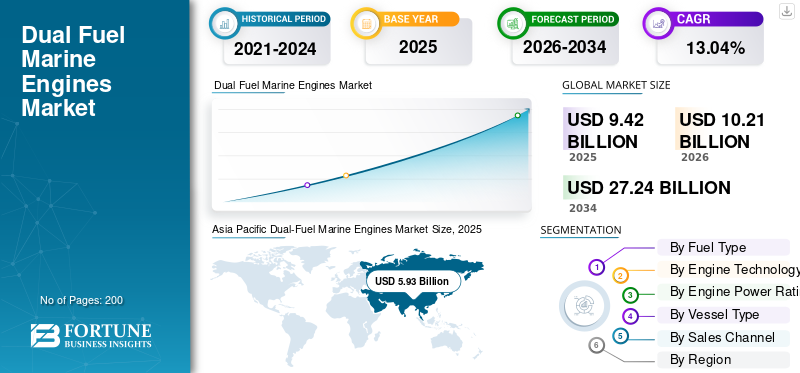
The dual-fuel marine engines market size was valued at USD 9.42 billion in 2025. The market is projected to grow from USD 10.21 billion in 2026 to USD 27.24 billion by 2034, exhibiting a CAGR of 13.04% during the forecast period. Asia Pacific dominated the dual fuel marine engines market with a market share of 62.95% in 2025.
The market covers propulsion systems and auxiliary engines that can operate on conventional marine fuels, diesel and natural gas as well as alternative fuels such as LNG, methanol, LPG, and emerging ammonia. The market is growing as shipowners seek heavy fuel oil consumption flexibility, lower emission control areas, and future-ready vessels that can comply with tightening IMO decarbonization targets without fully locking into one fuel pathway. Some of the market growth drivers include stricter GHG and air-emission standards, rising orders for LNG- and methanol-capable vessels, expansion of alternative-fuel bunkering infrastructure, and fleet operators’ need to protect vessel asset value over a 20–30-year operating life.
Major players in the market are Everllence, Wartsila Corporation, Caterpillar Inc. (MaK), HD Hyundai Engine & Machinery, Yanmar Power Technology Co., Ltd., and China State Shipbuilding Corporation (CSSC). Across the market, leading companies are focusing on multi-fuel engine portfolios, ammonia- and methanol-ready platforms, methane-slip reduction, class approvals, retrofit/conversion solutions, and partnerships with shipyards, fuel-system suppliers, and classification societies to accelerate adoption.
Download Free sample to learn more about this report.
Dual Fuel Marine Engines Market Key Takeaways
 Global Market Size & Forecast
- 2025 Market Size: USD 9.42 billion
- 2026 Market Size: USD 10.21 billion
- 2034 Forecast Market Size: USD 27.24 billion
- CAGR: 13.04% (2026–2034)
 Market Share
- Asia Pacific dominated the market with a 62.95% share in 2025.
- The LNG–diesel dual fuel segment accounted for the largest market share of 48.04% in 2025.
- The two-stroke dual-fuel engines segment held the largest market share of 27.87% in 2025.
 Key Regional Highlights
Asia Pacific
Asia Pacific generated USD 5.93 billion in 2025, maintaining its leading market position.
North America
North America generated USD 0.98 billion in 2025 and is projected to reach USD 1.05 billion in 2026.
Europe
Europe generated USD 1.95 billion in 2025 and is projected to register the fastest growth at a 14.09% CAGR.
U.S.
U.S. market reached USD 0.78 billion in 2025 and is projected to grow at an 11.33% CAGR.
Japan
Japan market reached USD 0.97 billion in 2025 and is projected to grow at an 11.68% CAGR.
Read More

Dual-Fuel Marine Engines Market Trends
Increasing Shift Toward Multi-Fuel, Digitally Connected, and Lower-Emission Engine Portfolios is an Emerging Market Trend
A prominent market trend is that OEMs are no longer promoting dual-fuel engines only as LNG-compliance products; they are building broader fuel-flexible portfolios. LNG remains the most mature fuel route due to existing infrastructure and proven engine operating experience, but methanol and ammonia are becoming strategic options for shipowners that want lower lifecycle emissions exposure.
DNV’s 2026 update showed that alternative-fuel newbuilds still represented 38% of gross tonnage in 2025 despite the broader order slowdown, with container vessels remaining the strongest segment. In container vessels, DNV reported a 2025 fuel mix by tonnage of around 58% LNG, 36% conventional fuels, and 6% methanol, showing that LNG remains dominant but methanol is entering real ordering patterns.
For instance, in February, 2026, Everllence announced a COSCO order that took its cumulative two-stroke dual-fuel engine orders to 2,000, while also stating that just over half of its orderbook by engine power was dual-fuel.
Market Dynamics
MARKET DRIVERS
Download Free sample to learn more about this report.
Decarbonization Rules and Fuel-Flexibility Needs Are Accelerating Market Expansion
The strongest driver for the dual-fuel marine engines market growth is the shipping industry’s sift toward lower-carbon propulsion without losing operational flexibility. IMO’s 2023 GHG Strategy targets net-zero GHG emissions from international shipping by or around 2050 and aims for zero/near-zero GHG fuels to represent at least 5%, striving for 10%, of shipping cleaner energy use by 2030.
This creates direct demand for dual fuel engines that can run on LNG, methanol, LPG, ammonia, or conventional fuel depending on route, fuel availability, and compliance cost. Dual-fuel technology is attractive as shipowners can reduce emissions exposure while still protecting vessel uptime if alternative fuel supply is unavailable. Wärtsilä also highlights that dual-fuel engines allow seamless switching between LNG and conventional liquid fuels, supporting compliance and fuel-cost management.
For instance, in June, 2025, WinGD announced a Taiwanese owner selected XDFM dual-fuel methanol and methanol-ready X-Engine designs for over 30 container vessels, directly linking the order decision to IMO’s Net-Zero Framework and GHG Fuel Intensity standard.
MARKET RESTRAINTS
High System Cost, Fuel Uncertainty, And Regulatory Delay Are Slowing Market Adoption
A major market restraint is that dual-fuel engines require more than a different engine block. They need fuel storage tanks, fuel supply systems, ventilation, safety controls, monitoring equipment, crew training, and often larger onboard space allocation. LNG systems are relatively mature, but methanol and ammonia pathways still face supply-chain, bunkering, safety, and fuel-price uncertainty across many ports.
For shipowners, this increases capex and creates a practical risk as a vessel may be technically future-ready but commercially underused if clean fuel is not available on its operating routes. This is why some owners prefer “ready” or “convertible” designs instead of immediately ordering full alternative-fuel propulsion.
For instance, in October, 2025, IMO’s adjournment of the Net-Zero Framework adoption process became a clear restraining signal for owners waiting for final compliance rules before locking in engine and fuel choices.
MARKET OPPORTUNITIES
Ammonia, Methanol-Ready Vessels, And Retrofit Pathways Are Opening the Growth Opportunities
The biggest opportunity is the shift from LNG-only dual-fuel adoption toward a wider multi-fuel market covering methanol, ammonia, LPG, bio-LNG, and future synthetic fuels. Methanol is gaining traction as it is easier to store than cryogenic fuels and can be integrated into large container vessels with manageable onboard complexity.
Ammonia is more challenging from a safety standpoint, but it offers a strong long-term zero-carbon route if fuel production, bunkering, and onboard safety standards mature. This creates opportunities not only for engine OEMs, but also for fuel-system suppliers, tank designers, control-system providers, class societies, shipyards, and retrofit specialists.
Major OEMs are positioning around platform-based engines rather than one-fuel products. Everllence is commercializing ME-LGIA ammonia dual fuel technology, WinGD is validating X-DF-A ammonia engines, and Wärtsilä is moving ammonia solutions into commercial vessel projects.
For instance, in June, 2026, WinGD announced delivery of ANTWERPEN to EXMAR, described as the world’s first ocean-going vessel designed to operate on ammonia fuel, powered by WinGD’s X52DF-A engine and developed with EXMAR, HD Hyundai Engine Machinery Division, and HD Hyundai Heavy Industries.
MARKET CHALLENGES
Safety Validation, Crew Readiness, And Onboard Integration Challenges Market Development
A key challenge is that next-generation marine fuels are technically viable but operationally demanding. Ammonia is attractive as it emits no CO₂ during combustion, but it is toxic and requires strict control of leaks, ventilation, containment, PPE, emergency response, and crew handling procedures. Methanol is easier to store but still needs dedicated safety and fuel-handling systems, while LNG engines continue to face scrutiny over methane slip and lifecycle emissions. These issues make classification approval, crew training, risk assessment, and port-side emergency readiness central to market growth.
Class societies and IMO are therefore becoming as important as OEMs in market development as safe adoption depends on standards, certification, and operating procedures. IMO issued interim guidelines for ships using ammonia as fuel through MSC.1/Circ.1687 on February, 2025, while ClassNK has emphasized that alternative fuels carry unique risks and that operational information is still limited for ammonia-fueled vessels.
SEGMENTATION ANALYSIS
By Fuel Type
Growing Shift Toward Zero-Carbon Deep-Sea Fuels, Ammonia–Diesel Dual Fuel is the Fastest-Growing
The global market, by fuel type, is classified into LNG–diesel dual fuel, LPG–diesel dual fuel, methanol–diesel dual fuel, ammonia–diesel dual fuel, hydrogen–diesel dual fuel, synthetic E-fuel, multi-fuel engines, and others.
The ammonia–diesel dual fuel segment is estimated to grow at a fastest rate with a CAGR of 16.74% during the forecast period. Shipowners are increasingly looking for a long-term fuel pathway that can support deep-sea decarbonization without fully depending on carbon-based marine fuels, thus promoting segment growth.
The LNG–diesel dual fuel segment accounted for the largest dual-fuel marine engines market share of 48.04% in year 2025. In addition, it is projected to grow at a CAGR of 11.52% during the forecast period.
By Engine Technology
Need for Fuel Flexibility and Combustion Optimization Leads to Variable Compression Ratio Engines Segment Growth
The global market, by engine technology, is segmented into low-pressure dual-fuel engines, high-pressure dual-fuel engines, two-stroke dual-fuel engines, four-stroke dual-fuel engines, Variable Compression Ratio (VCR) engines, High-Pressure Direct-Injection (HPDI) Engines, and others.
The Variable Compression Ratio (VCR) engines segment is predicted to grow at a fastest rate with a CAGR of 16.49% during the forecast period. This is due to dual-fuel marine engines are moving toward more flexible and efficient combustion systems. As vessels operate with LNG, methanol, ammonia, hydrogen blends, and future fuels, engine platforms need better control over combustion behavior, fuel efficiency, knocking risk, emissions, and operating stability.
The two-stroke dual-fuel engines segment held largest market share of 27.87% in 2025. In addition, the segment is projected to grow at a CAGR of 11.91% during the forecast period.
By Engine Power Rating
Above 60,000 kW Engines is the Fastest-Growing Segment Due to Rising Ultra-Large Vessel Orders
The global market, by engine power rating, is divided into below 1,000 kW, 1,001–10,000 kW, 10,001–20,000 kW, 20,001–40,000 kW, 40,001–60,000 kW, and above 60,000 kW.
The above 60,000 kW segment is estimated to grow at a fastest rate with a CAGR of 14.69% during the forecast period. This is attributed to the market being shaped by large container ships, LNG carriers, major tankers, and other high-capacity ocean-going vessels. These vessels require very high-power main engines, and even a small number of orders can generate substantial market value as the engine packages are expensive and technically complex.
The 20,001–40,000 kW segment held a largest market share of 25.49% in 2025. It is projected to grow at a CAGR of 13.23% during the forecast period.
By Vessel Type
Container Ships is Fastest-Growing Segment Owing to Large Fleet Renewal and Alternative-Fuel Newbuild Demand
By vessel type, the market is classified into container ships, tankers, bulk carriers, offshore support vessels, naval vessels, cargo vessels, ferries, fishing vessels, tugboats and harbor craft, and yachts and pleasure crafts.
The container ships segment is probable to grow at fastest rate with a CAGR of 14.17% during the forecast period. In addition, this segment also held largest market share of 31.50% in year 2025. Liner operators are among the most active buyers of LNG- and methanol-capable dual-fuel vessels. Container shipping companies face strong pressure from cargo owners, regulators, and green corridor initiatives, so they are moving faster than many other vessel categories in adopting lower-carbon propulsion options.
The tankers segment accounted for the second-largest market share of 17.69% in 2025. It is projected to grow at a CAGR of 13.66% during the forecast period.
By Sales Channel
To know how our report can help streamline your business, Speak to Analyst
Due to Expanding Installed Fleet and Lifecycle Service Needs, MRO Services are the Fastest-Growing
The global market by sales channel is classified into OEM direct engine sales, licensed engine builder production, spare parts aftermarket, and MRO services.
The MRO services is estimated to be the fastest growing segment with a highest CAGR of 14.55% during the forecast period. This is due to the market is moving from early newbuild adoption toward a larger operating fleet. As more LNG, methanol-ready, ammonia-ready, and multi-fuel engines enter service, shipowners need recurring maintenance, inspection, calibration, software updates, and fuel-system servicing.
The OEM direct engine sales segment held the largest market share of 35.89% in 2025. It is projected to grow at a CAGR of 12.04% during the forecast period.
Dual-Fuel Marine Engines Market Regional Outlook
By region, the market is categorized into Europe, North America, Asia Pacific, and rest of the world.
North America
Asia Pacific Dual-Fuel Marine Engines Market Size, 2025 (USD Billion)
To get more information on the regional analysis of this market, Download Free sample
North America noticed a significant growth in 2025, valued at USD 0.98 billion, and also will maintain the leading share in 2026, with USD 1.05 billion. U.S. maritime decarbonization plan prioritizes low-GHG fuels such as green methanol and green ammonia for ocean-going vessels, shipowners and port operators are evaluating dual-fuel engines as a practical transition technology rather than waiting for full zero-emission vessels.
U.S. Dual-Fuel Marine ENGINES Market
Based on North America's strong contribution, the U.S. market reached USD 0.78 billion in 2025 and is estimated to have a CAGR of 11.33% during the forecast period.
Europe
Europe is projected to grow at fastest growing rate with a highest CAGR of 14.09% during the forecast period. In 2025, the market value stood at USD 1.95 billion. FuelEU Maritime requires shipping to shift toward renewable and low-carbon fuels, European vessel owners are adopting dual-fuel engines to manage compliance while keeping fuel flexibility. This is pushing demand for methanol- and ammonia-ready vessels, especially in container shipping, ferries, tankers, and short-sea routes where EU port calls make emissions compliance more commercially urgent.
U.K. Dual-Fuel Marine Engines Market
The U.K. market in 2025 was valued at USD 0.27 billion and is estimated to grow at a CAGR of 14.50% during the forecast period.
Germany Dual-Fuel Marine Engines Market
The Germany market in 2025 was at USD 0.48 billion and is projected to grow at a 15.19% CAGR during the forecast period.
Rest of Europe Dual-Fuel Marine Engines Market
The Rest of Europe market growth in 2025 was valued at USD 0.41 billion and is estimated to grow at a rate of 10.75% during the forecast period.
Asia Pacific
The Asia Pacific accounted for the largest market share, was valued at USD 5.93 billion in 2025 and secures the position of the second-largest region in the market. Asia Pacific has the world’s strongest shipbuilding base and major bunkering hubs such as Singapore, the region is moving quickly from engine development to real vessel integration. Singapore’s methanol bunkering standard and Japan’s ammonia-fueled vessel demonstrations are creating the operating rules and technical confidence needed for shipowners to order dual-fuel engines at scale.
China Dual-Fuel Marine Engines Market
The China market in 2025 reached a value of USD 2.28 billion and is estimated to grow at a rate of 12.24% over the forecast period.
South Korea Dual-Fuel Marine Engines Market
The South Korea market in 2025 was at USD 1.82 billion and is predicted to grow at a CAGR of 14.11% during the forecast period.
Japan Dual-Fuel Marine Engines Market
The Japan market in 2025 reached USD 0.97 billion and is probable to grow at a rate of 11.68% over the forecast period.
Rest of World
Rest of World consist Latin America and Middle East & Africa regions and are expected to witness moderate growth during the forecast period. The Latin America market was valued at USD 0.17 billion in 2025. Chile and Brazil have strong renewable energy resources and are developing green hydrogen, ammonia, and renewable methanol pathways, the region is emerging as a future supply base for low-carbon marine fuels.
The Middle East & Africa market was valued at USD 0.38 billion in 2025. Gulf is investing in green hydrogen, ammonia, and alternative marine fuel supply, ports in the UAE, Saudi Arabia, and Oman are positioning themselves as future bunkering hubs for dual-fuel vessels.
COMPETITIVE LANDSCAPE
Key Industry Players
Multi-Fuel Readiness, Class Approval, and Long-Term Fleet Decarbonization Enhances Market Competition
The dual-fuel marine engines market is becoming more technology-led, with competition moving from basic LNG dual-fuel engines toward methanol-ready, ammonia-ready, LPG, and future synthetic-fuel-capable platforms. OEMs are developing engines with better fuel injection, methane-slip control, SCR integration, digital monitoring, and safer fuel-handling systems to support long vessel operating lives. The industry is also growing through closer cooperation among engine makers, shipyards, classification societies, and fleet owners, as alternative-fuel engines need complete vessel-level integration rather than only engine supply.
Overall competition is now focused on proving commercial readiness through real vessel projects, type approvals, factory acceptance tests, and large newbuilding orders. Recent developments show the market moving from concept to execution. This competitive landscape shows that growth will not be driven by one fuel or one company; it will be driven by OEMs that can offer flexible engine architectures, verified safety systems, retrofit options, and lifecycle service support for shipowners facing uncertain fuel availability and tightening emission control areas.
LIST OF KEY DUAL-FUEL MARINE ENGINES COMPANIES PROFILED
- Everllence (Germany)
- Wartsila Corporation (Finland)
- Caterpillar Inc. (MaK) (Germany)
- Hanwha Engine Co., Ltd. (South Korea)
- HD Hyundai Engine & Machinery (South Korea)
- China State Shipbuilding Corporation (CSSC) (China)
- Mitsubishi Heavy Industries (MHI) (Japan)
- Yanmar Power Technology Co., Ltd. (Japan)
- Rolls-Royce Power Systems (MTU) (Germany)
- Anglo Belgian Corporation (ABC) (Belgium)
- WinGD Ltd. (Switzerland)
- Cummins Inc. (U.S.)
- Volvo Penta (Sweden)
- Kawasaki Heavy Industries (Japan)
KEY INDUSTRY DEVELOPMENT
- June 2026: Everllence received an order from Global Car Carriers for 4 × 6S60ME-GI Mk10.7 dual-fuel methane engines. The engines will be built by CSSC Engine in Qingdao and installed on four 8,600 CEU car-carrier vessels under construction at China Merchants Jinling Shipyard, supporting LNG/methane dual-fuel propulsion in the PCTC segment.
- May 2026: Everllence received an engine order through Yantai CIMC Raffles for Hapag-Lloyd’s eight container vessels; the contract value was not disclosed. The scope covers 8 × 6G70ME-C 10.7-LGIM methanol dual-fuel engines, to be built by Hanwha Engine in Korea, with an option for six additional engines.
- January 2026: Wärtsilä received an order from Skarv Shipping Solutions for the Wärtsilä 25 Ammonia engine solution; the contract value was not disclosed. The package includes the ammonia engine, fuel gas supply system, and exhaust after-treatment for a new cargo vessel being built at Huanghai Shipyard in China, with the order booked in Q4 2025.
- December 2025: CIMC Raffles received a contract from Hapag-Lloyd for eight dual-fuel methanol container ships, with an investment volume of more than USD 500 million. The 4,500 TEU vessels are scheduled for delivery in 2028 and 2029 and will use modern dual-fuel methanol engines to improve fleet efficiency and reduced emissions.
- October 2025: Wärtsilä renewed a lifecycle agreement with TMS Cardiff Gas for seven LNG carriers; the contract value was not disclosed. The agreement covers vessels operating with WinGD 5X72DF dual-fuel two-stroke engines and Wärtsilä gas valve units, focusing on maintenance planning, remote support, and operational reliability.
REPORT COVERAGE
The dual-fuel marine engines market analysis includes a comprehensive study of the market size & forecast by all the market segments included in the report. It contains details on the market dynamics and trends expected to drive the market over the forecast period. It provides information on key aspects, including an overview of technological advancements, pipeline candidates, the regulatory environment, and product launches. Additionally, it details partnerships, mergers & acquisitions, as well as key marine industry developments and prevalence by key regions. The market research report also provides a detailed competitive landscape with information on the market share and profiles of key operating players.
Request for Customization to gain extensive market insights.
Report Scope & Segmentation
| ATTRIBUTE | DETAILS |
| Study Period | 2021-2024 |
| Base Year | 2025 |
| Estimated Year | 2026 |
| Forecast Period | 2026-2034 |
| Historical Period | 2021-2024 |
| Growth Rate | CAGR of 13.04% from 2026-2034 |
| Unit | Value (USD Billion) |
|
Segmentation |
By Fuel Type
By Engine Technology
By Engine Power Rating
By Vessel Type
By Sales Channel
By Region
|
Frequently Asked Questions
Fortune Business Insights says that the global market value stood at USD 9.42 billion in 2025 and is projected to reach USD 27.24 billion by 2034.
In 2025, the European market value stood at USD 1.95 billion.
The market is expected to exhibit a CAGR of 13.04% during the forecast period.
The MRO services segment is expected to hold the highest CAGR over the forecast period.
Decarbonization rules and fuel-flexibility needs are accelerating dual-fuel engine adoption and driving the market growth.
Everllence, Wartsila Corporation, Caterpillar Inc. (MaK), HD Hyundai Engine & Machinery, Yanmar Power Technology Co., Ltd., and China State Shipbuilding Corporation (CSSC) are the top key players in the market.
Asia Pacific dominated the market in 2025.



- 2021-2034
- 2025
- 2021-2024
- 200
Get 30-60 hrs Free Customization
Expand Regional and Country Coverage, Segments Analysis, Company Profiles, Competitive Benchmarking, and End-user Insights.




















-
US +1 833 909 2966 ( Toll Free )
-
Get In Touch With Us