E-Diesel Market Size, Share & Industry Analysis, By Technology (ERWGS and Fischer-Tropsch Synthesis), By Application (Automotive, Marine, Industrial, Aviation, and Others), and Regional Forecast, 2026-2034
 Download Free Sample
KEY MARKET INSIGHTS
 Listen to Audio Version
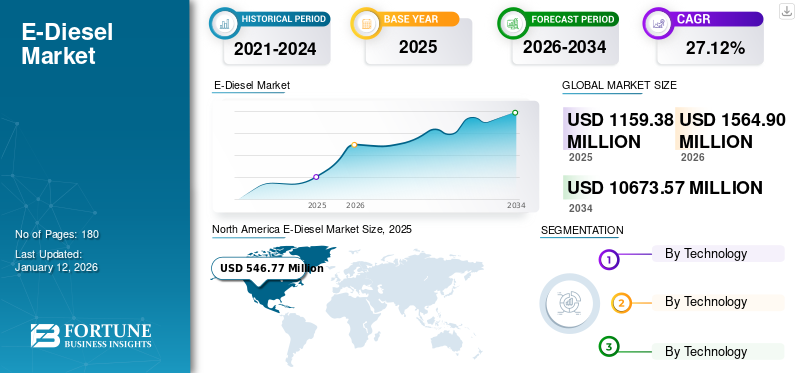
The global e-diesel market size was valued at USD 1,159.38 million in 2025. The market is projected to grow from USD 1,564.90 million in 2026 to USD 10,673.57 million by 2034, exhibiting a CAGR of 27.12% during the forecast period. North America dominated the e-diesel market with a share of 47.16% in 2025.
E-diesel is a synthetic diesel fuel developed from renewable sources such as solar and wind using electricity to generate green hydrogen and carbon dioxide. E-diesel, if generated with 100% renewable sources, can reduce carbon emissions compared to outdated fossil diesel, possibly leading to near-zero emissions in the use phase.
E-diesel is used as a fuel to source automotive, marine, aviation, and other applications. Rising adaptation of renewable sources is creating fresh demand for the e-fuel market globally. Moreover, rising players in the e fuels market are also influencing the demand globally.
Norsk e-Fuel AS is one of the key players holding substantial market share as a project developer aiming to establish the industrial production of sustainable fuels, particularly for aviation, using CO2 and water, and is working on large-scale production sites for synthetic fuels. Market players are more inclined toward development of synthetic fuels which also includes e-diesel to support carbon reduction targets across the globe.
Download Free sample to learn more about this report.
E-DIESEL MARKET Key Takeaways
 Global Market Size & Forecast
- 2025 Market Size: USD 1,159.38 million
- 2026 Market Size: USD 1,564.90 million
- 2034 Forecast Market Size: USD 10,673.57 million
- CAGR: 27.12% from 2026–2034
 Market Share
- North America dominated the e-diesel market with a 47.16% share in 2025.
- Fischer-Tropsch synthesis (FTS) is the dominating segment in the market.
- Automotive sector is the dominating segment and holds a notable e-diesel market share.
 Key Regional Highlights
North America
The market was valued at USD 546.77 million in 2025 and is expected to reach USD 742.47 million in 2026, driven by strong demand for low-carbon fuels across transportation and industrial sectors.
Europe
The region accounted for USD 418.07 million in 2025 and is projected to reach USD 583.38 million in 2026, supported by decarbonization targets and policies promoting renewable fuels.
Asia Pacific
The market reached USD 117.50 million in 2025 and is expected to grow to USD 144.62 million in 2026, fueled by increasing environmental awareness and supportive government initiatives for clean energy.
U.S.
The market is supported by favorable environmental regulations, growing investments in sustainable fuel production, and increasing adoption of low-carbon transportation solutions.
Japan
Demand is expected to grow steadily due to the country's focus on carbon neutrality, clean fuel innovation, and the adoption of advanced low-emission technologies.
Read More

E-DIESEL MARKET TRENDS
Advancement in Technology Worldwide to Boost Market Growth
Technological breakthroughs have played a crucial role in advancing e-diesel by making its production more efficient and economically viable. Innovations in key processes such as water electrolysis for green hydrogen generation, direct air capture (DAC) of carbon dioxide, and the Fischer–Tropsch synthesis have significantly improved the overall efficiency and scalability of e-diesel production. These technologies enable the use of renewable electricity to produce hydrogen and capture CO₂ from the atmosphere, which are then chemically combined to create synthetic diesel. As these technologies become more mature and cost-effective, they lower the barriers to large-scale deployment of e-diesel, making it a promising alternative to fossil fuels, particularly for sectors that are difficult to electrify.
MARKET DYNAMICS
MARKET DRIVERS
Growing Awareness Regarding CO2 Emission to Boost Market Growth
The recent advancements in multiple areas to control CO2 emission is influencing several markets globally. E-diesel is one of the by-products of crude oil which is developed considering the environmental impact & security. Government and private businesses are focusing on renewable based products to achieve net-zero goals. Hence, factors that are associated with environmental concerns such as regulations, business agendas, and renewable investment are leading to the global e-diesel market growth.
MARKET RESTRAINTS
High Investment Cost of Renewable Based Products Lead to Hinder Market Growth
Manufacturing renewable based products requires huge investment owing to the advancement in the process. The cost of electricity for the generation of e-fuel is high due to the incorporation of multiple methods such as electrolysis, association of renewable sources, storage of generated e-fuel, and others. Moreover, the lengthy timeline of the contracts is also hindering the growth of the market. For instance, numerous large e-fuel projects, such as Orsted's FlagshipONE e-methanol project, have been canceled or significantly overdue owing to slow market growth and the trouble in securing long-term offtake contracts.
MARKET OPPORTUNITIES
Growing Investment in Renewable Sector to Boost E-Diesel Market Expansion
Renewable sources are one of the trending products that are currently changing business overview in many sectors. Manufacturing, hydrogen production, power generation, and other areas are using renewable sources such as solar and wind to reduce carbon emission. E-fuel is also sourced by renewable energy and uses the electrolysis process associated with hydrogen generation. This is backed by the heavy investment in the renewable sector that is driving the e-fuel market. For instance, in February 2025, HIF Global India is particularly interested in setting up a unit to generate electro fuel (e-fuel) to match the rising demand of green energy across the world. Moreover, these are sustainable alternatives to traditional fossil fuels, this factor is considerable in the rapid growth.
Download Free sample to learn more about this report.
SEGMENTATION ANALYSIS
By Technology
Technological Advancements in Fischer-Tropsch synthesis to Augment Segment Growth
Based on technology, the market is classified into Fischer-Tropsch Synthesis and ERWGS (electrochemical Reverse Water-Gas Shift).
Fischer-Tropsch synthesis (FTS), is the dominating segment in the market due to the need for sustainable alternatives to fossil fuels, with FTS offering a promising route to produce synthetic fuels from renewable sources. Key factors influencing this demand include the ability to produce high-quality, drop-in fuels, the potential for decarbonization, and the scalability of the FTS process.
Electrochemical reverse water-gas shift (e-RWGS) for e-diesel production involves using renewable hydrogen and captured CO2 to generate syngas (CO and H2), which is then converted to liquid hydrocarbons via Fischer-Tropsch (FT) synthesis, ultimately producing e-diesel.
By Application
Growing Decarbonization Initiatives in Industries to Lead Automotives Growth
Based on application, the market is classified into automotive, marine, industrial, aviation, and others.
Automotive sector is the dominating segment and holds a notable e-diesel market share driven by factors such as environmental regulations, the need for sustainable transportation, and e-diesel's compatibility with existing infrastructure and engine technology.
Moreover, the growing demand for e-diesel in the marine sector is driven by the need to decarbonize shipping, with factors such as environmental regulations, technological advancements, and the potential for cost reductions playing key roles.
E-DIESEL MARKET REGIONAL OUTLOOK
The market has been studied across five main regions: North America, Europe, Asia Pacific, and the rest of the world.
North America
North America E-Diesel Market Size, 2025 (USD Million)
To get more information on the regional analysis of this market, Download Free sample
The North American market generated USD 546.77 million in 2025, representing 47.16% of the global market landscape, and is expected to reach USD 742.47 million in 2026. The growing demand for e-diesel is driven by environmental regulations, the need for sustainable fuels, and the potential for reducing greenhouse gas emissions, particularly in sectors such as transportation and industry where electrification is difficult.
- In August 2024, Canadian Nuclear Laboratories announced plans to produce ready to deploy low carbon intensity synthetic diesel, and sustainable aviation fuel through government funding worth USD 4.9 million. Such developments will propel the market growth in coming years.
Moreover, in the U.S., the demand for e-diesel is driven by an increasing push for renewable energy, and the need for cleaner fuels, particularly in sectors such as heavy-duty transportation and industry which is expected to propel market growth over the forecast period.
Europe
Europe contributed 36.06% to the global market in 2025, with a valuation of USD 418.07 million, and is projected to reach USD 583.38 million in 2026. In Europe, the demand for e-diesel is driven by decarbonization targets, particularly in sectors such as aviation and shipping, with policies mandating the use of Renewable Fuel Non-Bio origin (RFNBO). Green hydrogen and CO2 are key cost drivers in e-fuel production, and the potential market size is substantial, with projections indicating a significant increase in e-fuel consumption by 2050.
Asia Pacific
Asia Pacific accounted for USD 117.5 million in 2025, representing 10.13% of the global market share, and is projected to reach USD 144.62 million in 2026. In the Asia Pacific region, the demand for e-diesel is growing due to factors such as increasing environmental awareness, the need for sustainable energy alternatives, and government policies promoting low-carbon technologies, particularly in the transportation and industrial sectors.
- In October 2024, China Energy Investment Corporation announced an investment of USD 24 billion for the coal-to-eRWGS project to develop an integrated plant for production of synthetic fuels such as diesel and Fischer-Tropsch Synthesisoline with capacity of 4 million tons per year. Heavy government investment in synthetic fuel production is expected to foster market growth in coming years.
The region, particularly emerging economies such as China and India, is experiencing rapid industrialization, leading to increased energy demand and a greater need for sustainable alternatives to fossil fuels.
COMPETITIVE LANDSCAPE
Key Market Players
Technological Advancements in E-Diesel Industry to Augment Market Growth
The e-diesel market is a competitive landscape featuring both established energy companies and emerging players, with strategies such as partnerships, collaborations, and investments being used to gain market share. Key players focus on developing innovative technologies for efficient e-fuel production and cost reduction. For instance, in January 2024, Neste and partners announced plans for a research project for development of novel sustainable transportation fuel such as synthetic e-diesel which was tested on diesel powered tractors in 2023.
List of Key E-Diesel Companies Profiled
- Aramco (Saudi Arabia)
- Infinium (U.S.)
- Norsk e-Fuel AS (Norway)
- ENOWA (U.S.)
- Audi AG (Germany)
- Repsol (Spain)
- Siemens Energy (Germany)
- ERWGS Wind SE (Sweden)
- Ineratec GmbH (Germany)
- HIF Global (U.S.)
- Orsted (Denmark)
- Sunfire GmbH (Germany)
KEY INDUSTRY DEVELOPMENTS
- In August 2024, Neste oil refining and marketing company and other 15 partner companies arranged the e-fuel research project showcasing progress in the advancement of e-fuels. The project positively made hundreds of kilograms of synthetic hydrocarbons proposed for the production of novel sustainable transportation fuel.
- In August 2024, the Canadian nuclear science and technology laboratory launched sustainable aviation fuel projects. This project is in partnership with Calgary, Alta.-based Expander Energy Inc., Kincardine, ON-based Nuclear Promise X, CT-based FuelCell Energy, and other investors.
- In August 2024, Porsche planned to scale making of synthetic fuel that will play a key role in reducing emissions. It will be available for specialized applications such as racing and vintage cars.
- In March 2024, Repsol started large-scale production of clean fuels in Cartagena, the first plant of its kind in the Iberian Peninsula. The plant has the ability to produce 250,000 tons of renewable fuels annually sourced from waste, such as used cooking oil.
- In November 2023, The first commercial export of green hydrogen-based electronic fuels produced by HIF Global in Chile was transported to the U.K. 24,600 liters of e-Fischer-Tropsch Synthesisoline produced at the Haru Oni demonstration plant left Puerto Mardones before docking in St. Antonio before going to Great Britain, where Porsche used it.
REPORT COVERAGE
The report provides a detailed analysis of the market and focuses on key aspects such as leading companies, product process, competitive landscape, and leading source. Besides, the report offers insights into the market trends and highlights key industry developments. In addition to the factors above, the report encompasses several factors that contributed to the growth of the market in recent years.
Request for Customization to gain extensive market insights.
Report Scope & Segmentation
|
ATTRIBUTE |
DETAILS |
|
Study Period |
2021-2034 |
|
Base Year |
2025 |
|
Estimated Year |
2026 |
|
Forecast Period |
2026-2034 |
|
Historical Period |
2021-2024 |
|
Growth Rate |
CAGR of 27.12% from 2026 to 2034 |
|
Unit |
Value (USD Million) |
|
Segmentation |
By Technology
|
|
By Application
|
|
|
By Region
|
Frequently Asked Questions
As per Fortune Business Insights study, the market size was USD 1,159.38 million in 2025.
In 2025, the market value stood at USD 546.77 million.
The market is expected to exhibit a CAGR of 27.12% during the forecast period of 2026-2034.
eRWGS technology is leading in the global market.
Growing awareness regarding CO2 emission is a crucial factor boosting market growth.
Some of the top major players in the market are Aramco, Infinium, Norsk e-Fuel AS, ENOWA, and Audi AG



- 2021-2034
- 2025
- 2021-2024
- 180
Get 30-60 hrs Free Customization
Expand Regional and Country Coverage, Segments Analysis, Company Profiles, Competitive Benchmarking, and End-user Insights.



















Related Reports
-
US +1 833 909 2966 ( Toll Free )
-
Get In Touch With Us