E-Kerosene Market Size, Share & Industry Analysis, By Production Process (Direct Air Capture (DAC) and Power-to-Liquid (PtL)), By Application (Automotive, Marine, Aviation, Industrial, and Others), and Regional Forecast, 2026-2034
 Download Free Sample
KEY MARKET INSIGHTS
 Listen to Audio Version
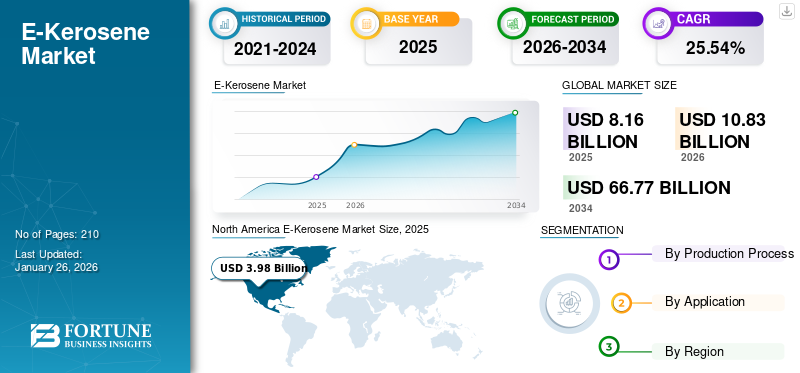
The global e-kerosene market size was valued at USD 8.16 billion in 2025 and is projected to grow from USD 10.83 billion in 2025 to USD 66.77 billion by 2034, exhibiting a CAGR of 25.04% during the forecast period. North America dominated the global market with a share of 48.80% in 2025.
The e-kerosene market is experiencing growth due to increasing demand for sustainable aviation fuels, technological advancements in Power-to-Liquid (PtL) technology, and supportive government policies and regulations, all aimed at reducing carbon emissions in the aviation sector. The aviation industry is under increasing pressure to reduce its carbon footprint and achieve net-zero emissions by 2050. E-kerosene, or synthetic kerosene, is a potential solution as it can be produced from renewable sources and offers a significant reduction in CO2 emissions compared to traditional fossil fuels.
Gevo, Inc. is one of the prominent players holding a substantial market share. It is an American company focused on renewable chemicals and advanced biofuels, including Sustainable Aviation Fuel (SAF), which is essentially a form of e-kerosene, and aims to produce drop-in hydrocarbon fuels and chemicals with a net-zero carbon footprint.
Moreover, market players are more focused toward innovation in sustainable fuels catering to end use industries which is expected to propel market demand over the forecast period.
Download Free sample to learn more about this report.
Download Free sample to learn more about this report.
E-Kerosene Market KEY TAKEAWAYS
 Global Market Size & Forecast
- 2025 Market Size: USD 8.16 billion
- 2026 Market Size: USD 10.83 billion
- 2034 Forecast Market Size: USD 66.77 billion
- CAGR: 25.04% from 2026–2034
 Market Share
- North America dominated the e-kerosene market with a 48.80% share in 2025.
- The Power-to-Liquid (PtL) technology segment is expected to dominate the market.
- The aviation segment is projected to hold the largest market share during the forecast period.
 Key Regional Highlights
Asia Pacific
Projected to reach USD 0.96 billion in 2026, driven by growing adoption of sustainable aviation fuels.
North America
Projected to reach USD 5.32 billion in 2026, supported by strong decarbonization initiatives and government incentives.
Europe
Projected to reach USD 3.92 billion in 2026, driven by stringent SAF blending mandates and climate policies.
U.S.
Market growth is supported by the country's net-zero aviation targets and increasing investments in sustainable aviation fuels.
Japan
Market growth is driven by rising focus on aviation decarbonization and adoption of sustainable fuel technologies.
Read More

E-KEROSENE MARKET TRENDS
Rising Government Initiatives and Mandates to Drive Market Growth
Governments and international bodies are establishing mandates and targets to decarbonize the aviation sector, creating a strong demand signal for sustainable fuels. For instance, the European Union’s ReFuelEU Aviation initiative requires a gradually increasing share of synthetic aviation fuels in the fuel mix, compelling airlines and fuel suppliers to invest in alternatives such as e-kerosene. In parallel, various national programs, such as the U.S. SAF Grand Challenge and the U.K.’s funding schemes for e-fuels, provide financial backing through subsidies, grants, and tax credits. These mechanisms help reduce the cost gap between e-kerosene and conventional jet fuel, making it more competitive in the short term. By lowering investment risks and supporting early-stage production, policy frameworks are essential for scaling up e-kerosene infrastructure and enabling long-term market growth.
MARKET DYNAMICS
MARKET DRIVERS
Growing Demand for Sustainable Fuels to Drive Market Growth
The global e-kerosene market growth is driven by increasing demand for sustainable aviation fuels, technological advancements, and supportive government policies. Growing awareness of climate change and the need to reduce carbon emissions from the aviation sector are major drivers for the adoption of SAFs such as e-kerosene.
- In March 2025, Japan’s Ministry of Economy announced a subsidy for advanced SAF production in Japan. Moreover, Japan has also set the objective of diversifying 10% of petroleum-based fuels with alternatives by 2030.
Governments worldwide are implementing policies and regulations to promote the use of SAFs, including setting targets for their use and providing incentives for production. Governments are providing subsidies and tax breaks to encourage the production of e-kerosene, making it more competitive with conventional fuels.
MARKET RESTRAINTS
High Production Costs to Limit Market Expansion
The market faces restraints, including high production costs of e-kerosene, the need for substantial renewable electricity, and the challenges of CO2 capture and storage, all of which hinder its widespread adoption and competitiveness with traditional fossil fuels. Producing e-kerosene requires significant investment in infrastructure, including electrolyzers, synthetic fuel plants, and storage facilities. Moreover, e-fuel production facilities need to be large to be efficient, requiring substantial capital investment.
MARKET OPPORTUNITIES
Decarbonization of Aviation and Marine Industry is Expected to Augment Market Growth
The e-kerosene market presents significant opportunities, particularly in decarbonizing aviation and other hard-to-electrify sectors, with the global market expected to grow rapidly, driven by increasing environmental concerns and supportive policies.
- In July 2021, the European Commission announced plans for airlines to have a 5% share in low-carbon fuels in 2030, with an increase above 60% in 2050.
International agreements such as the Paris Accord and stricter environmental regulations, such as the European Union's Green Deal, are pushing for the adoption of sustainable aviation fuels. The growing adoption of e-kerosene in commercial aircraft is a key driver of market growth.
Segmentation Analysis
By Production Process
Rising Demand for Renewable Energy Segment Growth
Based on production process, the market is classified into Direct Air Capture (DAC) and Power-to-Liquid (PtL).
The Power-to-Liquid (PtL) technology, specifically the Fischer-Tropsch (FT) synthesis, is likely to dominate the e-kerosene market share. The Power-to-Liquid (PtL) process, which uses renewable energy sources to produce synthetic kerosene (e-kerosene) by combining CO2 and hydrogen, is gaining attention as a potential solution for decarbonizing the aviation sector, offering a prominent replacement for conventional jet fuel with a favorable GHG balance.
Direct Air Capture (DAC) technology, which extracts CO2 from the atmosphere, can be used to produce e-kerosene, a synthetic aviation fuel, by combining the captured CO2 with hydrogen produced through electrolysis using renewable energy. To meet the growing demand for e-kerosene, Direct Air Capture (DAC) is crucial as a sustainable source of CO2, combining it with green hydrogen to produce synthetic kerosene for aviation, requiring significant CO2 capture. Moreover, The Fischer-Tropsch (FT) synthesis is a key process in producing e-kerosene, a sustainable aviation fuel, by converting hydrogen and carbon dioxide (CO2) into liquid hydrocarbons, which can then be refined to meet aviation fuel standards.
By Application
Growing adoption of E-Fuels in Prominent Industries to Boost Market Growth
Based on application, the market is segmented into automotive, marine, aviation, industrial, and others. The aviation industry is poised to be the dominant application sector for e-kerosene, driven by the need to decarbonize air travel and the limited alternatives to conventional jet fuel. E-kerosene, or synthetic kerosene, is a promising sustainable aviation fuel produced from renewable sources, with applications in aviation, marine, and potentially other industries, aiming to reduce greenhouse gas emissions.
- For instance, The EU's ReFuelEU Aviation regulation mandates blending e-kerosene into jet fuel delivered to EU airports, starting at 1.2% in 2030 and rising to 35% in 2050.
Similar to aviation, the marine sector also faces pressure to reduce its carbon dioxide footprint, and e-kerosene could play a role. Moreover, e-kerosene could be used in industrial processes that require heat or energy, potentially reducing reliance on fossil fuels.
E-Kerosene Market Regional Outlook
By region, the market is categorized into North America, Europe, Asia Pacific, and the rest of the world.
North America
North America E-Kerosene Market Size, 2025 (USD Billion)
To get more information on the regional analysis of this market, Download Free sample
The North America region captured 48.80% of the global market in 2025, generating USD 3.98 billion in revenue, and is projected to reach USD 5.32 billion in 2026. The North American e-kerosene market dominates, driven by the urgent need to decarbonize the aviation sector and supported by favorable government policies and incentives. As the aviation industry faces increasing pressure to reduce its carbon footprint, e-kerosene is emerging as a sustainable alternative to conventional jet fuel, with the regional market valued at USD 3.98 billion in 2025.
- In 2021, the U.S. government announced a carbon neutrality target for commercial aviation, which will have net zero greenhouse gas emissions by 2050. This objective by the government includes domestic flights operated by the U.S. companies and carbon emissions from international flights operated by U.S. airlines between two countries that are members of the International Civil Aviation Organization (ICAO), as well as emissions generated by airport operations.
Europe
Europe maintained a strong presence in the global market, reaching USD 2.86 billion in 2025, accounting for 35.10% share, and is expected to reach USD 3.92 billion in 2026. The European e-kerosene market is experiencing growth due to ambitious climate goals, supportive regulations, and increasing demand for sustainable aviation fuels, with the European Commission mandating a blend of e-kerosene into jet fuel by 2030 and 2050. This regulation mandates that jet fuel suppliers blend a certain percentage of e-kerosene (a type of SAF) into the jet fuel they deliver to EU airports. The regulation sets targets for SAF blending, starting at 1.2% in 2030 and progressively rising to 35% in 2050.
- As per Airports Council International Europe, European airports are notified to commit to net zero carbon emissions by 2050. Such initiatives are expected to propel the demand for e-kerosene in Europe in the near future.
Asia Pacific
In 2025, Asia Pacific generated USD 0.8 billion, contributing 9.77% to global market revenue, and is projected to grow to USD 0.96 billion in 2026. The Asia Pacific e-kerosene market demand is expected to grow due to rising concerns about carbon emissions, the increasing adoption of Sustainable Aviation Fuels (SAF), and the region's economic growth and population increase, leading to higher energy consumption. The aviation sector is a major contributor to carbon emissions, and the need to decarbonize this industry is a significant driver for the adoption of e-kerosene (also known as sustainable aviation fuel or SAF).
Rest of the World
The e-kerosene (or sustainable aviation fuel, SAF) market in the rest of the world is poised for growth, driven by factors such as increasing aviation demand, environmental concerns, and government initiatives promoting sustainable fuels, with a potential shift toward biofuels and e-fuels. As economies in emerging countries continue to grow, so does the demand for air travel, leading to a higher demand for aviation fuel. The growing middle class and rising disposable incomes in the Middle East & Africa are leading to more frequent air travel, boosting the need for aviation fuels. Saudi Arabia, with its significant oil reserves and established refineries, is a key player in the bunker fuel market, and its dominance is expected to continue as the global maritime activity and fuel demand grow.
COMPETITIVE LANDSCAPE
Key Industry Players
Key Companies are Focused on Investment in Sustainable Aviation Fuels, Resulting in Increased Demand for E-Kerosene Globally
The global e-kerosene market is concentrated with companies such as Gevo, Inc., LanzaJet, Climeworks, and others, which account for a significant market share. For instance, in December 2024, HIF Global announced the development of an e-fuel facility in California, U.S. The facility will produce sustainable aviation fuel, which also includes e-kerosene used in the aviation industry. Focusing on significant investments in e-fuel production has supported the companies’ share in the market.
LIST OF KEY E-KEROSENE COMPANIES PROFILED
- Gevo, Inc. (U.S.)
- Johnson Matthey (U.K.)
- Shell Aviation (U.K.)
- HY2GEN (Germany)
- Chevron Lummus Global LLC (California)
- eFuel Pacific Limited (New Zealand)
- Climeworks (Switzerland)
- Norsk e-fuel (Norway)
- HIF Global (U.S.)
- LanzaJet (U.S.)
KEY INDUSTRY DEVELOPMENTS
- February 2025: Norsk e-Fuel, Prime Capital, and RES announced a collaboration for a sustainable aviation fuel project in Ange, Sweden. The project aims to produce 80,000 tons of e-fuel. Moreover, the facility will utilize power to produce synthetic e-kerosene in a liquid process.
- May 2024: COPEC and INERATEC announced a strategic partnership to develop sustainable fueling solutions with construction of power to liquid plants in Chile to produce 3,500 tons per annum of e-fuel.
- June 2023: EDF, IFPEN, HOLCIM, and AXENS announced collaboration to convert CO2 to synthetic aviation fuel in Europe to support decarbonization of the aviation industry across the globe.
- June 2022: Airbus, Uniper, and Siemens announced a collaboration to develop an e-kerosene production facility with a capacity of 10,000 tons per year in Germany, which is scheduled to be operational by 2026.
- October 2021: Lufthansa Group partnered with Kuehne+Nagel for the development of an e-kerosene power-to-liquid aviation fuels production facility in Emsland, Germany.
REPORT COVERAGE
The global e-kerosene market analysis provides market size and forecast by all the segments included in the report. It includes details on market dynamics and trends expected to drive the market in the forecast period. It offers information on key regions/countries, industry developments, new product launches, details on partnerships, mergers & acquisitions, and investments in key countries. The report covers a detailed competitive landscape with information on the market share and profiles of key players.
Request for Customization to gain extensive market insights.
Report Scope & Segmentation
|
ATTRIBUTE |
DETAILS |
|
Study Period |
2021-2034 |
|
Base Year |
2025 |
|
Estimated Year |
2026 |
|
Forecast Period |
2026-2034 |
|
Historical Period |
2021-2024 |
|
Growth Rate |
CAGR of 25.54% from 2026-2034 |
|
Unit |
Value (USD Billion) |
|
Segmentation |
By Production Process
|
|
By Application
|
|
|
By Region
|
Frequently Asked Questions
Fortune Business Insights says that the global market value stood at USD 8.16 billion in 2025 and is projected to reach USD 66.77 billion by 2034.
In 2025, the market value stood at USD 8.98 billion.
The market is expected to exhibit a CAGR of 25.54% during the forecast period of 2026-2034.
The aviation segment led the market by application.
The key factor driving the market is the growing demand for sustainable fuels.
Gevo, Inc., LanzaJet, Climeworks, and others are the top players in the market.
North America dominated the global market with a share of 48.80% in 2025.



- 2021-2034
- 2025
- 2021-2024
- 210
Get 30-60 hrs Free Customization
Expand Regional and Country Coverage, Segments Analysis, Company Profiles, Competitive Benchmarking, and End-user Insights.



















Related Reports
-
US +1 833 909 2966 ( Toll Free )
-
Get In Touch With Us