Edamame Market Size, Share & Industry Analysis, By Product Type (Fresh Edamame, Frozen Edamame, and Processed Edamame [Snacks, Spreads, and Others), By Nature (Conventional and Organic), By Form (Whole, Shelled, Powder, Paste, and Roasted/Extruded), By End-Use (Food Processing, Food Service, and Retail), and Regional Forecast, 2026-2034
 Download Free Sample
(Offer valid till 30th Sep 2026)

Edamame Market Size and Future Outlook
 Listen to Audio Version
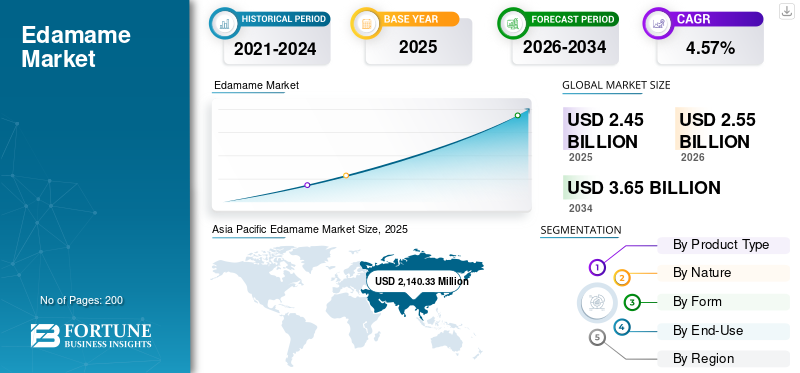
The global edamame market size was valued at USD 2,458.86 million in 2025. The market is projected to grow from USD 2,556.18 million in 2026 to USD 3,653.47 million by 2034, exhibiting a compound annual growth rate CAGR of 4.57% during the forecast period. Asia Pacific dominated the edamame market with a market share of 87.04% in 2025.
Edamame, a young soybean harvested before maturity, is gaining strong global traction as a plant-based, protein-rich food ingredient. Raw materials play a central role in the global market, primarily consisting of fresh vegetable soybeans harvested at an immature stage for optimal tenderness and flavor. Its rising incorporation across retail snacks, ready-to-eat meals, and foodservice menus reflects shifting consumer preferences toward healthier, minimally processed, and plant-forward diets. Growth is further supported by expanding vegan and vegetarian populations, increasing awareness of functional foods, and the versatility of edamame across cuisines such as Asian, fusion, and Western plant-based formats. Manufacturers are also innovating with flavored, roasted, and ready-to-eat edamame products to enhance convenience and appeal.
The global market demand is led by key companies, including Seapoint Farms, Hain Celestial Group, Sunrise Growers, JFC International, and Green Giant, competing through product innovation, frozen supply chain optimization, and expansion into retail and foodservice channels.
Download Free sample to learn more about this report.
Edamame Market Takeaways
 Global Market Size & Forecast
- 2025 Market Size: USD 2,458.86 million
- 2026 Market Size: USD 2,556.18 million
- 2034 Forecast Market Size: USD 3,653.47 million
- CAGR: 4.57% from 2026–2034
 Market Share
- Asia Pacific dominated the edamame market with a market share of 87.04% in 2025.
- Frozen edamame segment dominated the market with a value of USD 1,512.49 million in 2025.
- Conventional edamame segment held the largest share with a value of USD 2,325.29 million in 2025.
 Key Regional Highlights
North America
North America was valued at USD 151.42 million in 2025 and is projected to reach USD 267.74 million by 2034, supported by rising demand for plant-based protein and healthy snack alternatives.
Europe
Europe recorded a market value of USD 113.70 million in 2025 and is expected to reach USD 209.70 million by 2034, growing due to increasing demand for plant-based and organic food products.
Asia Pacific
Asia Pacific dominated the edamame market, valued at USD 2,140.03 million in 2025, and is projected to reach USD 3,092.34 million by 2034, driven by traditional consumption patterns and strong production capabilities.
U.S.
The U.S. edamame market reached approximately USD 126.42 million in 2025, supported by strong retail penetration of frozen edamame products and increasing vegan consumer adoption.
Japan
Japan remains a mature edamame market, valued at approximately USD 704.72 million in 2025, supported by traditional consumption habits and established demand for edamame-based foods.
Read More

Edamame Market Trends
Growing Demand for Premium and Clean-Label Flavor Ingredients to Shape Industry Trends
Consumers are increasingly shifting toward plant-based diets for health, environmental, and ethical considerations, positioning edamame as a preferred protein source. It is naturally rich in protein, fiber, and essential amino acids, making it highly attractive for health-conscious consumers. The growing popularity of plant-based diets and clean-label foods is encouraging manufacturers to introduce organic, non-GMO, and minimally processed edamame variants.
Additionally, product innovation, such as dry roasted edamame, flavored snack packs, and ready-to-cook frozen formats, is expanding consumption beyond traditional Asian cuisine into global mainstream markets.
- For instance, in February 2025, Biena, one of the pioneers in healthy snacking, launched Biena Crispy Edamame, a high-protein, plant-based snack made with 100% avocado oil. Biena Crispy Edamame provides 12–13 g of plant protein per serving, which is equivalent to two large eggs and more than many common nuts and meat‑based snacks on a per‑serving basis.
MARKET DYNAMICS
Market Drivers
Download Free sample to learn more about this report.
Increasing Global Adoption of Plant-Based Diets and Protein-Rich Foods to Support Market Growth
The increasing shift toward plant-based nutrition is a primary driver of the market. Consumers are actively seeking alternatives to animal-based protein, and edamame offers a complete protein profile along with low-fat and high fiber content. Rising health awareness, coupled with demand for functional foods, is significantly boosting consumption across retail and foodservice channels.
- According to the Plant Based Food Association, in 2023 U.S. retail sales of plant-based foods reached USD 8.1 billion, with 62% of households purchasing these products.
Market Restraints
Supply Chain Constraints and Limited Awareness in Emerging Markets to Restrict Market Growth
Despite its growth potential, the market faces challenges related to supply chain infrastructure, particularly cold storage and frozen logistics needed to maintain product quality. Limited awareness and availability in developing regions also restrict adoption. Edamame, being a perishable, temperature-sensitive product, requires a well-developed cold chain infrastructure for harvesting, processing, storage, and transportation. However, in many emerging economies across Asia, Africa, and parts of Latin America, cold storage capacity remains insufficient and fragmented.
- For instance, according to the Food and Agriculture Organization (FAO), nearly 30–40% of perishable agricultural produce is lost annually in developing regions due to inadequate post-harvest infrastructure. This directly impacts edamame distribution, leading to higher wastage, inconsistent supply, and elevated logistics costs.
Market Opportunities
Rising Strategic Investments and Funding Activities in Frozen and Plant-Based Food Segment Creates Growth Opportunities
Rising strategic investments and funding activities in the frozen and plant-based food segment are creating significant edamame market growth opportunities. As global demand for healthy, convenient, and plant-based food products accelerates, private equity firms and institutional investors are increasingly channeling capital into companies operating within the frozen vegetable and edamame value chain. These investments are enabling producers to scale up cultivation, enhance processing capabilities, expand cold chain infrastructure, and strengthen global distribution networks.
- For instance, in June 2025, Proterra Investment Partners Asia made its largest investment to date via its Proterra Asia Food Fund 3 (PAFF3) in Lanna Agro Industry Co., Ltd. (LACO), Thailand's top frozen edamame producer and exporter.
SEGMENTATION ANALYSIS
By Product Type
Frozen Edamame Segment Dominated the Market Due to High Shelf Life and Strong Retail & Foodservice Demand
Based on product type, the market is segmented into fresh edamame, frozen edamame, and processed edamame.
The frozen edamame segment dominated the global edamame market share, valued at USD 1,512.49 million in 2025, supported by its extended shelf life, ease of storage, and widespread adoption across retail and foodservice channels. It is extensively used in ready-to-cook and ready-to-eat formats, making it highly convenient for consumers.
The processed edamame segment is projected to grow at the fastest CAGR of 7.50% during the forecast period, driven by increasing demand for value-added products such as snacks, spreads, and flavored edamame offerings.
To know how our report can help streamline your business, Speak to Analyst
By Nature
Conventional Segment Dominated the Market Due to Cost Efficiency and Large-Scale Availability
Based on nature, the market is segmented into conventional and organic.
The conventional segment held the largest market share, valued at USD 2,325.29 million in 2025, owing to its affordability, large-scale edamame production, and wide availability across global markets. It remains the preferred choice for mass consumption and food processing applications.
The organic segment, valued at USD 133.57 million in 2025, is expected to grow at the fastest CAGR of 6.29% over the forecast period, driven by rising consumer demand for clean-label, non-GMO, and pesticide-free food products.
By Form
Whole Edamame Segment Dominated the Market Due to Its Extensive Use in Frozen and Traditional Consumption Formats
Based on form, the market is segmented into whole, shelled, powder, paste, and roasted/extruded.
The whole edamame segment dominated the market, valued at USD 1,589.01 million in 2025, driven by its strong demand in frozen packs and traditional consumption, particularly in Asia Pacific and North America.
The paste segment is anticipated to grow at the fastest CAGR of 9.70% during the forecast period, supported by its increasing application in dips, spreads, sauces, and processed food products.
By End-Use
Retail Segment Dominated the Market Due to Strong Consumer Demand for Packaged and Frozen Edamame Products
Based on end-use, the market is segmented into food processing, food service, and retail.
The market is segmented into bakery products, dairy products, beverages, frozen desserts, snacks, and others.
The retail segment held the largest share, valued at USD 1,392.11 million in 2025, supported by increasing consumer preference for convenient, ready-to-cook, and frozen edamame products available in supermarkets and online retail channels.
The food service segment, valued at USD 602.58 million in 2025, is projected to grow at the fastest CAGR of 5.39% over the forecast period, driven by the rising incorporation of edamame in restaurant menus, salads, and plant-based dishes.
Edamame Market Regional Outlook
Regionally, the market is studied across North America, Europe, Asia Pacific, South America, and the Middle East & Africa.
Asia Pacific
Asia Pacific Edamame Market Size, 2025 (USD Million)
To get more information on the regional analysis of this market, Download Free sample
Asia Pacific dominated the global market, valued at USD 2,140.03 million in 2025, and is projected to reach USD 3,092.34 million by 2034, growing at a CAGR of 4.24% during the forecast period. The region benefits from strong cultural consumption and large-scale soybean production from China, South Korea, and Japan.
China Edamame Market
China accounted for the largest market, valued at approximately USD 1,147.92 million in 2025, driven by high domestic consumption and export-oriented production.
Japan Edamame Market
Japan remains a key mature market, valued at approximately USD 704.72 million in 2025, supported by traditional consumption patterns.
North America
North America was valued at USD 151.42 million in 2025 and is projected to reach USD 267.74 million by 2034, growing at a CAGR of 6.59% during the forecast period. Growth is driven by rising demand for plant-based protein and healthy snacks.
U.S. Edamame Market
The U.S. market dominates the region, valued at approximately USD 126.42 million in 2025, supported by strong retail penetration of frozen edamame and a growing vegan consumer base.
Europe
Europe was valued at USD 113.70 million in 2025 and is projected to reach USD 209.70 million by 2034, registering the fastest CAGR of 7.08% over the forecast period. Growth is supported by increasing demand for plant-based and organic food products.
Germany Edamame Market
Germany was valued at approximately USD 25.57 million in 2025, driven by strong demand for plant-based protein and frozen vegetables.
U.K. Edamame Market
The U.K. market reached around USD 21.86 million in 2025, supported by rising vegan and flexitarian populations.
South America and the Middle East & Africa
South America was valued at USD 35.63 million in 2025 and is projected to reach USD 56.31 million by 2034, growing at a CAGR of 5.28% during the forecast period. Growth is supported by expanding soybean cultivation, increasing regional availability of soy-based food products, rising consumer interest in plant-based protein, and growing adoption of frozen vegetables and healthy snacks in countries such as Brazil and Argentina.
The Middle East & Africa market was valued at USD 18.09 million in 2025 and is projected to reach USD 27.38 million by 2034, expanding at a CAGR of 4.78% during the forecast period. Growth is driven by rising demand for healthy and functional foods, increasing product availability through modern retail and foodservice channels, and growing consumer interest in plant-based diets, particularly in urban markets such as the UAE and Saudi Arabia.
Brazil Edamame Market
The Brazilian market was valued at approximately USD 19.25 million in 2025, driven by growing demand for premium and healthy food products in the foodservice and retail sectors.
COMPETITIVE LANDSCAPE
Key Industry Players
Key Players Focus on Product Innovation, Frozen Supply Chain Expansion, and Retail Penetration Strategies
The global edamame market is moderately fragmented, with companies focusing on expanding frozen product lines, improving supply chain efficiency, and introducing value-added products such as flavored and roasted edamame. Strategic partnerships with retail chains and foodservice operators are also key growth strategies.
Key Players in the Edamame Market
|
Rank |
Company Name |
|
1 |
Seapoint Farms |
|
2 |
Gadre Group |
|
3 |
Sunrise Growers Inc. |
|
4 |
JFC International Inc. |
|
5 |
B&G Foods Inc. |
List of Key Edamame Companies Profiled
- Seapoint Farms (U.S.)
- Cixi Yongjin Frozen Food Co., Ltd (Taiwan)
- Sunrise Growers Inc. (U.S.)
- JFC International Inc. (U.S.)
- B&G Foods Inc. (Green Giant) (U.S.)
- Gadre Group (India)
- Yuyao Gumancang Food Co., Ltd. (China)
- Laco Chiangmai Frozen Foods Public (Thailand)
- Ardo NV (Belgium)
- Shaoxing Lurong Food Co., Ltd. (China)
KEY INDUSTRY DEVELOPMENTS
- January 2026: The Only Bean, a brand specializing in crunchy roasted edamame snacks, expanded its nationwide availability to major warehouse clubs such as Costco and Sam's Club. These plant-based snacks are high in protein (14g per serving), fiber (6g), and low in net carbs (2g), with about 120 calories per serving, appealing to keto, gluten-free, and clean-label diets.
- September 2025: Colruyt Group, a major Belgian retailer, partnered with De Aardappelhoeve, a potato farm in Tielt, to launch Belgium's first locally grown fresh edamame beans. These young soybeans, sold under the Boni Plan't brand in 200-gram packs, were available for up to two months in Colruyt Lowest Prices stores, marking a shift from previously imported frozen options.
- July 2025: Aldi expanded its popular plant‑based snack lineup by launching two new flavors of Season’s Choice Seasoned Edamame, a steam‑in‑bag snack made from shell‑on edamame beans. The new variants include chili garlic and wasabi, which offer bold, savory twists on the original product, leaning into the growing demand for protein‑rich, plant‑based snacks.
- August 2022: The Good Bean debuted Black Edamame Snacking Beans as a crunchy, plant-based innovation in the low-carb snack category. These snacks leverage Japanese-origin black soybeans (kuromame), roasted for a bold texture and packed with antioxidants comparable to those in blueberries.
REPORT COVERAGE
The global edamame market industry report analyzes the market in depth and highlights crucial aspects such as global market trends, market dynamics, prominent companies, investment in research and development, and end-use. Besides this, the report also provides insights into the global market analysis and highlights significant industry developments.
Request for Customization to gain extensive market insights.
Report Scope & Segmentation
| ATTRIBUTE | DETAILS |
| Study Period | 2021-2034 |
| Base Year | 2025 |
| Estimated Year | 2026 |
| Forecast Period | 2026-2034 |
| Historical Period | 2021-2024 |
| Growth Rate | CAGR of 4.57% from 2026 to 2034 |
| Unit | Value (USD Million) |
|
Segmentation |
By Product Type
|
|
By Nature
|
|
|
By Form
|
|
|
By End-Use
|
|
|
By Region
|
Frequently Asked Questions
Fortune Business Insights says that the global market was valued at USD 2,458.86 million in 2025 and is anticipated to reach USD 3,653.47 million by 2034.
At a CAGR of 4.57%, the global market will exhibit steady growth over the forecast period.
By form, the whole segment led the market in 2025.
Asia Pacific held the largest market share in 2025.
Increasing global adoption of plant-based diets and protein-rich foods is the crucial factor driving the global market.
Seapoint Farms, Sunrise Growers, and JFC International are the leading players in the market.
Growing demand for premium and clean-label flavor ingredients to shape industry trends.



- 2021-2034
- 2025
- 2021-2024
- 200
-
(Offer valid till 30th Sep 2026)
Get 30-60 hrs Free Customization
Expand Regional and Country Coverage, Segments Analysis, Company Profiles, Competitive Benchmarking, and End-user Insights.



















-
US +1 833 909 2966 ( Toll Free )
-
Get In Touch With Us