Edge-to-Cloud Continuum Infrastructure Market Size, Share & Industry Analysis, By Offering (Hardware, Software, and Services), By Infrastructure (Connected Device Infrastructure, Business Site Infrastructure, Telecom Network Infrastructure, Regional Edge Data Centers, Private Data Centers, and Public Cloud Infrastructure), By Enterprise Type (Large Enterprises and Small & Medium Enterprises), By End-User (IT & Telecommunications, Manufacturing, Retail & E-commerce, Healthcare & Life Sciences, BFSI, Government & Defense, Energy & Utilities, and Others), and Regional Forecast, 2026-2034
 Download Free Sample
EDGE-TO-CLOUD CONTINUUM INFRASTRUCTURE MARKET SIZE AND FUTURE OUTLOOK
 Listen to Audio Version
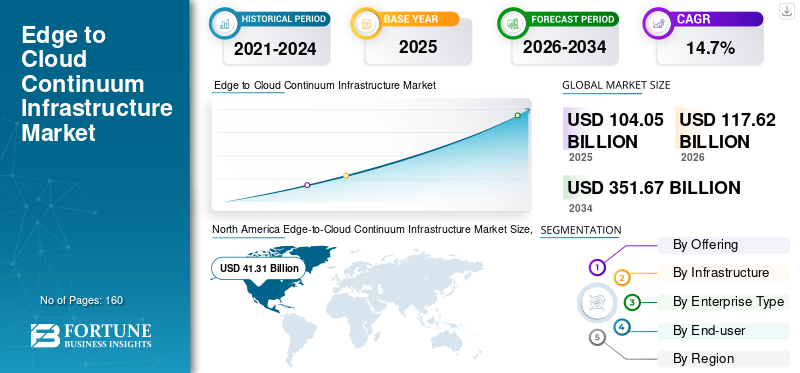
The edge-to-cloud continuum infrastructure market size was valued at USD 104.05 billion in 2025. The market is projected to grow from USD 117.62 billion in 2026 to USD 351.67 billion by 2034, exhibiting a CAGR of 14.7% during the forecast period. North America dominated the edge to cloud continuum infrastructure market with a market share of 39.70% in 2025.
The global market encompasses hardware, software, and services designed to connect, manage, and operate computing resources across connected devices, business sites, telecom networks, regional edge data centers, private data centers, and public cloud infrastructure. The market serves large enterprises and SMEs across IT and telecommunications, manufacturing, retail and e-commerce, healthcare and life sciences, BFSI, government and defense, energy and utilities, transportation and logistics, and other industries.
Market growth is primarily supported by the expansion of 5G networks, rising IoT adoption, increasing AI workloads, hybrid cloud deployment, and growing demand for real-time data processing. Hewlett Packard Enterprise Company, Dell Technologies Inc., Cisco Systems, Inc., and Microsoft Corporation are the top players in the global market.
Download Free sample to learn more about this report.
Edge to Cloud Continuum Infrastructure Market Key Takeaways
 Global Market Size & Forecast
- 2025 Market Size: USD 104.05 billion
- 2026 Market Size: USD 117.62 billion
- 2034 Forecast Market Size: USD 351.67 billion
- CAGR: 14.7% from 2026-2034
 Market Share
- North America dominated the edge-to-cloud continuum infrastructure market with a 39.70% share in 2025.
- The hardware segment held the largest share of 50.1% in 2025.
- The business site infrastructure segment held the largest share of 28.0% in 2025.
 Key Regional Highlights
North America
North America held the largest market share in 2025, supported by advanced cloud, telecom, and data center infrastructure.
Asia Pacific
Asia Pacific is expected to record the highest CAGR, driven by rapid 5G rollout, cloud expansion, data center investment, and manufacturing digitalization.
Europe
Europe held the second-largest share in 2025, supported by its strong industrial base, developed telecom networks, and established data center markets.
U.S.
The market was valued at around USD 35.85 billion in 2025, accounting for roughly 34.5% of global sales.
Japan
The market was valued at around USD 4.26 billion in 2025, accounting for roughly 4.1% of global revenues.
Read More

EDGE-TO-CLOUD CONTINUUM INFRASTRUCTURE MARKET TRENDS
Distributed AI Workloads Accelerate Edge-to-Cloud Infrastructure Adoption
Enterprises are distributing AI inference across edge devices, business sites, telecom networks, and regional facilities to process dynamic data closer to its source. This approach improves control over data flows, reduces latency, and provides computing power where operational decisions occur. Central platforms remain important for model training and governance, creating a coordinated cloud continuum that connects cloud and edge environments. Vendors are consequently supporting Kubernetes clusters and cloud-native applications with orchestration, security, observability, and edge lifecycle management capabilities. This shift enables organizations to place workloads according to performance, privacy, availability, cost, and governance requirements.
- In March 2025, GSMA reported that 50% of telecom operators considered AI important for revenue growth, while 97% of telecom respondents were adopting or assessing AI.
MARKET DYNAMICS
MARKET DRIVERS
Download Free sample to learn more about this report.
Expansion of 5G Networks and Connected Devices to Drive Market Growth
The expansion of 5G networks and IoT devices is increasing demand for edge computing that can support faster data processing near users and machines. Applications such as autonomous vehicles, smart cities, industrial automation, and supply chain monitoring depend on real time responses and reliable connectivity. Telecom operators are also virtualizing network functions and adopting Software-Defined Networking (SDN) and Software-Defined WAN (SD-WAN) to route workloads efficiently across distributed locations. These developments encourage enterprises to invest in edge-to-cloud continuum infrastructure that connects local systems with central platforms while reducing latency, network congestion, and dependence on distant facilities.
- According to the ITU’s 2025 report, 5G networks covered 55% of the global population and represented more than one-third of worldwide mobile broadband subscriptions.
|
Rank |
Market Drivers |
Overall Impact Rank |
Estimated Gross Market Growth Contribution (USD Billion) |
Impact 2026-2028 |
Impact 2029-2031 |
Impact 2032-2034 |
|
1 |
Rapid expansion of 5G networks and IoT devices is increasing demand for low-latency data processing across edge and cloud environments. |
High |
71.63 |
High |
High |
High |
|
2 |
Growing deployment of distributed AI, real-time analytics, and automation is increasing the need for computing power closer to data sources. |
High |
57.01 |
High |
High |
Medium |
|
3 |
Rising adoption of hybrid and multi-cloud infrastructure is supporting seamless workload movement across business sites, data centers, and public clouds. |
High |
49.32 |
High |
High |
High |
|
4 |
Expansion of regional edge data centers and sovereign cloud infrastructure is improving local processing, data residency, and application performance. |
High |
40.77 |
Medium |
High |
High |
|
5 |
Modernization of telecom networks through private 5G, virtualized network functions, and software-defined networking is strengthening distributed infrastructure demand. |
Medium |
35.48 |
High |
High |
Medium |
|
6 |
Others, including smart cities, autonomous vehicles, industrial automation, supply chain monitoring, and connected healthcare, are creating additional market growth opportunities. |
Low |
28.84 |
Medium |
Medium |
High |
|
|
Total Positive Growth Contribution |
|
283.05 |
|
|
|
MARKET RESTRAINTS
Integration Complexity and Cybersecurity Risks to Restrict Market Growth
Managing distributed computing environments across multiple locations creates substantial integration and cybersecurity challenges. Organizations must secure edge data, identities, applications, and configurations while maintaining consistent visibility across equipment, platforms, and service providers. Differences in hardware, operating systems, security policies, connectivity standards, and legacy systems increase deployment time and integration costs. Remote locations may also have limited technical staff, connectivity, or physical protection, which can delay updates and incident response. These issues expand the attack surface, complicate governance, and may discourage SMEs and regulated organizations from implementing large-scale deployments until interoperability, automation, and security controls improve.
- IBM reported in November 2025 that breaches involving data distributed across multiple environments cost an average of USD 5.05 million, compared with USD 4.01 million for on-premises breaches.
|
Rank |
Market Restraints |
Overall Impact Rank |
Estimated Reduction in Market Size (USD Billion) |
Impact 2026-2028 |
Impact 2029-2031 |
Impact 2032-2034 |
|
1 |
Integration complexity across different edge devices, cloud platforms, networks, and legacy systems may delay large-scale infrastructure deployment. |
High |
15.80 |
High |
High |
Medium |
|
2 |
Cybersecurity, data privacy, and regulatory concerns across distributed computing environments may restrict adoption among regulated organizations. |
High |
13.20 |
High |
High |
High |
|
3 |
High initial investment, connectivity costs, infrastructure maintenance, and edge lifecycle management requirements may limit adoption among smaller enterprises. |
Medium |
11.10 |
High |
Medium |
Low |
|
4 |
Others, including skills shortages, interoperability gaps, power limitations, uneven network coverage, and uncertain returns on investment, may restrict market expansion. |
Low |
8.90 |
Medium |
Medium |
Low |
|
|
Total Negative Growth Impact |
|
49.00 |
|
|
|
MARKET OPPORTUNITIES
Expansion of Regional Edge and Sovereign Cloud Infrastructure to Create Growth Opportunities
The expansion of regional data centers and sovereign platforms creates a major opportunity for the global edge-to-cloud continuum infrastructure market growth. Providers can deploy hybrid edge cloud infrastructure, fog computing nodes, and Hyperconverged Infrastructure (HCI) to position compute resources closer to users and operational locations. Connecting these assets with cloud data centers and multi-cloud infrastructure can create scalable distributed computing infrastructure for regulated and latency-sensitive workloads. This development can widen the market as governments and enterprises increase cloud computing investment, localize sensitive information, and modernize industrial and public-sector systems through partnerships, managed services, and locally operated platforms.
- The European Commission stated that seven EU countries are mobilizing up to USD 1.37 billion in public funding, expected to unlock USD 1.60 billion in private investment, for next-generation cloud-edge infrastructure.
SEGMENTATION ANALYSIS
By Offering
Hardware Segment Led the Market Due to High Demand for Physical Infrastructure
Based on the offering, the market is divided into hardware, software, and services.
In 2025, the hardware segment held the largest share of 50.1% as the market requires servers, storage systems, gateways, processors, and networking equipment across distributed locations. Enterprises also make substantial upfront investments in physical systems before adding management software and related services.
The software segment is expected to grow at the highest CAGR of 16.9% over the forecast period, as organizations increasingly need centralized platforms to manage, monitor, secure, and automate distributed infrastructure. Rising adoption of AI workloads, hybrid cloud, containers, and virtualization will further increase software demand over time.
By Infrastructure
Business Site Infrastructure Segment Held the Largest Share Due to Widespread On-Site Deployments
Based on infrastructure, the market is segmented into connected device infrastructure, business site infrastructure, telecom network infrastructure, regional edge data centers, private data centers, and public cloud infrastructure.
In 2025, the business site infrastructure segment held the largest share of 28.0% as companies deploy computing systems across factories, offices, stores, hospitals, warehouses, and branch locations. These systems process data locally and support applications requiring response times and availability.
Regional edge data centers are expected to grow at the highest CAGR of 20.9% over the forecast period, as providers move computing and storage capacity closer to users and locations. Rising demand for AI, video processing, connected devices, and real-time analytics will further support regional edge data center expansion.
By Enterprise Type
Large Enterprises Segment Dominated the Market Due to Higher Infrastructure Spending
Based on enterprise type, the market is bifurcated into large enterprises and Small and Medium Enterprises (SMEs).
In 2025, the large enterprises segment held the largest share as they require more locations, connected devices, applications, data centers, and cloud environments. Their larger technology budgets also support spending on infrastructure, cybersecurity, system integration, and management platforms.
Small and Medium Enterprises (SMEs) are expected to grow at the highest CAGR of 18.4% over the forecast period, as managed services, subscription models, and ready-to-use edge systems become more affordable. Lower deployment costs and reduced technical complexity will further increase edge-to-cloud continuum infrastructure adoption among SMEs across business operations.
By End-user
To know how our report can help streamline your business, Speak to Analyst
IT and Telecommunications Segment Led the Market Due to Strong Cloud and Network Investments
Based on end-user, the market is divided into IT and telecommunications, manufacturing, retail and e-commerce, healthcare and life sciences, BFSI, government and defense, energy and utilities, transportation and logistics, and others.
In 2025, the IT and telecommunications segment held the largest share of 30.8% as cloud providers, telecom operators, data center companies, and managed service providers operate much of the supporting infrastructure. The sector also requires investment in cloud platforms, 5G networks, network automation, and distributed data processing.
The manufacturing segment is expected to grow at the highest CAGR of 17.8% over the forecast period, as factories increasingly adopt robotics, machine vision, predictive maintenance, and automation. These applications require local processing and continuous cloud connectivity for storage, monitoring, analysis, and control.
Edge-to-Cloud Continuum Infrastructure Market Regional Outlook
By region, the market is categorized into North America, South America, Asia Pacific, Europe, and the Middle East & Africa.
North America
North America Edge-to-Cloud Continuum Infrastructure Market Size, 2025 (USD Billion)
To get more information on the regional analysis of this market, Download Free sample
North America held the largest edge-to-cloud continuum infrastructure market share in 2025 due to its large cloud provider base, extensive data center network, advanced enterprise IT spending, and early adoption of edge computing. The U.S. and Canada also lead in 5G deployment, supporting distributed applications, AI workloads, and telecom edge infrastructure. Strong vendor presence and mature hybrid cloud adoption further increase demand across major regional industries.
To know how our report can help streamline your business, Speak to Analyst
U.S. Edge-to-Cloud Continuum Infrastructure Market
The U.S. market was valued at around USD 35.85 billion in 2025, accounting for roughly 34.5% of sales.
Europe
Europe held the second-largest share in 2025 due to its strong industrial base, developed telecom networks, established data center markets, and growing use of hybrid cloud infrastructure. Data sovereignty, cybersecurity, and regulatory requirements encourage enterprises to deploy secure local and regional computing systems. European programs supporting cloud-edge adoption and secure edge nodes also strengthen investment across manufacturing, healthcare, government, and financial services.
U.K. Edge-to-Cloud Continuum Infrastructure Market
The U.K. market was valued at approximately USD 5.18 billion in 2025, accounting for roughly 5.0% of global revenues.
Germany Edge-to-Cloud Continuum Infrastructure Market
Germany’s market reached USD 5.90 billion in 2025, equivalent to around 5.7% of global sales.
Asia Pacific
Asia Pacific is expected to record the highest CAGR over the forecast period due to rapid 5G rollout, expanding cloud regions, rising data center investment, and strong manufacturing digitalization. China, India, Japan, South Korea, and ASEAN are increasing spending on AI, IoT, industrial automation, and connected infrastructure. A large enterprise base and lower current penetration in emerging markets create substantial expansion opportunities through 2034.
Japan Edge-to-Cloud Continuum Infrastructure Market
The Japanese market was valued at around USD 4.26 billion in 2025, accounting for roughly 4.1% of global revenues.
China Edge-to-Cloud Continuum Infrastructure Market
China’s market is projected to be one of the largest globally, with 2025 revenues valued at USD 9.54 billion, roughly 9.2% of global sales.
India Edge-to-Cloud Continuum Infrastructure Market
The Indian market was valued at USD 3.36 billion in 2025, accounting for roughly 3.2% of global revenues.
Middle East & Africa
The Middle East & Africa is expected to record the second-highest CAGR during the forecast period as the region is expanding from a smaller infrastructure base. GCC countries are investing heavily in cloud regions, AI infrastructure, smart cities, and 5G networks, while African markets are improving connectivity and digital services. Rising data localization, government digitalization, and enterprise modernization create strong long-term demand for distributed infrastructure.
GCC Edge-to-Cloud Continuum Infrastructure Market
The GCC market reached USD 1.82 billion in 2025, accounting for roughly 1.7% of global revenues.
South America
South America is expected to grow at an average rate during the forecast period as Brazil, Chile, Colombia, and Argentina expand cloud, data center, and 5G infrastructure. Growth is supported by digital banking, e-commerce, telecom modernization, and industrial automation. However, IT spending, uneven connectivity, volatility, limited cloud capacity, and investment constraints prevent the region from matching Asia Pacific or the Middle East & Africa.
Brazil Edge-to-Cloud Continuum Infrastructure Market
The Brazilian market was valued at USD 2.98 billion in 2025, accounting for roughly 2.9% of global revenues.
COMPETITIVE LANDSCAPE
Key Industry Players
Leading Vendors Expand Integrated Edge-to-Cloud Solutions to Strengthen Market Presence
Key players such as Hewlett Packard Enterprise Company, Dell Technologies Inc., Cisco Systems, Inc., and Microsoft Corporation are strengthening their market positions by expanding integrated edge-to-cloud infrastructure portfolios, improving workload orchestration capabilities, and addressing the growing demand for low-latency, secure, and scalable computing environments. They are focusing on innovations in edge hardware, cloud infrastructure, network management, data processing, cybersecurity, and infrastructure monitoring. Product enhancements, strategic partnerships, acquisitions, and continuous platform development enable vendors to strengthen their competitive presence and support the evolving distributed computing needs of organizations worldwide.
LIST OF KEY EDGE-TO-CLOUD CONTINUUM INFRASTRUCTURE COMPANIES PROFILED
- Hewlett Packard Enterprise Company (U.S.)
- Dell Technologies Inc. (U.S.)
- Cisco Systems, Inc. (U.S.)
- Microsoft Corporation (U.S.)
- Amazon Web Services, Inc. (U.S.)
- Google LLC (U.S.)
- Oracle Corporation (U.S.)
- IBM Corporation (U.S.)
- Huawei Technologies Co., Ltd. (China)
- Lenovo Group Limited (China)
KEY INDUSTRY DEVELOPMENTS
- June 2026: Hewlett Packard Enterprise expanded GreenLake and HPE Morpheus Software with agent-based orchestration and unified infrastructure management. The update supports AI and traditional workloads across edge, private cloud, and data center environments.
- March 2026: Microsoft collaborated with Armada to deploy Azure Local on Galleon modular data centers for secure edge computing. The edge-to-cloud continuum infrastructure solution supports AI workloads across remote, disconnected, and constrained locations with consistent management.
- March 2026: Lenovo expanded its Hybrid AI Advantage portfolio with NVIDIA to improve distributed enterprise AI deployment. The edge-to-cloud continuum infrastructure solutions support AI inferencing across workstations, edge systems, data centers, and cloud infrastructure at scale.
- November 2025: Cisco launched Cisco Unified Edge for distributed AI workloads requiring consistent performance and control. The platform combines computing, networking, storage, security, and centralized management in one modular system for enterprise operations.
- July 2025: Oracle announced a USD 1 billion investment in AI and cloud infrastructure across the Netherlands. The investment will expand Oracle Cloud Infrastructure capacity and strengthen sovereign cloud services for local customers.
- May 2025: Dell Technologies introduced new Dell NativeEdge features for virtualized edge workloads and remote branches. The update added workload protection, migration, load balancing, and support for Dell and third-party infrastructure at scale.
- April 2025: Amazon Web Services launched second-generation AWS Outposts racks for demanding on-premises and edge workloads. The systems provide higher performance, improved network resilience, and scalable cloud infrastructure for distributed operations at scale.
REPORT COVERAGE
The edge-to-cloud continuum infrastructure market report provides a comprehensive overview of market size, forecasts, and key segments. It evaluates market dynamics, emerging trends, technological advancements, and the growing adoption of distributed computing, hybrid cloud, edge infrastructure, AI workloads, and real-time data processing solutions supporting market growth. The report highlights major developments, including product launches, partnerships, mergers, acquisitions, and strategic initiatives undertaken by leading market participants. It also presents the competitive landscape, market share analysis, and detailed profiles of prominent companies operating in the global market.
Request for Customization to gain extensive market insights.
REPORT SCOPE & SEGMENTATION
| ATTRIBUTE | DETAILS |
| Study Period | 2021-2034 |
| Base Year | 2025 |
| Estimated Year | 2026 |
| Forecast Period | 2026-2034 |
| Historical Period | 2021-2024 |
| Growth Rate | CAGR of 14.7% from 2026 to 2034 |
| Unit | Value (USD Billion) |
| Segmentation | By Offering, By Infrastructure, By Enterprise Type, By End-user, and By Region |
| By Offering |
|
| By Infrastructure |
|
| By Enterprise Type |
|
| By End-user |
|
| By Region |
|
Frequently Asked Questions
Fortune Business Insights says that the global market value stood at USD 104.05 billion in 2025 and is projected to reach USD 351.67 billion by 2034.
In 2025, the market value stood at USD 41.31 billion.
The market is expected to grow at a CAGR of 14.7% over the forecast period.
By end-user, the IT and telecommunications segment led the market.
Expansion of 5G networks, growth of IoT devices, rising edge computing demand, increasing hybrid cloud adoption, and growth of AI-based applications are the key factors driving the market.
Hewlett Packard Enterprise Company, Dell Technologies Inc., Cisco Systems, Inc., and Microsoft Corporation are among the top players in the market.
North America held the largest market share in 2025.
Low-latency processing, real-time data handling, improved data security, reduced bandwidth use, and centralized infrastructure management are the major factors expected to favor product adoption.



- 2021-2034
- 2025
- 2021-2024
- 160
Get 30-60 hrs Free Customization
Expand Regional and Country Coverage, Segments Analysis, Company Profiles, Competitive Benchmarking, and End-user Insights.




















-
US +1 833 909 2966 ( Toll Free )
-
Get In Touch With Us