Electric Ambulance Market Size, Share & Industry Analysis, By Vehicle Type (Van and Light Commercial Vehicle), By Propulsion Type (Battery Electric Ambulances and Plug-in Hybrid Electric Ambulances), By Battery Capacity (Below 50 kWh, 50–100 kWh, 101–150 kWh, and Above 150 kWh), By Driving Range (Below 150 Kilometers, 150–250 Kilometers, and Above 250 Kilometers), By Charging Type (AC Charging and DC Fast Charging), and Regional Forecast, 2026–2034
 Download Free Sample
(Offer valid till 15th Oct 2026)

Electric Ambulance Market Size and Future Outlook
 Listen to Audio Version
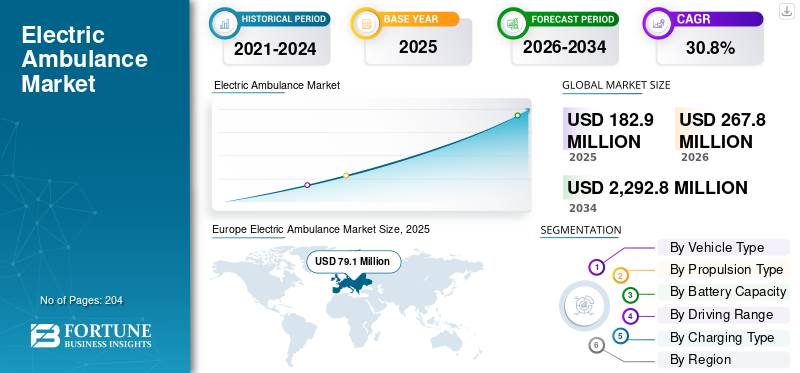
The global electric ambulance market size was valued at USD 182.9 million in 2025. The market is projected to grow from USD 267.8 million in 2026 to USD 2,292.8 million by 2034, exhibiting a CAGR of 30.8% during the forecast period. Europe dominated the electric ambulance market with a market share of 43.24% in 2025.
The global market includes battery-electric and plug-in hybrid emergency medical vehicles designed to transport emergency medical patients while reducing fuel use, emissions, noise, and operating costs. It covers ambulances and converted vans or light commercial vehicles equipped with electric drivetrains, batteries, charging stations, medical cabins, communication equipment, and life-support systems. Growth is driven by fleet electrification mandates, hospital sustainability targets, air-quality policies, charging infrastructure expansion, and improvements in battery performance.
Major players in the global market include WAS Vehicles, Demers Ambulances, Vehicle Conversion Specialists (VCS), and Mercedes-Benz, competing through purpose-built electric platforms, specialized ambulance conversions, extended driving range, lightweight construction, advanced medical-cabin integration, and enhanced operational cost efficiency.
Download Free sample to learn more about this report.
ELECTRIC AMBULANCE MARKET KEY TAKEAWAYS
 Global Market Size & Forecast
- 2025 Market Size: USD 182.9 million
- 2026 Market Size: USD 267.8 million
- 2034 Forecast Market Size: USD 2,292.8 million
- CAGR: 30.8% from 2026–2034
 Market Share
- Europe dominated the market with a 43.24% share in 2025.
- The Van segment held the largest market share in 2025.
- The Battery Electric Ambulances segment held the largest market share in 2025.
 Key Regional Highlights
Europe
Europe dominated the market in 2025 with a 43.24% share, driven by fleet decarbonization policies, healthcare sustainability targets, expanding charging infrastructure, and zero-emission ambulance deployments.
North America
North America held the second-largest market position and is projected to grow at a 29.4% CAGR, supported by municipal fleet electrification, hospital sustainability initiatives, and increasing availability of electric commercial vehicle platforms.
Asia Pacific
Asia Pacific held the third-largest position, supported by rapid urbanization, air-quality concerns, public-service fleet electrification, and expanding electric vehicle manufacturing and charging infrastructure.
U.S.
The market is estimated at USD 70.75 million in 2026, driven by municipal fleet modernization, clean-transport incentives, and hospital sustainability commitments.
Japan
The market is estimated at USD 10.61 million in 2026, supported by advanced vehicle engineering, aging-population healthcare demand, disaster-response modernization, and expanding zero-emission public fleets.
Read More

ELECTRIC AMBULANCE MARKET TRENDS
Purpose-Built Lightweight Platforms and Intelligent Energy Management to Shape Product Development
A prominent market trend is the development of purpose-built electric ambulances combining lightweight bodies, high-voltage systems, rapid charging, and intelligent energy management. Manufacturers are moving beyond basic conversions by optimizing vehicle architecture around battery placement, payload capacity, medical-cabin space, climate control, and equipment power requirements. Lightweight composite or aluminum structures help offset battery mass and preserve usable payload, while dedicated auxiliary power systems support ventilation, lighting, monitors, and life-support devices without compromising propulsion. Current electric ambulance designs are also incorporating telematics that track route conditions, battery state, charging windows, and energy use. WAS reports real-world ranges of approximately 200–250 kilometers for a 5.5-ton electric ambulance, demonstrating how specialized engineering is improving operational suitability for intensive urban emergency-service applications and shifts.
MARKET DYNAMICS
MARKET DRIVERS
Download Free sample to learn more about this report.
Government Decarbonization Mandates to Accelerate Electric Ambulance Procurement
Government decarbonization mandates and public healthcare sustainability programs are accelerating demand for electric ambulances. Emergency medical fleets operate continuously in densely populated areas, making their fuel consumption, emissions, and noise visible to policymakers and communities. Health authorities are therefore incorporating zero-emission targets into fleet renewal plans, procurement frameworks, and transport strategies. The NHS roadmap, for example, targets all newly purchased ambulances to be zero-emission from 2030 and more than half of its ambulance fleet by 2036. Similar clean-vehicle policies, urban emission zones, and institutional net-zero commitments are encouraging ambulance operators to evaluate battery-electric and plug-in hybrid models. As older diesel vehicles reach replacement age, mandated procurement schedules are expected to convert policy commitments into orders for electric emergency vehicles globally.
MARKET RESTRAINTS
High Acquisition and Infrastructure Costs to Restrain Fleet Conversion
High acquisition and infrastructure costs remain a restraint for electric ambulance market growth, particularly for municipal agencies and hospitals operating under fixed budgets. Electric chassis, high-capacity batteries, specialized medical conversions, thermal-management systems, and redundant electrical architecture increase vehicle expenditure compared with conventional diesel ambulances. Operators may also need depot chargers, electrical upgrades, backup power, energy-management software, and technician training before deployment. These investments are difficult to justify when agencies must fund staffing, medical equipment, and emergency-response coverage. Procurement complexity increases as ambulance configurations are customized according to national safety standards and clinical requirements, limiting manufacturing scale. Although lifetime operating savings may improve the business case, restricted capital budgets and lengthy approval cycles can delay fleet replacement decisions and slow large-volume adoption.
MARKET OPPORTUNITIES
Non-Emergency Patient Transport Electrification to Create Scalable Opportunities
Electrification of non-emergency patient transport and urban response fleets creates a near-term opportunity for manufacturers. These vehicles generally follow predictable routes, return regularly to hospitals or depots, and require fewer high-speed emergency journeys than frontline ambulances. Such operating patterns allow scheduled charging, route optimization, and battery sizing based on mileage, reducing deployment risk. Successful patient-transport trials can provide operators with data on energy consumption, maintenance, charging availability, staff acceptance, and patient comfort before expanding electrification to emergency units. Manufacturers can address this opportunity through modular conversions, leasing packages, charging partnerships, and fleet-management ambulance services. Growing demand from hospitals, elderly patient care providers, private ambulance companies, airports, campuses, and event operators could broaden the customer base and establish scalable pathways toward full emergency-fleet electrification.
MARKET CHALLENGES
Unpredictable Emergency Duty Cycles to Challenge Operational Readiness
Ensuring uninterrupted emergency readiness across unpredictable duty cycles remains the market’s most critical operational challenge. Ambulances may face extended shifts, repeated acceleration, and prolonged idling at incidents, extreme temperatures, traffic diversions, and continuous use of heating, cooling, communications, and medical equipment. These conditions can produce energy demand that differs from standardized testing. Fleet managers must determine whether range, charging speed, charger redundancy, and reserve capacity can support worst-case operations without reducing response coverage. Charging failures or unexpected mission extensions cannot be managed similarly to ordinary fleet disruptions since patient outcomes may depend on immediate vehicle availability. Manufacturers and operators need real-world trials, duty-cycle simulation, battery-health monitoring, contingency planning, and performance validation before electric ambulances can be deployed confidently across diverse emergency-service environments.
Segmentation Analysis
By Vehicle Type
Compact Design and Operational Flexibility to Strengthen Van Segmental Dominance
Based on vehicle type, the market is categorized into van and light commercial vehicle.
The van segment dominates the electric ambulance market share as its compact dimensions, lower curb weight, and flexible interior layouts suit urban emergency response and patient transport. Van-based platforms are widely available from established automakers, simplifying electric conversion, servicing, and fleet procurement. Their maneuverability supports operation in congested cities, while comparatively lower acquisition costs and energy consumption encourage adoption by hospitals, municipalities, and private ambulance operators replacing conventional diesel vehicles globally.
The light commercial vehicle segment is expected to expand at a CAGR of 26.5% during forecast period. Higher payload capacity, larger medical cabins, and suitability for advanced life-support equipment will drive adoption for intensive emergency operations, intercity transport, and specialized ambulance configurations.
By Propulsion Type
Zero-Emission Operations and Fleet Decarbonization Targets to Reinforce Battery Electric Ambulances Segmental Dominance
Based on propulsion type, the market is categorized into battery electric ambulances and plug-in hybrid electric ambulances.
The battery electric ambulances segment dominates the market as zero-tailpipe-emission operation aligns with government EMS agencies’ fleet decarbonization targets and hospital sustainability programs. Battery electric platforms offer lower fuel and maintenance expenses, quieter urban operation, and simplified drivetrains. Expanding charging infrastructure, improving battery energy density, and growing availability of electric van and LCV chassis support procurement. Their suitability for predictable urban routes and depot-based charging further strengthens adoption among public and private operators.
The plug-in hybrid electric ambulances segment is projected to grow at a CAGR of 26.5% during the forecast period. Extended driving capability, reduced range anxiety, flexible refueling, and suitability for long-distance or infrastructure-constrained emergency operations will support adoption globally and steadily.
By Battery Capacity
Balanced Range and Payload Efficiency to Sustain 50–100 kWh Segmental Dominance
Based on battery capacity, the market is categorized into below 50 kWh, 50–100 kWh, 101–150 kWh, and above 150 kWh.
The 50–100 kWh segment dominates the market as it provides a practical balance between driving range, payload retention, charging time, and vehicle cost. This capacity supports typical urban emergency routes while supplying sufficient energy for climate control, lighting, communications, and medical equipment. Its compatibility with widely available electric van and LCV platforms also simplifies vehicle conversion, fleet procurement, depot charging, and routine operation for hospitals and ambulance authorities.
The 101–150 kWh segment is projected to grow at a CAGR of 31.5% during the forecast period. Longer range, greater auxiliary-power availability, and improved suitability for extended shifts, intercity transfers, intensive-care equipment, and unpredictable emergency duty cycles will accelerate adoption.
By Driving Range
Optimal Route Coverage and Charging Practicality to Support 150–250 Kilometers Segmental Dominance
Based on driving range, the market is categorized into below 150 Kilometers, 150–250 Kilometers, and above 250 Kilometers.
The 150–250 kilometers segment dominates the market by offering sufficient range for daily urban and suburban emergency operations without requiring excessively large, heavy, or costly batteries. This range supports multiple patient-response trips between charging sessions while preserving payload capacity for medical equipment and personnel. Compatibility with depot charging, improving battery efficiency, and availability across electric van and LCV platforms further encourage adoption among hospitals, municipalities, and emergency medical service providers.
The below 150 kilometers segment is projected to grow at a CAGR of 28.2% during the forecast period. Lower purchase costs, smaller battery packs, faster charging, and suitability for short-distance urban response, patient transfers, campuses, airports, and localized healthcare networks will drive growth.
To know how our report can help streamline your business, Speak to Analyst
By Charging Type
Depot Compatibility and Cost-Efficient Overnight Charging to Sustain AC Charging Segmental Dominance
Based on charging type, the market is categorized into AC charging and DC fast charging.
The AC charging segment dominates the market as most fleets return to hospitals or centralized depots between shifts, enabling convenient overnight or scheduled charging. AC chargers require lower installation costs, place less pressure on local electrical infrastructure, and are widely compatible with electric van and LCV platforms. Their suitability for predictable urban routes, routine downtime, and battery conditioning supports economical fleet deployment by public and private ambulance operators.
The DC fast charging segment is projected to grow at a CAGR of 31.7% during the forecast period. Rapid energy replenishment, shorter vehicle downtime, higher daily utilization, and support for unpredictable emergency calls will accelerate deployment across intensive frontline fleets.
Electric Ambulance Market Regional Outlook
By geography, the market is categorized into Europe, North America, Asia Pacific, Latin America, and the Middle East & Africa.
Europe
Europe Electric Ambulance Market Size, 2025 (USD Million)
To get more information on the regional analysis of this market, Download Free sample
Europe dominates the global market, supported by stringent fleet decarbonization policies, rising healthcare sustainability targets, and early deployment of zero-emission ambulance. Strong government funding, expanding charging infrastructure, and established ambulance manufacturers accelerate procurement across the U.K., Germany, France, and Nordic countries. Urban low-emission zones further encourage replacement of diesel fleets. Growing adoption of electric vans, pilot programs by ambulance authorities, and coordinated public procurement are expected to sustain Europe’s leading market position globally throughout the forecast period.
U.K. Electric Ambulance Market
The U.K. market is estimated at around USD 32.44 million in 2026, supported by NHS decarbonization targets, charging investments, urban deployment, and growing procurement of zero-emission emergency vehicles.
Germany Electric Ambulance Market
The German market is estimated at around USD 23.23 million in 2026, driven by strict fleet emission standards, advanced ambulance manufacturing, strong EV infrastructure, and municipal healthcare electrification.
North America
North America holds the second-largest share of the global market and is projected to expand at a CAGR of 29.4% during the forecast period. Growth is driven by municipal fleet electrification, hospital sustainability commitments, and increasing availability of electric commercial vehicle platforms. The U.S. leads regional adoption through pilot deployments and clean-transport funding, while Canada benefits from provincial emission-reduction programs. Rising fuel costs, expanding charging networks, and demand for quieter urban emergency vehicles further support regional market expansion.
U.S. Electric Ambulance Market
The U.S. market is estimated at around USD 70.75 million in 2026, supported by municipal fleet modernization, clean-transport incentives, electric commercial vehicle availability, and hospital sustainability commitments nationwide.
Asia Pacific
Asia Pacific represents the third-largest market, supported by rapid urbanization, worsening air quality, and government efforts to electrify public-service fleets. China benefits from a mature electric commercial vehicle supply chain, extensive battery manufacturing, and large-scale charging infrastructure. Japan, South Korea, and India are gradually introducing electric emergency and patient-transport vehicles through pilot programs. Expanding healthcare infrastructure, rising ambulance demand, domestic electric vehicle production, and smart-city initiatives are expected to strengthen regional adoption across countries during the forecast period.
China Electric Ambulance Market
The Chinese market is estimated at around USD 21.19 million in 2026, benefiting from domestic battery manufacturing, extensive charging infrastructure, government fleet electrification programs, and urban healthcare expansion.
Japan Electric Ambulance Market
The Japanese market is estimated at around USD 10.61 million in 2026, supported by advanced vehicle engineering, aging-population healthcare demand, disaster-response modernization, and expanding zero-emission public fleets nationwide.
Middle East & Africa
The Middle East & Africa market is developing as governments modernize healthcare systems and introduce cleaner public-transport fleets. Gulf countries, particularly the UAE and Saudi Arabia, are expected to lead adoption through smart-city programs, sustainability strategies, and investment in advanced emergency medical services. High temperatures and long-distance operations require specialized battery thermal management and reliable charging infrastructure. In Africa, adoption will remain selective, led by urban hospitals, private healthcare providers, and internationally funded pilot projects in major metropolitan areas.
UAE Electric Ambulance Market
The UAE market is estimated at around USD 3.51 million in 2026, driven by smart-city programs, premium healthcare investment, sustainability targets, and modern emergency fleet procurement across emirates.
Latin America
Latin America’s market is expected to expand gradually as major cities address transport emissions and modernize emergency medical fleets. Brazil, Mexico, Chile, and Colombia offer potential due to growing electric bus and commercial vehicle ecosystems, renewable electricity availability, and urban air-quality initiatives. Initial demand is likely to come from municipal authorities, private hospitals, airports, and non-emergency patient transport operators. Financing constraints and limited charging coverage may slow deployment, but pilot programs and international partnerships will support long-term growth.
Brazil Electric Ambulance Market
The Brazilian market is estimated at around USD 4.49 million in 2026, supported by urban air-quality initiatives, expanding healthcare infrastructure, renewable electricity, and municipal fleet modernization programs nationwide.
COMPETITIVE LANDSCAPE
Key Industry Players
Strategic Partnerships and Technology Differentiation by Key Players to Shape Competitive Landscape
The global electric ambulance market remains moderately consolidated, with established ambulance manufacturers, vehicle converters, and commercial vehicle OEMs competing through platform integration, range optimization, lightweight bodies, and medical-cabin customization. Companies such as WAS Vehicles, Demers Ambulances, REV Group, Vehicle Conversion Specialists, and Mercedes-Benz leverage engineering expertise, regulatory knowledge, and relationships with public health authorities. Competitive strength depends on delivering reliable duty-cycle performance, sufficient payload, auxiliary power for medical equipment, and compliance with national ambulance standards while controlling acquisition costs and ensuring dependable after-sales service across diverse urban and regional fleets.
Competition is increasingly shaped by partnerships between chassis producers, conversion specialists, charging providers, hospitals, and emergency-service operators. Manufacturers are conducting pilot deployments to validate real-world range, charging time, thermal performance, crew ergonomics, and total cost of ownership before securing fleet-scale contracts. European companies benefit from early procurement mandates and mature electric van platforms, while North American suppliers emphasize modular designs and larger ambulance bodies. Future differentiation will center on fast-charging capability, battery durability, telematics, predictive maintenance, financing solutions, and localized service networks that reduce operational risk for ambulance authorities globally.
LIST OF KEY ELECTRIC AMBULANCE COMPANIES PROFILED IN REPORT
- WAS Vehicles (Germany)
- Demers Ambulances (Canada)
- Terex Ambulance Group (U.S.)
- Vehicle Conversion Specialists—VCS (U.K.)
- BINZ Automotive (Germany)
- Ambulanz Mobile (Germany)
- IVECO (Italy)
- Mercedes-Benz (Germany)
- Ford Motor Company (U.S.)
- Alke (Italy)
- Polaris GEM (U.S.)
KEY INDUSTRY DEVELOPMENTS
- April 2026: North East Ambulance Service showcased Renault E-Master and Ford E-Transit ambulances alongside electric response and patient-transport vehicles, highlighting lower whole-life costs, reduced downtime, quicker servicing, improved reliability, and progressive introduction into frontline and patient-transport operations across the region.
- March 2026: North East Ambulance Service secured USD 2.9 million for 46 high-powered charging ports across seven ambulance stations. The chargers can restore emergency vehicles to 80% in around 15 minutes, expanding the network to 113 ports by year-end.
- September 2025: IVECO and WAS supplied SDIS 78 in France with its first fully electric eDaily ambulance. The 4.5-ton vehicle integrates solar panels, auxiliary lithium batteries, heating, air conditioning, and station-based rapid charging for frontline operational availability
- August 2025: East of England Ambulance Service received USD 2,96,245 through the NHS Chargepoint Accelerator programme. The funding supports installation of 44 double-vehicle chargepoints at ambulance stations and depots, enabling the next phase of electric fleet integration across regional operations.
- February 2025: Ford documented London Ambulance Service crews operating specially converted E-Transit ambulances across consecutive 12-hour shifts. Paramedics reported the 68-kWh vehicles remained above 50% battery, while integrated SYNC technology supported dispatch, navigation, communications, and medical operations in service.
- January 2025: JBM Auto unveiled the e-MediLife electric medical mobile unit at Bharat Mobility Global Expo. The e-ambulance features modular lithium-ion battery packs, ultra-fast charging, and thermal-management technology, broadening JBM’s zero-emission portfolio beyond electric buses and airport vehicles globally.
- October 2024: Demers Ambulances presented its eFX electric ambulance in Ontario for the first time at OAPC. Paramedic leaders tested its ergonomic patient compartment, FX Action Seats, swivelling drawer cabinets, safety harnesses, and steering controls, generating strong market interest.
REPORT COVERAGE
The global electric ambulance market analysis provides an in-depth study of market size and forecast by all the market segments included in the report. It includes details on the market dynamics and market trends expected to drive the market during the forecast period. It offers information on the technological advancements, new product launches, key industry developments, and details on partnerships, mergers & acquisitions. The market research report also encompasses a detailed competitive landscape, including market share and profiles of key operating players.
Request for Customization to gain extensive market insights.
Report Scope & Segmentation
| ATTRIBUTE | DETAILS |
| Study Period | 2021-2034 |
| Base Year | 2025 |
| Estimated Year | 2026 |
| Forecast Period | 2026-2034 |
| Historical Period | 2021-2024 |
| Growth Rate | CAGR of 30.8% from 2026-2034 |
| Unit | Value (USD Million) |
| Segmentation | By Propulsion Type, By Vehicle Type, By Battery Capacity, By Driving Range, By Charging Type, and By Region |
| By Propulsion Type |
|
| By Vehicle Type |
|
| By Battery Capacity |
|
| By Driving Range |
|
| By Charging Type |
|
| By Region |
|
Frequently Asked Questions
Fortune Business Insights says that the global market value stood at USD 182.9 million in 2025 and is projected to reach USD 2,292.8 million by 2034.
In 2025, the Europe’s market value stood at USD 79.1 million.
The market is expected to exhibit a CAGR of 30.8% during the forecast period of 2026-2034
The van segment led the market by vehicle type.
Government decarbonization mandates to accelerate electric ambulance procurement.
Europe held the largest market share in 2025.



- 2021-2034
- 2025
- 2021-2024
- 204
-
(Offer valid till 15th Oct 2026)
Get 30-60 hrs Free Customization
Expand Regional and Country Coverage, Segments Analysis, Company Profiles, Competitive Benchmarking, and End-user Insights.




















Related Reports
-
US +1 833 909 2966 ( Toll Free )
-
Get In Touch With Us