Electric Bike Battery Market Size, Share & Industry Analysis, By Battery Type (Lead Acid, Lithium-ion, and Others), By Battery Pack Position Type (Rear Carrier, Down Tube, and In Frame), By Bicycle Type (City/Urban, Mountain/Trekking, and Cargo/Luggage), By Battery Capacity (Below 250W, 251 W to 450W, 451 W to 650 W, and Above 650W), and Regional Forecast, 2026-2034
 Download Free Sample
(Offer valid till 15th Oct 2026)

KEY MARKET INSIGHTS
 Listen to Audio Version
The global electric bike battery market size was valued at USD 18.90 billion in 2025 and is projected to grow from USD 21.05 billion in 2026 to USD 55.04 billion by 2034, exhibiting a CAGR of 12.77% during the forecast period. Asia Pacific dominated the global market with a share of 57.85% in 2025.
An e-bike battery is a rechargeable power source that provides electrical energy to an electric bicycle's motor system. These batteries are typically chosen for their high energy density, lightweight, and ability to handle charging cycles. These batteries are essential for the power of an electric motor, which assists the rider in pedaling, making e-bikes a viable and convenient alternative to traditional bicycles and motor vehicles. The market includes a wide range of battery types, technologies, and capacities, catering to diverse consumer needs and preferences.
Major players in this market include Samsung SDI Co. Ltd., Shimano Inc., and Panasonic Industry Europe GmbH. Major players are forming partnerships with e-bike manufacturers to ensure seamless integration and optimal performance. This collaboration helps expand market reach and improve product development.
The global shift toward sustainable and eco-friendly transportation has given rise to substantial advancements in electric vehicles, including electric bikes (e-bikes). The development and innovation in electric bike batteries are crucial for the proliferation of e-bikes. The market is dynamic and rapidly growing, driven by increasing environmental awareness, technological advancements, and supportive government policies.
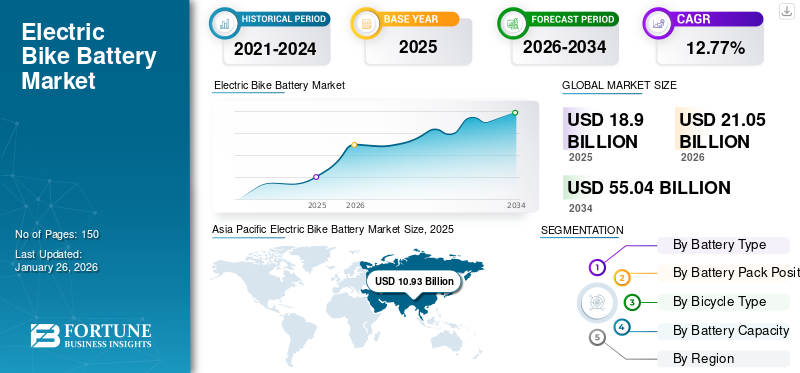
Download Free sample to learn more about this report.
Electric Bike Battery Market KEY TAKEAWAYS
 Global Market Size & Forecast
- 2025 Market Size: USD 18.90 billion
- 2026 Market Size: USD 21.05 billion
- 2034 Forecast Market Size: USD 55.04 billion
- CAGR: 12.77% from 2026–2034
 Market Share
- Asia Pacific dominated the market with a 57.85% share in 2025.
- Lithium-ion batteries are projected to hold a 72.35% share in 2026.
- The 451W–650W battery capacity segment is expected to account for 33.97% of the market in 2026.
 Key Regional Highlights
North America
North America captured 13.48% of the global market in 2025.
Asia Pacific
Asia Pacific held a 57.85% market share in 2025.
Europe
Europe accounted for 28.91% of the global market in 2025.
U.S.
U.S.: The market is projected to reach USD 0.67 billion in 2026.
Japan
Japan: The market is expected to reach USD 0.21 billion in 2026.
Read More

Electric Bike Battery Market Trends
Advancements in Battery Technology, Including Solid State Batteries to Set a Positive Trend for Market Growth
The number of ongoing research and development in solid-state batteries is accelerating rapidly. These batteries offer the potential for higher energy density, enhanced safety, and quicker charging times. Although they are still in the experimental stage, they anticipate transforming the e-bike market in the coming years.
For instance, in July 2023, Stromer introduced the first solid-state battery in the e-bike industry. Solid-state batteries are the next frontier of battery technology. These batteries can store almost double the energy by both volume and weight as compared to lithium-ion batteries. The liquid or gels in current lithium-ion batteries are one of the key contributors to battery degradation, and removing them leads to longer lifespans.
Certain manufacturers are investigating wireless charging technology for e-bike batteries. This advancement could streamline the charging process and improve user convenience, and it is currently becoming more common in premium models. This innovation is expected to fuel market growth in the coming years.
For instance, in July 2024, re: Charge and the Capital District Transportation Authority (CDTA) announced the piloting of a new universal wireless charging solution for electric bikes in Amsterdam, New York. The pilot program is the first in the U.S. to utilize a wireless charging solution compatible with a variety of shared electric micro-mobility bikes.
Download Free sample to learn more about this report.
MARKET DYNAMICS
Market Drivers
Increasing Demand for Electric Bikes in Urban Areas Propels Market Growth
Urban areas define the key markets for e-bikes, driven by the demand for sustainable and efficient transportation options. Cities such as Amsterdam, Berlin, and Shanghai have encountered a notable increase in e-bike usage, supported by government initiatives that encourage their adoption. This trend is contributing to the growing electric bike battery demand.
The rise of e-bike-sharing programs in cities around the world is driving demand for durable and reliable batteries. As more cities implement e-bike sharing systems, the demand for high-capacity, reliable batteries will increase to support these fleets. Companies involved in battery production can capitalize on this growing demand by developing specialized batteries tailored for shared e-bike applications. Thus, the increasing demand for ride-sharing programs directly drives the growth of the market.
For instance, In November 2024, BIXI announced that it had surpassed 13 million trips taken in 2024. The bike-sharing service records a 15% increase in ridership, following years of sustained growth, with new records set every month. More importantly, in July and September of 2024, more than 2 million trips were made. This sustainable growth for e-bike ride-sharing is driving the growth of the market.
Market Restraints
Limited Charging Infrastructure May Hamper the Market Growth
The presence of charging infrastructure is a vital issue hampering the market growth. Unlike conventional bicycles, electric bikes need access to effective charging facilities. In numerous areas, particularly in rural and underdeveloped regions, the absence of charging stations can make it difficult or even unfeasible for e-bike owners to recharge their batteries. This restriction not only impacts the functionality of e-bikes but also hinders the electric bike battery demand.
Setting up and overseeing a charging station is an expensive undertaking. It demands considerable expenditure on equipment, software, and utilities. This financial strain can be overwhelming, particularly in areas with constrained budgets for public infrastructure initiatives. Thus, the high cost of installing the charging station may hamper the market growth.
Market Opportunities
Technological Advancements and the Integration of Smart Technologies are Emerging as Huge Opportunities for Market Growth
The ongoing advancement in battery technology plays a crucial role in the expansion of the market. Lithium-ion batteries, which are currently the most widely used battery type in e-bikes, are increasingly becoming more efficient, durable, and affordable. Research and development initiatives are concentrating on enhancing battery energy density, prolonging battery life, and minimizing charging durations. These advancements make e-bikes more attractive to a wider spectrum of consumers, ranging from occasional riders to long-distance travelers. This advancement brings new opportunities for the electric bike battery market growth.
The integration of smart technologies into e-bike batteries is another significant opportunity. Modern e-bike batteries can be equipped with features, such as real-time monitoring, energy management systems, and even connectivity to mobile apps. These features enhance the user experience by providing real-time data on battery status, optimizing energy use, and offering customization options. As the Internet of Things (IoT) and smart city initiatives gain traction, the demand for smart e-bike batteries increases.
Market Challenges
Cost of Battery Production May Hamper the Market Growth
The cost of battery production particularly impacts the overall price of e-bikes. Despite continuous advancements in technology, the production cost of batteries remains high, leading to elevated retail prices for e-bikes. The prices of essential battery components, such as lithium, cobalt, and nickel, are volatile and can lead to increased production costs. Fluctuating prices can affect manufacturers' profitability and subsequently impact consumers. With manufacturers emphasizing more advanced battery technologies, the cost-per-unit production can be high due to still limited market penetration. Thus, the cost of battery production hinders market growth.
Segmentation Analysis
By Battery Type
Lithium-ion Batteries Dominate the Market Due to Their Longer Lifespan
The market is segmented into lead acid, lithium ion, and others, based on battery type.
The lithium-ion segment holds the largest share and is expected to increase over the forecast period. Lithium-ion batteries have a longer lifespan than many other battery types. They typically last between 500 to 1000 charge cycles, which translates to several years of regular use. This longevity reduces the frequency of battery replacements, making lithium-ion batteries a more cost-effective and environmentally friendly option over the long term. Due to their longer lifespan, many players have adopted lithium-ion batteries in their e-bikes. The lithium ion segment is expected to lead the market, contributing 72.35% globally in 2026.
For instance, in February 2024, Trek launched a new electric mountain bike based on its popular Marlin model, calling it the “go-anywhere hardtail electric mountain bike.” The Marlin+ has a few of the same features as the Marlin, but a 250W Active Line Plus mid-drive motor and an in-frame 400Wh battery that provides an electric boost.
The lead-acid segment held a significant share of the market. This is due to lead acid batteries typically being less expensive upfront compared to other batteries, making electric bikes more affordable for customers. Thus, the lower cost of lead-acid batteries drives the market growth.
To know how our report can help streamline your business, Speak to Analyst
By Battery Pack Position Type
Enhanced Aesthetics and Design Integration Drive the Down Tube Segment Growth
This market can be segmented into rear carrier, down tube, and in frame, based on battery pack position type.
The down tube segment dominated the market in 2024. Various elements are driving this segment's expansion, including its flawless incorporation with the e-bike's frame. In contrast to external battery packs that may make the bike bulky and less stylish, down tube batteries are concealed within the frame, preserving a sleek and contemporary look. This design attracts consumers who value aesthetics and also corresponds with the general trend toward more integrated and streamlined products in the consumer electronics and transportation industries. These elements collectively contribute toward the dominance of the segment in the market. The down tube segment will account for 65.00% market share in 2026.
The rear carrier segment held a significant market share. The rear carrier position delivers a balanced weight distribution with larger battery capacities, particularly for city and commuter e-bikes. It minimizes interference with pedaling or frame design, making it an optimal choice for casual riders. Thus, the enhanced weight distribution of the rear carrier battery position drives the market growth.
By Bicycle Type
Strict Emission Measures and Government Efforts to Boost Green Vehicle Usage Fuel City/Urban Segment Growth
Based on bicycle type, the market is segmented into city/urban, mountain/trekking, and cargo/luggage.
The city/urban is the dominant and rapidly growing segment in the market. The growing need for eco-friendly conveyance and the ongoing emphasis on government initiatives have caused the growth of city bikes used for daily traveling. In July 2024, Acer announced the new Acer ebii elite, eNomad-R series, and Acer eCargo-M e-bikes, which was showcased at EUROBIKE 2024 in Frankfurt, Germany, conducted from July 3rd to 7th, 2024. A full range of Acer and Predator e-mobility products was also displayed during the show, bannering the theme 'Revolutionize Your Ride with Our Full Range of Next-Gen Smart e-Bikes and e-Scooters.' The cargo/luggage segment is expected to account for 81.63% of the market in 2026.
The mountain/trekking segment is the second-largest segment in the market. It is anticipated to expand significantly throughout the forecast duration due to the rising interest in sports and adventurous hobbies, which is encouraging the global adoption of mountain/off-road bikes. The utilization of e-bikes in leisure and trekking activities is swiftly on the rise. Increasing awareness regarding performance-oriented adventure sports will aid the growth of the segment.
By Battery Capacity
Increasing Adoption of 451W to 650W Battery Capacity e-Bikes to Drive the 451W to 650W Segment Growth
Based on battery capacity, the market is segmented into below 250W, 251W to 450W, 451W to 650W, and above 650W.
The 451W to 650W battery capacity has the largest share of the market. This is due to the increasing acceptance of batteries with a capacity of 451W to 650W for e-bikes. These batteries offer a huge range and lifetime as compared to other batteries that have lesser capabilities, bolstering the segment’s growth. The 451 W to 650 W segment is projected to dominate the market with a share of 33.97% in 2026.
The above 650W segment has the second-largest electric bike battery market share. This is due to its highly balanced performance. The above 650W battery capacity range bids a balanced performance, offering a good blend of weight and range. E-bikes with batteries above 650W are frequently suitable for short travels and longer rides, making them adaptable and interesting to a wide range of consumers.
ELECTRIC BIKE BATTERY REGIONAL OUTLOOK
The market covers four major regions, mainly Europe, Asia Pacific, North America, and the Rest of the World.
Asia Pacific
Asia Pacific Electric Bike Battery Market Size, 2025 (USD Billion)
To get more information on the regional analysis of this market, Download Free sample
The market in Asia Pacific reached USD 5.38 billion in 2025, representing 27.75% of total market revenue, and is projected to reach USD 5.62 billion in 2026. The electric bike battery market in the Asia Pacific region is leading with a worth of USD 10.93 Billion in 2025. The Asia Pacific region has become an important market for electric bikes, with nations, such as China and Japan at the forefront regarding adoption rates and technological innovations. The market for electric bike batteries in this region is seeing strong growth, fueled by a collection of government initiatives, rising environmental consciousness, and a growing need for sustainable transport options. China has the largest e-bike market share globally, boasting a penetration rate that significantly surpasses that of other nations. Chinese cities rank among the most crowded globally, resulting in significant traffic jams. E-bikes provide a convenient and time-saving option compared to conventional vehicles. This propels the market expansion in the area. The Japan electric bike battery market is anticipated to reach USD 0.21 billion by 2026, the China electric bike battery market is set to attain USD 10.96 billion by 2026, and the India electric bike battery market is likely to reach USD 0.42 billion by 2026.
Europe
In 2025, Europe held 28.91% of the global market, reaching a valuation of USD 5.61 billion, and is projected to grow to USD 5.75 billion in 2026. The market for electric bikes has grown significantly in Europe in recent years due to a combination of government incentives, technology breakthroughs, and environmental awareness. One of the main drivers of the e-bike market's expansion in the region has been the growth of cycling infrastructure in European cities. To make e-bike riding safer and easier, nations, including the Netherlands and Denmark, have electric bike battery made significant investments in bike lanes, bike-sharing schemes, and charging stations. The United Kingdom electric bike battery market is estimated to reach USD 0.23 billion by 2026, while the Germany electric bike battery market is forecast to reach USD 1.77 billion by 2026.
North America
The North America market was valued at USD 2.62 billion in 2025, capturing 13.48% of global revenue, and is estimated to reach USD 2.7 billion in 2026. The increasing need for long-lasting, eco-friendly, and high-efficiency power sources drives the North American electric bike battery industry. These batteries are vital parts of e-bikes as they supply the energy required to move the bike forward and guarantee a dependable and comfortable ride. Due to a huge consumer base and a strong focus on sustainability, the U.S. has the largest electric bike battery market in North America. With the help of public programs to encourage cycling, e-bike use has significantly increased in major cities, including New York, Los Angeles, and San Francisco. The United States electric bike battery market is expected to reach USD 0.67 billion by 2026.
Rest Of The World
The market growth in the rest of the world is attributed to rising tourism. These bikes are used for traveling and leisure activities in regions with scenic lands and cultural attractions. They offer travelers an enjoyable and eco-friendly way to travel destinations, which helps drive the market growth. In 2025, the Middle East & Africa market stood at USD 0.7 billion, representing 3.59% of global demand, and is projected to grow to USD 0.71 billion in 2026. Latin America maintained a strong presence in the global market, reaching USD 5.1 billion in 2025, accounting for 26.27% share, and is expected to reach USD 5.3 billion in 2026.
COMPETITIVE LANDSCAPE
Key Industry Players
Key players in this market include Samsung SDI Co. Ltd., Shimano Inc., and Panasonic Industry Europe GmbH
Panasonic is a Japanese multinational electronics company that develops, manufactures, and sells a wide range of products. The company was founded in 1918 and is headquartered in Kadoma, Osaka, Japan. The company provides semi-integrated batteries. The cell type 20700 has been developed for a compact battery design. It is the first time that these cells are being used for semi-integrated batteries.
In May 2024, LIV and Giant introduced two electric hardtail bikes—the Liv Lurra E+ and the Giant Fathom E+. Both are mid-drive, powered by Giant’s own SyncDrive Pro motors, and both have 130mm travel forks. Both bikes are available as standard electric hardtail options and an EX option, which includes racks and mudguards to appeal to the touring and commuting market.
LIST OF KEY ELECTRIC BIKE BATTERY COMPANIES PROFILED
- Samsung SDI Co. Ltd (South Korea)
- Yamaha Corporation (Japan)
- Yoku Energy (Zhangzhou) Co. Ltd (China)
- Kingbo Power Technology Co. Limited (China)
- Liv Cycling (Taiwan)
- Shimano Inc. (Japan)
- Panasonic Industry Europe GmbH (Germany)
- BMZ GmbH (Germany)
- Mahle GmbH (Germany)
- Varta AG (Germany)
- Johnson Matthey (U.K.)
KEY INDUSTRY DEVELOPMENTS
- In December 2024, Bosch introduced the compact Performance Line SX and Sprint drive units. With the Performance Line SX and Performance Line Sprint, Bosch eBike Systems aims to set new standards for riding with lightweight eMTBs, Gravel eBikes and Urban eBikes. With a Light eMTB, the combination of frame geometry, weight, motor power, and battery capacity determines the ride characteristics.
- In September 2024, Bosch introduced its new e-bike motor and bigger batteries. The company claims that the drive system’s re-engineered sensor technology precisely measures pedal input more than 1,000 times per second using a suite of cadence, torque, and inertial sensors. The company also announced a new PowerTube 600 for those who don’t need quite the massive battery capacity found in the PowerTube 800.
- In May 2024, EMotorad, one of the leading e-bike manufacturers in India, expanded its manufacturing base with 2,40,000 square feet gigafactory in Pune. This facility is expected to focus on manufacturing essential components such as batteries, motors, displays, and chargers, with an initial capacity of 5,00,000 electric cycles annually.
- In January 2024, Yamaha revealed ENYRING, a new battery-swapping initiative for electric bikes. It has been launched in Europe, starting in Berlin, Germany, and soon following in the Netherlands. ENYRING is a collaborative effort between Yamaha Motor and strategic partners. The goal is to simplify recharging and reduce the cost of battery replacement.
- In June 2023, Bosch introduced 2024 E-Bike Hardware and Software. The newest additions to the family are the PowerPack 400 Frame, the PowerPack 400 and 500 Rack, and the CompactTube 400, with the lightest being the CompactTube 400, an integrated battery that adds just 2.0 kg (4.4 lbs) to a two-wheeler.
REPORT COVERAGE
The market research report provides a detailed analysis of the market and focuses on crucial aspects such as leading companies, product types, and leading product applications. Besides this, the report offers insights into the market trends and highlights vital industry developments. In addition to the factors above, the report encompasses several factors contributing to the market's growth over recent years.
Request for Customization to gain extensive market insights.
Report Scope & Segmentation
|
ATTRIBUTE |
DETAILS |
|
Study Period |
2021-2034 |
|
Base Year |
2025 |
|
Estimated Year |
2026 |
|
Forecast Period |
2026-2034 |
|
Historical Period |
2021-2024 |
|
Growth Rate |
CAGR of 12.77% over 2026 to 2034 |
|
Unit |
Value (USD Billion) |
|
Segmentation |
By Battery Type
|
|
By Battery Pack Position Type
|
|
|
By Bicycle Type
|
|
|
By Battery Capacity
|
|
|
By Region
|
Frequently Asked Questions
Fortune Business Insights says that the global market size was USD 18.90 billion in 2025 and is projected to reach USD 55.04 billion by 2034.
In 2025, the Asia Pacific market size stood at USD 10.93 billion.
The market is projected to grow at a CAGR of 12.77% and exhibit steady growth during the forecast period.
Increasing demand in urban areas will propel the market growth.
Major players in this market include Samsung SDI Co. Ltd., Shimano Inc., and Panasonic Industry Europe GmbH.
Asia Pacific dominated the market with a share of 57.85% in 2025.



- 2021-2034
- 2025
- 2021-2024
- 150
-
(Offer valid till 15th Oct 2026)
Get 30-60 hrs Free Customization
Expand Regional and Country Coverage, Segments Analysis, Company Profiles, Competitive Benchmarking, and End-user Insights.




















-
US +1 833 909 2966 ( Toll Free )
-
Get In Touch With Us