Electric Car Subscription Market Size, Share & Industry Analysis, By Vehicle Type (Hatchbacks, Sedans, and SUVs & Crossovers), By Subscription Duration (1-6 months, 6-12 months, and More than 12 months), By Customer Type (Individual Consumers, Corporate Customers, and Mobility Service Providers), By Propulsion Type (Battery Electric Vehicles (BEVs) and Plug-in Hybrid Electric Vehicles (PHEVs)), and Regional Forecasts, 2026-2034
 Download Free Sample
(Offer valid till 30th Sep 2026)

Electric Car Subscription Market Size and Future Outlook
 Listen to Audio Version
The electric car subscription market size was valued at USD 2.45 billion in 2025. The market is projected to grow from USD 2.93 billion in 2026 to USD 11.37 billion by 2034, exhibiting a CAGR of 18.5% during the forecast period. Europe dominated the electric car subscription market with a market share of 42.85% in 2025.
The market represents recurring access to electric vehicles through monthly or fixed-period subscription plans instead of direct purchase, loan, or long-term lease. It is positioned as an alternative to traditional vehicle ownership, especially for consumers and businesses that want flexibility, predictable costs, and lower upfront commitment. These services are generally managed through digital platforms, where users choose the vehicle type, subscription tenure, mileage package, and bundled services.
The market covers car subscription services and EV subscription services that include the vehicle, registration, insurance maintenance and roadside assistance, and sometimes charging support. It does not include normal vehicle sales, daily rentals, ride-hailing revenue, or conventional IC engine leasing unless an electric vehicle is offered through a subscription-style contract.
The industry is expected to evolve as customers become more comfortable using vehicles as a service rather than owning them. The rising demand for flexible mobility solutions, growing EV adoption, urban mobility needs, and higher awareness of ownership costs will support market expansion. EV subscriptions also help users test an EV before purchase, avoid depreciation risk, and switch models as battery range and charging technologies improve.
Applications include personal mobility, corporate employee mobility, executive car access, short-term urban commuting, and flexible fleet deployment. Key players such as FINN GmbH, SIXT SE and Volvo Cars are expanding EV fleets, improving app-based subscription journeys, and adding bundled services to make subscriptions more convenient than buying or leasing.
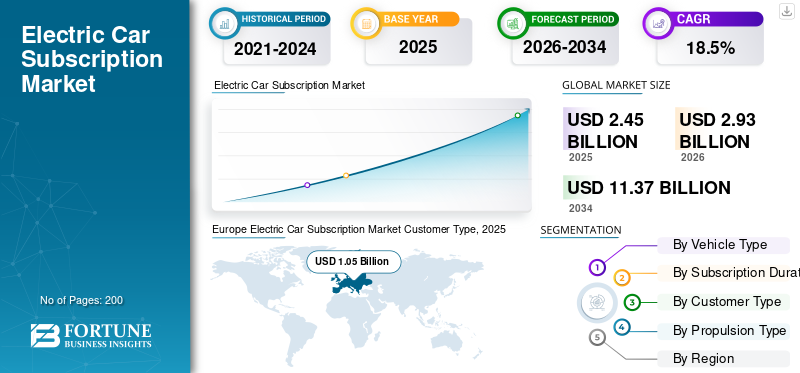
Download Free sample to learn more about this report.
Electric Car Subscription Market Key Takeaways
 Global Market Size & Forecast
- 2025 Market Size: USD 2.45 billion
- 2026 Market Size: USD 2.93 billion
- 2034 Forecast Market Size: USD 11.37 billion
- CAGR: 18.5% from 2026–2034
 Market Share
- Europe dominated the electric car subscription market with a 42.85% share in 2025.
- The sedans segment is expected to grow at a CAGR of 19.9% over the forecast period.
- The 6–12 months segment is expected to grow at a CAGR of 22.3% over the forecast period.
 Key Regional Highlights
Europe
Europe led the market with a valuation of USD 1.05 billion in 2025.
North America
North America is estimated to reach USD 0.91 billion in 2026, securing the position of the second-largest regional market.
Asia Pacific
Asia Pacific is projected to grow at a CAGR of 21.0% and reach USD 0.67 billion in 2026.
U.S.
The market reached USD 0.64 billion in 2025, representing roughly 26.2% of global revenue.
Japan
The market is supported by growing electric vehicle adoption and rising interest in flexible vehicle subscription models.
Read More

ELECTRIC CAR SUBSCRIPTION MARKET TRENDS
Digital Platforms Leading to Improved Scaling of EV Subscriptions is a Prominent Market Trend
A key trend is the shift toward app-based and online-first subscription journeys. Digital platforms help customers compare vehicle type, monthly cost, mileage, tenure, and included services before subscribing. This improves transparency and reduces paperwork compared with traditional leasing. Operators also use digital systems for customer onboarding, payments, maintenance scheduling, and vehicle switching, improving scalability of car subscription services.
- For instance, in 2024, SIXT+ promoted its electric car subscription as a flexible online alternative to buying or leasing an electric vehicle.
MARKET DYNAMICS
MARKET DRIVERS
Download Free sample to learn more about this report.
Rising Demand for Flexible Mobility Solutions Strengthens EV Subscription Adoption
The rising demand for flexible mobility solutions is a major driver as customers increasingly want access without full vehicle ownership risk. EV buyers remain concerned about battery life, charging access, resale value, and technology upgrades. Car subscription services reduce these barriers by bundling vehicle use with insurance maintenance and roadside assistance, making EV subscriptions easier to test and scale. These factors collectively drive the electric car subscription market growth.
- For instance, in February 2023, Hyundai Evolve+ offered a 28-day EV subscription with 1,000 miles, insurance, maintenance, roadside assistance, and cancel-anytime flexibility.
MARKET RESTRAINTS
High Monthly Costs Limit Mass Adoption of EV Subscription Plans
High monthly fees restrain the market as subscription pricing usually includes depreciation, insurance, servicing, taxes, and operator margins. This makes EV subscription services costlier than normal financing or some leases, especially for budget-sensitive users. In emerging markets, the gap between IC engine ownership costs and EV monthly subscriptions can slow adoption despite growing interest in electric vehicles.
- For instance, in 2023, Hyundai Evolve+ pricing started at USD 699 for Kona Electric and USD 899 for IONIQ 5, above many standard monthly payments.
MARKET OPPORTUNITIES
Corporate Fleet Electrification Creates New Subscription Opportunities
Corporate customers are a strong opportunity as companies want lower-emission fleets without purchasing EVs outright. Flexible EV fleet subscriptions allow firms to trial models, manage employee mobility, and adjust fleet size without long asset commitments. As sustainability targets expand, subscription-based electric vehicles can support business mobility while reducing exposure to depreciation, charging uncertainty, and future technology changes.
- For instance, in February 2024, The U.K. Society of Motor Manufacturers and Traders (SMMT) said fleet demand drove market growth, with fleets accounting for more than six in ten new car registrations.
MARKET CHALLENGES
Weak Unit Economics and Residual Value Risk Challenge Market Growth
Subscription operators face challenges from vehicle depreciation, idle fleet periods, insurance cost volatility, and uncertain residual values. EV technology changes quickly, so older models can lose appeal faster than expected. If utilization falls, providers must still carry financing and fleet maintenance costs. These pressures can affect profitability, especially when subscription pricing must remain attractive against leasing and IC engine alternatives.
- For instance, in 2024, Lynk & Co said it was phasing out its in-house subscription offer while shifting toward a stronger European retail presence.
Segmentation Analysis
By Vehicle Type
SUVs & Crossovers Dominate Due to Higher Practicality and Strong EV Model Availability
On the basis of vehicle type, the market is segmented into hatchbacks, sedans and SUVs & crossovers.
SUVs & crossovers segment dominates the market as customers prefer higher seating, larger cabins, better perceived safety, and versatile usage. Many leading subscription-ready electric vehicles, including Tesla Model Y, Hyundai IONIQ 5, Kia EV6, Volvo EX30/EX40, and Volkswagen ID.4, are SUV or crossover models. Subscription providers also favor SUVs as they command higher monthly fees and have broad appeal across individual and corporate users.
- For instance, in June 2025, FINN signed a framework deal to procure up to 5,000 BYD EVs, supporting wider electric fleet availability.
Sedans segment is expected to grow at a CAGR of 19.9% over the forecast period.
To know how our report can help streamline your business, Speak to Analyst
By Subscription Duration
More Than 12 Months Segment Dominates Due to Stable Recurring Revenue
On the basis of subscription duration, the market is segmented into 1-6 months, 6-12 months and more than 12 months.
More than 12 months segment dominates due to longer subscription plans create steadier revenue, better fleet utilization, and lower customer acquisition costs. Corporate customers and committed individual users often prefer longer access when EVs replace daily-use cars. This duration also helps providers recover depreciation and service costs more predictably while still remaining more flexible than full vehicle ownership.
- For instance, in 2024, Porsche Drive promoted single and multi-vehicle subscription choices that allow users to continue a vehicle or switch models.
6-12 months segment is expected to grow at a CAGR of 22.3% over the forecast period.
By Customer Type
Individual Consumers Dominate as EV Subscriptions Reduce Ownership Risk
On the basis of customer type, the market is segmented into individual consumers, corporate customers and mobility service providers.
Individual consumers dominate as EV subscriptions directly address concerns around upfront cost, charging uncertainty, battery degradation, and resale value. The model gives households an alternative to traditional buying or leasing while bundling costs into one monthly payment. Consumers also use subscriptions to test EV suitability before long-term ownership, especially in urban markets with strong charging access.
- For instance, in 2024, Hyundai Evolve+ positioned its monthly EV subscription for customers wanting low-commitment access without long-term ownership.
Corporate customers segment is expected to grow at a CAGR of 22.7% over the forecast period.
By Propulsion Type
BEVs Dominate as Subscription Fleets Move Toward Fully Electric Models
On the basis of propulsion type, the market is segmented into Battery Electric Vehicles (BEVs) and Plug-in Hybrid Electric Vehicles (PHEVs).
BEVs held largest electric car subscription market share as subscription operators increasingly focus on zero-emission electric vehicles rather than plug-in hybrids. BEVs align better with regulatory targets, corporate sustainability goals, and consumer interest in fully electric mobility. Improving battery range and charging infrastructure reduce dependence on IC engine backup systems, while BEV-heavy fleets help operators position themselves as clean mobility providers.
- For instance, in 2024, IEA reported China sold over 11 million electric cars, showing the scale of BEV-led electrification momentum.
PHEVs segment is expected to grow at a CAGR of 13.8% over the forecast period.
Electric Car Subscription Market Regional Outlook
By geography, the market is categorized into North America, Europe, Asia Pacific, Latin America and the Middle East & Africa.
Europe
Europe Electric Car Subscription Market Customer Type, 2025 (USD Billion)
To get more information on the regional analysis of this market, Download Free sample
Europe held the dominant share in 2025, valuing at USD 1.05 billion, and also maintained the leading share in 2024, with USD 0.92 billion. This is due to its mature EV ecosystem, strong consumer acceptance of mobility subscriptions, and the presence of leading providers such as FINN, SIXT+, ViveLaCar, Porsche Drive, and Volvo. The region benefits from established leasing culture, high EV penetration, supportive emissions regulations, and widespread charging infrastructure. Germany and the U.K. are the largest contributors, while France, the Nordics, and the Netherlands continue expanding adoption of car subscription services and EV subscription services as an alternative to traditional vehicle ownership.
- For instance, in January 2024, FINN secured EUR 100 million in funding to accelerate fleet expansion, with over 40% of its fleet comprising low-emission vehicles.
Germany Electric Car Subscription Market
Germany market in 2025 was at USD 0.32 billion, accounting for roughly 13.0% of the global revenue.
U.K. Electric Car Subscription Market
U.K. market in 2025 reached USD 0.24 billion, accounting for roughly 9.7% of global sales.
North America
North America is estimated to reach USD 0.91 billion in 2026 and secure the position of the second-largest region in the market. This is due to growing EV adoption, increasing consumer interest in flexible access models, and the expansion of OEM-backed subscription programs. The U.S. drives regional demand through premium EV adoption and corporate fleet electrification initiatives. Digital platforms, bundled insurance maintenance and roadside assistance, and flexible subscription plans continue supporting market growth.
U.S. Electric Car Subscription Market
Based on North America’s strong contribution, the U.S. market reached USD 0.64 billion in 2025, representing roughly 26.2% of global revenue.
Asia Pacific
Asia Pacific is projected to record a growth rate of 21.0% in the coming years, and reach a valuation of USD 0.67 billion by 2026. Asia Pacific is experiencing rapid growth, supported by expanding EV adoption in China, Japan, South Korea, Australia, and India. While EV sales volumes are extremely high, subscription penetration remains lower than in Europe and North America. Growing urbanization, app-based mobility behavior, and corporate electrification programs are expected to strengthen future demand.
China Electric Car Subscription Market
China’s market is projected to be one of the largest worldwide, and its 2025 revenues reached USD 0.24 billion, representing roughly 9.7% of market sales.
India Electric Car Subscription Market
India market in 2025 was at USD 0.03 billion, accounting for roughly 1.3% of global market revenue.
Latin America
Latin America is projected to record a growth rate of 19.9% in the coming years, and reach a valuation of USD 0.05 billion by 2026. Latin America remains an emerging market led by Brazil. Growing EV availability, rising awareness of flexible mobility models, and expanding presence of international EV brands are supporting adoption. However, charging infrastructure limitations and higher financing costs continue to slow widespread deployment of EV subscriptions across the region.
Middle East & Africa
Middle East & Africa is projected to record a growth rate of 22.5% in the coming years, and reach a valuation of USD 59.5 billion by 2026. The Middle East & Africa market is growing from a relatively small base, led by the UAE and Saudi Arabia. Government electrification initiatives, premium mobility demand, and increasing charging investments are creating opportunities for subscription providers. The region is expected to witness gradual adoption of electric vehicles through flexible mobility and corporate fleet programs.
COMPETITIVE LANDSCAPE
Key Industry Players
Subscription Providers Compete Through Fleet Depth and Flexible Bundles
The competitive landscape of the electric car subscription market is shaped by OEM-backed programs, independent subscription platforms, rental companies, leasing firms, and mobility providers. Companies compete by offering wider electric vehicles availability, transparent pricing, flexible subscription plans, bundled services, and faster delivery through digital platforms. Since the model is still developing, players are trying to reduce customer hesitation by simplifying contracts and positioning subscriptions as an alternative to traditional vehicle ownership.
Independent providers such as FINN GmbH, ViveLaCar GMbH, and SIXT SE focus on multi-brand access, while OEM-backed programs such as Hyundai Evolve+ and Porsche Drive use subscriptions to introduce customers to brand-specific EV models. Rental and fleet companies are also entering the space as they already own vehicles, maintenance systems, and remarketing networks. This gives them an advantage in fleet utilization and residual value management.
Competitive advantage is increasingly linked to EV fleet procurement, subscription tenure flexibility, insurance integration, and aftersales support. Providers offering insurance maintenance and roadside assistance in one monthly package are better positioned as users want predictable costs. Partnerships with OEMs and dealers are also important as they help subscription operators access newer EV models and reduce vehicle acquisition costs.
- For instance, in January 2024, SIXT and Stellantis expanded their long-term partnership, under which Stellantis is expected to deliver up to 250,000 vehicles to SIXT across Europe and North America through 2026, supporting fleet modernization and electrification initiatives.
LIST OF KEY ELECTRIC CAR SUBSCRIPTION COMPANIES PROFILED
- FINN GmbH (Germany)
- SIXT SE (Germany)
- ViveLaCar GmbH (Germany)
- FAAREN GmbH (Germany)
- Hyundai Motor Company (South Korea)
- Porsche AG (Germany)
- Volvo Cars (Sweden)
- Lynk & Co (Sweden)
- NIO Inc. (China)
- BYD Company Limited (China)
- Tesla Inc. (U.S.)
- BMW Group (Germany)
- Mercedes-Benz Group AG (Germany)
- Volkswagen AG (Germany)
- Renault Group (France)
KEY INDUSTRY DEVELOPMENTS
- April 2026: Europcar U.K. announced that bookings for fully electric vehicles increased by 93% during 2025 compared with the previous year, reflecting accelerating consumer adoption of EV mobility solutions. The company expanded availability of electric models including the Tesla Model 3, Tesla Model Y, Jeep Avenger Electric, Mercedes-Benz EQ range, and MG4 EV across its fleet. Europcar highlighted growing customer confidence in EV driving, supported by wider charging infrastructure and improved vehicle range capabilities.
- March 2026: Europcar U.K. added the JAECOO 7 to its PHEV fleet, expanding low-emission vehicle availability for flexible mobility users. This supports wider plug-in vehicle access in subscription and rental-based models.
- October 2025: Europcar Mobility Group U.K. partnered with Voltric to support EV subscription and flexible access services. Through the partnership, customers gained access to a range of electric vehicles including the Tesla Model Y, Polestar 2, BMW i4, Volkswagen ID.4, and Kia EV6 via monthly subscription plans. The service allows users to switch vehicles without ownership commitments, while Voltric's platform provides digital fleet management, charging support, and subscription administration for business and individual users.
- September 2025: OVO launched Charge Anytime monthly plans, the U.K.’s first home and public EV charging subscription. Plans start at GBP 27.50/month, helping simplify EV running costs.
- August 2025: Drivalia and SelfDrive U.K. launched Flexi Rent, an all-inclusive car subscription service covering ICE, hybrid, and EV models. The service starts from GBP 199/month with one-month minimum commitment.
- June 2025: Octopus Energy and BYD launched the Power Pack Bundle in the U.K., combining a BYD Dolphin, bidirectional charger, and smart tariff. The package is priced under GBP 300/month with free home charging.
- August 2024: Autonomy pivoted from EV subscriptions to Autonomy Data Services in partnership with Deloitte. The company secured USD 2.5 million funding and completed a USD 32 million debt-for-equity swap.
REPORT COVERAGE
The electric car subscription market analysis provides an in-depth study of market size & forecast by all the market segments included in the report. It includes details on the market dynamics and market trends expected to drive the market in the forecast period. It offers information on the technological advancements, new product launches, key industry developments, and details on partnerships, mergers & acquisitions. The research report also encompasses detailed competitive landscape with information on the market share and profiles of key operating players.
Request for Customization to gain extensive market insights.
Report Scope & Segmentation
| ATTRIBUTE | DETAILS |
| Study Period | 2021-2034 |
| Base Year | 2025 |
| Estimated Year | 2026 |
| Forecast Period | 2026-2034 |
| Historical Period | 2021-2024 |
| Growth Rate | CAGR of 18.5% from 2026-2034 |
| Unit | Value (USD Billion) |
| Segmentation | By Vehicle Type, Subscription Duration, Customer Type, Propulsion Type and Region |
| By Vehicle Type |
|
| By Subscription Duration |
|
| By Customer Type |
|
| By Propulsion Type |
|
| By Region |
|
Frequently Asked Questions
Fortune Business Insights says that the global market value stood at USD 2.45 billion in 2025 and is projected to reach USD 11.37 billion by 2034.
In 2025, the Europe market value stood at USD 1.05 billion.
The market is expected to exhibit a CAGR of 18.5% during the forecast period of 2026-2034.
SUVs & crossovers segment led the market by vehicle type.
Rising demand for flexible mobility solutions is driving the market.
FINN GmbH, SIXT SE, Volvo Cars, and Hyundai Motor Company are some of the top players in the market.
Europe held the largest share of the market.



- 2021-2034
- 2025
- 2021-2024
- 200
-
(Offer valid till 30th Sep 2026)
Get 30-60 hrs Free Customization
Expand Regional and Country Coverage, Segments Analysis, Company Profiles, Competitive Benchmarking, and End-user Insights.




















-
US +1 833 909 2966 ( Toll Free )
-
Get In Touch With Us