Electric Coolant Pump Market Size, Share & Industry Analysis, By Propulsion Type (Internal Combustion Engine (ICE) Vehicles, Hybrid Vehicles (HEV & PHEV), and Battery Electric Vehicles (BEV)), By Application (Engine Cooling, Battery Thermal Management, Power Electronics Cooling, HVAC/Cabin Thermal Management, and Turbocharger/Auxiliary Cooling), By Vehicle Type (Hatchback/Sedan, SUV, LCV, and HCV), By Sales Channel (OEM/Factory-Fit and Aftermarket/Replacement), and Regional Forecast, 2026-2034
 Download Free Sample
(Offer valid till 30th Sep 2026)

Electric Coolant Pump Market Size and Future Outlook
 Listen to Audio Version
The global electric coolant pump market size was valued at USD 2.81 billion in 2025 and is projected to grow from USD 3.28 billion in 2026 to USD 6.99 billion by 2034, with a CAGR of 9.9% over the forecast period. Asia Pacific dominated the electric coolant pump market with a market share of 50.89% in 2025.
An electric coolant pump (ECP) is an electronically controlled pump used in vehicles to circulate coolant through the engine, battery, power electronics, and HVAC thermal loops. Unlike belt-driven mechanical pumps, it operates independently using an electric motor, enabling precise temperature control, improved energy efficiency, and optimized thermal management in ICE, hybrid, and electric vehicles. The growth in the electric coolant pump market is witnessing a rapid rise driven by the inclination of electric and hybrid vehicles, which require advanced thermal management for batteries and power electronics. Increasing vehicle electrification, stricter emission regulations, and the shift toward energy-efficient automotive components are also accelerating adoption. Additionally, the growing use of turbocharged engines and start-stop systems in modern vehicles is boosting demand for electronically controlled coolant circulation solutions.
Key players in the market include Robert Bosch GmbH, Continental AG, Denso Corporation, MAHLE GmbH, Rheinmetall, Valeo S.A., Hanon Systems, BorgWarner Inc., and Aisin Corporation. Industry trends include a growing focus on high-efficiency compact pumps, integration with vehicle thermal management systems, and the development of high-voltage pumps for electric vehicles and next-generation electrified powertrains.
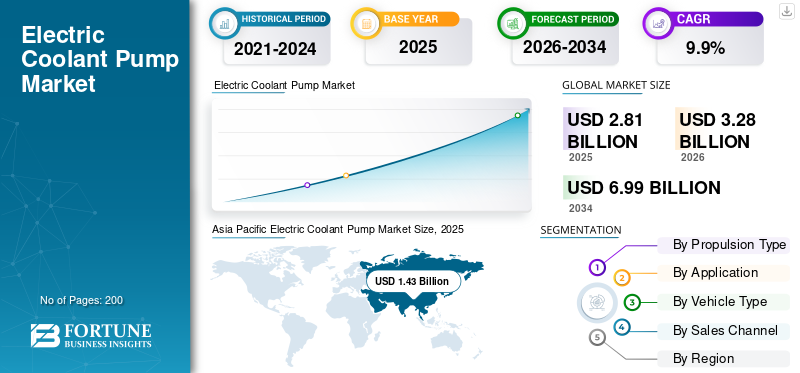
Download Free sample to learn more about this report.
Electric Coolant Pump Market Key Takeaways
 Global Market Size & Forecast
- 2025 Market Size: USD 2.81 billion
- 2026 Market Size: USD 3.28 billion
- 2034 Forecast Market Size: USD 6.99 billion
- CAGR: 9.9% from 2026-2034
 Market Share
- Asia Pacific dominated the electric coolant pump market with a 50.89% share in 2025.
- The Battery Thermal Management segment is projected to grow at a CAGR of 12.9% during the forecast period.
- The SUV segment is projected to grow at a CAGR of 11.6% during the forecast period.
 Key Regional Highlights
North America
North America is witnessing steady growth due to increasing adoption of electrified powertrains.
Asia Pacific
Asia Pacific dominates the market owing to strong automotive production and EV manufacturing.
Europe
Europe is expanding steadily, supported by vehicle electrification policies.
U.S.
The U.S. market is valued at USD 0.46 billion in 2026.
Japan
Japan is valued at USD 0.17 billion in 2026.
Read More

ELECTRIC COOLANT PUMP MARKET TRENDS
Rapid Shift Toward Electrification of Vehicles Drives the Market Expansion
The rapid shift toward vehicle electrification is reshaping automotive thermal management requirements, increasing the use of electric coolant pumps in battery, inverter, and motor cooling circuits. Electrified powertrains require precise temperature control to maintain battery efficiency, extend component lifespan, and support high-power charging. Electric coolant pumps enable independent, variable coolant flow, improving thermal efficiency compared with traditional mechanical pumps. As battery capacities grow and vehicle architectures evolve toward integrated thermal platforms, manufacturers are increasingly deploying multiple pumps per vehicle to manage separate cooling loops. This structural shift toward electrified mobility is strengthening demand for electric coolant pumps across passenger cars, SUVs, and commercial vehicles, particularly in regions where EV production is expanding rapidly, and vehicle manufacturers are prioritizing energy-efficient thermal management technologies.
MARKET DYNAMICS
MARKET DRIVERS
Download Free sample to learn more about this report.
Rising Adoption of Electric Vehicles Expands Demand for Battery and Power Electronics Cooling
The increasing global adoption of electric vehicles is strengthening demand for electric coolant pumps that regulate the temperature of batteries and power electronics. Efficient cooling systems help maintain battery safety, improve charging performance, and ensure stable operation of inverters and traction motors. As EV sales increase, automotive companies are integrating dedicated cooling circuits that rely on electronically controlled pumps rather than belt-driven systems. This technological shift expands pump demand not only in passenger cars but also in electric buses and commercial fleets. Electrification policies and infrastructure investments are also encouraging automakers to develop new EV platforms with sophisticated thermal management architectures, further boosting the electric coolant pump market growth.
- In April 2024, the International Energy Agency reported that global electric car sales exceeded 17 million, highlighting the rapid expansion of electric mobility and increasing demand for advanced vehicle thermal management components.
MARKET RESTRAINTS
High Development and Integration Costs Limit Adoption in Cost-Sensitive Vehicle Segments
Advanced electric coolant pump systems incur higher manufacturing and integration costs than conventional mechanical pumps. These pumps require electronic controllers, sensors, and software to regulate coolant flow based on vehicle operating conditions. In price-sensitive automotive segments, particularly entry-level passenger vehicles and emerging-market models, manufacturers may still prioritize conventional cooling systems to keep production costs down. Additional engineering effort is needed to integrate electric pumps with vehicle electrical architectures, battery systems, and thermal modules. These cost considerations can slow adoption in markets where electrification is progressing gradually or where vehicle affordability remains a key purchasing factor, limiting the immediate expansion of electric coolant pump penetration across all vehicle categories.
MARKET OPPORTUNITIES
Expansion of Electric Commercial Vehicles Creates New Growth Opportunities for Electric Coolant Pumps
The electrification of commercial vehicles is creating new opportunities for electric coolant pump suppliers. Electric buses, delivery vans, and heavy-duty trucks require robust thermal management systems to maintain battery performance during long operating hours and heavy load conditions. These vehicles typically use larger battery packs and higher-power electric drivetrains, increasing the need for efficient coolant circulation across multiple thermal loops. As logistics companies and public transportation operators shift toward reduced-emissions fleets, demand for reliable cooling technologies that maintain consistent operating temperatures is increasing. Electric coolant pumps designed for high-capacity cooling systems and continuous-duty applications are expected to gain wider adoption as global commercial electrification accelerates.
MARKET CHALLENGES
Increasing Thermal System Complexity Presents Engineering and Reliability Challenges
Modern electrified vehicles rely on highly integrated thermal management architectures that combine battery cooling, power electronics cooling, HVAC systems, and auxiliary circuits. Managing multiple thermal loops within compact vehicle platforms requires sophisticated control strategies and highly reliable components. Electric coolant pumps must operate across varying load conditions while maintaining precise coolant flow and durability over extended vehicle lifetimes. Ensuring reliability under high temperatures, vibration, and continuous operation can present engineering challenges for manufacturers. Additionally, integrating pumps with advanced vehicle electronics and software-based thermal management systems requires careful calibration to ensure optimal performance, making system design and validation increasingly complex for automotive OEMs and component suppliers.
Segmentation Analysis
By Propulsion Type
Large Production Base of Conventional Vehicles Leads to Internal Combustion Engine (ICE) Segmental Leadership
Based on propulsion type, the market is segmented into Internal Combustion Engine (ICE) Vehicles, Hybrid Vehicles (HEV & PHEV), and Battery Electric Vehicles (BEV).
The ICE vehicles segment dominates the electric coolant pump market share due to the continued large production base of conventional vehicles and the increasing integration of electrically driven pumps in modern engine cooling, turbocharger cooling, and start-stop systems. Even as electrification accelerates, millions of ICE and hybrid vehicles still require efficient thermal management systems, sustaining demand for electric coolant pumps in engine-based platforms.
The battery electric vehicles segment is projected to grow at a 10.5% CAGR over the forecast period.
- In January 2024, the International Organization of Motor Vehicle Manufacturers (OICA) reported that global vehicle production exceeded 93 million units in 2023, highlighting the continued large installed base of ICE-powered vehicles, which supports engine cooling
By Application
Widespread Engine Thermal Management Requirements Strengthen Engine Cooling Application Dominance
Based on application, the market is segmented into engine cooling, battery thermal management, power electronics cooling, HVAC/cabin thermal management, and turbocharger/auxiliary cooling.
The engine cooling segment dominates because virtually every internal combustion and hybrid vehicle requires efficient coolant circulation to maintain optimal engine operating temperature and improve fuel efficiency. Electric coolant pumps enable precise coolant flow control, supporting advanced thermal management architectures and start-stop systems in modern vehicles.
The Battery Thermal Management segment is projected to grow at a 12.9% CAGR over the forecast period.
- In March 2024, the U.S. Energy Information Administration reported that hybrid, plug-in hybrid, and battery electric vehicles accounted for over 21% of new light-duty vehicle sales in the U.S. during the third quarter of 2023, indicating increasing demand for advanced vehicle thermal management systems.
By Vehicle Type
High Passenger Vehicle Production Supports Hatchback and Sedan Segment Leadership
Based on vehicle type, the market is segmented into hatchback/sedan, SUV, LCV, and HCV.
The hatchback and sedan segments dominate the market due to their large production volumes and widespread adoption across major automotive markets. Passenger cars account for the largest share of global vehicle output, driving consistent demand for cooling systems used in engines, hybrid systems, and increasingly electrified powertrains. The high penetration of turbocharged engines and start-stop technology in passenger vehicles also supports strong adoption of electric coolant pumps. The SUV segment is projected to grow at a CAGR of 11.6% over the forecast period.
- In January 2024, OICA reported that passenger cars accounted for over 70 million of the 93 million vehicles produced globally in 2023, reinforcing the strong production base supporting passenger vehicle cooling system demand.
To know how our report can help streamline your business, Speak to Analyst
By Sales Channel
Strong Integration with Vehicle Manufacturing Drives OEM / Factory-Fit Channel Dominance
Based on sales channel, the market is segmented into OEM/factory-fit and aftermarket/replacement.
The OEM/factory-fit segment dominates the market because electric coolant pumps are typically installed during vehicle manufacturing as part of the integrated thermal management system. Automotive manufacturers increasingly adopt electronically controlled pumps to support advanced cooling architectures in both conventional and electrified vehicles. As vehicle production grows and thermal management systems become more sophisticated, OEM installations remain the primary source of demand for electric coolant pumps.
The aftermarket/replacement segment is projected to grow at a 11.6% CAGR over the forecast period.
- In April 2024, Bosch Mobility announced the continued expansion of its electric coolant pump portfolio, designed for integration into modern vehicle thermal management systems across both combustion and electric powertrains.
ELECTRIC COOLANT PUMP MARKET REGIONAL OUTLOOK
By region, the market is categorized into Europe, North America, Asia Pacific, and the rest of the world.
NORTH AMERICA
Asia Pacific Electric Coolant Pump Market Size, 2025 (USD Billion)
To get more information on the regional analysis of this market, Download Free sample
North America is a significant market for electric coolant pumps, driven by strong automotive manufacturing and the gradual transition toward electrified powertrains. Increasing hybrid and electric vehicle adoption is encouraging automakers to integrate advanced thermal management systems, including electronically controlled coolant pumps. The region also benefits from strong R&D investments and the presence of major automotive suppliers. Growth is further supported by expanding EV charging infrastructure and by stricter emission standards that encourage efficient vehicle cooling technologies. Hybrid vehicle adoption and electrified powertrain development across passenger and commercial vehicles continue to sustain steady demand for electric coolant pumps across the region.
U.S. ELECTRIC COOLANT PUMP MARKET
The U.S. is the largest market, valued at USD 0.46 billion in 2026, for electric coolant pumps in North America, driven by its large vehicle production base and the increasing adoption of hybrid and electric vehicles. Automakers are expanding EV manufacturing and integrating advanced thermal management technologies to support battery and power-electronics cooling. The growing share of electrified vehicles and increasing investment in EV production facilities are strengthening demand for electric coolant pumps in the U.S. automotive sector.
EUROPE
Europe is an important region, driven by strong vehicle electrification policies and a mature automotive manufacturing ecosystem. Stringent emission regulations and government incentives for electric vehicle adoption are driving demand for advanced vehicle thermal management systems. European automakers are rapidly integrating electrified powertrains, which require efficient cooling solutions for batteries and power electronics. Continuous innovation in vehicle efficiency, combined with a strong supplier network, is supporting steady demand for electric coolant pumps across passenger and commercial vehicle segments throughout the region.
U.K ELECTRIC COOLANT PUMP MARKET
The U.K. is witnessing rising demand for electric coolant pumps amid the expansion of EV manufacturing and supportive government policies promoting vehicle electrification. Investments in electric vehicle production and the increasing adoption of hybrid and battery-electric vehicles are driving the adoption of advanced thermal management systems. These developments are strengthening demand for electric coolant pumps in the country’s evolving automotive market. UK is valued at USD 0.14 billion in 2026.
GERMANY ELECTRIC COOLANT PUMP MARKET
Germany plays a crucial role in the European market due to its strong automotive manufacturing base and technological leadership. Major automotive manufacturers and suppliers are investing heavily in electrified vehicle platforms and advanced thermal management systems. The country’s focus on high-performance electric vehicles and hybrid technologies is increasing demand for efficient coolant circulation solutions across both passenger and commercial vehicles. Germany's growth rate is forecast at 7.2% during the forecast period.
ASIA PACIFIC
Asia Pacific dominates the market due to the region’s massive automotive production capacity and rapidly expanding electric vehicle industry. Countries such as China, Japan, and India are experiencing strong growth in vehicle manufacturing and electrification, which require efficient thermal management systems. Increasing EV production, rising hybrid vehicle adoption, and expanding automotive component manufacturing networks contribute significantly to regional demand. Additionally, supportive government policies promoting electric mobility and large-scale vehicle manufacturing facilities make the Asia Pacific the largest and most influential market for electric coolant pumps worldwide.
CHINA ELECTRIC COOLANT PUMP MARKET
China leads the market with a share of 62.9% in 2026 in the Asia Pacific due to its position as the world’s largest automotive and electric vehicle producer. The country’s aggressive EV adoption policies, large battery manufacturing ecosystem, and strong domestic automotive industry significantly increase demand for advanced vehicle thermal management technologies. Rapid expansion of EV production and growing domestic vehicle sales continue to drive demand for electric coolant pumps in China.
JAPAN ELECTRIC COOLANT PUMP MARKET
Japan is a key contributor to the regional market due to its strong hybrid vehicle ecosystem and advanced automotive technology development. Major Japanese automakers widely adopt electric coolant pumps in hybrid powertrains and advanced thermal management systems. Continuous innovation in vehicle efficiency and hybrid technology ensures steady demand for electric coolant pumps across Japan’s automotive industry. Japan is valued at USD 0.17 billion in 2026.
INDIA ELECTRIC COOLANT PUMP MARKET
India is emerging as an important market due to growing automotive production and government initiatives supporting electric mobility with a CAGR of 13.5%. Rising hybrid and electric vehicle adoption, combined with increasing domestic vehicle manufacturing, is gradually expanding the need for efficient thermal management systems. These trends are expected to drive steady growth in demand for electric coolant pumps in the Indian automotive sector.
REST OF THE WORLD
The Rest of the World region, including Latin America, the Middle East, and Africa, is expected to be the fastest-growing market for electric coolant pumps. Automotive production is expanding across several emerging economies, while governments are gradually introducing policies to encourage vehicle electrification. The increasing adoption of hybrid vehicles and the emergence of early-stage EV markets are creating new opportunities for thermal management component suppliers. As automotive manufacturing capabilities expand and electrification technologies spread across emerging markets, demand for electric coolant pumps is expected to grow rapidly in this region over the forecast period.
COMPETITIVE LANDSCAPE
Key Industry Players
Electrification-Driven Thermal Management Innovation and Strategic OEM Partnerships Strengthen Electric Coolant Pump Competition
The global electric coolant pump market trends are characterized by continuous technological innovation, rising vehicle electrification, and strong collaboration between automotive OEMs and component suppliers. Leading manufacturers such as Robert Bosch GmbH, Continental AG, Denso Corporation, MAHLE GmbH, Rheinmetall Automotive (Pierburg), Hanon Systems, Valeo S.A., Aisin Corporation, and BorgWarner Inc. compete by developing high-efficiency pumps with improved electronic control, compact design, and enhanced vehicle durability for modern vehicle thermal management systems. Companies are expanding their product portfolios to support battery cooling, power-electronics cooling, and integrated thermal modules for electric and hybrid vehicles. Strategic partnerships with automakers, investments in advanced manufacturing technologies, and development of high-voltage pumps for next-generation EV architectures are strengthening market positioning.
- In June 2024, Rheinmetall announced a major order valued at a low three-digit million euros to supply several million electric coolant pumps for hybrid vehicles, highlighting growing OEM demand for advanced thermal management solutions in electrified powertrains.
LIST OF KEY ELECTRIC COOLANT PUMP COMPANIES PROFILED
- Robert Bosch GmbH (Germany)
- Continental AG (Germany)
- Aisin Corporation (Japan)
- Valeo S.A. (France)
- MAHLE GmbH (Germany)
- Rheinmetall Automotive AG / Pierburg (Germany)
- Denso Corporation (Japan)
- BorgWarner Inc. (U.S.)
- Johnson Electric Holdings Limited (Hong Kong)
- Panasonic Automotive Systems Co., Ltd. (Japan)
- Grundfos Holding A/S (Denmark)
- Schaeffler AG (Germany)
- Sanden Corporation (Japan)
- Eberspacher Group (Germany)
- Hanon Systems (South Korea)
KEY INDUSTRY DEVELOPMENTS
- December 2025: Marelli unveiled its new Intelligent Energy Management technology at CTI Europe 2025 in Berlin. The modular system integrates with vehicle and zonal control units and thermal components, coordinating thermal, propulsion, and electronics domains, which is significant for future electric coolant pump control strategies in hybrid and electric vehicles.
- December 2025: DENSO announced it had developed Japan’s first battery thermal management module for electric heavy-duty trucks. The module includes a pump, a heat-pump cycle, a radiator, and a heater, and DENSO said it was installed in the Hino Profia Z FCV, launched on October 24, 2025.
- November 2025: Hanon Systems said it would jointly exhibit with Hankook & Company Group affiliates at AAPEX 2025 in Las Vegas, highlighting its automotive thermal management technologies. The announcement mattered because it signaled Hanon’s stronger commercial push in the aftermarket and broader visibility for cooling-system components tied to electrified vehicle architectures.
- September 2025: Valeo unveiled its Smart Thermal Management platform at IAA Mobility 2025, combining smart control, heat-pump hardware, and immersive cooling for EVs. Valeo said the system can recover up to 24% electric range when paired with its Predict4Range software, underscoring rising demand for highly integrated thermal circuits and components.
- June 2025: Rheinmetall won a double-digit-million-euro order from a North American truck manufacturer for a mid-six-figure quantity of CWA 2000 high-voltage coolant pumps. The pumps will be used in battery-powered medium- and heavy-duty trucks, with supply scheduled from 2028 to 2035.
REPORT COVERAGE
The global electric coolant pump market analysis provides an in-depth study of the market size & forecast across all market segments included in the report. It contains details on market research dynamics and trends expected to drive the market during the forecast period. It offers information on technological advancements, new product launches, key industry developments, strategic partnerships, mergers & acquisitions. The market forecast provides a comprehensive competitive landscape, including the most significant global market share, emerging opportunities, and profiles of key players in the automotive industry.
Request for Customization to gain extensive market insights.
Report Scope & Segmentation
| ATTRIBUTE | DETAILS |
| Study Period | 2021-2034 |
| Base Year | 2025 |
| Estimated Year | 2026 |
| Forecast Period | 2026-2034 |
| Historical Period | 2021-2024 |
| Growth Rate | CAGR of 9.9% from 2026 to 2034 |
| Unit | Value (USD billion) |
| Segmentation | By Propulsion Type, By Application, By Vehicle Type, By Sales Channel, and By Region |
| By Propulsion Type |
|
| By Application |
|
| By Sales Channel |
|
| By Vehicle Type |
|
| By Region |
|
Frequently Asked Questions
Fortune Business Insights says that the global market value stood at USD 2.81 billion in 2025 and is projected to reach USD 6.99 billion by 2034.
In 2025, the market value stood at USD 1.43 billion.
The market is expected to grow at a CAGR of 9.9% from 2026 to 2034.
The OEM/factory-fit segment led the market share in the sales channel segment.
The rising adoption of electric vehicles is expanding demand for battery and power-electronics cooling, driving market momentum.
Key market players include Robert Bosch GmbH, Continental AG, Denso Corporation, MAHLE GmbH, and Rheinmetall Automotive.
Asia Pacific accounted for the largest share of the market in 2025.



- 2021-2034
- 2025
- 2021-2024
- 200
-
(Offer valid till 30th Sep 2026)
Get 30-60 hrs Free Customization
Expand Regional and Country Coverage, Segments Analysis, Company Profiles, Competitive Benchmarking, and End-user Insights.




















-
US +1 833 909 2966 ( Toll Free )
-
Get In Touch With Us