Electric Scooter Battery Market Size, Share & Industry Analysis, By Battery Type (Lithium-ion, Lead-acid, Nickel Metal Hydride, and Others), By Battery Capacity (Below 1 kWh, 1 kWh-2 kWh, 2 kWh-3 kWh, and Above 3 kWh), By Voltage (Below 48V, 48V, 60V, and 72V and Above), By Scooter Type (Low-speed Electric Scooter, High-speed Electric Scooter, and Performance Electric Scooter), By Sales Channel (OEM and Aftermarket/Replacement), and Regional Forecast, 2026-2034
 Download Free Sample
(Offer valid till 30th Sep 2026)

Electric Scooter Battery Market Size and Future Outlook
 Listen to Audio Version
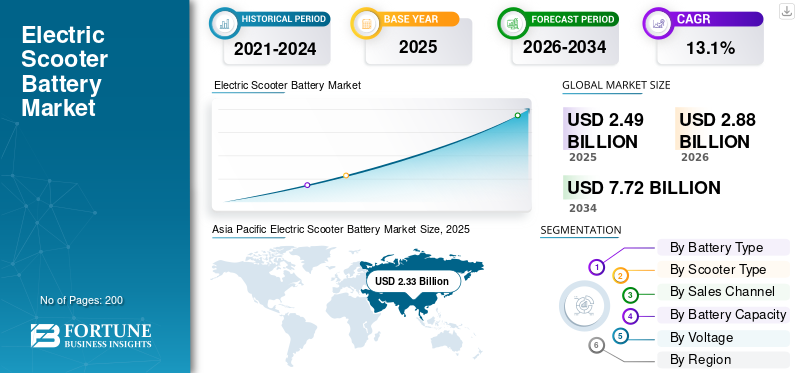
The global electric scooter battery market size was valued at USD 2.49 billion in 2025. The market is projected to grow from USD 2.88 billion in 2026 to USD 7.72 billion by 2034, with a CAGR of 13.1% during the forecast period. Asia Pacific dominated the electric scooter battery market with a market share of 93.57% in 2025.
An electric scooter battery is a rechargeable energy storage pack that powers the scooter’s motor, controller, lights, display, and auxiliary systems. It directly influences electric vehicle range, charging time, speed, weight, safety, lifecycle, and overall ownership cost.
The global market growth is driven by rising urban mobility needs, increasing fuel costs, government incentives for electric two-wheelers, expanding delivery fleets, and demand for low-emission sustainable transportation. Market growth is further supported by Lithium Iron Phosphate (LFP) batteries cost reduction, battery swapping, improved charging infrastructure, charging stations and adoption of electric scooters for longer range. Major players in the global market include CATL, BYD, LG Energy Solution, Panasonic, Samsung SDI, and Gotion. Companies are focusing on lithium-ion packs, LFP chemistry, battery swapping, safer battery management systems, local partnerships, and higher-capacity batteries to meet rising market demand.
Download Free sample to learn more about this report.
ELECTRIC SCOOTER BATTERY MARKET TRENDS
Battery Swapping and Smart Pack Integration Accelerate Market Trends
Battery swapping is reshaping the market trends by reducing charging downtime, improving fleet utilization, and creating recurring battery-service revenue. This trend is strongest in dense urban markets where delivery riders and shared mobility operators need quick energy replenishment instead of long plug-in charging. Smart batteries with cloud monitoring, battery health tracking, and swappable battery packs designs are also improving safety and asset utilization.
- In December 2023, Gogoro launched its battery swapping ecosystem in India and opened networks in Delhi and Goa, with expansion planned for Mumbai and Pune.
MARKET DYNAMICS
MARKET DRIVERS
Download Free sample to learn more about this report.
Policy Incentives for Electric Two-Wheelers Strengthen Market Growth
Government-backed electrification programs are increasing market demand for electric scooters batteries by reducing vehicle acquisition costs and encouraging OEMs to localize battery supply chains. Electric scooters are highly price-sensitive, so incentives linked to battery capacity, advanced battery use, and domestic manufacturing directly support battery pack adoption. This driver is especially visible in India, where electric two-wheelers form a large portion of EV adoption and policy support targets mass mobility.
- In September 2024, India notified the PM E-DRIVE scheme with around USD 1 million outlay to support EV adoption and ecosystem development.
MARKET RESTRAINTS
Battery Safety Regulations Increase Compliance Costs and Restrict Low-Quality Products
Battery safety rules are necessary, but they can restrain short-term market growth by increasing testing, certification, sourcing, labeling, recycling, and compliance costs for battery pack suppliers. Smaller manufacturers may face higher barriers when selling electric scooter batteries in regulated markets, while low-cost imports can be restricted if they fail to meet recognized safety standards. This affects market share by favoring larger, certified suppliers with stronger battery thermal management systems.
MARKET OPPORTUNITIES
Localized Cell Manufacturing Creates Long-Term Market Opportunity
Localized battery cell and pack production creates a major electric scooter battery market growth opportunity by reducing import dependence, improving supply security, lowering logistics costs, and allowing battery designs to be customized for regional scooter usage. Electric scooter batteries require cost-effective, compact, thermally stable, and modular battery architecture with cycle-resistant packs so that local manufacturing can support faster product launches and better after-sales service. It also supports market analysis around country-level value creation and future market share shifts.
MARKET CHALLENGES
Critical Mineral Dependence Creates Supply Chain Challenge During Market Forecast Period
Dependence on lithium, nickel, cobalt, graphite, and other battery minerals remains a challenge as price volatility, concentrated processing capacity, and geopolitical risks can affect battery availability and margins. Electric scooter batteries are smaller than car batteries, but they are still exposed to global cell supply dynamics, especially as solid-state batteries, lithium-ion, and lithium polymer (LiPo) batteries adoption rises in Asia, Europe, and emerging regions. This challenge can influence pricing assumptions during the market forecast period.
Segmentation Analysis
By Battery Type
Lightweight Design and Higher Energy Density Sustain Lithium-ion Segment Growth
Based on battery type, the market is segmented into lithium-ion, lead-acid, nickel metal hydride, and others.
The lithium-ion segment dominated in 2025 and is also projected to grow at the fastest CAGR over the forecast period. The segment’s growth is supported by lighter weight, higher energy density, faster charging, longer cycle life, and suitability for high-speed electric scooters. OEMs prefer lithium ion for extended-range batteries, safety, and battery management integration.
- In January 2024, Bajaj Auto launched the Chetak Premium 2024 with an improved 3.2 kWh battery, 127 km certified range, and 73 km/h top speed.
The lead-acid segment is the second-largest segment and is projected to grow at a CAGR of 4.2% during 2026-2034. Lead acid battery demand continues in price-sensitive low-speed scooters due to lower upfront cost, easy availability, and established replacement channels, but share declines as lithium-ion adoption expands.
By Scooter Type
Affordable Urban Mobility and Short-Range Commuting Sustain Low-Speed Electric Scooter Demand
Based on scooter type, the market is segmented into low-speed electric scooter, high-speed electric scooter, and performance electric scooter.
The low-speed electric scooter segment dominated the market in 2025. The growth of the segment is due to strong adoption in short-distance commuting, affordable personal mobility, student travel, and entry-level urban transport. These scooters generally use smaller battery packs, lower-voltage systems, and cost-efficient designs, supporting large-volume demand across price-sensitive markets.
The performance electric scooter segment is projected to grow at a CAGR of 22.3% during 2026-2034. The growth is driven by rising demand for higher acceleration, longer range, premium features, and larger battery packs. Performance scooters use higher-capacity lithium-ion batteries, supporting stronger value growth than low-speed models.
To know how our report can help streamline your business, Speak to Analyst
By Sales Channel
New Scooter Production and Battery Integration Sustain OEM Demand
Based on the sales channel, the market is segmented into OEM and aftermarket/replacement.
The OEM segment dominated the market in 2025. The growth of the segment is due to rising electric scooter production, direct battery integration at the manufacturing stage, warranty-linked battery sourcing, and OEM preference for certified battery packs with battery management systems. Scooter makers procure batteries as core vehicle components, making new vehicle sales the main revenue contributor.
The aftermarket/replacement segment is projected to grow at a CAGR of 22.9% during 2026-2034. The growth is driven by aging electric scooter fleets, battery degradation, delivery-fleet usage, replacement purchases, over-the-air battery diagnostics and battery-as-a-service models. Replacement demand rises as early electric scooters complete battery life cycles and users seek range upgrades.
By Battery Capacity
Balanced Range and Affordability Sustain 1 kWh-2 kWh Battery Capacity Demand
Based on battery capacity, the market is segmented into below 1 kWh, 1 kWh-2 kWh, 2 kWh-3 kWh, and above 3 kWh.
The 1 kWh-2 kWh segment dominated the market in 2025. The growth of the segment is due to its suitability for mainstream urban electric scooters, where buyers require practical range, manageable charging time, moderate vehicle weight, and affordable pricing. This capacity range supports daily commuting, entry-to-mid-range scooter models, and large-volume OEM adoption across price-sensitive markets.
The above 3 kWh segment is projected to grow at a CAGR of 17.8% during 2026-2034. The growth is driven by longer-range commuter scooters, high-speed models, delivery usage, and premium electric scooters requiring larger lithium-ion packs.
By Voltage
Cost-Effective Commuter Performance Sustains 48V Battery Demand
Based on voltage, the market is segmented into below 48V, 48V, 60V, and 72V and above.
The 48V segment dominated the market in 2025, due to its balance of affordability, safety, energy efficiency, and sufficient power for mainstream urban electric mobility. It supports daily commuting, moderate range, manageable charging requirements, and wide OEM compatibility. Many entry-to-mid range scooters use 48V systems to keep battery cost and vehicle price competitive while still offering practical riding performance.
The 72V and above segment is projected to grow at a CAGR of 21.1% during 2026-2034. The growth is driven by rising adoption of high-speed and performance scooters requiring higher torque, faster acceleration, better hill-climbing ability, and longer range.
- In 2024, Teewing highlighted 72V electric scooters for high-speed performance applications.
ELECTRIC SCOOTER BATTERY MARKET REGIONAL OUTLOOK
By region, the market is categorized into Europe, North America, Asia Pacific, South America, and the Middle East & Africa.
Asia Pacific
Asia Pacific Electric Scooter Battery Market Size, 2025 (USD Billion)
To get more information on the regional analysis of this market, Download Free sample
Asia Pacific is projected to hold a strong position in the electric scooter battery market share. It is supported by large electric two-wheeler sales, strong domestic battery manufacturing, and expanding scooter adoption across China, India, Japan, South Korea, and Southeast Asia. The region benefits from battery cost advantages, OEM scale, lithium-ion migration, and rising demand for higher-capacity scooter batteries. Market demand is also supported by delivery fleets, battery swapping, government incentives, and replacement battery needs across high-volume urban mobility markets.
China Electric Scooter Battery Market
China accounts for approximately 72.8% of the Asia Pacific market in 2026, supported by its large electric two-wheeler fleet, local battery manufacturing scale, and strong OEM supply base. Low-speed scooters, high-speed commuter scooters, replacement batteries, lithium-ion adoption, and battery swapping networks support demand.
India Electric Scooter Battery Market
India is expected to register a CAGR of 22.4% during the forecast period, supported by rising electric two-wheeler adoption, government incentives, domestic battery manufacturing, and delivery-fleet electrification. Lithium-ion batteries are gaining strong demand as consumers shift toward longer-range scooters, lower running costs, and improved battery performance.
Japan Electric Scooter Battery Market
Japan’s market is estimated to reach USD 0.04 billion in 2026, supported by compact urban mobility, premium electric scooter demand, and high battery safety expectations. Consumers prefer reliable lithium-ion packs, smart battery systems, and efficient short-distance transport solutions, especially in dense metropolitan areas with strong quality and durability requirements.
North America
North America is projected to maintain steady growth in the market, supported by rising demand for premium urban mobility, delivery applications, imported electric scooter platforms, and lithium-ion battery adoption. The region remains smaller in volume compared to Asia Pacific, but battery value per scooter is higher due to a stronger preference for high-speed and performance electric scooters. The U.S. and Canada support higher-value demand, while Mexico contributes expanding volume demand through affordability-focused electric scooter adoption and urban mobility needs.
U.S. Electric Scooter Battery Market
The U.S. market is estimated to reach USD 0.02 billion in 2026, supported by rising adoption of lithium-ion electric scooters, road-capable models, and premium battery packs. Urban commuting, last-mile delivery, higher battery safety expectations, and growing replacement needs as early electric scooter fleets age drive demand.
Europe
Europe is expected to show consistent growth in the market, supported by urban emission reduction policies, e-moped adoption, premium scooter demand, and strong battery safety requirements. The region benefits from higher battery prices, certified lithium-ion packs, and increasing use of electric scooters for short-distance commuting and delivery services. Germany, France, Italy, the U.K., and Russia support regional demand through different adoption patterns, while higher-voltage and higher-capacity batteries gain importance during the forecast period.
U.K. Electric Scooter Battery Market
The U.K. market is projected to reach USD 0.013 billion in 2026, supported by demand for lithium-ion battery packs, road-capable electric scooters, and premium personal mobility formats. Urban commuting, zero-emission vehicles transport preferences, delivery applications, and higher-value battery systems support market demand across major cities during the forecast period.
Germany Electric Scooter Battery Market
Germany accounts for approximately 22.8% of the European market in 2026, supported by premium electric mobility adoption, strong purchasing power, and demand for certified lithium-ion battery systems. Consumers and fleet operators prefer reliable batteries with advanced battery management systems, longer range, and better safety compliance.
South America
South America is projected to expand steadily in the market, supported by rising demand for affordable urban mobility, delivery services, imported electric scooter models, and gradual lithium-ion adoption. Brazil remains the main demand center, while Argentina and the rest of South America contribute smaller but expanding demand. Market growth is supported by fuel-cost sensitivity, traffic congestion, and increasing preference for electric two-wheelers as practical short-distance mobility solutions in major urban centers.
Brazil Electric Scooter Battery Market
Brazil accounts for approximately 68.8% of the South America market in 2026, supported by its large urban population, stronger electric mobility ecosystem, and rising use of electric scooters for commuting and delivery applications. Demand is supported by imported lithium-ion scooters, replacement batteries, and growing high-speed scooter adoption.
Middle East & Africa
The Middle East & Africa region is expected to record steady growth in the market, supported by rising urban mobility needs, fleet electrification, delivery applications, battery swapping, and fuel-cost sensitivity. South Africa supports higher-value demand through formal retail channels and lithium-ion adoption, while the rest of the region is driven by affordability and commercial mobility needs. Demand is increasingly linked to durable battery packs, higher-cycle applications, and practical electric two-wheelers used for short-distance transport and delivery services.
South Africa Electric Scooter Battery Market
South Africa is projected to grow at a CAGR of 19.5% during the forecast period, supported by premium urban mobility, delivery applications, and lithium-ion electric scooter adoption. Demand is supported by high-speed scooters, battery safety requirements, replacement batteries, and higher-value models used in major urban centers.
COMPETITIVE LANDSCAPE
Key Industry Players
Battery Chemistry Innovation, Swapping Ecosystems, and Localized Supply Define Competitive Landscape
The electric scooter battery market is moderately fragmented, with strong competition between global cell manufacturers, two-wheeler battery pack suppliers, and battery-swapping ecosystem providers. Key players such as CATL, BYD, LG Energy Solution, Panasonic, Samsung SDI, EVE Energy, Gotion, Sunwoda, Phylion, Tianneng, Gogoro, and Yadea compete through lithium-ion packs, LFP chemistry, sodium-ion development, battery management systems, and swappable battery platforms. To gain an edge over competitors, companies are improving energy density, safety, charging speed, cycle life, and localized pack assembly for electric scooter OEMs. Partnerships with scooter makers, fleet operators, and swapping networks help expand market reach across Asia Pacific, Europe, and emerging markets.
- In January 2025, Yadea launched electric two-wheelers powered by its sodium battery technology, highlighting faster charging, safer chemistry, low-carbon batteries and lower-cost battery innovation for electric mobility.
LIST OF KEY ELECTRIC SCOOTER BATTERY COMPANIES PROFILED
- Contemporary Amperex Technology Co., Limited (CATL) (China)
- BYD Company Limited / FinDreams Battery (China)
- LG Energy Solution Ltd. (South Korea)
- Panasonic Energy Co., Ltd. (Japan)
- Samsung SDI Co., Ltd. (South Korea)
- SK On Co., Ltd. (South Korea)
- CALB Group Co., Ltd. (China)
- EVE Energy Co., Ltd. (China)
- Gotion High-tech Co., Ltd. (China)
- SVOLT Energy Technology Co., Ltd. (China)
- Sunwoda Electronic Co., Ltd. (China)
- Farasis Energy Co., Ltd. (China)
- BAK Power Battery Co., Ltd. (China)
- REPT BATTERO Energy Co., Ltd. (China)
- Phylion Battery Co., Ltd. (China)
KEY INDUSTRY DEVELOPMENTS
- May 2026: Ola Electric received government certification for its 4680 Bharat Cell-powered S1 X+ 5.2 kWh scooter. The company stated that the certification made the model the longest-range product in its mass-market scooter portfolio, reinforcing the role of locally developed cells in high-capacity electric scooter batteries.
- April 2026: Komaki Electric commissioned its second lithium battery manufacturing facility in Udyog Vihar, Gurugram, with an annual capacity of 1.2 lakh units. The USD 3 billion, 40,000 sq. ft. plant will produce 10,000 LiFePO4 batteries per month and focus on LFP and LMFP battery technologies.
- March 2026: TVS Motor Company launched the Orbiter V1 electric scooter with a battery-as-a-service model, reducing upfront ownership costs for consumers. The model was priced from around USD 5000 under BaaS and without BaaS, highlighting how battery subscription models are becoming important for electric scooter affordability.
- January 2026: Quantum Energy partnered with EMO Energy to introduce the Quantum Bziness EMO electric scooter for last-mile delivery and fleet operations in India. The collaboration combines Quantum’s vehicle platform with EMO’s advanced battery and energy systems, targeting faster charging, lower downtime, and stronger fleet productivity for commercial electric two-wheeler users.
- January 2026: Greaves Electric Mobility’s Ampere brand launched the Magnus G Max electric scooter for Indian family mobility needs. The model offers over 100 km range in eco mode and strengthens Ampere’s battery-led product portfolio, supporting demand for practical electric scooters with improved everyday usability and range confidence.
REPORT COVERAGE
The global electric scooter battery market analysis provides an in-depth study of the market size & forecast across all market segments included in the report. It contains details on market research dynamics and trends expected to drive the market during the forecast period. It offers information on rapid technological advancements, new product launches, key industry developments, strategic partnerships, and mergers & acquisitions. The market forecast provides a comprehensive competitive landscape, including the most significant global market shares, emerging opportunities, and profiles of key players.
Request for Customization to gain extensive market insights.
Report Scope & Segmentation
| ATTRIBUTE | DETAILS |
| Study Period | 2021-2034 |
| Base Year | 2025 |
| Estimated Year | 2026 |
| Forecast Period | 2026-2034 |
| Historical Period | 2021-2024 |
| Growth Rate | CAGR of 13.1% from 2026 to 2034 |
| Unit | Value (USD Billion) |
| Segmentation | By Battery Type, By Scooter Type, By Sales Channel, By Battery Capacity, By Voltage, and By Region. |
| By Battery Type |
|
| By Scooter Type |
|
| By Sales Channel |
|
| By Battery Capacity |
|
| By Voltage |
|
| By Region |
|
Frequently Asked Questions
Fortune Business Insights says that the global market value stood at USD 2.49 billion in 2025 and is projected to reach USD 7.72 billion by 2034.
In 2025, the market value stood at USD 2.33 billion.
The market demand is expected to grow at a CAGR of 13.1% from 2026 to 2034.
The OEM segment led the market share by sales channel.
Rising urban mobility needs, increasing fuel costs, and government incentives for electric two-wheelers are the key factors driving the market.
Key market players include CATL, BYD, LG Energy Solution, Panasonic, Samsung SDI, and Gotion.
The Asia Pacific region accounts for the largest share of the market in 2025.
North America, Europe, Asia Pacific, South America, and the Middle East & Africa regions are considered in the market.



- 2021-2034
- 2025
- 2021-2024
- 200
-
(Offer valid till 30th Sep 2026)
Get 30-60 hrs Free Customization
Expand Regional and Country Coverage, Segments Analysis, Company Profiles, Competitive Benchmarking, and End-user Insights.




















-
US +1 833 909 2966 ( Toll Free )
-
Get In Touch With Us