Electric Tractor Market Size, Share & Industry Analysis, By Power Output (<30 HP, 30–60 HP & >60 HP), By Type (Orchard Tractor, Row Crop Tractor, and Others), By Battery Type (Lithium-Ion (Li-Ion), Lead-Acid, and Others (LFP, Solid-State)), By Drive Type (2-Wheel Drive (2WD) & 4-Wheel Drive (4WD)), and Regional Forecast, 2026-2034
 Download Free Sample
(Offer valid till 15th Oct 2026)

Electric Tractor Market Size and Future Outlook
 Listen to Audio Version
The global electric tractor market size was valued at USD 0.32 billion in 2025 and is projected to grow from USD 0.48 billion in 2026 to USD 1.69 billion by 2034, exhibiting a CAGR of 17.04% during the forecast period. Asia Pacific dominated the facial recognition market with a market share of 48.92% in 2025.
The market is a rapidly emerging segment within the agricultural machinery and sustainable mobility industries, focused on the development and deployment of tractors powered by rechargeable batteries instead of conventional diesel tractors. These tractors utilize electric drivetrains, lithium-ion or lithium-iron-phosphate (LFP) battery packs, and in some cases hybrid configurations, to perform core farming activities such as plowing, tilling, mowing, and precision spraying.
Battery-electric tractors contribute to the reduction of greenhouse gas (GHG) emissions and local air pollutants, thereby supporting sustainable agricultural practices. In addition, these tractors provide significant cost advantages for farmers by lowering fuel consumption and minimizing maintenance requirements when compared to conventional diesel-powered models. With compact and mid-range models increasingly reaching commercial production, electric tractors are gaining acceptance among small to medium-sized farms and vineyards operations across North America, Europe, and Asia.
Furthermore, the market encompasses several major players with John Deere, CNH Industrial (New Holland, Case IH), and Monarch Tractor at the forefront.
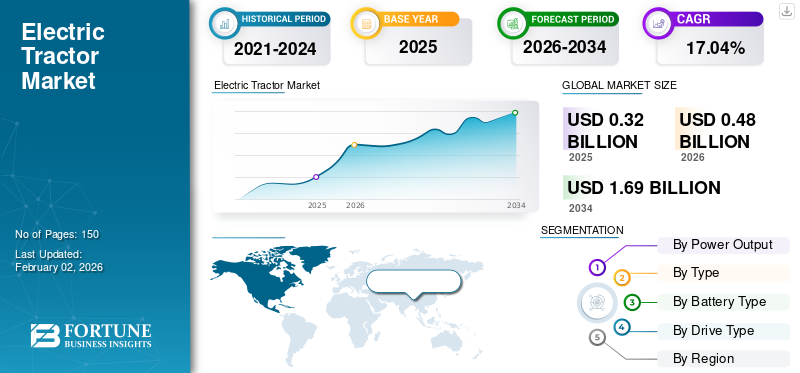
Download Free sample to learn more about this report.
Electric Tractor MARKET KEY TAKEAWAYS
 Market Size & Forecast
- 2025 Market Size: USD 0.32 billion
- 2026 Market Size: USD 0.48 billion
- 2034 Forecast Market Size: USD 1.69 billion
- CAGR: 17.04% from 2026–2034
 Market Share
- Asia Pacific dominated the electric tractor market with a 48.92% share in 2025.
- Row crop tractors are projected to account for 60.42% of the market in 2026.
- Lithium-ion batteries are expected to hold 77.08% of the market share in 2026.
 Key Regional Highlights
North American
North America represented 20.22% of the global market in 2025, valued at USD 0.07 billion, and is projected to reach USD 0.10 billion in 2026.
Europe
Europe accounted for 15.11% of the global market in 2025, valued at USD 0.05 billion, and is projected to reach USD 0.07 billion in 2026.
Asia Pacific
Asia Pacific accounted for 48.92% of the global market in 2025, valued at USD 0.16 billion, and is projected to reach USD 0.24 billion in 2026.
U.S.
The market is projected to reach USD 0.06 billion by 2026.
Japan
The market is projected to reach USD 0.02 billion by 2026.
Read More

MARKET DYNAMICS
MARKET DRIVERS:
Rising World Population Driving Growth in Agriculture Industry to Propel Electric Market Growth
The continuous expansion of the global agriculture industry is a major driver for the growth of the market. The world population is projected to reach 9.7 billion by 2050 (UN), the demand for food is expected to rise by 60–70% compared to current levels. The Food and Agriculture Organization (FAO) reports that global tractor sales have been steadily increasing, with Asia-Pacific (particularly India and China). This development increases the demand for electric tractor market growth.
- For instance, in India, which is the one of the largest tractor markets (accounting for 900,000–1,000,000 units annually), companies such as Sonalika and Escorts Kubota have launched electric tractor models such as the Tiger Electric and Farmtrac EV prototypes to serve small and medium farmers.
MARKET RESTRAINTS:
Limited Battery Capacity & Runtime May Limit Market Growth
The restricted battery capacity directly impacts runtime and usability in demanding agricultural sector operations. Current electric tractors, however, are typically equipped with lithium ion batteries or lithium-iron-phosphate (LFP) batteries in the 15–60 kWh range, which translates into 3–6 hours of continuous operation depending on load and terrain. Thus, the limited battery capacity and runtime may hamper market growth.
- For instance, the Sonalika Tiger Electric (India), one of the first commercially available models, offers about 4 hours of field runtime on a single charge, which is sufficient for small farms but not for larger fields requiring extended daily operations.
MARKET OPPORTUNITIES:
Growing Focus on Carbon-Neutral Agriculture to Create Lucrative Growth Opportunities
The global focus toward carbon-neutral and sustainable farming is creating a strong opportunity for electric tractors. Agriculture contributes nearly 20–25% of total greenhouse gas (GHG) emissions, with diesel-powered tractors and machinery being significant contributors due to their reliance on fossil fuels. As governments, NGOs, and large agribusinesses tighten sustainability targets, to reduce carbon intensity in crop production by farmers. This development increases the demand for the electric tractor market.
· For instance, the European Green Deal sets a target to cut agricultural emissions by 55% by 2030, while the U.S. Department of Agriculture is funding programs that encourage low-emission farming.
ELECTRIC TRACTOR MARKET TRENDS:
Integration of Smart & Autonomous Technologies is a One of Significant Market Trend
The many new electric models are designed from the ground up to be software-driven, digitally connected, and automation technologies. Companies such as Monarch Tractor (U.S.) and John Deere (U.S.) are leading this transformation by embedding AI, machine vision, IoT connectivity, and autonomous navigation systems into their electric tractor platforms. This development drives the electric tractor market growth.
· For instance, Monarch Tractor’s MK-V is a fully electric, driver-optional tractor that uses six cameras and AI-based perception systems to autonomously navigate orchards and vineyards, while also collecting and analyzing crop data in real time.
MARKET CHALLENGES:
Underdeveloped Rural Charging Infrastructure is a Challenging Factor for Market Growth
In many agricultural regions, electricity supply is either unstable, low voltage, or non-existent in the fields, making it difficult to establish reliable charging stations. Even in developed countries such as the U.S. or parts of Europe, most charging networks are concentrated along highways and cities. Moreover, the charging time requirement creates operational inefficiencies. Standard AC chargers may take 6–8 hours to fully charge an electric tractor, which is not feasible during peak farming seasons when machines are required for continuous 10–12 hour shifts. Thus, the limited development of electric tractor charging infrastructure may limit the market growth.
Download Free sample to learn more about this report.
Segmentation Analysis
By Type
Rising Demand of Row Crop Electric Tractors for Large-Scale Farming Boosted Segment Growth
On the basis of type, the market is classified into orchard tractor, row crop tractor, and others.
The row crop tractor segment is expected to account for 60.42% of the market in 2026. These tractors are specifically designed for large-scale and intensive farming operations such as plowing, planting, cultivating, and spraying, which are critical for high-yield crop production. Their versatility, higher horsepower range, and compatibility with multiple implements make them indispensable for commercial agriculture. Demand is particularly strong in countries with extensive farmlands and mechanized farming practices, including the U.S., China, and major European nations. With rising emphasis on sustainable agriculture and growing adoption of precision farming technologies, the integration of electric propulsion in row crop tractors is gaining traction. This development drives the market growth.
For instance, in the U.S. large farms in states such as Iowa, Illinois, and Nebraska heavily depend on row crop tractors to manage vast corn and soybean fields. An electric row crop tractor, such as the New Holland T4 Electric Power (74 HP) or Case IH Farmall 75C Electric, can perform the same duties as diesel models but with lower emissions and operating costs.
To know how our report can help streamline your business, Speak to Analyst
By Power Output
Increasing Small to Medium Farms Globally Fueled 30–60 HP Power Output Segment Growth
In terms of power output, the market is categorized into <30 HP, 30–60 HP, and >60 HP.
The 30–60 HP segment is anticipated to hold a dominant market share of 45.83% in 2026. The rising prevalence of small and medium-sized farms globally is a key factor driving the demand for tractors in this power range, as they offer the right balance between affordability, efficiency, and versatility. This segment caters to a wide range of applications, from specialized vineyards and orchards in Europe to mixed-crop farms across North America and Asia. Prominent models such as the Monarch MK-V (40 HP) and Sonalika Tiger Electric (35–40 HP) are strategically positioned within this category, reflecting strong manufacturer focus on this demand cluster. Moreover, supportive government incentives for sustainable farming equipment and increasing awareness among farmers about reducing operational costs are further expected to accelerate the adoption of 30–60 HP electric tractors during the forecast period 2025-2032.
By Battery Type
High Energy Density, Lightweight Design, Faster Charging, and Longer Cycle Life of Lithium-Ion Batteries Fuel Segment Growth
Based on battery type, the market is segmented into lithium-ion (li-ion), lead-acid, and others (LFP, solid-state).
Lithium-ion batteries drive electric tractor adoption by combining performance with practicality. Lithium-ion batteries segment is poised to account for 77.08%of the market share in 2026. Their high energy density delivers longer operating hours without bulky packs, while a lightweight design improves maneuverability and reduces soil compaction. Faster charging ensures minimal downtime during peak farming periods, directly impacting productivity. With a longer cycle life, farmers gain durability and lower replacement costs, strengthening overall economics. These factors make lithium-ion the most suitable technology for balancing efficiency, reliability, and sustainability in modern agricultural operations.
By Drive Type
Rising Popularity of 2WD Tractor Propelled Segment Growth
Based on drive type, the market is segmented into 2-wheel drive (2WD) and 4-wheel drive (4WD).
The 2-Wheel Drive (2WD) segment is expected to lead the market, contributing 66.67% globally in 2026. The segmental growth is attributed to the rising popularity of 2-Wheel Drive (2WD) tractors in India, China, Africa, and Southeast Asia, where farms are small (<2 hectares) and tractors are mainly used for light-duty types such as tilling, spraying, and hauling.
· The Fendt e100 Vario-type models are being released (Europe) for / vegetable / livestock sectors, where 2WD/4WD mix is important. The design, driving modes, and loader compatibility indicate drive type flexibility.
Electric Tractor Market Regional Outlook
By geography, the market is categorized into Europe, North America, Asia Pacific, and Rest of the World
ASIA PACIFIC
Asia Pacific Electric Tractor Market Size,2025 ( USD billion) To get more information on the regional analysis of this market, Download Free sample
Asia Pacific contributed 48.92% to the global market in 2025, with a valuation of USD 0.16 billion, and is projected to reach USD 0.24 billion in 2026. Countries such as India and China are leading adoption due to strong government subsidies for sustainable agriculture, rising fuel costs, and the requirement for affordable mechanization for smallholder farmers. In India, several manufacturers such as Sonalika, Escorts Kubota, and Autonxt Automation are increasing their product portfolio of electric tractors (<30 HP and 30–50 HP). China is focusing on low-cost models for domestic and export markets. Rapid rural electrification and growing environmental awareness are further boosting penetration in this region. The Japan market is projected to reach USD 0.02 Billion by 2026, the China market is projected to reach USD 0.06 Billion by 2026, and the India market is projected to reach USD 0.12 Billion by 2026.
Other regions, including North America, Europe, and the rest of the world, are expanding steadily.
NORTH AMERICA
In 2025, North America represented USD 0.07 billion, accounting for 20.22% of the worldwide market, and is projected to grow to USD 0.1 billion in 2026. North America is driven by large-scale farms, vineyards, and orchards, increasing adoption of high-power electric tractors (>50 HP), led by John Deere, Solectrac, and Monarch Tractor. The U.S. market is projected to reach USD 0.06 Billion by 2026.
EUROPE
The Europe market generated USD 0.05 billion in 2025, representing 15.11% of the global market landscape, and is expected to reach USD 0.07 billion in 2026. In Europe the strict emission norms (EU Green Deal, CAP reforms) and heavy investments by OEMs such as Fendt and New Holland in mid-to-high power electric tractors. This development drives the market growth. The UK market is projected to reach USD 0.01 Billion by 2026, while the Germany market is projected to reach USD 0.01 Billion by 2026.
REST OF THE WORLD
Rest of the World contributed approximately USD 0.05 billion to the global market in 2025, accounting for 15.75% share, and is expected to reach USD 0.08 billion in 2026. In the rest of the world, the electric tractor market is at a relatively developing stage. In the Middle East & Latin America, the adoption is being driven by rising sustainability initiatives, government-backed renewable energy projects.
COMPETITIVE LANDSCAPE
Key Industry Players:
Competitive Landscape Driven by Global Leaders and Regional Innovators in Electric Tractors
The global electric tractor market shows a mix of established agricultural equipment manufacturers and emerging startups across regions. While large OEMs dominate through brand reputation, dealer networks, and international reach, smaller innovators are rapidly entering with cost-effective and localized solutions. Players are actively focusing on battery innovation, autonomous capabilities, and strategic partnerships to drive the electric tractor market in 2024.
John Deere, CNH Industrial (New Holland, Case IH), and Monarch Tractor are some of the market’s dominant players. The company focuses on broad product portfolios across tractor segments, strong R&D investment, extensive dealer and service networks, and collaborations with technology providers for electrification and autonomy.
Other prominent players in the market include Sonalika, Monarch Tractor, Solectrac (Ideanomics), Fendt (AGCO), Escorts Kubota, Autonxt Automation, and Cellestial E-Mobility.
LIST OF KEY ELECTRIC TRACTOR COMPANIES PROFILED:
- Newholland (U.K.)
- Monarchtractor (U.S.)
- Fendt (AGCO) (Germany)
- Vardenelectrictractor (India)
- Montraelectrictractor (India)
- Farmtrac (India)
- John Deere (U.S.)
- Knegt (Netherlands)
- Sonalika (India)
- Moonrider AI (India)
KEY INDUSTRY DEVELOPMENTS:
- In June 2025, Maharashtra, India, officially registered its first 45 HP electric tractor at the Thane RTO, marking a milestone for e-tractor adoption in the state.
- In August 2025, Ravindra Energy associate EIM obtained CMVR Type Approval and ARAI certification for its 55-ton “Ashwa” electric tractor and made its first commercial sale in India.
- In March 2025, DeepTech startup Voltrac announced it is launching an autonomous electric tractor platform (for agriculture & defense Types), backed by USD 2.2 million in funding.
- In May 2025, Escorts Kubota announced setting up a new greenfield tractor manufacturing plant in Uttar Pradesh, India, targeting an additional 100,000 units capacity over the next 3-4 years.
- In July 2025, John Deere’s E-Power electric tractor prototype (multiple configurations) was undergoing tests across orchard, vineyard, utility use cases; Deere says the performance so far has surprised expectations.
REPORT COVERAGE
The global electric tractor market analysis provides an in-depth study of market size & forecast by all the market segments included in the report. It includes details on the market dynamics and market trends expected to drive the market during the forecast period. It offers information on the technological advancements, new product launches, key industry developments, and details on partnerships, mergers & acquisitions. The Electric Tractor Market research report also encompasses detailed competitive landscape with information on the market share and profiles of key operating players.
Request for Customization to gain extensive market insights.
Report Scope & Segmentation
| ATTRIBUTE | DETAILS |
| Study Period | 2021-2034 |
| Base Year | 2025 |
| Estimated Year | 2026 |
| Forecast Period | 2026-2034 |
| Historical Period | 2021-2024 |
| Growth Rate | CAGR of 17.04% from 2026-2034 |
| Unit | Value (USD Billion) |
| Segmentation |
By Power Output
By Type
By Battery Type
By Drive Type
By Region
|
Frequently Asked Questions
Fortune Business Insights says that the global market value stood at USD 0.32 Billion in 2025 and is projected to reach USD 1.69 Billion by 2034.
In 2025, the market value stood at USD 0.16 Billion.
The market is expected to exhibit a CAGR of 17.04% during the forecast period of 2026-2034.
The Row Crop Tractor Type segment led the market.
Rising Agriculture Industry to Propel the Market Growth
Other prominent players in the market include Sonalika, Monarch Tractor, Solectrac (Ideanomics), Fendt (AGCO), Escorts Kubota, Autonxt Automation, and Cellestial E-Mobility.
Asia Pacific dominated the facial recognition market with a market share of 48.92% in 2025.



- 2021-2034
- 2025
- 2021-2024
- 150
-
(Offer valid till 15th Oct 2026)
Get 30-60 hrs Free Customization
Expand Regional and Country Coverage, Segments Analysis, Company Profiles, Competitive Benchmarking, and End-user Insights.




















-
US +1 833 909 2966 ( Toll Free )
-
Get In Touch With Us