Electric Vehicle (EV) Motor Market Size, Share & Industry Analysis, By Vehicle Type (Two Wheeler, Three Wheeler, Passenger Vehicle, and Commercial Vehicle), By Component (Motor Stator, Rotor, Shaft, and Bearing, Permanent Magnet, Casing, and Wiring & Connectors), By Power Rating (Up to 20 kW, 20 KW to 100 KW, 100 KW to 250 KW, and Above 250 KW), Regional Forecast, 2026-2034
 Download Free Sample
(Offer valid till 30th Sep 2026)

Electric Vehicle (EV) Motor Market Size & Overview
 Listen to Audio Version
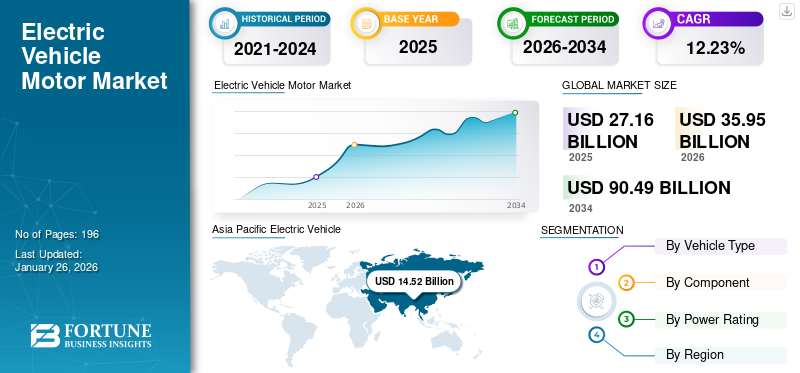
The global electric vehicle (EV) motor market size was valued at USD 27.16 billion in 2025 and is projected to grow from USD 35.95 billion in 2026 to USD 90.49 billion by 2034, exhibiting a CAGR of 12.23% during the forecast period. Asia Pacific dominated the global market with a share of 53.46% in 2025.
An Electric Vehicle (EV) motor is an essential component of electric vehicles and is responsible for converting electrical energy into mechanical energy to propel the vehicle. Electric vehicles are powered by batteries, which supply electricity to the motor. There are several types of electric motors, such as Brushless DC motors (BLDC), Permanent Magnet Synchronous Motors (PMSM), induction motors, and Switched Reluctance Motors (SRM). Electric vehicle motors play a critical role in the operation and performance of electric vehicles, contributing to their efficiency, environmental friendliness, and increasingly widespread adoption as a sustainable transportation solution. The demand for electric motors is directly proportional to the sale and adoption of electric vehicles. According to IEA, the sale of electric vehicles increases yearly and the rising adoption of EVs is expected to drive market growth over the forecast period 2026-2034.
Download Free sample to learn more about this report.
Electric Vehicle Motor Market KEY TAKEAWAYS
 Global Market Size & Forecast
- 2025 Market Size: USD 27.16 billion
- 2026 Market Size: USD 35.95 billion
- 2034 Forecast Market Size: USD 90.49 billion
- CAGR: 12.23% from 2026–2034
 Market Share
- Asia Pacific dominated the electric vehicle (EV) motor market with a 53.46% share in 2025.
- The Passenger Vehicle segment is projected to hold the largest market share with 43.92% in 2026.
- The Permanent Magnet segment is projected to account for the largest market share with 40.00% in 2026.
 Key Regional Highlights
Asia Pacific
The market was valued at USD 14.52 billion in 2025, driven by rapid growth in electric vehicle sales.
Europe
The market reached USD 6.06 billion in 2025, supported by increasing demand for zero-emission vehicles.
North America
The market was valued at USD 4.71 billion in 2025, driven by rising consumer demand for Evs.
U.S.
The market is projected to reach USD 5.54 billion by 2026.
Japan
The market is projected to reach USD 2.06 billion by 2026.
Read More

Electric Vehicle (EV) Motor Market Trends
Replacement and Minimal Use of Rare Earth Metals in Permanent Magnets to Drive the Market Growth
Rare earth metals such as cerium, lanthanum, neodymium, dysprosium, and terbium, are used to produce permanent magnets used in manufacturing PMSM (Permanent Magnet Synchronous Motor). These metals are expensive and produce much waste with certain mining concerns. Magnets require high coercivity, the ability to maintain magnetization at high temperatures. For this purpose, about 30% of the magnet is made of rare earth metals.
Terbium and dysprosium are used in neodymium magnets for high-temperature applications such as in automotive systems. However, these metals are very expensive and found in geopolitically sensitive regions, which could lead to potential shortages. The companies are focusing on reducing the use of these metals, and research and development activities are underway to find a replacement for these metals.
Download Free sample to learn more about this report.
MARKET DRIVERS
Strict Government Regulations and Policies to Drive Market Growth
Various regulatory authorities have implemented strict regulation policies to reduce vehicle emissions, which contribute to environment degradation and trigger the greenhouse gas effect. Vehicle pollution has become a serious concern, leading to worsening air quality. In response, government has planned on banning or stopping the production of diesel and petrol cars. For instance, the U.S. State of California has planned to ban the sale of petrol cars by 2035. Furthermore, government aims to promote the use of electric or hybrid-electric vehicles. This initiative is expected to increase the number of electric vehicles on the roads, driving demand for EV motors. For instance, in Delhi, India, 12.4 million tons of CO2 are emitted by annually. The Delhi government is promoting the use of electric vehicles and is also investing in charging infrastructure to improve accessibility, which will further encourage the adoption of electric vehicles and propels the growth of electric vehicle (EV) motor market.
MARKET RESTRAINTS
High Manufacturing Costs of Electric Vehicles to Restrain Market Growth
Electric vehicles are becoming popular in developing countries, considering their benefits and supportive government incentives. Due to this, demand for vehicles is increasing drastically year-on-year. However, electric vehicles need high capital for manufacturing due to the procurement of rare earth metals used in permanent magnets for synchronous motors. The cost of EVs is equal to luxury car segments, posing affordability challenges. To address this, governments are taking steps on reducing the cost of e-vehicles. For instance, in June 2022, the Union Transport and Highways Minister of India announced that the cost of electric vehicles would be the same as the cost of petrol vehicles within one year.
Companies are working on reusing earth metals to reduce manufacturing costs. For instance, in March 2022, GKN Automotive announced the development of EV motors using recycled rare earth metals under the Secure Critical Rare Earth Magnets (SCREAM) initiative in the U.K. The project aimed to manufacture 800-volt electric motor using sustainable materials. Despite these advancements, high manufacturing cost make electric vehicles much costlier than conventional vehicles, limiting their adoption among low-to-middle class income populace in certain countries. This affordability barrier remains a key restraint to the electric vehicle (EV) motor market growth.
MARKET OPPORTUNITY
Technological Innovations and Eco-friendly Initiatives to Present Significant Growth Aspects
Various companies are focusing on developing advanced drivetrain to provide a more efficient electric driving experience. Research and development efforts are driving advancements in powertrain units for better vehicle performance. The constant need for better-performing vehicles continually fuels innovation. Companies with steady development in technologies are creating lucrative opportunities for the electric vehicle (EV) motor market.
For instance, Toyota created a new type of magnet that reduces the use of rare earth metal neodymium by half and replaces terbium and dysprosium with lanthanum and cerium, which are 20 times less expensive. This innovation lowers the manufacturing cost of electric vehicle motors. Additionally, developments in variable frequency drives, which control motor performance in electric vehicles, are creating growth opportunities for electric vehicle (EV) motor market players.
The shift from conventional powertrains, which rely on fossil fuels, to electric powertrains enables automakers to meet eco-friendly goals, producing less or no CO2 and other harmful pollutants. Moreover, adoption of electric vehicle is increasing, driven by green mobility initiatives and efforts to create clean environment, thereby boosting the Electric Vehicle (EV) motor market growth.
Segmentation Analysis
By Vehicle Type
High Fuel Prices and Government Incentives Boosted the Passenger Vehicle Segment Growth
By vehicle type, the market is segmented into two wheeler, three wheeler, passenger vehicle, and commercial vehicle.
The passenger vehicle segment is expected to dominate the market with a significant market share of 43.92% in 2026. The segment covers battery and hybrid electric vehicle propulsion type. The growing shift toward electric mobility, which provides an easy and quiet driving experience, has witnessed significant increase in recent years. Moreover, governments are implementing stringent emission rules and providing subsidies for adopting electric vehicles. Along with this, high fossil fuel prices for conventional vehicles are pushing the populace to adopt electric vehicles, fueling the demand for electric motor.
Two wheeler was the fastest-growing segment in the market in 2024. Electric two wheelers are compact, lightweight, and easy to drive in congested cities. The high rates of petrol along with the increasing availability of electric two wheeler from manufacturers have accelerated adoption among consumers, particularly with the incorporation of in-wheel EV motor.
Three wheeler segment accounted for a significant market share in the year 2024. Electric three wheeler offer lower operating costs than a conventional three wheelers. These vehicles can be used for various applications such as transporting passengers and goods. Rising demand for electric three wheelers in commercial purposes to drive market growth.
The commercial vehicle segment accounted for a considerable market share in 2024. The segment covers battery electric vehicle propulsion type and hybrid electric vehicle propulsion type. High-power electric motors have been introduced, providing high torque and power, making electric commercial vehicles suitable for light, medium, and heavy-duty applications.
By Component
Permanent Segment led the Market Due to Increasing Focus on Developing Motors Made from These Metals
Based on component, the market is divided into motor stator, rotor, shaft, and bearing, permanent magnet, casing, and wiring & connectors.
The permanent magnet segment is projected to dominate the market share of 40.00% in 2026, with the highest CAGR during the forecast period. Permanent magnets, which are manufactured with the help of rare earth metals, are critical in motor manufacturing. However, mining and utilization of rare earth metals are expensive and complicated. Therefore, companies are focused on developing electric motors that utilize permanent magnets for effectively.
The rotor, shaft, and bearing segment held a significant market share in 2024. The rotor, being the rotational part of the motor, produces torque through the interaction between windings and magnetic fields. Development in rotor technology aims to save energy by reducing losses and improving efficiency, such as the use of copper rotors in AC induction motors. These advancements will fuel market growth.
The motor stator segment accounted for a considerable market share in 2024. The stator, the stationary part of the EV motor, produces the magnetic field that drives the rotating armature. Its crucial role in the motor’s functioning contributes significantly to the growth of the segment.
The casing segment held a decent market share in 2024. The casing is the housing of the EV motor. A good casing helps in the efficient functioning of the motor. The steel used for the electric motor casing makes the EV motor heavy in weight. The adoption of lightweight aluminum casings is driving market growth.
The wiring & connectors segment held a substantial market share in 2024. Wiring and connectors are used to connect the electric motor with various parts of an electric vehicle, including the battery, enabling the motor to receive power and drive the vehicle. Less complicated wiring and connectors provide easy assembling and disassembling when servicing a vehicle.
By Power Rating
To know how our report can help streamline your business, Speak to Analyst
Increasing Demand for High Power and Efficient Electric Motor to Drive the 100 kW to 250 kW Segment
Based on power rating, the market is segmented into up to 20 kW, 20 kW to 100 kW, 100 kW to 250 kW, and above 250 kW.
The 100 kW to 250 kW segment is expected to hold a major market share of 33.24% in 2026. The 100 kW to 250 kW motor is used in high-power passenger electric cars and medium-duty commercial vehicles due to their high power output, high efficiency, low maintenance, and operating cost. The adoption of medium-duty commercial vehicles is increasing, which propels the growth of the market. For instance, leading OEMs such as Tesla, BYD, and others use EV motor with power output between 100 kW to 250 kW. Moreover, governments of several countries have adopted electric buses for the mass transit of the populace. Consumers are inclined to adopt electric medium-duty trucks, which fueled the EV motor market.
The 20 kW to 100 kW segment is the fastest-growing segment in the market. 20 kW to 100 kW motor is used in four wheelers such as passenger cars and lightweight commercial vehicles. Consumers are inclined toward adopting electric vehicles for day-to-day purposes due to their high efficiency, low maintenance, and operating costs. This trend along with the increasing adoption of electric passenger vehicles and light-duty commercial vehicles have driven the demand for EV motors in this power range.
The up to 20 kW segment held a significant market share in 2024. Up to 20 kW motors are used in electric two wheelers and three wheelers. The segment’s growth is attributed to the rising demand for electric two wheelers and three wheelers for various applications and their accessibility and affordability, driving the market growth during the forecast period.
The above 250 kW segment held a considerable market share in 2024. Above 250 kW motors are used in heavy-duty commercial vehicles such as buses and trucks. Governments have implemented various schemes to promote the adoption of electric buses for mass transit and electric trucks to transport heavy goods. These vehicles offer benefits such as less noise and high torque and efficiency, while also preventing to lower CO2 emission.
ELECTRIC VEHICLE (EV) MOTOR MARKET REGIONAL OUTLOOK
In terms of region, the market is categorized into Europe, North America, the Asia Pacific, and the rest of the world.
Asia Pacific
Asia Pacific Electric Vehicle (EV) Motor Market Size, 2025 (USD Billion)
To get more information on the regional analysis of this market, Download Free sample
In 2025, Asia Pacific generated USD 14.52 billion, contributing 53.46% to global market revenue, and is projected to grow to USD 19.41 billion in 2026. This is due to rise in the sale and registration of electric vehicles (two, three wheelers, passenger, and commercial vehicles). The Chinese electric vehicle market recorded solid growth in 2024, supported by established players such as BYD, SAIC and Geely, and new entrants such as Leapmotor, Li Auto and Xiaomi, fueling the growth of the market. Moreover, countries such as Japan, China, and India have witnessed a growing preference for EVs, further increasing demand for EV motors. The Japan market is projected to reach USD 2.06 billion by 2026, the China market is projected to reach USD 15.18 billion by 2026, and the India market is projected to reach USD 1.51 billion by 2026.
Europe
Europe maintained a strong presence in the global market, reaching USD 6.06 billion in 2025, accounting for 22.31% share, and is expected to reach USD 8.03 billion in 2026. Europe is anticipated to show significant market growth due to rise in demand for electric vehicles driven by reduced transportation and maintenance costs and zero-emission. Most electric vehicles in Europe are used for specific tasks within fixed delivery areas, and may not need an extended driving range, which will contribute to a surge in demand for EV motors. The UK market is projected to reach USD 1.29 billion by 2026, and the Germany market is projected to reach USD 1.98 billion by 2026.
North America
The North America region captured 17.35% of the global market in 2025, generating USD 4.71 billion in revenue, and is projected to reach USD 6.16 billion in 2026. North America is expected to witness promising market growth. In the U.S., the demand for electric vehicle has been consistently increasing, with a boost in consumer and government spending. In 2024, the U.S. government increased investments in charging infrastructure, which will drive market growth for EV motors. The U.S. market is projected to reach USD 5.54 billion by 2026.
Rest of the World
Rest of the World contributed 6.88% to the global market in 2025, with a valuation of USD 1.87 billion, and is projected to reach USD 2.34 billion in 2026.
Competitive Landscape
Key Industry Players
Key Players Focus on the Development of EV Motor Technologies to Expand their Business
The market is highly fragmented and is led by various global market players operating in this industry. These companies focus on expanding their product range to cater to an extensive EV customer base. Additionally, motor manufacturer are targeting Europe to expand their business due to the increasing focus on green energy adoption, especially post-pandemic. Besides, companies are also focused on technological developments to enhance their EV motors with features, such as compact design, increased torque, and inverters, intensifying market competition.
Robert Bosch GmbH Company Ltd Dominates the Market due to Industry-leading Products Such as Powertrain, Motor Etc.
Robert Bosch GmbH Company Ltd is a leading player in the global market. It’s primarily engaged in the development and manufacturing of EV motors. These focus has helped the company capture a larger market share. The company provides a wide range of electric mobility solutions and products, such as electric motors, powertrains, traction motors, and electric drive modules, for passenger and commercial vehicles.
LIST OF KEY COMPANIES PROFILED
- Robert Bosch GmbH (Germany)
- Siemens AG (Germany)
- ABB (Switzerland)
- AISIN CORPORATION (Japan)
- LG Magna e-Powertrain Co., Ltd (South Korea)
- Johnson Electric Holdings Limited (Hong Kong)
- BorgWarner Inc. (U.S.)
- Nidec Industrial Solutions (Japan)
- Mitsubishi Electric Corporation (Japan)
- Allied Motion, Inc. (U.S.)
- TECO Corporation (Taiwan)
- Toshiba International Corporation (Japan)
- GKN Automotive (U.K.)
KEY INDUSTRY DEVELOPMENTS
- February 2024: Magna singed a contract with North America-based automotive OEM to supply a specialized primary rear eDrive system for a well-known niche vehicle platform, increasing expansion of its electrification customer base.
- October 2023 - GKN Automotive introduced a new plug-and-play eDrive concept designed to meet the growing demand for modular electric drive technology among niche electric vehicle players and EV conversion companies. The e-drive concept utilizes GKN Automotive’s 20 years of eDrive experience to deliver a cost-effective modular electric drive system with optimal efficiency and performance, offering market-proven technology in an off-the-shelf format.
- May 2023 - Nidec Industrial Solutions announced that the company opened two new factories in Novi Sad, Republic of Serbia, in response to growing demand for electric vehicle (EVs) components in Europe. Nidec Electric Motor Serbia would focus on mass-producing automotive motors, while Nidec Elesys Europe planned to mass produce automotive inverters and ECUs.
- June 2022 – ABB and Integrated Power Services (IPS) signed a partnership to provide reliable, efficient solutions for customers in Western Ontario, Manitoba, and Saskatchewan. ABB would provide its products and services for all powertrain applications. IPS would provide electrical products in Canada, particularly motors and drives for switchgears applications.
- April 2022 – AISIN CORPORATION, in collaboration with DENSO Corporation and BluE Nexus Corporation, developed a new powertrain unit, eAxle, for Toyota’s BEV bZ4X. The eAxle, available in two models, 150 kW specification (front) for FWD vehicles and 80 kW specification (front and rear) for 4WD vehicles. The eAxle features a compact design that incorporates an inverter and motor with a short distance between shafts for efficient output.
REPORT COVERAGE
The research report covers a detailed market analysis. It focuses on key aspects such as leading companies, product types, and leading product applications. Besides this, the electric vehicle motor market report offers insights into the market trends and highlights key automotive industry developments. In addition to the factors mentioned above, the report delivers an in-depth analysis of several factors that have contributed to the market growth in recent years.
Request for Customization to gain extensive market insights.
Report Scope & Segmentation
|
ATTRIBUTE |
DETAILS |
|
Study Period |
2021-2034 |
|
Base Year |
2025 |
|
Estimated Year |
2026 |
|
Forecast Period |
2026-2034 |
|
Historical Period |
2021-2024 |
|
Growth Rate |
CAGR of 12.23% from 2026 to 2034 |
|
Unit |
Value (USD Billion) |
|
Segmentation |
By Vehicle Type
|
|
By Component
|
|
|
By Power Rating
|
|
|
By Region
|
Frequently Asked Questions
Fortune Business Insights says that the global market stood at USD 35.95 billion in 2026 and is projected to reach USD 90.49 billion by 2034.
In 2025, the Asia Pacific electric vehicle motor market size stood at USD 14.52 billion.
The market will exhibit a promising growth rate of 12.23% CAGR during the forecast period (2026-2034).
The passenger vehicle segment held the significant share of the market in 2025.
Strict government regulations and policies is a key factor driving market growth.
Robert Bosch GmbH, BorgWarner Inc, and ABB are the major players in the global market.
Asia Pacific dominated the market in 2025.



- 2021-2034
- 2025
- 2021-2024
- 196
-
(Offer valid till 30th Sep 2026)
Get 30-60 hrs Free Customization
Expand Regional and Country Coverage, Segments Analysis, Company Profiles, Competitive Benchmarking, and End-user Insights.




















Related Reports
-
US +1 833 909 2966 ( Toll Free )
-
Get In Touch With Us