Electrodialysis Desalination System Market Size, Share & Industry Analysis, By Process (Batch and Continuous), By Source (Sea Water, Brackish Water, River Water, and Others), By End-User (Municipal, Industrial, and Power Generation), and Regional Forecast, 2026-2034
 Download Free Sample
KEY MARKET INSIGHTS
 Listen to Audio Version
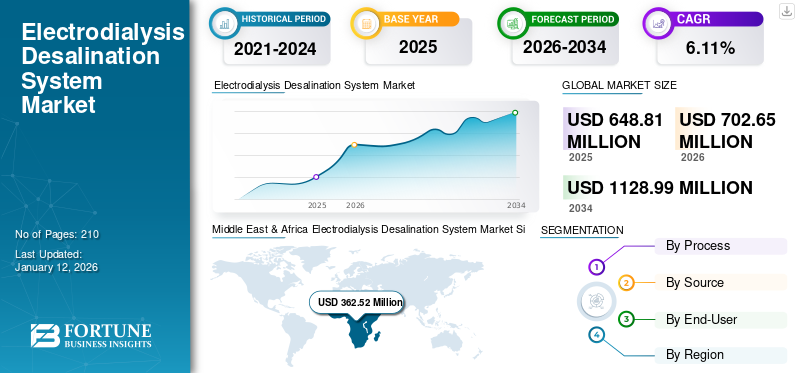
The global electrodialysis desalination system market size was valued at USD 648.81 million in 2025. The market is projected to grow from USD 702.65 million in 2026 to USD 1,128.99 million by 2034, exhibiting a CAGR of 6.11% during the forecast period. Middle East & Africa dominated the global market with a share of 55.87% in 2025.
The global electrodialysis desalination system market is majorly driven by the growing demand for clean water, rising industrial needs for water purification, and continuous advancements in electrodialysis technologies. The increasing scarcity of potable water, especially in developing regions, fuels the demand for electrodialysis systems, which offer a viable solution for desalination and water purification.
Veolia, a France-based company specializing in environmental services, focuses on water, waste, and energy management. Through its Water Technologies & Solutions division, the company offers various membrane separation technologies, including electrodialysis (ED). This process uses electric fields to move ions through selective membranes, effectively separating salts and impurities from water.
Download Free sample to learn more about this report.
Electrodialysis Desalination System Market Key Takeaways
 Global Market Size & Forecast
- 2025 Market Size: USD 648.81 million
- 2026 Market Size: USD 702.65 million
- 2034 Forecast Market Size: USD 1,128.99 million
- CAGR: 6.11% from 2026–2034
 Market Share
- Middle East & Africa dominated the market with a 55.87% share, reaching USD 362.52 million in 2025.
- Continuous segment dominated the market due to its suitability for large-scale water treatment.
- Municipal segment led the market owing to rising demand for freshwater supply.
 Key Regional Highlights
North America
North America reached USD 75.54 million in 2025 and is projected to reach USD 81.35 million in 2026.
Asia Pacific
Asia Pacific reached USD 151.50 million in 2025 and is projected to reach USD 162.81 million in 2026.
Middle East & Africa
Middle East & Africa dominated the market, reaching USD 362.52 million in 2025 and USD 396.35 million in 2026.
U.S.
The U.S. market is driven by rising demand for industrial water reuse and brackish water treatment.
Japan
The Japan market is supported by growing demand for advanced and energy-efficient water treatment technologies.
Read More

MARKET DYNAMICS
MARKET DRIVERS
Water Scarcity and Rising Demand for Clean Water to Support Market Growth
The scarcity of clean water resources is one of the significant global challenges, exacerbated by rapid population growth, urbanization, industrialization, and climate change, all of which place increasing stress on freshwater supplies. According to United Nations projections, the global population is expected to reach USD 9.7 billion by 2050, significantly raising the demand for potable water. Electrodialysis (ED) desalination systems offer a highly efficient solution for this growing issue. These systems use electrical energy to selectively move salt ions across membranes, effectively desalinating brackish water. Brackish water desalination through electrodialysis is less energy-intensive than treating seawater, making it a cost-effective solution.
Download Free sample to learn more about this report.
MARKET RESTRAINTS
High Initial Investment and Operational Costs Limit Market Expansion
Electrodialysis desalination systems require substantial capital investment for installation, including costs related to membranes, electrodes, and control systems. Ion-exchange membranes, in particular, represent a major cost component, and their pricing can impact the overall cost of desalinated water production. Furthermore, operational expenses, including energy consumption, maintenance, and skilled labor, can be significant. Such financial constraints are high, particularly for small-scale water treatment facilities and regions with limited financial resources. Building and maintaining large-scale electrodialysis desalination plants involves high expenditure, which can act as a deterrent for potential buyers, thereby limiting market growth.
MARKET OPPORTUNITIES
Increasing Adoption in Industrial Applications to Encourage Market Growth
Electrodialysis desalination systems are increasingly being adopted in industrial settings, driven by the growing need for pure water and wastewater treatment. Industries such as pharmaceuticals and food & beverages require ultrapure water for their processes, as contaminants can disrupt operations, corrode equipment, and affect product quality. Electrodialysis is useful in these applications due to its ability to remove dissolved salts and charged contaminants. This trend, coupled with the need for sustainable wastewater treatment management, is anticipated to support the electrodialysis desalination system market growth.
ELECTRODIALYSIS DESALINATION SYSTEM MARKET TRENDS
Integration of Electrodialysis with Renewable Energy Sources for Sustainable Production
The process of electrodialysis uses electricity and certain membranes to separate ionic compounds from water. The process can be made more ecologically friendly by combining this technique with renewable energy sources such as solar and wind power. Photo-electrodialysis and photovoltaic-electrodialysis are two well-liked methods for integrating sun energy with the electrodialysis procedure. Hybrid systems are more popular that combine electrodialysis (ED) with renewable energy sources such as wind and solar power in an effort to lessen the carbon footprint associated with desalination.
Segmentation Analysis
By Process
Continuous Segment Dominates Market Owing to Higher Efficiency and Wide-Scale Applications
Based on the process, the market is segmented into batch and continuous. The continuous segment holds a major electrodialysis desalination system market share, owing to its application in large-scale industries where there is a need for continual water treatment. Continuous operation allows for a steady and consistent production of both dilute and concentrate solutions, making it suitable for large-scale industrial applications.
By Source
Sea Water Segment Dominates Market Share Due to Its Abundant Availability
Based on the source, the market is divided into sea water, brackish water, river water, and others. The sea water segment holds a major share of the market. Desalination of sea water provides a reliable and sustainable source of freshwater, helping to reduce reliance on traditional water sources and mitigate the effects of drought. Electrodialysis desalination system typically achieves higher water recovery rates compared to reverse osmosis, meaning less water is wasted as brine. This is owing to its capability to operate at lower pressures, reducing the amount of water needed to pass through the membranes to achieve the desired separation.
By End-User
Municipal Segment Commands Market Owing to High Demand for Fresh Water in Urban Areas
Based on end-user, the market is trifurcated into municipal, industrial, and power generation. The municipal segment holds a major share of the market. Desalination, particularly seawater desalination, offers several advantages for municipal water supply. It enhances water availability, improves water quality, and provides a reliable and sustainable source of freshwater, especially crucial in water-scarce regions. Desalination helps meet the growing demand from the urban population and can be implemented at various scales, from small localized systems to large-scale plants, making it suitable for diverse municipal needs.
Electrodialysis Desalination System Market Regional Outlook
By region, the market is categorized into North America, Europe, Asia Pacific, Latin America, and Middle East & Africa.
Middle East & Africa
Middle East & Africa Electrodialysis Desalination System Market Size, 2025 (USD Million)
To get more information on the regional analysis of this market, Download Free sample
The Middle East & Africa region dominates the market due to high water scarcity and strong investments in advanced desalination technologies. Middle East & Africa is one of the prominent markets for electrodialysis desalination systems, where technologies such as electrodialysis are essential for ensuring water security. The arid climate and inadequate freshwater resources necessitate the use of desalination technologies to meet the growing fresh water demand in the region.
North America
In North America, the market for electrodialysis desalination systems is driven by stringent environmental regulations, technological advancements, and a growing need for efficient water treatment solutions. The U.S. Environmental Protection Agency (EPA) and other regulatory bodies have placed strict guidelines for wastewater discharge and water quality. These regulations necessitate advanced treatment methods, making electrodialysis an attractive option, owing to its efficient operation and other associated benefits. The North America market was valued at USD 75.54 million in 2025, capturing 11.64% of global revenue, and is estimated to reach USD 81.35 million in 2026.
U.S.
The U.S. market is niche but steadily expanding, driven by rising demand for brackish water treatment, industrial water reuse, and supporting sustainable initiatives. Moreover, developments in energy-efficient membrane technologies and increasing focus on decentralized water systems are driving market growth.
Europe
In Europe, the market is expected to grow steadily, owing to the region’s high focus on sustainability and technology adoption. The European Union’s commitment to environmental sustainability encourages the adoption of energy-efficient and eco-friendly technologies for water treatment. Electrodialysis aligns with these objectives, as it consumes less energy than conventional desalination methods. In 2025, Europe held 5.19% of the global market, reaching a valuation of USD 33.66 million, and is projected to grow to USD 35.58 million in 2026.
Asia Pacific
The market in Asia Pacific is anticipated to grow considerably due to rapid industrialization and urbanization, leading to an increase in water demand and the need for efficient water treatment solutions. Countries such as China, India, and Southeast Asian countries are experiencing significant urbanization, leading to increased water demand and a need for water treatment solutions. Furthermore, the expansion of industries in the region necessitates the treatment of industrial wastewater, where electrodialysis systems are employed for their effectiveness in removing contaminants. The market in Asia Pacific reached USD 151.5 million in 2025, representing 23.35% of total market revenue, and is projected to reach USD 162.81 million in 2026.
Latin America
In Latin America, the market is fueled by the urgent need to address water scarcity and improve water quality in both urban and rural areas. Many countries in the region face water shortages, making the adoption of electrodialysis desalination systems essential for ensuring a reliable water supply. Furthermore, agriculture is a significant sector in the region where the demand for water is substantial. Electrodialysis systems can treat brackish water for agricultural use, supporting this demand. Latin America maintained a strong presence in the global market, reaching USD 25.59 million in 2025, accounting for 3.94% share, and is expected to reach USD 26.55 million in 2026.
Middle East & Africa
In 2025, the Middle East & Africa market stood at USD 362.52 million, representing 55.87% of global demand, and is projected to grow to USD 396.35 million in 2026.
COMPETITIVE LANDSCAPE
Key Industry Players
Continuous R&D Investments by Key Players for Technological Innovations to Support Market Growth
In this market, technological innovations drive the market due to increasing demand for advanced electrodialysis desalination systems. Key players in this market, such as Veolia, Saltworks Technologies Inc., Yasa ET Co., Ltd., and others, are focusing on advanced membrane materials, energy-efficient designs, and system automation to enhance performance and reduce the overall operational cost.
Moreover, continuous R&D for innovations is crucial for this market and is creating market growth opportunities over the forecast period. For instance, in November 2024, a student at the University of Texas at El Paso innovated salt-free electrodialysis metathesis. The innovative technique transforms more than 90% of brine into fresh water. Also, it allows for the recovery of essential minerals and metals, which can be repurposed in various technologies and industries, providing both environmental and economic advantages.
LIST OF KEY ELECTRODIALYSIS DESALINATION SYSTEM COMPANIES PROFILED
- Veolia (France)
- Saltworks Technologies Inc. (Canada)
- Yasa ET Co., Ltd. (China)
- PCCell GmbH (Germany)
- Xylem Inc. (U.S.)
- ASTOM Corporation (Japan)
- Condorchem Enviro Solutions (Spain)
- Pure Water Group (Netherlands)
- Xiamen eSep Membrane Technology Co., Ltd. (China)
- AGC Engineering CO., LTD. (Japan)
KEY INDUSTRY DEVELOPMENTS
- February 2025: Energy and Services company ENGIE signed a Sale and Purchase Agreement (SPA) to divest its power and water desalination assets in Kuwait and Bahrain to ACWA Power. The company is set to sell its 17.5% stake in Az Zour North, a combined gas power and water desalination plant with a capacity of 1.5 gigawatts (GW).
- September 2024: MediSun Energy signed a Memorandum of Understanding (MoU) with Emirates Electrical and Instrumentation Company (EEIC), appointing EEIC as the exclusive distributor of MediSun's WEGen technologies across UAE. The Reverse Electrodialysis technology by WEGen efficiently converts saltwater into electricity.
- June 2024: Capture6 and Veolia Water Technologies & Solutions formed a partnership to tackle climate change through the installation of carbon dioxide (CO₂) removal facilities equipped with comprehensive water management systems. Veolia provides advanced water treatment processes based on its expertise in electrodialysis and other technologies.
- September 2023: The National Alliance for Water Innovation (NAWI) partnered with communities to treat unconventional water resources and offer usable water. Out of 5 pilot projects, one of the projects focuses on creating and implementing desalination through the concentration of brine through electrodialysis.
- September 2022: ACCIONA launched the LIFE INDESAL initiative, aimed at enhancing the energy efficiency of seawater desalination, generating renewable energy from brine, and converting brine into chemicals necessary for the desalination process. The project constitutes the implementation of electrodialysis with bipolar membranes alongside other cutting-edge technologies.
REPORT COVERAGE
Request for Customization to gain extensive market insights.
Report Scope & Segmentation
|
ATTRIBUTE |
DETAILS |
|
Study Period |
2021–2034 |
|
Base Year |
2025 |
|
Estimated Year |
2026 |
|
Forecast Period |
2026-2034 |
|
Historical Period |
2021–2024 |
|
Growth Rate |
CAGR of 6.11% from 2026-2034 |
|
Unit |
Value (USD Million) |
|
Segmentation |
By Process
|
|
By Source
|
|
|
By End-User
|
|
|
By Region
|
Frequently Asked Questions
Fortune Business Insights says that the global market value stood at USD 599.68 million in 2024 and is projected to reach USD 1,166.18 million by 2032.
In 2025, the market value stood at USD 362.52 million.
The market is expected to exhibit a CAGR of 6.11% during the forecast period (2026-2034).
By process, the continuous segment leads the market.
Water scarcity and rising demand for clean water support market growth.
Veolia, Xylem Inc., and PCCell GmbH are the top players in the market.
The Middle East & Africa region holds the largest share of the market.
Increasing demand in industrial applications is a major factor that is expected to favor product adoption.



- 2021-2034
- 2025
- 2021-2024
- 210
Get 30-60 hrs Free Customization
Expand Regional and Country Coverage, Segments Analysis, Company Profiles, Competitive Benchmarking, and End-user Insights.



















Related Reports
-
US +1 833 909 2966 ( Toll Free )
-
Get In Touch With Us