Energy Efficient Materials Market Size, Share & Industry Analysis, By Material Type (Insulation Materials, Energy-efficient Glass & Glazing Materials, Energy-efficient Coatings, Sustainable Building Materials, Reflective & Cool Roofing Materials, and Others), By Application (Building & Construction, Automotive & Transportation, HVAC Systems, Energy & Power, and Industrial Equipment & Appliances), and Regional Forecast, 2026-2034
 Download Free Sample
Energy Efficient Materials Market Size and Future Outlook
 Listen to Audio Version
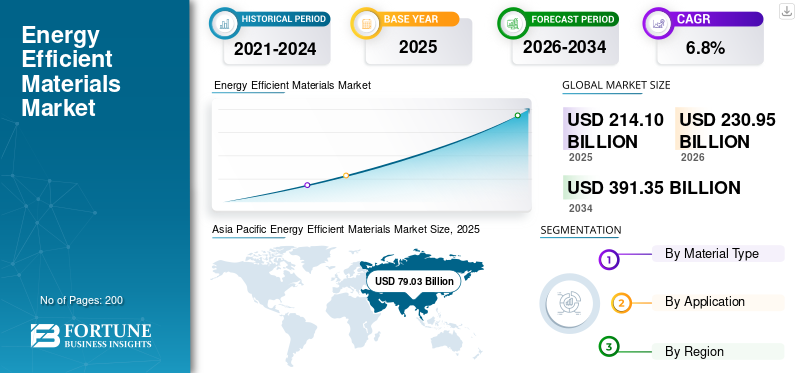
The global energy efficient materials market size was valued at USD 214.10 billion in 2025. The market is projected to grow from USD 230.95 billion in 2026 to USD 391.35 billion by 2034, exhibiting a CAGR of 6.8% during the forecast period. Asia Pacific dominated the energy efficient materials market with a market share of 36.91% in 2025.
Energy-efficient materials are used to reduce energy loss and improve the performance of buildings, vehicles, and industrial systems. These include insulation, energy-efficient glass, cool roofing materials, coatings, and sustainable building materials. Demand is mainly linked to green construction, building renovation, energy-saving regulations, and efforts to lower heating and cooling costs. Globally, the market is growing steadily as governments, builders, and industries focus on reducing energy consumption, improving thermal comfort, and supporting sustainable infrastructure. Replacement of older materials and rising investment in efficient buildings continue to support long-term demand across both developed and emerging economies.
The market is led by a mix of global building material manufacturers, insulation producers, glass companies, coating suppliers, and regional construction material players with strong product portfolios and established distribution networks. Major players such as Saint-Gobain, Owens Corning, ROCKWOOL A/S, Kingspan Group, and 3M, and regional producers, focus on thermal insulation, energy-efficient glazing, cool roofing systems, advanced coatings, and sustainable building solutions. This results in a moderately fragmented market, supported by steady demand from green buildings, renovation projects, energy-saving regulations, and long-term sustainability goals.
Download Free sample to learn more about this report.
Energy Efficient Materials Market KEY TAKEAWAYS
 Market Size & Forecast
- 2025 Market Size: USD 214.10 Billion
- 2026 Market Size: USD 230.95 Billion
- 2034 Forecast Market Size: USD 391.35 Billion
- CAGR: 6.8% from 2026-2034
 Market Share
- Asia Pacific holds 36.91% market share.
- Insulation materials held the largest market share in 2025.
- Building & construction held the largest market share in 2025.
 Key Regional Highlights
Asia Pacific
Asia Pacific holds 36.91% market share, driven by rapid urbanization, large-scale construction activity.
North America
North America reached USD 51.17 billion in 2025, supported by building renovation.
Europe
Europe reached USD 59.51 billion in 2025, driven by strict building energy-efficiency regulations.
U.S.
The U.S. market was valued at USD 43.56 billion in 2025.
Japan
Japan is one of the major Asia-Pacific markets, supported by demand for insulation.
Read More

ENERGY EFFICIENT MATERIALS MARKET TRENDS
Shift Toward Advanced Building Envelope Materials Is Reshaping the Market
A key trend in the market is the growing use of advanced building envelope materials. Companies are improving insulation, energy-efficient glass, reflective roofing materials, and coatings to reduce heat transfer through walls, roofs, and windows. These materials are becoming more durable, easier to apply, and better at improving indoor temperature control. The trend is mainly focused on product improvement rather than only demand growth. From a business perspective, manufacturers are investing in better material performance and practical solutions that support modern construction, renovation, and long-term energy savings.
- According to the U.S. Department of Energy, the building envelope accounts for nearly 30% of primary energy use in commercial buildings, supporting demand for advanced insulation, glazing, roofing, and coating materials.
MARKET DYNAMICS
MARKET DRIVERS
Download Free sample to learn more about this report.
Rising Focus on Energy Savings and Green Buildings Supports Market Growth
Energy efficient materials market growth is mainly driven by the increasing need to reduce energy consumption in buildings, transportation, and industrial systems. Insulation materials, energy-efficient glass, cool roofing materials, and advanced coatings are increasingly used to improve thermal performance and lower heating and cooling losses. In buildings, these materials help reduce electricity use, improve indoor comfort, and support compliance with energy-efficiency standards. This creates steady demand from new construction as well as renovation projects, as governments, builders, and property owners focus on lower operating costs and more sustainable infrastructure.
- According to the U.S. Department of Energy, heat gain and heat loss through windows account for 25–30% of residential heating and cooling energy use. Further, highlighting the need for energy-efficient glass, glazing, insulation, and other building envelope materials.
MARKET RESTRAINTS
High Initial Cost and Project Dependency Limit Faster Adoption of Energy-Efficient Materials
Their higher upfront cost restrains energy efficient materials demand compared to conventional building and industrial materials. Products such as advanced insulation, energy-efficient glass, cool roofing systems, and specialized coatings often require higher material investment, skilled installation, and compliance with specific building standards. This can slow adoption in price-sensitive construction projects, especially in emerging economies and small-scale renovation work. The market is also closely linked to construction activity, retrofit spending, and government-backed efficiency programs. When building projects are delayed or renovation budgets weaken, the use of such materials can be postponed despite their long-term energy-saving benefits.
MARKET OPPORTUNITIES
Retrofitting of Old Buildings Creates Long-Term Growth Opportunities
Energy-efficient materials have strong growth opportunities in the renovation of old buildings. Many existing residential, commercial, and public buildings still use traditional insulation, windows, roofing, and coating materials that allow higher energy loss. As owners focus on reducing electricity bills and improving indoor comfort, demand for insulation materials, energy-efficient glass, cool roofing materials, and advanced coatings is expected to increase. This opportunity is strong in developed regions with aging building stock and in cities where rebuilding is expensive. Retrofitting supports regular material replacement and creates steady long-term demand for energy efficient materials.
- According to the U.S. Department of Energy, an estimated 75% of U.S. buildings will be new or renovated by 2035, supporting long-term demand for insulation, energy-efficient glazing, cool roofing, and other building efficiency materials used in retrofit and renovation projects.
MARKET CHALLENGES
Installation Quality and Performance Gaps Affect Material Efficiency
Energy-efficient materials face a key challenge in proper installation and performance consistency. Products such as insulation, energy-efficient glass, reflective roofing materials, and coatings can provide strong energy-saving benefits only when they are correctly selected and applied. Poor installation, limited technical knowledge, or the use of unsuitable materials can reduce their actual performance. This issue is more common in small construction projects, renovation work, and developing regions where skilled labor and quality checks may be limited. As a result, better training, clear standards, and performance testing are important to ensure these materials deliver expected energy savings.
Segmentation Analysis
By Material Type
Insulation Materials Lead the Market Due to Strong Role in Reducing Energy Loss
Based on material type, the market is segmented into insulation materials, energy-efficient glass & glazing materials, energy-efficient coatings, sustainable building materials, reflective & cool roofing materials, and others.
The insulation materials segment accounted for a significant global energy efficient materials market share in 2025. Insulation materials lead consumption as they are widely used in residential, commercial, and industrial buildings to reduce heat loss, improve indoor comfort, and lower heating and cooling energy use. Their demand is strongly supported by new construction, renovation of old buildings, and stricter energy-efficiency standards. As building owners and developers focus on reducing operating costs and improving thermal performance, insulation remains one of the most practical and widely adopted energy-efficient material solutions.
The sustainable building materials segment is expected to grow at a 7.7% CAGR over the forecast period.
To know how our report can help streamline your business, Speak to Analyst
By Application
Building & Construction Remains the Primary Demand Anchor Due to Strong Energy-Saving Needs
Based on application, the market is categorized into building & construction, automotive & transportation, HVAC systems, energy & power, and industrial equipment & appliances.
The building & construction segment accounted for the largest share in 2025. This segment leads demand as energy efficient materials are widely used to reduce heat loss, improve insulation, and lower energy consumption in residential, commercial, and public buildings. Materials such as insulation, energy-efficient glass, reflective roofing, and advanced coatings help improve building envelope performance and support long-term energy savings. As construction standards focus more on thermal comfort, lower operating costs, and sustainable buildings, the use of energy-efficient materials continues to grow in both new construction and renovation projects.
The automotive & transportation segment is expected to grow at a 8.0% CAGR over the forecast period.
Energy Efficient Materials Market Regional Outlook
By region, the market is categorized into North America, Europe, Asia Pacific, Latin America, and the Middle East & Africa.
Asia Pacific
Asia Pacific Energy Efficient Materials Market Size, 2025 (USD Billion)
To get more information on the regional analysis of this market, Download Free sample
Asia Pacific held the dominant position in 2025, valued at USD 79.03 billion, and is expected to retain its leading place in 2026, reaching USD 85.67 billion. The region’s leadership is driven by rapid urbanization, large-scale construction activity, rising investment in energy-efficient buildings, and growing demand for sustainable infrastructure. Strong use of insulation materials, energy-efficient glass, cool roofing materials, coatings, and sustainable building materials across residential, commercial, and industrial projects supports market growth. Expanding building renovation, stricter energy-efficiency goals, and increasing focus on reducing heating and cooling costs further strengthen demand across major economies such as China, India, Japan, and South Korea.
China Energy Efficient Materials Market
Based on Asia Pacific’s strong contribution and China’s large construction base, the China market was valued at USD 35.73 billion in 2025, accounting for approximately 45.2% of global revenues. Demand is supported by residential and commercial construction, building renovation, and wider use of insulation, energy-efficient glass, reflective roofing, coatings, and sustainable materials to improve building performance and reduce energy loss across key urban markets.
India Energy Efficient Materials Market
The India market in 2025 was valued at around USD 14.16 billion. The growth is supported by expanding residential and commercial construction, rising urban housing demand, renovation activity, and wider use of insulation, energy-efficient glass, reflective roofing, coatings, and sustainable materials to reduce energy consumption levels.
North America
North America remains a significant regional market, and reached USD 51.17 billion in 2025. The demand is supported by building renovation, improving energy efficiency standards, and replacement of older insulation, windows, roofing, and coating systems. The region benefits from strong awareness of energy savings, established green building practices, and mature construction activity. However, growth remains moderate due to market maturity and slower new construction compared to the Asia Pacific across some key states.
U.S. Energy Efficient Materials Market
The U.S. market in 2025 was valued at USD 43.56 billion, representing approximately 85.1% of global revenues. The consumption is driven by insulation materials, energy-efficient glass, reflective roofing, coatings, and sustainable building materials across residential and commercial buildings. Further, supported by renovation activity, efficiency standards, and efforts to reduce heating and cooling costs in major states.
Europe
Europe is projected to record steady growth over the forecast period and reached a valuation of USD 59.51 billion in 2025. Strict building energy-efficiency regulations, high energy costs, sustainable construction targets, and renovation activity drive the region. Demand is supported by insulation materials, energy-efficient glass, reflective roofing, coatings, and sustainable building materials across residential, commercial, and public infrastructure projects, especially in mature urban markets.
Germany Energy Efficient Materials Market
Germany’s market reached USD 14.44 billion in 2025, equivalent to 24.3% of the global market. Renovation, strict efficiency standards, high energy costs, and wider use of insulation, glazing, roofing, coatings, and sustainable materials support demand.
U.K. Energy Efficient Materials Market
The U.K. market in 2025 was valued at USD 12.21 billion, accounting for roughly 20.5% of global revenues. The consumption is concentrated in building renovation, residential and commercial construction, and wider use of insulation materials, energy-efficient glass, reflective roofing, coatings, and sustainable building materials to improve energy performance and reduce heating costs.
Latin America and the Middle East & Africa
Latin America and the Middle East & Africa regions are expected to witness moderate growth during the forecast period. The Latin America market reached USD 13.70 billion in 2025, supported by rising construction activity, urban housing development, renovation projects, and increasing use of insulation, energy-efficient glass, reflective roofing, coatings, and sustainable building materials. In the Middle East & Africa, demand is driven by commercial construction, infrastructure development, high cooling requirements, and the gradual adoption of energy-efficient building solutions in new projects. The region’s market reached USD 10.70 billion in 2025, with growth remaining steady across major regional urban economies overall.
GCC Energy Efficient Materials Market
The GCC market size was valued at around USD 4.68 billion in 2025, representing approximately 43.8% of regional revenues. Construction activity, infrastructure development, high cooling needs, and wider use of insulation, glazing, roofing, coatings, and sustainable building materials support demand.
COMPETITIVE LANDSCAPE
Key Industry Players
Performance Standards and Product Certification Shape Market Competition
The energy efficient materials market is moderately fragmented and performance-driven, as varied product categories, certification requirements, technical standards, and building code compliance create important competitive factors. These factors limit easy substitution and support the position of established manufacturers with proven material performance, strong distribution networks, and relationships with builders, contractors, and infrastructure developers.
Leading players such as Saint-Gobain, Owens Corning, ROCKWOOL A/S, Kingspan Group, and 3M, and regional manufacturers, focus primarily on improving product performance, strengthening sustainability positioning, and expanding material applications rather than pursuing aggressive capacity expansion. Recent activities across these companies highlight a strategic emphasis on insulation efficiency, energy-efficient glazing, reflective roofing systems, advanced coatings, and low-carbon material solutions to support long-term market positioning.
LIST OF KEY ENERGY EFFICIENT MATERIALS COMPANIES PROFILED
- Saint-Gobain (France)
- Owens Corning (U.S.)
- Knauf Group (Germany)
- Nippon Sheet Glass Co., Ltd. (Japan)
- ROCKWOOL A/S (Denmark)
- DuPont (U.S.)
- Armacell (Luxembourg)
- Kingspan Group (Ireland)
- AGC Glass Europe (Belgium)
- 3M (U.S.)
KEY INDUSTRY DEVELOPMENTS
- January 2025: Saint-Gobain completed the acquisition of OVNIVER Group in Mexico and Central America to strengthen its construction chemicals portfolio, including façade coatings, waterproofing, tile adhesives, and surface preparation solutions for residential and non-residential construction.
REPORT COVERAGE
The global energy efficient materials market analysis provides an in-depth study of market size & forecast by all the market segments included in the report. It includes details on market dynamics and trends expected to drive the market during the forecast period. It offers information on technological advancements, new product launches, key industry developments, and partnerships, mergers & acquisitions. The market research report also includes a detailed competitive landscape, including market share and profiles of key players.
Request for Customization to gain extensive market insights.
Report Scope & Segmentation
| ATTRIBUTE | DETAILS |
| Study Period | 2021-2034 |
| Base Year | 2025 |
| Estimated Year | 2026 |
| Forecast Period | 2026-2034 |
| Historical Period | 2021-2024 |
| Growth Rate | CAGR of 6.8% from 2026-2034 |
| Unit | Value (USD Billion), Volume (Kiloton) |
| Segmentation | By Material Type, Application, and Region |
| By Material Type |
|
| By Application |
|
| By Region |
|
Frequently Asked Questions
Fortune Business Insights says that the global market size was valued at USD 214.10 billion in 2025 and is projected to reach USD 391.35 billion by 2034.
Recording a CAGR of 6.8%, the market is slated to exhibit steady growth during the forecast period.
By application, the building & construction segment led in 2025.
Asia Pacific held the highest market share in 2025.
The growing building renovation and energy-saving standards drive adoption of advanced insulation, glazing, roofing, and coating materials across residential and commercial projects.



- 2021-2034
- 2025
- 2021-2024
- 200
Get 30-60 hrs Free Customization
Expand Regional and Country Coverage, Segments Analysis, Company Profiles, Competitive Benchmarking, and End-user Insights.


















-
US +1 833 909 2966 ( Toll Free )
-
Get In Touch With Us