Energy Portfolio Management Market Size, Share & Industry Analysis, By Deployment Type (Cloud-Based, On-Premises, and Hybrid), By Solution (Software, Services, and Others), By Application (Renewable Energy Management, Energy Trading and Risk Management, Demand Response Management, Energy Forecasting & Analytics, and Others), and Regional Forecast, 2026-2034
 Download Free Sample
KEY MARKET INSIGHTS
 Listen to Audio Version
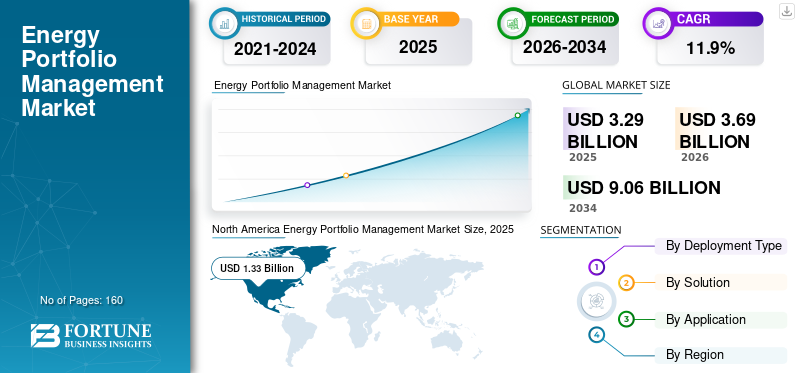
The global energy portfolio management market size was valued at USD 3.29 billion in 2025. The market is projected to grow from USD 3.69 billion in 2026 to USD 9.06 billion by 2034, exhibiting a CAGR of 11.9% during the forecast period. North America dominated the global market with a market share of 40.43% in 2025.
The market is witnessing steady growth, driven by the increasing complexity of energy landscapes and the need for efficient management of diverse energy resources across the energy sector. Energy portfolio management solutions, as defined in this report, refer to digital platforms and software tools that enable utilities, energy producers, and traders to optimize asset performance, manage risk, forecast energy demand, and support long-term strategic planning. These solutions are used across both renewable energy and fossil fuels based portfolios and are increasingly deployed through cloud-based environments.
The growing adoption of real-time monitoring and predictive maintenance capabilities has strengthened demand for advanced portfolio management systems. Additionally, the integration of artificial intelligence and machine learning is enhancing forecasting accuracy and operational efficiency across dynamic energy markets. Furthermore, key industry players such as ION Group, Siemens Energy, SAP SE, Oracle Corporation, and Schneider Electric are focusing on expanding analytics-driven and AI-enabled portfolio management platforms to address evolving energy sector requirements.
Download Free sample to learn more about this report.
Energy Portfolio Management Market KEY TAKEAWAYS
 Global Market Size & Forecast
- 2025 Market Size: USD 3.29 billion
- 2026 Market Size: USD 3.69 billion
- 2034 Forecast Market Size: USD 9.06 billion
- CAGR: 11.9% from 2026–2034
 Market Share
- North America dominated the energy portfolio management market with a 40.43% share in 2025.
- The renewable energy management segment held the largest market share in 2025.
- The cloud-based deployment segment held the largest market share in 2025.
 Key Regional Highlights
North America
The market was valued at USD 1.33 billion in 2025, maintaining the leading market position.
Europe
The market is projected to reach USD 1.06 billion in 2026, supported by stringent energy regulations.
Asia Pacific
The market is projected to reach USD 0.79 billion in 2026, emerging as the fastest-growing region.
U.S.
The market is estimated to reach USD 1.26 billion in 2026.
Japan
The market is estimated to reach USD 0.11 billion in 2026.
Read More

ENERGY PORTFOLIO MANAGEMENT MARKET TRENDS
Rising Integration of Renewable Energy Assets is a Prominent Market Trend
The increasing integration of renewable energy sources such as wind and solar into energy portfolios has emerged as a prominent trend in the market. Renewable assets introduce variability and intermittency into energy supply, making portfolio optimization, forecasting, and risk management more complex. As a result, energy producers, utilities, and traders are increasingly adopting advanced portfolio management platforms to balance generation, demand, and market exposure. Additionally, regulatory pressure to increase renewable penetration and reduce carbon emissions is accelerating the need for sophisticated portfolio analytics. These systems support real-time decision-making and enhance operational visibility across diverse energy assets.
- For instance, the International Energy Agency has highlighted that the growing share of renewables in power generation is increasing the need for advanced digital tools to manage portfolio complexity and market volatility.
Download Free sample to learn more about this report.
MARKET DYNAMICS
MARKET DRIVERS
Growing Energy Market Volatility is Accelerating Market Growth
Increasing volatility in global energy markets is a major factor driving the market. Fluctuations in fuel prices, electricity demand, and supply conditions have heightened financial and operational risks for utilities and energy traders. Portfolio management solutions enable organizations to model scenarios, manage exposure, and optimize trading and generation strategies. Furthermore, the liberalization of electricity markets and the expansion of energy trading activities have increased reliance on portfolio optimization and risk management tools, reinforcing demand for energy portfolio management platforms.
- For example, according to the European Commission, market liberalization and cross-border energy trading are increasing the complexity of energy markets, driving demand for advanced portfolio and risk management systems.
MARKET RESTRAINTS
High Implementation Complexity and Integration Challenges to Restrict Market Growth
The high complexity associated with implementing solutions poses a significant restraint on energy portfolio management market growth. These platforms often require deep integration with existing energy trading, forecasting, billing, and grid management systems. The need for specialized expertise, data harmonization, and customization can result in longer deployment timelines and higher upfront costs. Such challenges may limit adoption, particularly among smaller utilities and independent power producers with constrained IT budgets and technical resources.
- For instance, the World Energy Council has noted that the integration of advanced digital systems in energy operations remains challenging due to legacy infrastructure and fragmented data environments.
MARKET OPPORTUNITIES
Advancements in AI and Predictive Analytics to Create Growth Opportunities
With the increased usage of AI and predictive analytics within the area of Energy Management, new opportunities will be available for considerable growth within this sector. AI-based tools will assist in more accurately forecasting demand, optimally managing assets and assessing risk through the analysis of immense amounts of both market and operational data in real time. Due to the data-intensive nature of current energy systems, utility companies and energy traders are moving toward the implementation of portfolio management software that incorporates advanced analytical methods to both increase profitability and optimize operations.
- Siemens Energy, for example, has stressed the importance of using AI analytics as a tool for optimizing energy portfolios, as well as for being able to make effective decisions in real time in a very complex energy market.
Segmentation Analysis
By Application
Accelerating Renewable Integration to Strengthen Renewable Energy Management Segment Growth
Based on the application, the market is divided into renewable energy management, energy trading and risk management, demand response management, energy forecasting & analytics, and others.
In 2025, the renewable energy management segment held the largest market share, supported by the rapid expansion of wind and solar capacity and the associated variability in energy generation. Managing renewable assets requires advanced portfolio tools to balance intermittency, forecast generation, and align supply with market demand. Energy portfolio management platforms play a critical role in optimizing renewable asset performance and supporting grid stability. The growing focus on decarbonization and clean energy targets has further strengthened adoption of renewable energy management solutions.
- For instance, the International Renewable Energy Agency has emphasized that advanced digital tools are essential for managing renewable-heavy energy portfolios and ensuring system reliability.
The energy trading and risk management segment is anticipated to rise with a CAGR of 12.1% over the forecast period.
[DDQaPfkjnM]
By Deployment Type
Scalability and Operational Flexibility to Drive Cloud-Based Deployment Adoption
Based on deployment type, the market is segmented into cloud-based, on-premises, and hybrid.
In 2025, the cloud-based deployment segment held the largest share of the market. The dominance of this segment is primarily attributed to the scalability, flexibility, and real-time data processing capabilities offered by cloud-based platforms. Energy companies increasingly rely on cloud environments to manage large volumes of operational, market, and forecasting data across geographically distributed assets. Additionally, cloud-based solutions support faster deployment, easier integration with external data sources, and continuous updates, making them well-suited for dynamic energy market conditions. These advantages have reinforced the adoption of cloud-based energy portfolio management platforms across utilities and energy traders.
- For instance, Amazon Web Services has emphasized that cloud computing enables energy companies to process and analyze market and operational data in real time, supporting portfolio optimization and risk management.
The hybrid segment is projected to grow at a CAGR of 11.7% over the forecast period.
By Solution
Growing Demand for Integrated Optimization Platforms to Support Software Segment Dominance
Based on the solution, the market is segmented into software, services, and others.
The software segment accounted for the highest share in 2025, due to an increase in the use of fully integrated energy portfolio management systems which include forecasting, optimization, and risk management as part of one system. As energy companies increasingly seek software that gives them real-time visibility, scenario modelling, and decision support tools. They require solutions to manage their risk associated with the increased complexity of the energy portfolio resulting from adding more renewables and market based trading. Companies want to manage their exposure; optimize the performance of their assets, and maximize profits.
The services segment is projected to grow at a CAGR of 12.4% over the forecast period.
Energy Portfolio Management Market Regional Outlook
By region, the market is categorized into Europe, North America, Asia Pacific, South America, and the Middle East & Africa.
North America
North America Energy Portfolio Management Market Size, 2025 (USD Billion) To get more information on the regional analysis of this market, Download Free sample
North America accounted for the largest energy portfolio management market share in 2025, with a valuation of USD 1.33 billion. Market growth in the region is driven by advanced energy trading ecosystems, high penetration of renewable energy assets, and early adoption of digital energy management platforms. The presence of mature power markets, strong regulatory frameworks, and increasing deployment of analytics-driven optimization tools continues to support sustained adoption of energy portfolio management solutions across utilities, independent power producers, and energy traders.
U.S Energy Portfolio Management Market
Based on North America’s strong contribution and the U.S. dominance within the region, the U.S. market can be analytically approximated at around USD 1.26 billion in 2026, accounting for roughly 34.2% of the global market.
Europe
Europe recorded a valuation of USD 1.06 billion in 2026. Market growth in the region is supported by stringent energy regulations, increasing cross-border electricity trading, and strong policy emphasis on energy transition and decarbonization. Utilities and energy companies across the region are adopting portfolio management platforms to improve forecasting accuracy, manage price volatility, and optimize diverse energy asset portfolios.
U.K Energy Portfolio Management Market
The U.K. market in 2026 is estimated at around USD 0.19 billion, representing roughly 5.2% of global revenues.
Germany Energy Portfolio Management Market
Germany’s market is projected to reach approximately USD 0.21 billion in 2026, equivalent to around 5.7% of global sales.
Asia Pacific
Asia Pacific is the fastest growing region in the market and to reach a valuation of USD 0.79 billion by 2026. Rapid expansion of renewable energy capacity, rising electricity demand, and increasing investments in digital energy infrastructure are supporting market growth. Energy producers and utilities in the region are increasingly deploying portfolio management solutions to manage asset variability, enhance forecasting capabilities, and improve operational efficiency.
Japan Energy Portfolio Management Market
The Japan market in 2026 is estimated at around USD 0.11 billion, accounting for roughly 3.1% of global revenues.
China Energy Portfolio Management Market
China’s market is projected to reach USD 0.35 billion in 2026, representing roughly 9.6% of global revenues. Ongoing power market reforms and large-scale renewable energy integration are driving demand for advanced portfolio analytics and optimization platforms.
India Energy Portfolio Management Market
The India market in 2026 is estimated at around USD 0.10 billion, accounting for roughly 2.7% of global revenues.
South America
The market in South America is projected to reach a valuation of USD 0.21 billion in 2026. Market growth in the region is supported by gradual power market reforms, increasing renewable energy adoption, and improving digital infrastructure. Energy companies in the region are adopting portfolio management solutions to enhance forecasting accuracy, manage operational risks, and improve overall asset performance.
Middle East & Africa
The Middle East & Africa market is expected to reach USD 0.14 billion in 2026. Market growth is supported by increasing investments in renewable energy projects, power sector modernization, and national digital transformation initiatives. Energy producers in the region are deploying portfolio management platforms to support energy diversification strategies and improve operational visibility across conventional and renewable assets.
GCC Energy Portfolio Management Market
The GCC market is projected to reach around USD 0.06 billion in 2026, representing roughly 1.7% of global revenues.
COMPETITIVE LANDSCAPE
Key Industry Players
Focus on Expanding Digital Energy Optimization and Analytics Capabilities to Propel Market Progress
The market exhibits a moderately consolidated market structure, characterized by the presence of established energy software providers and technology-driven solution vendors. Key players such as ION Group, Siemens Energy, Oracle Corporation, and SAP SE hold a significant position in the market due to their comprehensive software offerings, strong domain expertise, and long-standing relationships with utilities and energy trading organizations.
The strong market presence of these companies is supported by continuous investments in advanced analytics, cloud-based deployment models, and AI-driven optimization capabilities. Leading players are increasingly focusing on enhancing their portfolio management platforms to address growing complexities arising from renewable energy integration, energy market volatility, and regulatory compliance requirements. Additionally, companies are adopting strategies such as product innovation, platform modernization, partnerships with energy utilities, and integration of forecasting and risk management modules to strengthen their competitive positioning.
LIST OF KEY ENERGY PORTFOLIO MANAGEMENT COMPANIES PROFILED
- ION Group (Ireland)
- Siemens Energy AG (Germany)
- Oracle Corporation (U.S.)
- SAP SE (Germany)
- ABB Ltd. (Switzerland)
- Schneider Electric SE (France)
- General Electric Company (U.S.)
- Emerson Electric Co. (U.S.)
- Energy Exemplar (Australia)
- Enverus (U.S.)
KEY INDUSTRY DEVELOPMENTS
- December 2025: CFEX announced the launch of a new energy portfolio management solution designed to support energy supply portfolios for AI data centers, EV charging networks, and large users, enhancing contract management and cost optimization.
- September 2025: GE Vernova announced the sale of its Proficy industrial software unit to private equity firm TPG for approximately USD 600 million, with plans to reinvest proceeds into grid and energy software investments. The strategic divestiture reflects a focused shift toward advanced energy systems and portfolio-oriented software solutions amid rising global electricity demand.
- June 2025: KKR agreed to acquire a majority stake in Zenith Energy in a transaction exceeding USD 2 billion, expanding infrastructure and sustainable power capabilities, an example of significant private-equity activity in energy asset portfolios.
- May 2025: Blackstone submitted a USD 1.5 billion non-binding offer to acquire Statkraft’s Indian operations, including a large renewable energy portfolio, highlighting growing investment interest in energy transition assets.
- April 2025: Hexa Climate Solutions acquired Fortum’s India renewable energy portfolio and announced plans to invest USD 500 million to expand clean energy operations, reflecting broader strategic shifts in energy asset management.
- March 2025: Equilibrium Energy raised USD 28 million in funding and launched its flagship EQ Mission Control energy portfolio management platform to enhance AI-enabled portfolio analytics and power market optimization capabilities.
- August 2023: Hitachi Energy partnered with Google Cloud to integrate cloud-based data analytics and AI services with its Energy Portfolio Management solutions, enabling utilities and renewable energy producers to accelerate decision-making and optimize investments.
REPORT COVERAGE
Request for Customization to gain extensive market insights.
Report Scope & Segmentation
|
ATTRIBUTE |
DETAILS |
|
Study Period |
2021-2034 |
|
Base Year |
2025 |
|
Estimated Year |
2026 |
|
Forecast Period |
2026-2034 |
|
Historical Period |
2021-2024 |
|
Growth Rate |
CAGR of 11.9% from 2026-2034 |
|
Unit |
Value (USD Billion) |
|
Segmentation |
By Deployment Type, Solution, Application, and Region |
|
By Deployment Type |
· Cloud-Based · On-Premises · Hybrid |
|
By Solution |
· Software · Services · Others |
|
By Application |
· Renewable Energy Management · Energy Trading and Risk Management · Demand Response Management · Energy Forecasting & Analytics · Others |
|
By Region |
· North America (By Deployment Type, Solution, Application, and Country) o U.S. o Canada o Mexico · Europe (By Deployment Type, Solution, Application, and Country) o Germany o U.K. o France o Italy o Rest of Europe · Asia Pacific (By Deployment Type, Solution, Application, and Country) o China o Japan o India o South Korea o Rest of Asia Pacific · South America (By Deployment Type, Solution, Application, and Country) o Brazil o Argentina o Rest of South America · Middle East & Africa (By Deployment Type, Solution, Application, and Country) o GCC o South Africa o Rest of the Middle East & Africa |
Frequently Asked Questions
According to Fortune Business Insights, the global market value stood at USD 3.29 billion in 2025 and is projected to reach USD 9.06 billion by 2034.
In 2025, the market value stood at USD 1.33 billion.
The market is expected to exhibit a CAGR of 11.9% during the forecast period.
By application, the renewable energy management segment is expected to lead the market.
The market is driven by rising energy price volatility, market liberalization, and the need for advanced portfolio optimization and risk management tools.
ION Group, Siemens Energy, Oracle Corporation, and SAP SE are the major players in the global market.
North America dominated the market in 2025.



- 2021-2034
- 2025
- 2021-2024
- 160
Get 30-60 hrs Free Customization
Expand Regional and Country Coverage, Segments Analysis, Company Profiles, Competitive Benchmarking, and End-user Insights.











Related Reports
-
US +1 833 909 2966 ( Toll Free )
-
Get In Touch With Us