Espresso Machine and Capsule Coffee Machine Market Size, Share & Industry Analysis, By Type (Espresso Machines [Residential Espresso Machines {Automatic Espresso Machines and Semi-Automatic Espresso Machines} and Commercial Espresso Machines {Automatic Espresso Machines and Semi-Automatic Espresso Machines}] and Capsule Coffee Machines [Closed-System Capsule Machines, Open-System Capsule Machines, Multi-Beverage Capsule Machines, and Commercial Capsule Coffee Machines]), By Application (Residential, HoReCa, Workplaces, Retail/Vending, and Coffee Shops), and Regional Forecast, 2026-2034
 Download Free Sample
(Offer valid till 15th Oct 2026)

Espresso Machine and Capsule Coffee Machine Market Size and Future Outlook
 Listen to Audio Version
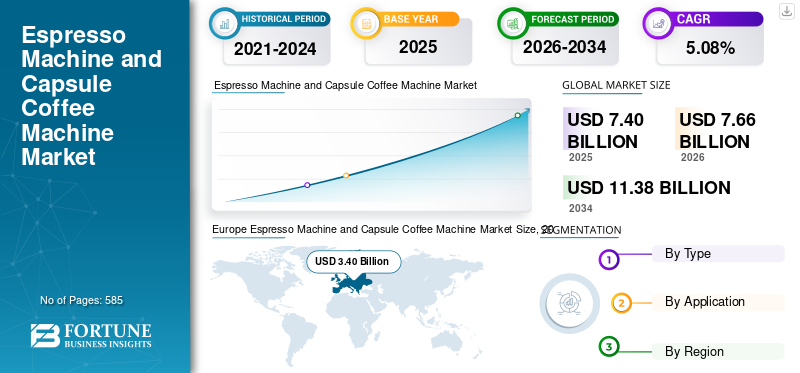
The global espresso machine and capsule coffee machine market size was valued at USD 7.40 billion in 2025. The market is projected to grow from USD 7.66 billion in 2026 to USD 11.38 billion by 2034, exhibiting a CAGR of 5.08% during the forecast period. Europe dominated the espresso machine and capsule coffee machine market with a market share of 45.94% in 2025.
Espresso machines allow users to craft high-quality, concentrated coffee, lattes, and cappuccinos with added high-pressure extracts of rich flavors and creams. Machines featuring eco-conscious capsule designs, hybrid multi-pod systems, and centrifugal barcode extraction are increasingly popular among at-home coffee brewers and foodservice outlets. To meet consumer demand, manufacturers produce machines made of recycled and sustainable materials and avoid using single-use aluminum and plastic pods, which increase the environmental footprint during production. The manufacturers’ implementation of sustainable production measures is positively contributing to the global market expansion.
- For instance, in October 2024, Quality Espresso, a Barcelona, Spain-based manufacturer, launched the traditional espresso coffee machine Gaggia La Vetro and the premium version, Gaggia La Vetro Pro. These machines are made of energy-efficient models, eco-friendly boilers, and sustainable recycled parts & packaging.
Key companies in the global market include De’Longhi S.p.A., Nestlé S.A., Keurig Dr. Pepper Inc., Breville Group Limited, and WMF Group.
Download Free sample to learn more about this report.
Espresso Machine and Capsule Coffee Machine Market KEY TAKEAWAYS
 Global Market Size & Forecast
- 2025 Market Size: USD 7.40 billion
- 2026 Market Size: USD 7.66 billion
- 2034 Forecast Market Size: USD 11.38 billion
- CAGR: 5.08% during 2026–2034
 Market Share
- Europe dominated the global market with a 45.94% share in 2025, supported by strong coffee culture.
- Espresso Machines held the leading market share in 2025.
- Residential/Household accounted for the largest application share of 39.09% in 2025.
 Key Regional Highlights
Europe
Dominated the market with a valuation of USD 3.40 billion in 2025, representing approximately 45.97% of global sales.
North America
Held the second-largest market share of 26.34% in 2025 and is projected to grow at a 4.08% CAGR.
Asia Pacific
Held an 18.95% share in 2025 and is projected to register the fastest growth at a 7.29% CAGR.
U.S.
The market reached USD 1.34 billion in 2025, accounting for approximately 18.05% of global sales.
Japan
The market reached approximately USD 0.28 billion in 2025, accounting for around 3.73%.
Read More

ESPRESSO MACHINE AND CAPSULE COFFEE MACHINE MARKET TRENDS
Surging Popularity of Compact Urban Coffee Machines to Favor Industry Growth
Urban consumers prefer portable, compact, lightweight, touchscreen-based smart coffee machines for installation in their modular kitchens and multifunctional living spaces. The growing popularity of compact appliances is driving global market growth. In addition, consistent manufacturers’ launches of compact machines equipped with integrated grinders, milk systems, vertical machine designs, removable water tanks, and touchscreen interfaces, elevating users’ coffee-brewing experiences, are driving the demand for such products.
MARKET DYNAMICS
MARKET DRIVERS
Download Free sample to learn more about this report.
Growing At-Home Coffee Consumption and Work-From-Home Culture to Accelerate Product Sales
The increasing adoption of remote and hybrid work arrangements is encouraging consumers to produce coffee beverages that feel fresh throughout the workday. According to the National Coffee Association (NCA), as of 2025, around 71% of American coffee drinkers prepared coffee exclusively at home. The emerging remote-working trend is driving product demand across many countries. In addition, the rising adoption of smart kitchen appliances is driving the demand for connected, technology-based coffee machines featuring programmable home brewing and app-controlled features, thereby driving the global espresso machine and capsule coffee machine market growth.
MARKET RESTRAINTS
High Upfront Cost of Fully Automatic and Premium Espresso Machines to Restrain Market Growth
Premium espresso machines are usually sold at higher prices as they feature automatic grinders, touchscreen interfaces, milk frothing systems, and smart connectivity features. Higher product prices are limiting the demand among price-sensitive at-home consumers. In addition, the high costs of repairing and maintaining such machines are restraining the adoption rate of the product across price-sensitive consumer markets.
MARKET OPPORTUNITIES
Emerging Strategic Brand Partnerships are Creating New Market Growth Opportunities
Coffee machine manufacturers establish partnerships with specialty coffee brands and roasters to build compatibility and functionality across espresso and single-serve systems, and to offer premium coffee brews. In 2025, Nestle S.A.-owned premium coffee brand Nespresso partnered with Café Joyeux to expand its premium coffee experiences and deepen engagement within the premium coffee ecosystem. Furthermore, manufacturers establish partnerships with hospitality operators, offices, and co-working spaces to drive their commercial deployment of premium espresso machines and capsule coffee machine systems. These manufacturers’ efforts are creating newer market growth prospects.
MARKET CHALLENGES
Increasing Cost of Raw Materials and Components and Rising Inflationary Pressure to Challenge Key Players’ Business Profitability
The increasing cost of raw materials and components used in coffee machines, including metals, plastics, electronic components, pumps & heating systems, grinders, sensors, and others, may negatively impact manufacturers’ business profitability. In addition, price volatility in packaging materials, transportation, energy, and other inputs is hampering companies’ profit margins and posing challenges to the global industry growth. The increasing inflationary pressures and reduced consumer spending on premium products are also hampering the growth in product sales across many countries.
Segmentation Analysis
By Type
Greater Preference for Café-style Beverages Led to Dominance of Espresso Machines Segment in 2025
By type, the market is bifurcated into espresso machines and capsule coffee machines.
The espresso machines segment accounted for a leading espresso machine and capsule coffee machine market share in 2025. The segment is projected to grow at a rate of 4.77% from 2026 to 2034. The greater consumer preference for café-style beverages, including espresso, cappuccino, latte, flat white, and macchiato, which require the extensive use of espresso machines, is generating considerable revenue for the market. In addition, advancements in the development of fully automatic espresso machines with customizable beverage extraction options and better control over grind size, milk frothing, temperature, and cup quality are positively contributing to the segment growth.
The espresso machines segment is further bifurcated into residential and commercial. The residential sub-segment held a leading share in the espresso machines segment in 2025. A significant number of at-home consumers invest in compact coffee machines to prepare their coffee drinks, including lattes and cappuccinos, generating considerable revenue from the residential segment. In addition, the expanding number of small housing facilities seeking premium espresso machines for daily use is driving the segment’s growth.
The commercial sub-segment within the espresso machines segment is poised to expand at a CAGR of 5.35% from 2026 to 2034. The expanding infrastructure of cafes, restaurants, and foodservice outlets seeking instant coffee brewers for quick coffee service is accelerating the sub-segment growth.
Each of the residential and commercial segments is further bifurcated into automatic and semi-automatic segments. Across both residential and commercial end-use sectors, the automatic segment is anticipated to maintain a leading market share throughout 2026-2034. The rising demand for innovative, fully automatic machines equipped with advanced multi-milk texturing systems and IoT-based maintenance monitoring is positively contributing to the segment’s revenue growth. The semi-automatic segment is mainly driven by the rising consumer demand for coffee machines with an adjustable manual milk texturing system and budget-friendly product options.
To know how our report can help streamline your business, Speak to Analyst
The capsule coffee machines segment is projected to grow at the fastest rate of 5.56% from 2026 to 2034. The rising consumer demand for coffee capsule machines, delivering beverage-making speed and consistency, compared to espresso machines, is driving the segment’s growth. The capsule coffee machines segment is further divided into closed-system capsule machines, open-system capsule machines, multi-beverage capsule machines, and commercial capsule coffee machines.
Within the capsule coffee machine segment, the closed-system capsule machines sub-segment held a leading market share of 43.25% in 2025. The segment’s leading share is attributed to a significant consumer shift toward closed-system capsule machines for greater convenience and premium home-café experiences. The commercial capsule coffee machines segment is projected to grow at the fastest CAGR of 6.80% from 2026 to 2034. The increasing official requirements for installing capsule machines with premium coffee menus and a single-button brewing system are driving the segment growth.
By Application
Residential/Household Segment Dominated the Market Owing to At-home Consumer Investments in Coffee Machines
Based on application, the market is divided into residential/household, HoReCa, offices/workplaces coffee solutions, convenience retail/vending environments, and specialty coffee shops.
The residential/household segment exhibited a leading market share of 39.09% in 2025. The segment is projected to maintain its leading position during the forecast period. Significant at-home consumer investment in espresso machines, capsule systems, bean-to-cup machines, and compact premium coffee appliances to create café-style beverages such as espresso, cappuccino, latte, flat white, and iced coffee is generating considerable revenue from the residential/household segment. In addition, the growing number of residential settings replacing their existing basic drip coffee makers with higher-value espresso and capsule platforms to improve taste, convenience, and personalization is driving the segment’s growth.
The offices/workplaces coffee solutions segment is projected to grow at the fastest CAGR of 6.02% over 2026-2034. The increasing employers’ focus on improving their employees’ convenience, workplace experience, productivity, and in-office amenities is driving the demand for instant coffee brewing machines, favoring the segment’s revenue growth.
Espresso Machine and Capsule Coffee Machine Market Regional Outlook
By region, the market is categorized into North America, Europe, Asia Pacific, South America, and the Middle East & Africa.
Europe
Europe Espresso Machine and Capsule Coffee Machine Market Size, 2025 (USD Billion)
To get more information on the regional analysis of this market, Download Free sample
The European region is expected to maintain its leading market position during the forecast period (2026-2034). The European market size reached USD 3.40 billion in 2025, accounting for approximately 45.97% of global product sales. The regional market is projected to grow at a CAGR of 4.46% during 2026-2034. An increasing number of international travelers seeking luxury hospitality and cafeteria services requiring facilities to install innovative touchscreen display-based coffee brewing machines is driving the growth of the European market. According to the European Union (EU), in 2025, the number of nights spent in tourist accommodation by international travelers in Europe reached 3.1 billion, up 2.2% from the previous year. In addition, a deep coffee-drinking tradition, a strong coffee culture, and robust adoption of innovative kitchen appliances are generating significant product revenues across the region.
U.K. Espresso Machine and Capsule Coffee Machine Market
The U.K. market reached a value of around USD 0.57 billion in 2025, representing approximately 7.75% of global sales.
Germany Espresso Machine and Capsule Coffee Machine Market
The Germany market reached approximately USD 0.67 billion in 2025, equivalent to around 9.06% of global sales.
North America
The North America region held the second-largest market share of 26.34% in 2025. The region’s market is expected to maintain a similar position and grow at a CAGR of 4.08% during 2026-2034. The North American market size is estimated to reach USD 2.00 billion by 2026. The growing number of at-home consumers upgrading their existing products with innovative machines equipped with automatic milk frothing, built-in grinders, touchscreen controls, cold coffee options, and connected features is driving product revenues across the region. In addition, the rising number of manufacturers establishing partnerships with hospitality settings, offices, and coffee vending shops to distribute their products is favoring product sales across Canada and Mexico.
U.S. Espresso Machine and Capsule Coffee Machine Market
The U.S. market size reached USD 1.34 billion in 2025, accounting for around 18.05% of the global sales in 2025. Significant at-home coffee brewing trends and the broader adoption of single-serve pods and capsule formats are generating considerable product revenues across the U.S.
Asia Pacific
The Asia Pacific market is projected to grow at the fastest rate of 7.29% from 2026 to 2034. The region held a third-leading market share of 18.95% and a market size of USD 1.40 billion in 2025. Expanding commercial coffee chains and hospitality settings seeking advanced technology-based products are driving the regional market growth. In addition, government assistance in building residential infrastructure, coupled with emerging kitchen renovation trends, is driving the demand for newer coffee machines, favoring the market expansion in the region.
China Espresso Machine and Capsule Coffee Machine Market
The China market is projected to be one of the largest in the Asia Pacific, with revenues of around USD 0.40 billion in 2025, representing roughly 5.47% of global product sales. The rising consumer demand for cafe style beverages at home is driving the adoption of premium espresso and capsule coffee machines across China.
India Espresso Machine and Capsule Coffee Machine Market
The India market stood at a value of around USD 0.19 billion in 2025, accounting for roughly 2.60% of global market revenues. The increasing demand for high quality coffee beverages is a key factor driving the market growth.
Japan Espresso Machine and Capsule Coffee Machine Market
The Japan market stood at a value of around USD 0.28 billion in 2025, accounting for roughly 3.73% of global revenues.
South America and the Middle East & Africa
The South America and the Middle East & Africa markets are expected to grow at a moderate pace from 2026 to 2034. The South America market reached a valuation of USD 0.39 billion in 2025. The growing number of millennials and Gen-Z consumers seeking customizable machines that allow control over grind size, pressure, and milk texturing is driving South American market growth. Consistent governmental investments in developing household and commercial infrastructure are expected to drive product adoption rates, favoring market growth across the Middle East & Africa region. In the Middle East & Africa, the UAE reached a valuation of USD 0.076 billion in 2025.
South Africa Espresso Machine and Capsule Coffee Machine Market
The South Africa market reached approximately USD 0.061 billion in 2025, accounting for roughly 0.83% of global market revenues.
COMPETITIVE LANDSCAPE
Key Industry Players
Launch of Innovative Products and Customer Base Expansion to Help Key Players Maintain Market Position
The key players operating in the global market are De’Longhi S.p.A., Nestlé S.A., Keurig Dr. Pepper Inc., Breville Group Limited, and WMF Group. These players focus on launching innovative display- and app-connected coffee machines and capsule coffee formats to broaden their product portfolios worldwide. In addition, they establish partnerships with hospitality settings, cafes, offices, and retail environments to provide product demonstrations and drive their B2B sales.
LIST OF KEY ESPRESSO MACHINE AND CAPSULE COFFEE MACHINE COMPANIES PROFILED
- Rancilio Group S.p.A. (Italy)
- Gruppo Cimbali S.p.A. (Italy)
- Nuova Simonelli S.p.A. (Italy)
- WMF GmbH (Germany)
- Franke Coffee Systems (Switzerland)
- Schaerer AG (Switzerland)
- BUNN-O-Matic Corporation (U.S.)
- Lavazza Group (Italy)
- Eversys S.A. (Switzerland)
- Illycaffè S.p.A. (Italy)
- Thermoplan AG (Switzerland)
- Breville Group Limited (Australia)
- Nestlé Nespresso SA (Switzerland)
- Keurig Dr. Pepper (U.S.)
- Koninklijke Philips N.V. (Netherlands)
- JURA Elektroapparate AG (Switzerland)
- BSH Hausgeräte GmbH (Germany)
- Terra Kaffe (U.S.)
- Melitta Group (Germany)
- Smeg S.p.A. (Italy)
- De’Longhi Appliances S.r.l. (Italy)
KEY INDUSTRY DEVELOPMENTS
- May 2026: NIBE Industrier AB acquired Italian Beltrami Felice S.r.l., a manufacturer of heating solutions for commercial coffee machines, to strengthen its position in the premium commercial coffee machine market.
- May 2026: Thyme&Table, a manufacturer of high-performance homeware, launched a fully automatic espresso machine that efficiently prepares café-quality coffee at home.
- April 2026: De’Longhi launched PrimaDonna Aromatic, a premium, fully automatic espresso machine for home use. The machine is designed to make café-style hot and iced coffee drinks with minimal manual effort.
- March 2026: Ali Group acquired BUNN, a global machine manufacturer, to broaden its position across the global coffee and beverage equipment sector.
- November 2025: Cup&Cino Group, a German manufacturer, acquired Tone, a Switzerland-based manufacturer of boiler-less brewing equipment, to strengthen its global reach in production and distribution channels.
REPORT COVERAGE
The global espresso machine and capsule coffee machine market analysis provides an in-depth study of market insights, size, and forecast by business model and all other segmentation bases included in the report. In addition, the report provides details on the market outlook, market dynamics, and trends expected to drive the market during the forecast period. The market report also includes information on technological advancements, new product launches, key industry developments, partnerships, mergers, and acquisitions. The market research report also includes a detailed competitive landscape, with market share and profiles of key players.
Request for Customization to gain extensive market insights.
Report Scope & Segmentation
| ATTRIBUTE | DETAILS |
| Study Period | 2021-2034 |
| Base Year | 2025 |
| Estimated Year | 2026 |
| Forecast Period | 2026-2034 |
| Historical Period | 2021-2024 |
| Growth Rate | CAGR of 5.08% from 2026 to 2034 |
| Unit | Value (USD Billion) |
| Segmentation | By Type, Application, and Region |
| By Type |
|
| By Application |
|
| By Region |
|
Frequently Asked Questions
Fortune Business Insights says that the global market value stood at USD 7.40 billion in 2025 and is projected to reach USD 11.38 billion by 2034.
In 2025, the Europe market value stood at USD 3.40 billion.
The global market is poised to grow at a CAGR of 5.08% over 2026 to 2034.
By type, the espresso machines segment held the leading market share in 2025.
The growing at-home coffee consumption and emerging work-from-home culture are key factors driving the market.
De’Longhi S.p.A., Nestlé S.A., Keurig Dr. Pepper Inc., Breville Group Limited, and WMF Group are the leading players operating in the market.
Europe dominated the market in 2025.
The emerging strategic brand partnerships are expected to create new market growth opportunities.



- 2021-2034
- 2025
- 2021-2024
- 585
-
(Offer valid till 15th Oct 2026)
Get 30-60 hrs Free Customization
Expand Regional and Country Coverage, Segments Analysis, Company Profiles, Competitive Benchmarking, and End-user Insights.


















Related Reports
-
US +1 833 909 2966 ( Toll Free )
-
Get In Touch With Us