EV Charging-as-a-Service Market Size, Share & Industry Analysis, By Service Type (Public Charging Services, Fleet Charging Services, Residential Charging Services, Workplace Charging Services, and Highway Charging Services), By Charging Type (AC Charging, DC Fast Charging, Ultra-fast Charging, Wireless Charging, and Battery Swapping), By Business Model (Subscription-based Services, Pay-per-use Services, Leasing Services, Managed Charging Services, and Energy-as-a-Service), By Vehicle Type (Passenger Cars and Commercial Vehicles), and Regional Forecast, 2026-2034
 Download Free Sample
(Offer valid till 30th Sep 2026)

EV Charging-as-a-Service Market Size and Future Outlook
 Listen to Audio Version
The global EV charging-as-a-service market size was valued at USD 4.96 billion in 2025 and is projected to grow from USD 5.84 billion in 2026 to USD 27.42 billion by 2034, exhibiting a CAGR of 21.3% during the forecast period. Asia Pacific dominated the EV charging-as-a-service market with a market share of 44.15% in 2025.
EV charging-as-a-service (CaaS) is a subscription- or usage-based model providing EV charging infrastructure, charging solutions, software, maintenance, and energy management services without high upfront costs for EV drivers and businesses. The market growth is driven by increasing electric vehicle adoption, expansion of charging networks, rising public charging demand, government incentives, fast charging deployment, renewable energy integration, and growing investments by charge point operators globally.
Major players in the global market include ChargePoint Holdings, ABB Ltd., Siemens AG, Shell Recharge Solutions, EVgo Services LLC, and Blink Charging. These players compete through smart charging technologies, fast charging networks, energy management platforms, subscription-based charging solutions, and AI-enabled digital integration.
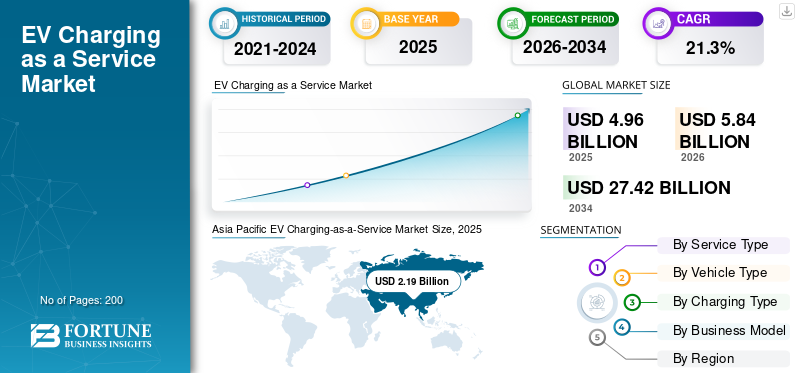
Download Free sample to learn more about this report.
EV CHARGING-AS-A-SERVICE MARKET KEY TAKEAWAYS
 Global Market Size & Forecast
- 2025 Market Size: USD 4.96 billion
- 2026 Market Size: USD 5.84 billion
- 2034 Forecast Market Size: USD 27.42 billion
- CAGR: 21.30% from 2026–2034
 Market Share
- Asia Pacific dominated the market with a 44.15% share in 2025.
- The Public Charging Services segment held the largest market share in 2025.
- The Passenger Cars segment held the largest market share in 2025.
 Key Regional Highlights
Asia Pacific
Dominated the market and is projected to witness the fastest growth, driven by strong EV adoption, expanding charging infrastructure, and government support.
Europe
Expected to grow at a 18.90% CAGR, supported by stringent emission regulations, public charging expansion, and sustainability initiatives.
North America
Growth is driven by rising EV sales, charging infrastructure modernization, and fleet electrification.
U.S.
The market is projected to reach USD 1.14 billion by 2026, accounting for 19.5% of global revenue.
Japan
The market is projected to reach USD 0.10 billion by 2026, accounting for 1.7% of global revenue.
Read More

EV CHARGING-AS-A-SERVICE MARKET TRENDS
Increasing Deployment of Smart Charging and Energy Management Solutions Emerges as a Key Market Trend
The integration of smart charging technologies and AI-enabled energy management platforms is becoming one of the major market trends. Companies are increasingly adopting intelligent charging solutions to optimize electricity consumption, balance grid loads, and reduce operational costs. Advanced software platforms provide real-time monitoring, predictive maintenance, dynamic pricing, and charging analytics for commercial and fleet applications. Renewable energy integration and vehicle-to-grid capabilities are also gaining traction across charging networks. These innovations improve charging efficiency, enhance user convenience, and support long term sustainability objectives, making smart charging systems a critical market trend globally.
- In May 2026, Driivz partnered with Dunamis Charge to accelerate U.S. EV charging infrastructure expansion through smart energy management platforms and AI-enabled charging optimization. The deal is also aimed at scalable Level-2 and DC fast-charging deployments across commercial, residential, fleet, and public charging station networks nationwide.
Expansion of Fast Charging Infrastructure and Ultra-Fast Chargers is a Significant Trend
The rapid deployment of fast charging and ultra-fast charging infrastructure is transforming the EV charging ecosystem worldwide. EV drivers increasingly demand shorter charging durations and improved charging accessibility for long-distance travel and commercial fleet operations. Charge point operators and energy companies are heavily investing in high-power charging stations across highways, urban corridors, and commercial hubs. Technological advancements in battery systems and charging hardware are further supporting fast charging compatibility. The expansion of public charging networks equipped with advanced fast chargers is improving customer confidence, strengthening EV adoption, and creating favorable conditions for global market expansion.
- In May 2026, BYD strengthened its European EV charging infrastructure presence by expanding dealership-based ultra-fast charging networks in Hungary. The move led to the introduction of flash charging technology capable of rapid battery charging and accelerating charging ecosystem expansion alongside rising electric vehicle sales and market growth across Europe.
MARKET DYNAMICS
MARKET DRIVERS
Download Free sample to learn more about this report.
Rising Electric Vehicle Adoption and Expanding Charging Networks to Accelerate Market Growth
The increasing adoption of electric vehicles globally is significantly driving the demand for EV charging-as-a-service solutions. Governments are promoting EV adoption through subsidies, emission regulations, and investments in charging infrastructure development. Expanding charging networks across highways, urban centers, workplaces, and residential areas are supporting convenient charging accessibility for EV drivers. Additionally, the growing collaboration between automakers, utilities, and charge point operators is accelerating installed EV charging capacity. Businesses and fleet operators are increasingly adopting scalable charging solutions to support operational electrification goals, further contributing to strong market growth during the forecast period.
Surging Commercial EV Fleet Electrification to Drive the Demand for Charging Solutions
The increasing electrification of commercial transportation fleets is creating substantial demand for charging services and solutions, propelling EV charging-as-a-service market growth. Logistics companies, ride-hailing operators, public transportation providers, and corporate mobility services are rapidly transitioning toward electric vehicles to reduce fuel expenses and carbon emissions. Fleet operators require scalable charging infrastructure, centralized energy management, and predictable operating costs, which CaaS models effectively provide. Subscription-based charging services help businesses avoid high upfront costs while ensuring operational efficiency. Additionally, government regulations encouraging commercial fleet decarbonization are accelerating investments in charging infrastructure deployment, significantly supporting long-term market growth across multiple industries.
- In May 2026, Amazon India partnered with Eicher Trucks to deploy 1,000 electric trucks by 2028. The move would help accelerate commercial fleet electrification and increase the demand for depot charging infrastructure, smart fleet energy management systems, and high-capacity EV charging networks across India’s logistics sector.
MARKET RESTRAINTS
High Infrastructure Deployment Costs and Grid Limitations May Restrain Market Expansion
Despite strong market demand, the high cost associated with deploying EV charging infrastructure remains a major restraint for the market. Establishing fast charging stations requires significant investments in equipment, land acquisition, grid upgrades, and maintenance systems. In several regions, inadequate power grid capacity and limited electrical infrastructure create operational challenges for large-scale charging deployment. Smaller businesses and developing economies often face financial constraints in implementing advanced charging solutions. Additionally, fluctuations in electricity prices and long approval processes for infrastructure installation can slow market penetration, limiting the pace of installed EV charging expansion globally.
MARKET OPPORTUNITIES
Increasing Renewable Energy Integration to Create Significant Market Opportunities
The growing integration of renewable energy sources with EV charging infrastructure is creating major opportunities in the market. Companies are increasingly deploying solar-powered charging stations, battery energy storage systems, and smart grid technologies to improve sustainability and reduce electricity costs. Renewable-powered charging solutions support corporate carbon neutrality goals and strengthen energy security for charging network operators. Governments and utility providers are also supporting clean energy-based charging initiatives through incentives and policy frameworks. This transition toward sustainable energy management is expected to create substantial long-term growth opportunities for charging solution providers worldwide.
- In December 2025, Exicom launched Exicom One, an end-to-end EV charging infrastructure deployment platform integrating installation, remote monitoring, predictive maintenance, and energy optimization capabilities. The platform supports faster charging network expansion, reduced operational costs, and scalable deployment of AC and DC fast-charging solutions across India.
Expansion of Subscription-Based and Managed Charging Services to Generate New Opportunities
The rising popularity of subscription-based and managed charging services is opening new revenue opportunities for market participants. Businesses and EV drivers increasingly prefer flexible payment models that reduce capital investment and simplify charging management. Managed charging services provide software integration, maintenance support, billing systems, and operational optimization under long-term service agreements. These solutions are particularly attractive for commercial fleets, workplaces, residential complexes, and public transportation operators. Additionally, digital platforms offering remote monitoring, automated scheduling, and predictive analytics are improving customer convenience and operational efficiency, creating strong opportunities for innovation and market expansion.
- In October 2025, Ionity launched annual subscription plans for public EV charging across Europe, offering fixed charging rates through its ultra-fast charging network. The move was aimed at improving pricing transparency, customer convenience, charging accessibility, and long-distance EV travel efficiency across 23 European countries.
MARKET CHALLENGES
Interoperability Issues across Charging Networks and Platforms to Create Market Challenges
The interoperability challenges between charging networks, vehicle platforms, and payment systems remain a significant obstacle for the market. Different charging standards, connector types, and software protocols vary across regions and manufacturers, limiting seamless charging experiences for EV drivers. Inconsistent network compatibility can reduce charging reliability and increase operational complexity for charge point operators. Additionally, integrating multiple hardware and software systems into unified charging solutions requires continuous technological upgrades and standardization efforts. Addressing cybersecurity concerns, data privacy risks, and cross-network communication barriers is becoming increasingly important for ensuring efficient and scalable market development.
Segmentation Analysis
By Service Type
Expanding Public Charging Networks and Rising EV Adoption to Boost Public Charging Services Segment Growth
Based on service type, the market is segmented into public charging services, fleet charging services, residential charging services, workplace charging services, and highway charging services.
The public charging services segment dominates the market due to the rapid expansion of public charging infrastructure and increasing electric vehicle adoption globally. Governments, utilities, and charge point operators are heavily investing in charging networks across urban areas, commercial hubs, and highways to improve charging accessibility for EV drivers. The rising deployment of fast charging stations, growing installed EV charging capacity, and increasing reliance on public charging for long-distance mobility continue to strengthen the demand for public charging services worldwide.
- In May 2026, the State of Maharashtra in India announced plans to establish around 200 EV charging stations under a public-private partnership model to support the electrification of the entire MSRTC bus fleet by 2035.
The residential charging services segment is projected to expand at a CAGR of 24.0% during the forecast period. Rising home EV adoption, increasing preference for convenient overnight charging, smart energy management integration, and government incentives supporting residential EV chargers are accelerating the demand for home-based charging solutions globally.
To know how our report can help streamline your business, Speak to Analyst
By Vehicle Type
Increasing Passenger EV Ownership to Propel Passenger Cars Segment Growth
Based on vehicle type, the market is segmented into passenger cars and commercial vehicles.
The passenger cars segment accounts for the largest market share. The expansion of the segment is due to the rapid growth of personal electric vehicle ownership worldwide. The rising consumer preference for sustainable mobility, expanding public charging infrastructure, and supportive government incentives are accelerating passenger EV adoption. The increasing deployment of residential charging solutions, workplace charging services, and urban charging networks is further supporting charging accessibility for daily commuting needs. Additionally, rising investments in fast charging stations and smart charging technologies continue to strengthen the charging demand from passenger vehicle users globally.
The commercial vehicles segment is anticipated to surge at a CAGR of 22.8% during the forecast period. The growing electrification of logistics fleets, public transportation systems, and last-mile delivery vehicles is increasing the demand for scalable charging solutions, fleet charging services, energy management platforms, and high-capacity fast charging infrastructure.
By Charging Type
Expanding AC Charging Infrastructure and Increasing Daily EV Usage to Propel AC Charging Segment Growth
Based on charging type, the market is segmented into AC charging, DC fast charging, ultra-fast charging, wireless charging, and battery swapping.
The AC charging segment holds a dominant EV charging-as-a-service market share due to its widespread deployment across residential, workplace, and public charging applications. AC charging solutions are cost-effective, easier to install, and highly suitable for the overnight and long-duration charging requirements of passenger electric vehicles. The increasing adoption of home charging systems, expanding urban charging networks, and supportive government initiatives promoting installed EV charging infrastructure are driving product demand. Additionally, lower infrastructure costs and compatibility with existing electrical systems continue to support large-scale AC charger deployment globally.
The ultra-fast charging segment is projected to expand at a CAGR of 23.1% during the forecast period. The rising demand for reduced charging time, increasing highway charging infrastructure investments, expanding commercial EV fleet operations, and growing deployment of high-power fast chargers are accelerating the adoption of ultra-fast charging solutions worldwide.
- In September 2025, Tata Power and Tata Passenger Electric Mobility Ltd. inaugurated India’s largest TATA.ev MegaCharger hub in Mumbai with 16 fast-charging bays and charging speeds of up to 120 kW.
By Business Model
Increasing Public Charging Adoption and Flexible Payment Models to Drive Pay-per-use Services Segment Growth
Based on business model, the market is segmented into subscription-based services, pay-per-use services, leasing services, managed charging services, and energy-as-a-service.
The pay-per-use services segment holds the largest share in the market due to its flexibility, convenience, and widespread adoption among public charging users. EV drivers increasingly prefer usage-based charging payments that eliminate long-term commitments and provide easy access to diverse charging networks. The growing deployment of public charging stations, expanding fast charging infrastructure, and increasing interoperability between charging platforms are further strengthening segmental expansion. Additionally, rising urban EV adoption and increasing participation of charge point operators are supporting the rapid expansion of pay-per-use charging solutions globally.
The energy-as-a-service segment is projected to expand at a CAGR of 26.3% during the forecast period. The increasing integration of renewable energy, smart grid technologies, battery storage systems, and AI-based energy management platforms is accelerating the demand for scalable and sustainable energy-focused charging solutions worldwide.
- In June 2023, SolarEdge launched a solar-attached EV charging management solution for commercial and industrial applications. The solution integrates AI-based energy management, solar generation, battery storage, and dynamic load balancing to optimize EV charging infrastructure efficiency across workplaces, apartment buildings, and public charging locations.
EV Charging-as-a-Service Market Regional Outlook
By geography, the market is categorized into Europe, North America, Asia Pacific, South America, and the Middle East & Africa.
Asia Pacific
Asia Pacific EV Charging-as-a-Service Market Size, 2025 (USD Billion)
To get more information on the regional analysis of this market, Download Free sample
Asia Pacific accounts for the largest market share and is projected to witness the fastest growth in the global market. Strong electric vehicle adoption across China, Japan, South Korea, and India is driving substantial investments in EV charging infrastructure and charging networks. Governments are aggressively supporting public charging deployment through subsidies, policy incentives, and clean mobility initiatives. Rapid urbanization, expansion of commercial EV fleets, increasing fast charging installations, and rising investments by charge point operators are further accelerating product demand. The growing renewable energy integration and smart charging technologies also strengthen long-term regional market expansion.
- In April 2024, Hubject launched its Plug&Charge technology across the Asia Pacific region, enabling seamless EV charging authentication and billing through ISO 15118 standards. The move would also help the expansion of its global eRoaming network to support interoperable, secure, and user-friendly charging infrastructure for EV drivers.
China EV Charging-as-a-Service Market
The China market is estimated to touch around USD 1.99 billion in 2026, accounting for roughly 34.1% of the global market revenues. The strong EV adoption, expanding charging networks, ultra-fast charging deployment, government subsidies, and rising commercial fleet electrification continue driving rapid market growth across the country.
Japan EV Charging-as-a-Service Market
The Japan market is estimated to touch a value of around USD 0.10 billion in 2026, accounting for roughly 1.7% of global market revenues. The increasing smart charging adoption, renewable energy integration, urban EV infrastructure expansion, and growing investments in public charging solutions support stable long-term market development.
India EV Charging-as-a-Service Market
The India market is anticipated to reach around USD 0.15 billion in 2026, accounting for roughly 2.5% of global market revenues. The rising electric vehicle adoption, government infrastructure programs, expanding fast charging stations, and increasing private sector investments are accelerating strong market growth across the country.
Europe
Europe holds the second largest market share and is expected to expand at a CAGR of 18.9% during the forecast period. Stringent emission regulations, strong sustainability targets, and increasing electric vehicle adoption are driving the demand for EV charging solutions across the region. Countries including Germany, the U.K., France, and the Netherlands are heavily investing in public charging infrastructure and ultra-fast charging corridors. The growing deployment of workplace charging, increasing commercial fleet electrification, and rising renewable energy-powered charging stations are supporting market growth. Additionally, advanced energy management systems and government-backed green mobility programs continue to accelerate regional market development.
- In May 2026, Cyprus deployed 11 fast EV charging stations across major hospitals, transport hubs, tourist sites, and urban locations nationwide, strengthening public charging infrastructure. The move is aimed at improving charging network connectivity, and supporting the country’s long-term transition toward sustainable electric mobility solutions.
Germany EV Charging-as-a-Service Market
The Germany market is estimated to touch a value of around USD 0.25 billion in 2026, accounting for roughly 4.3% of the global market revenues. Strong sustainability policies, widespread EV adoption, public charging expansion, and advanced energy management integration continue supporting steady market demand and infrastructure investments.
U.K. EV Charging-as-a-Service Market
The U.K. market is estimated to reach around USD 0.23 billion in 2026, accounting for roughly 3.9% of the global market revenues. The increasing deployment of public charging stations, rising EV ownership, smart charging technologies, and supportive government decarbonization initiatives are fueling market expansion across the country.
North America
North America represents the third-largest market due to rising electric vehicle sales and increasing investments in charging infrastructure modernization. The U.S. and Canada are witnessing a strong deployment of fast charging stations across highways, urban centers, and commercial facilities. Increasing partnerships between automakers, utilities, and charge point operators are improving charging accessibility and network scalability. The growing adoption of fleet charging services, supportive federal funding programs, and rising consumer preference for sustainable transportation are further driving market growth. Technological advancements in AI-based charging management platforms also contribute to regional expansion.
- In May 2026, Kempower and Blink Charging announced a 14-site EV charging expansion across the U.S. East Coast, deploying DC fast chargers in high-traffic locations to strengthen charging infrastructure reliability. The move is also aimed at improving EV accessibility and supporting growing electric vehicle adoption and public charging demand.
U.S. EV Charging-as-a-Service Market
The U.S. market is estimated to reach a value of around USD 1.14 billion in 2026, accounting for roughly 19.5% of the global market revenues. Expanding fast charging infrastructure, rising fleet electrification, federal clean transportation funding, and strong investments from charge point operators continue to accelerate the market growth in the country.
South America
South America accounts for the fourth largest share in the market, supported by the gradual electric vehicle adoption and expanding charging infrastructure investments. Countries such as Brazil, Chile, and Colombia are increasing investments in public transportation electrification and urban charging networks. Rising fuel costs and growing awareness regarding sustainable mobility are encouraging the demand for EV charging solutions across commercial and residential sectors. Governments are also introducing supportive regulations and incentives for clean transportation initiatives. Additionally, increasing partnerships between utilities and charging service providers are supporting the expansion of installed EV charging infrastructure across the region.
- In September 2025, the Government of Brazil expanded its EV charging network by 14% to nearly 17,000 charging points, supporting rising electric vehicle adoption. The move would help improve public charging accessibility and strengthen national charging infrastructure amid the growing demand for sustainable transportation and energy transition initiatives.
Middle East & Africa
The Middle East & Africa is a gradually emerging regional market due to increasing investments in sustainable transportation infrastructure and smart city development projects. Countries including the UAE, Saudi Arabia, and South Africa are expanding EV charging stations to support clean energy transition goals and electric mobility adoption. The growing tourism activities, urban infrastructure modernization, and government sustainability initiatives are supporting public charging deployment across major cities and highways. Additionally, the rising interest in renewable energy integration and energy management solutions is creating new opportunities for charging service providers across the regional market.
- In April 2026, Dubai’s IACAD partnered with UAEV to deploy smart EV charging infrastructure across mosque parking areas, supporting sustainable mobility, and expanding public charging accessibility. The move aimed at integrating advanced energy management technologies and strengthening Dubai’s long-term clean transportation and smart infrastructure development goals.
COMPETITIVE LANDSCAPE
Key Industry Players
Smart Charging Technologies, Fast Charging Expansion, and Energy Management Integration Define Competitive Landscape
The global EV charging-as-a-service market is moderately fragmented, with competition driven by charging infrastructure expansion, smart charging technologies, and integrated energy management solutions. Major companies, including ChargePoint Holdings, ABB Ltd., Siemens AG, Shell Recharge Solutions, EVgo Services LLC, and Blink Charging, compete through fast charging deployment, subscription-based charging platforms, and AI-enabled charging network management. Companies are increasingly focusing on renewable energy integration, cloud-based charging analytics, and fleet charging optimization services. Strategic partnerships with automakers, utilities, and charge point operators are strengthening regional expansion and improving long-term charging accessibility across the global market.
- In May 2026, ABB E-mobility launched the OM X-Series megawatt-scale EV charging system, designed for transit depots, logistics hubs, and public charging corridors. The solution features liquid-cooled fast charging architecture, advanced energy efficiency, battery storage integration, and scalable infrastructure supporting high-duty commercial fleet electrification.
LIST OF KEY EV CHARGING-AS-A-SERVICE COMPANIES PROFILED
- ChargePoint Holdings, Inc. (U.S.)
- ABB Ltd. (Switzerland)
- Siemens AG (Germany)
- Shell Recharge Solutions (U.S.)
- EVgo Services LLC (U.S.)
- Blink Charging Co. (U.S.)
- Tesla, Inc. (U.S.)
- bp pulse (U.K.)
- Eaton Corporation plc (Ireland)
- Schneider Electric SE (France)
- Tritium DCFC Limited (Australia)
- Wallbox N.V. (Spain)
- Enel X Way S.r.l. (Italy)
- Allego N.V. (Netherlands)
- Delta Electronics, Inc. (Taiwan)
KEY INDUSTRY DEVELOPMENTS
- May 2026: Jio-bp partnered with UPSRTC to deploy fast EV charging infrastructure for over 100 electric buses across Uttar Pradesh and Delhi in India. The move was aimed at strengthening commercial fleet electrification, expanding public charging networks, and supporting efficient electric mobility operations across multiple urban transport clusters.
- May 2026: PositivEnergy partnered with the City of Philadelphia to deploy approximately 435 DC fast charging and Level 2 charging ports. The partnership would help expand public EV charging accessibility, strengthening urban charging infrastructure and supporting reliable, large-scale electric mobility adoption across the city.
- May 2026: Loop Global completed a 64-port Level 2 EV charging installation at a multifamily residential development in Boston. The completion would expand residential charging infrastructure, supporting energy management capabilities and improving EV charging accessibility through utility-backed incentives and large-scale smart charging deployment.
- May 2026: Pod acquired EO Charging to strengthen its commercial fleet and depot charging capabilities, expanding smart charging, energy management, and fleet electrification services. The takeover would also support scalable EV charging infrastructure and flexible energy solutions across the U.K.’s growing electric mobility ecosystem.
- February 2026: Kiwi Charge launched an autonomous EV charging project backed by USD 1.7 million in funding to develop AI- and robotics-enabled mobile charging solutions. This move would support scalable EV charging infrastructure deployment for urban buildings, dealerships, and multi-tenant residential properties.
- December 2025: Duracell launched its first public EV charging site in the U.K. and announced an investment of approximately USD 270 million to expand ultra-fast charging infrastructure. The launch was aimed at strengthening public charging networks, improving EV accessibility, and accelerating long-term electric mobility growth across the country.
- November 2025: KEBA and EO Charging partnered to deploy large-scale AC and DC EV charging infrastructure for logistics and transport fleets across Europe. The deal would support fleet electrification through integrated charging solutions, energy management platforms, reliable depot charging, and scalable commercial EV charging networks.
REPORT COVERAGE
The global EV charging-as-a-service market analysis provides an in-depth study of the market size and forecast by all the market segments included in the report. It includes details on the market dynamics and trends expected to drive the market over the forecast period. It offers information on technological advancements, new product launches, key automotive industry developments, and details on partnerships, mergers, and acquisitions. The market report scope also encompasses a detailed competitive landscape with information on the market share and profiles of key operating players.
Request for Customization to gain extensive market insights.
Report Scope & Segmentation
| ATTRIBUTE | DETAILS |
| Study Period | 2021-2034 |
| Base Year | 2025 |
| Estimated Year | 2026 |
| Forecast Period | 2026-2034 |
| Historical Period | 2021-2024 |
| Growth Rate | CAGR of 21.3% from 2026-2034 |
| Unit | Value (USD Billion) |
| Segmentation | By Service Type, By Charging Type, By Business Model, By Vehicle Type, and By Region |
| By Service Type |
|
| By Vehicle Type |
|
| By Charging Type |
|
| By Business Model |
|
| By Region |
|
Frequently Asked Questions
Fortune Business Insights says that the global market value stood at USD 4.96 billion in 2025 and is projected to reach USD 27.42 billion by 2034.
In 2025, the Asia Pacific market value stood at USD 2.19 billion.
The market is expected to exhibit a CAGR of 21.3% during the forecast period of 2026-2034.
The public charging services segment leads the market by service type.
The public charging services segment leads the market by service type.
Major players in the global market include ChargePoint Holdings, ABB Ltd., Siemens AG, Shell Recharge Solutions, EVgo Services LLC, and Blink Charging.
Asia Pacific holds the largest share of the market.



- 2021-2034
- 2025
- 2021-2024
- 200
-
(Offer valid till 30th Sep 2026)
Get 30-60 hrs Free Customization
Expand Regional and Country Coverage, Segments Analysis, Company Profiles, Competitive Benchmarking, and End-user Insights.




















Related Reports
-
US +1 833 909 2966 ( Toll Free )
-
Get In Touch With Us