Expanded Polystyrene (EPS) Foam Packaging Market Size, Share & Industry Analysis, By Product Type (Sheets, Trays & Containers, Bags & Pouches, and Others), By End-use Industry (Automotive, Electricals & Electronics, Building & Construction, Healthcare, Food & Beverages, and Others), and Regional Forecast, 2026-2034
 Download Free Sample
(Offer valid till 15th Oct 2026)

Expanded Polystyrene Foam Packaging Market size and Industry overview
 Listen to Audio Version
The global expanded polystyrene (EPS) foam packaging market size was valued at USD 4.00 billion in 2025 and is projected to grow from USD 4.18 billion in 2026 to USD 6.48 billion by 2034, exhibiting a CAGR of 5.63% during the forecast period. Asia Pacific dominated the expanded polystyrene (EPS) foam packaging market with a market share of 34.89% in 2024.
Expanded polystyrene (EPS) foam packaging is a light and sturdy foam substance created from polystyrene beads that have been expanded using steam. It is commonly utilized for packaging due to its protective qualities, such as shock absorption and insulation, which make it perfect for the shipping and storage of delicate items. The rising production of expanded polystyrene material is a major contributor to the market growth.
- For instance, the Recycling Today Organization stated that in 2022, it was estimated that over 10 million metric tons of EPS were produced globally, with a major portion allocated to packaging (about 70% of total EPS consumption) and building materials (approximately 25%).
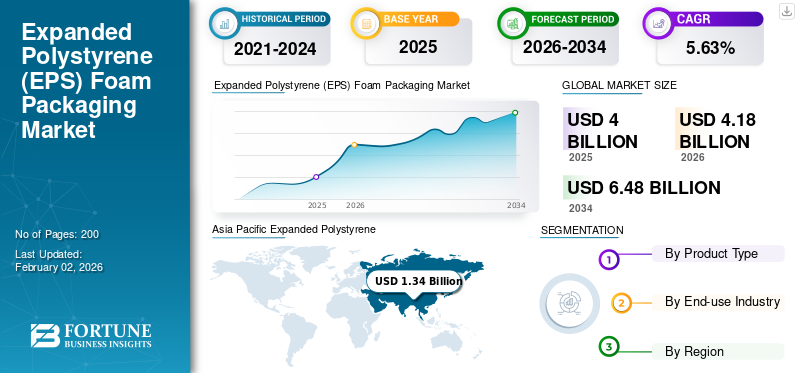
Download Free sample to learn more about this report.
Expanded Polystyrene (EPS) Foam Packaging Market KEY TAKEAWAYS
 Market Size & Forecast
- 2025 Market Size: USD 4.00 billion
- 2026 Market Size: USD 4.18 billion
- 2034 Forecast Market Size: USD 6.48 billion
- CAGR: 5.63% from 2026–2034
 Market Share
- Asia Pacific dominated the expanded polystyrene (EPS) foam packaging market with a 34.89% share in 2024.
- The sheets segment held the largest market share in 2024.
- The electrical & electronics segment dominated the market in 2024.
 Key Regional Highlights
Asia Pacific
Asia Pacific Strong EPS foam packaging demand driven by pharmaceuticals, food logistics, and high recycling rates across Japan, China, and South Korea.
North America
North America Second-largest market supported by strong food, beverage, and medical packaging demand and growing flexible packaging adoption.
Europe
Europe Recycling-driven EPS market growth supported by strong environmental regulations and expanding packaging sustainability initiatives.
U.S.
U.S. High demand from food, snack, beverage, and medical packaging segments driving EPS foam packaging usage.
Japan
Japan High EPS recycling rates and strong pharmaceutical and food packaging logistics supporting market leadership in the region.
Read More

MARKET DYNAMICS
MARKET DRIVERS
Remarkable Benefits Offered by EPS Foam Packaging Drives Market Growth
Expanded Polystyrene (EPS) foam packaging is a lightweight, rigid, and adaptable material commonly utilized to safeguard items during transit and storage. Its widespread use can be attributed to several reasons. Firstly, it delivers exceptional protective capabilities, offering strong shock absorption and the potential to be shaped uniquely for a snug fit around products, thus minimizing the chance of damage. Due to its very lightweight, EPS reduces shipping expenses while still being affordable to manufacture. Additionally, it delivers excellent thermal insulation, making it suitable for temperature-sensitive items such as food, pharmaceuticals, and frozen goods, particularly in cold chain logistics. Such potential benefits offered by the EPDS foam packaging drive the global expanded polystyrene (EPS) foam packaging market growth.
MARKET RESTRAINTS
Rising Environmental Concerns Hamper Market Growth
Expanded polystyrene (EPS) foam packaging, often referred to as Styrofoam, has a number of drawbacks despite being widely utilized. These drawbacks include its inability to decompose, the risk of causing environmental contamination, and health issues associated with styrene. Additionally, it is combustible and vulnerable to damage from UV radiation and rodent infestations. The environmental impact of EPS is significant. Although many assume it is biodegradable or recyclable, EPS is not environmentally friendly. It can decompose at elevated temperatures, but it contributes to the pollution of our planet with concerning amounts of microplastics, impacting both animals and humans. Henceforth, the rising environmental concerns regarding the use of expanded polystyrene foam packaging hamper the market growth.
MARKET OPPORTUNITIES
The Growing Electronics & Appliances Sector Will Offer Potential Growth Opportunities
The electronics & appliances sector is still growing due to increases in disposable income, urban development, the adoption of smart and connected products, the rise of e-commerce, and government initiatives favoring domestic manufacturing. The global market for consumer electronics is expected to expand at a rate ranging from mid-single to high-single digits during the forecast period. Home appliances are experiencing comparable consistent growth, particularly propelled by the Asia Pacific region’s strong performance. The growing electronics and appliances sector is propelling the demand for expanded polystyrene packaging. EPS foam packaging provides substantial advantages to the electronics and appliance sectors as it merges protection, cost effectiveness, and design flexibility—key factors for shipping delicate and valuable products. It thus offers potential growth opportunities.
EXPANDED POLYSTYRENE (EPS) FOAM PACKAGING MARKET TRENDS
Rising Recycling Rate of EPS and Initiatives by Government Bodies Emerges as a Key Trend
The recycling of EPS has gained traction as a way to lessen waste and minimize environmental damage. Public awareness regarding the environmental problems associated with EPS waste, particularly in oceans, has seen a notable increase. There has been a rising call from environmental groups, lawmakers, and consumers for sustainable replacements for EPS. Several consumers are focusing on sustainability and recyclable materials, thus motivating companies to look for ways to cut down their EPS use and enhance their recycling initiatives. As a result, it has become a significant trend in the market.
- According to the EPS Cycle Organization, in 2024, globally, 4.2 billion individuals across 34 nations can recycle EPS. This positions EPS as the third most recycled packaging material globally. This is an impressive milestone, especially when taking into account that EPS makes up less than 2% of all packaging materials produced.
Download Free sample to learn more about this report.
Segmentation Analysis
By Product Type
Rising Utilization of Sheets in Several Industries Boosts Segmental Growth
Based on product type, the market is divided into sheets, trays & containers, bags & pouches, and others.
Sheets are the dominating product type segment of the market. EPS (Expanded Polystyrene) foam sheets are adaptable materials utilized in numerous packaging applications owing to their lightweight, insulating, and protective characteristics. They are extensively employed in construction for insulation and filling voids, in packaging to safeguard products during shipping, and even in artistic projects. Its insulating qualities aid in preserving the temperature of food items, which makes it ideal for food packaging and transportation.
Trays and containers are the second-dominating segment of the market. EPS trays are used for growing and transporting seedlings. The trays offer several benefits, primarily due to their lightweight nature, excellent insulation, and shock absorption capabilities, making them popular for food packaging and other applications.
By End-use Industry
Significant Benefits of EPS Foam to Electronics Industry Fueled Segment’s Growth
Based on end-use industry, the market is segmented into automotive, electricals & electronics, building & construction, healthcare, food and beverages, and others.
The electrical and electronics segment dominated the global expanded polystyrene (EPS) market share in 2024. Expanded polystyrene (EPS) foam is a commonly utilized packaging material in the electronics sector due to its protective characteristics and light weight. It efficiently protects fragile electronic parts from harm during shipping, providing both shock resistance and thermal insulation. As a result, it is a favored option for packaging numerous electronic products, ranging from tiny components to large appliances. EPS can provide a level of thermal insulation, which may be crucial for specific electronic components that are vulnerable to changes in temperature.
On the other hand, the automotive segment is expected to witness steady growth during the forecast period. EPS is very efficient at absorbing impact forces, which makes it suitable for parts such as bumpers and side panels that safeguard occupants during accidents. It is also utilized in safety systems for crash testing, thus contributing to the segment’s expansion.
Expanded Polystyrene (EPS) Foam Packaging Market Regional Outlook
By geography, the market is categorized into North America, Europe, Asia Pacific, and the Rest of the World.
Asia Pacific
Asia Pacific Expanded Polystyrene (EPS) Foam Packaging Market Size, 2024 (USD Billion)
To get more information on the regional analysis of this market, Download Free sample
The Asia Pacific region dominates the global market. EPS foam packaging products are becoming increasingly popular in the region for the transportation of important pharmaceuticals, fresh food, and other valuable items. The rising recycling rate of EPS packaging in the region is a major contributor to the Asia Pacific expanded polystyrene (EPS) foam packaging market growth.
- According to the EPS Cycle Organization, in 2024, EPS achieved the benchmarks set by the United Nations Environmental Programme, with recycling rates surpassing 50% in Japan, China, and South Korea, 40% in Europe, and 30% in North America.
North America
North America is the second-largest market. Sustainable development offers the greatest potential within the expanded polystyrene foam packaging sector in the region. Moreover, the rapidly growing flexible packaging sector is also cushioning the market expansion. There is a rising demand for packaging designs in the U.S. that are convenient to transport, simple to open, resealable, and allow for portion control, particularly in the food, snack, and beverage categories, which in turn, drives demand for EPS foam packaging.
- According to the Flexible Packaging Association, flexible packaging ranks as the second largest segment in the U.S. packaging industry. The largest market for flexible packaging is food (both retail and institutional), representing roughly 50% of deliveries. Additional sectors for flexible packaging consist of pet food – 2%; personal care – 5%; beverages – 6%; other non-food items – 9%; industrial uses – 7%; consumer goods – 2%; and medical and pharmaceutical – 16%.
Europe
Europe is a significant market for expanded polystyrene (EPS) foam packaging. Government bodies and organizations' growing emphasis on decreasing the environmental impact and boosting packaging recycling drives market growth. The rising recycling initiatives in the EPS packaging are a key contributor to the rising demand, further boosting the market expansion.
- In a 2019 report published by EUMEPS, the Association for European Manufacturers of Expanded Polystyrene indicated that the recycling rate for EPS packaging in Europe was 38%, while construction-grade EPS had a recycling rate of 10%, leading to an overall recycling rate of 30%.
Latin America
The Latin America region is expected to observe considerable growth. An increasing number of companies in the region are implementing eco-friendly practices by utilizing recycled EPS or opting for alternative packaging options. Through collaborations with recycling initiatives, companies can contribute to the circular economy of EPS, making certain that the material is repurposed into new products rather than being discarded in landfills. It thus drives the market growth in Latin America.
Middle East & Africa
The Middle East and Africa region is expected to grow moderately in the coming years. Innovations in chemical recycling and emerging sorting technologies are presenting significant opportunities to enhance the effectiveness of EPS recycling in the region. Ongoing research and development in this field result in more scalable and economical approaches for managing contaminated EPS, thus contributing to the market expansion.
COMPETITIVE LANDSCAPE
Key Industry Players
Continuous Development and Introduction of New Products by Key Companies Resulted in Their Dominating Positions
The global expanded polystyrene (EPS) foam packaging market is concentrated with companies such as Atlas Foam Products, Koolfoam, Novapor Hans Lau GmbH & Co. KG, Schaumaplast, Engineered Foam Products Ltd., and Dart Container Corporation, accounting for a significant global expanded polystyrene (EPS) foam packaging market share.
Atlas Foam Products, based in Sylmar, California, is a provider of custom foam fabrication and protective cushioning solutions. They focus on a variety of foam materials, including polyurethane and polyethylene, and offer custom sizes and shapes to satisfy the needs of different clients. With more than 50 years of experience, they serve sectors such as aerospace, construction, entertainment, and the military, delivering innovative and efficient foam packaging solutions.
Schaumaplast Group is a producer focused on molded components and packaging created from particle foams such as EPS (Styropor, airpop) and EPP. Established in 1964, the company has expanded to feature several production facilities in Germany, Poland, and the U.S. They are recognized for their proficiency in cold chain packaging solutions, especially for temperature-sensitive pharmaceuticals and biotech products.
Additionally, BASF and DuPont are among the other prominent players in the market. Focus on significant investments in the research & development of innovative products has supported the cosmetic companies' share in the market and boosted the market expansion of glass cosmetics packaging.
- In March 2022, BASF broadened its range of graphitic expandable polystyrene (EPS) granulate. Neopor F 5 McycledTM incorporates 10 percent recycled content and is ideal for various building applications, especially for facade insulation. This new raw material is created through the extrusion process and provides the same reliable mechanical characteristics and enhanced insulation properties as Neopor F 5200 Plus.
LIST OF KEY EXPANDED POLYSTYRENE (EPS) FOAM PACKAGING COMPANIES PROFILED
- Atlas Foam Products (Spain)
- Koolfoam (Spain)
- Novapor Hans Lau GmbH & Co. KG (Spain)
- Schaumaplast (Spain)
- Engineered Foam Products Ltd (Spain)
- Dart Container Corporation (Spain)
- Index Packaging, Inc. (Spain)
- Romanow Container (Spain)
- Adherex Packaging (Spain)
- Omega Packaging Australia PTY. LTD (Spain)
- Conner Industries, Inc. (Spain)
- KB Foam Inc. (Spain)
- Michigan Foam Products LLC (Spain)
- DuPont (Spain)
- BASF SE (Spain)
KEY INDUSTRY DEVELOPMENTS
- January 2025: DGeo has teamed up with Lifoam Industries LLC, a division of Altor Solutions Inc., to deliver eco-friendly packaging solutions for the safe and compliant storage and transport of temperature-sensitive items. Lifoam’s BioEPS packaging serves as a sustainable substitute for conventional expanded polystyrene (EPS), commonly known as PS foam, which will break down in a bio-reactive landfill while maintaining the same level of convenience and performance.
- April 2025: USEON and TotalEnergies Corbion have formed a strategic alliance to promote the advancement and global commercialization of EPLA molded products — an innovative generation of sustainable, high-performance foam materials derived from Luminy PLA bioplastics.
- February 2024: Pregis, a producer of protective packaging solutions, has launched innovative protective foam packaging made from certified circular polyethylene resins. This initiative comes from Pregis' partnership with ExxonMobil, a company known for its advanced recycling technologies. Pregis stated that the increasing consumer demand for eco-friendly packaging alternatives prompted the creation of the foam packaging.
- February 2023: Cruz Foam, a company focused on circular materials, unveiled a groundbreaking new range of eco-friendly protective packaging solutions designed to address the particular requirements of shipping delicate and temperature-sensitive items for both consumers and businesses. The patented compostable foam developed by Cruz Foam surpasses comparable plastic-based products and meets or exceeds existing industry sustainability standards.
- April 2023: The U.S.-based company, Epsilyte, known for its advanced materials, launched 124LR, an EPS product containing at least 50% post-consumer recycled (PCR) content. The North American manufacturer of packaging materials states that 124LR is developed for moulded components that need a smooth finish and is specifically tailored for packaging purposes.
REPORT COVERAGE
The global expanded polystyrene (EPS) foam packaging industry analysis provides market size & forecast by all the segments included in the report. It details the market dynamics and expanded polystyrene (EPS) foam packaging market trends expected to drive the market during the forecast period. It offers information on the utilization of expanded polystyrene (EPS) foam packaging in key regions/countries, company profiles, industry developments, new product launches, and details on partnerships, mergers & acquisitions in key countries. It covers a detailed competitive landscape with information on the market share and profiles of key players.
Request for Customization to gain extensive market insights.
Report Scope & Segmentation
|
ATTRIBUTE |
DETAILS |
|
Study Period |
2021-2034 |
|
Base Year |
2025 |
|
Estimated Year |
2026 |
|
Forecast Period |
2026-2034 |
|
Historical Period |
2021-2024 |
|
Growth Rate |
CAGR of 5.63% from 2026-2034 |
|
Unit |
Value (USD Billion) |
|
Segmentation |
By Product Type
|
|
By End-use Industry
|
|
|
By Region
|
Frequently Asked Questions
Fortune Business Insights says that the global market value stood at USD 4.18 billion in 2026 and is projected to record a valuation of USD 6.48 billion by 2034.
In 2024, the market value stood at USD 1.34 billion.
The market is expected to grow at a CAGR of 5.63% during the forecast period.
The electrical and electronics segment led the market by end-use industry.
The key factor driving the market is the remarkable benefits offered by EPS foam packaging.
Atlas Foam Products, Koolfoam, Novapor Hans Lau GmbH & Co. KG, Schaumaplast, Engineered Foam Products Ltd., and Dart Container Corporation are the top players in the market.
Asia Pacific dominated the market in 2024.
Increased demand for the protection of automotive and electronic products is one of the factors that is expected to favor product adoption.



- 2021-2034
- 2025
- 2021-2024
- 200
-
(Offer valid till 15th Oct 2026)
Get 30-60 hrs Free Customization
Expand Regional and Country Coverage, Segments Analysis, Company Profiles, Competitive Benchmarking, and End-user Insights.












Related Reports
-
US +1 833 909 2966 ( Toll Free )
-
Get In Touch With Us