Experiential Retail Market Size, Share & Industry Analysis, By Experience Type (Immersive Store Experiences, Technology-enabled Retail Experiences, Pop-up Stores & Temporary Activations, In-store Events & Workshops, and Others), By Industry (Fashion & Apparel, Beauty & Personal Care, Consumer Electronics, Food & Beverage / Grocery Retail, and Others), By Store Format (Specialty Stores, Flagship Stores, Department Stores, Temporary Retail Spaces, and Others), and Regional Forecast, 2026-2034
 Download Free Sample
(Offer valid till 30th Sep 2026)

Experiential Retail Market Size and Future Outlook
 Listen to Audio Version
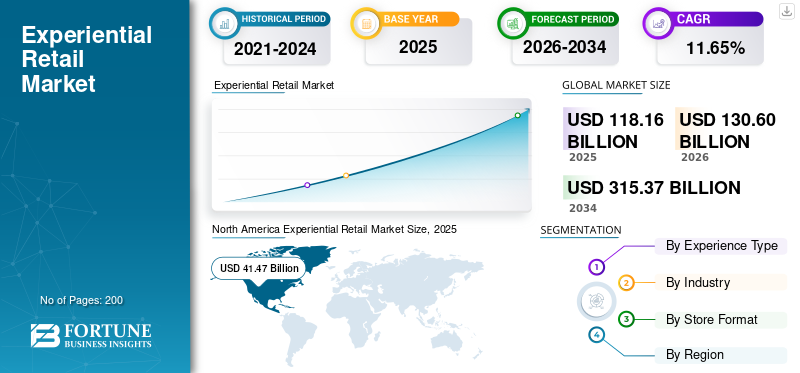
The global experiential retail market size was valued at USD 118.16 billion in 2025. The market is projected to grow from USD 130.60 billion in 2026 to USD 315.37 billion by 2034, exhibiting a CAGR of 11.65% during the forecast period. North America dominated the experiential retail market with a market share of 35.09% in 2025.
The experiential retail industry includes retail spaces designed to provide buyers with an engaging and captivating shopping experience. Experiential retail stores offer features such as interactive displays, personalized consultations, AR/VR tools (augmented reality and virtual reality), and product trials. Growing preference for personalized shopping boosts consumer interest in these stores as they offer a personalized and unique experience through expert guidance, trial zones, and consultation areas.
Prominent companies in the global market include Inter IKEA Systems B.V., Apple Inc., Nike, Inc., Samsung Electronics Co., Ltd., and Dyson Ltd.
Download Free sample to learn more about this report.
EXPERIENTIAL RETAIL MARKET TRENDS
Focus on Technology-Enabled Stores to Favor Market Growth
Companies across countries are adopting digital tools to make customers’ shopping more convenient and personalized. They are opening tech-enabled experiential retail spaces offering services such as mobile-app integration, digital signage, virtual try-ons, and augmented reality tools to help buyers explore products better and increase store visits. Large retailers such as Walmart and Target have invested in these latest technologies in their stores to offer an immersive shopping experience and attract more buyers.
MARKET DYNAMICS
MARKET DRIVERS
Download Free sample to learn more about this report.
Increasing Brands' Focus on Stronger Customer Engagement to Drive Market Growth
Prominent brands worldwide are prioritizing direct integration with consumers to build stronger brand trust and boost sales. As a result, they are increasingly investing in experiential retail stores, which drives global market expansion. These stores assist brands in engaging with shoppers through brand storytelling, interactive displays, workshops, and product demonstrations. These features result in buyers spending more time in the store and understanding products better. Furthermore, growing competition in the market has resulted in companies emphasizing experiential formats to increase customer engagement and improve brand loyalty, favoring global experiential retail market growth.
MARKET RESTRAINTS
High Setup and Maintenance Costs to Hamper Market Growth
Experiential retail environments require higher investment compared to regular retail shops due to multiple advanced features such as event areas, smart mirrors, themed interiors, and sound systems. After setup, companies need to maintain the store by regularly spending on equipment repair and technology updates. These factors trigger the overall cost required to manage these stores and make it challenging for medium and small-sized brands to open experiential retail stores.
MARKET OPPORTUNITIES
Social Media Influence to Provide Growth Opportunities
Recent years have witnessed influencers and modern consumers sharing their shopping experiences on social media through reviews, reels, and videos. This factor encourages companies to develop experiential retail stores that are interactive and visually attractive. Features in these stores, such as selfie spots, themed interiors, launch events, and product trial zones make shoppers post and share about their store visit through social media. These factors increase brand awareness and online visibility.
MARKET CHALLENGES
Operational Complexity to Impede Market Expansion
Operational complexity associated with experiential retail stores significantly hampers market expansion. These stores require customer interaction planning, event coordinators, continuous store updates, and personalized service management. Handling these multiple services can create pressure on store owners and increase the chances of an inconsistent shopper experience. Thus, several retailers avoid experiential retail formats and focus on standard retail shops that are easier to operate.
Segmentation Analysis
By Experience Type
Full-Store Experience and Wide Adoption to Trigger Immersive Store Experiences Segment’s Expansion
By experience type, the market is segmented into immersive store experiences, technology-enabled retail experiences, pop-up stores & temporary activations, in-store events & workshops, and others.
The immersive store experiences segment exhibited a leading global experiential retail market share of 33.94% in 2025. The segment is projected to grow at a CAGR of 11.88% from 2026 to 2034. An immersive store experience is an approach that emphasizes engaging shoppers through multiple features such as sensory elements, product zones, music, and themed interiors. In this format, the full store is planned to create a captivating experience, rather than focusing on a single area, resulting in more buyers entering the store. Thus, this format is widely used by electronics brands, beauty retailers, and fashion stores to encourage purchases.
The technology-enabled retail experiences segment is projected to grow at the fastest rate of 12.56% from 2026 to 2034.
To know how our report can help streamline your business, Speak to Analyst
By Industry
High Dependence on In-Store Styling and Product Experience to Drive the Fashion & Apparel Segment’s Growth
By industry, the market is divided into fashion & apparel, beauty & personal care, consumer electronics, food & beverage/grocery retail, and others.
The fashion & apparel segment exhibited a leading global market share of 32.29% in 2025. The segment is projected to grow at a CAGR of 11.43% from 2026 to 2034. Fashion and apparel brands are increasingly adopting an experiential retail format as they strongly depend on brand image, styling, product display, and store experience. Buyers prefer checking fashion products and clothing items’ style, fit, and quality in stores before purchase. This factor makes experiential retail useful for accessories, footwear, and apparel brands. These brands use virtual try-ons, styling zones, and influencer events in their experiential stores to increase customer footfall.
The beauty & personal care segment is projected to grow at the fastest CAGR of 12.45% from 2026 to 2034.
By Store Format
Strong Focus of Specialty Stores on Customer Experience to Support Segment Growth
Based on store format, the market is divided into specialty stores, flagship stores, department stores, temporary retail spaces, and others.
The specialty stores segment exhibited a leading global market share of 31.73% in 2025. The segment includes home décor, lifestyle, sports, appliances, and personal care-focused retail outlets. For these product categories, the shoppers’ store experience highly impacts their final buying decision. As a result, these specialty stores are increasingly adopting experiential retail as they assist buyers in comparing and understanding products better through demo areas, expert guidance, and personalized services, accelerating sales.
The flagship stores segment is projected to grow at the fastest rate, 12.46%, from 2026 to 2034.
Experiential Retail Market Regional Outlook
By region, the market is categorized into North America, Europe, Asia Pacific, South America, and the Middle East & Africa.
North America
North America Experiential Retail Market Size, 2025 (USD Billion)
To get more information on the regional analysis of this market, Download Free sample
North America exhibited the leading global market share of 35.10% in 2025 and is expected to maintain its position during the forecast period. The North America market size is estimated to reach USD 45.37 billion by 2026. A sizable number of technology-fluent customers in the region prefer technology-enabled retail experiences, supporting the growth of experiential retail stores. Moreover, numerous premium brands in North America, such as Apple Inc., Nike, Inc., and Lululemon Athletica Inc., use experiential retail to showcase exclusive collections, premium design, and the brand’s story.
U.S. Experiential Retail Market
The U.S. market size reached USD 28.71 billion in 2025, accounting for around 24.30% of the global market sales. High-end buyers in the country are inclined toward personalized shopping experiences, which increases their interest in experiential stores that offer product recommendations, guided shopping, and expect styling help.
Europe
Europe exhibited the second-leading global market share of 28.26%, with a market size reaching USD 33.39 billion in 2025. Multiple prominent companies across the region, including Inter IKEA Systems B.V., Sephora, and The LEGO Group, are prioritizing store modernization and adopting an experiential retail format to appeal to more shoppers, which favors the region’s expansion. In addition, strong tourism in the region fuels the growth of appealing experiential stores that captivate tourists’ attention and accelerate sales.
U.K. Experiential Retail Market
The U.K. market value in 2025 was estimated at around USD 6.22 billion, representing approximately 5.27% of global market revenues.
Germany Experiential Retail Market
Germany’s market reached approximately USD 5.55 billion in 2025, equivalent to around 4.69% of global sales.
Asia Pacific
The Asia Pacific market is projected to grow at the fastest rate of 13.34% from 2026 to 2034. The Asia Pacific market size reached USD 26.24 billion in 2025. A strong retail base in the region, including several specialty shops, flagship locations, and malls, creates an opportunity to upgrade them into experiential retail and escalate sales. Furthermore, as online shopping increases in the region, physical stores are opting for experiential retail to compete with the online channel and attract buyers.
China Experiential Retail Market
The Chinese market in 2025 was estimated at around USD 7.81 billion, accounting for roughly 6.61% of global market revenues. Rapid urbanization in the country, resulting in the expansion of shopping streets and malls, is likely to increase the number of experience-led stores for modern urban shoppers in the coming years.
India Experiential Retail Market
India’s market is projected to be one of the largest worldwide, with revenues estimated at around USD 3.63 billion in 2025, representing roughly 3.07% of the global market.
Japan Experiential Retail Market
The Japanese market size in 2025 was estimated to be around USD 5.51 billion, accounting for roughly 4.66% of the global market revenues.
South America and the Middle East & Africa
The market in South America and the Middle East & Africa regions is expected to witness a moderate growth rate from 2026 to 2034. The South American market in 2025 reached a valuation of USD 9.83 billion. The rapidly growing retail market in South America is expected to provide growth opportunities for brands to launch experience-led and tech-enabled outlets, favoring regional expansion. In the Middle East & African market, South Africa reached a market value of USD 1.33 billion in 2025.
UAE Experiential Retail Market
The UAE market reached approximately USD 4.21 billion in 2025, accounting for roughly 3.56% of the global market revenues.
COMPETITIVE LANDSCAPE
Key Industry Players
Experience-Led Store Launches and In-Store Technology Adoption to Support Growth
The key players operating in the global market include Inter IKEA Systems B.V., Apple Inc., Nike, Inc., Samsung Electronics Co., Ltd., and Dyson Ltd. Brands across countries are investing in experience-led stores featuring product trial zones and interactive product displays to provide premium and memorable experiences. Furthermore, companies are using new technologies in stores such as virtual try-on services, interactive kiosks, and smart mirrors to enhance customer interaction, build emotional connections, and boost sales.
LIST OF KEY EXPERIENTIAL RETAIL COMPANIES PROFILED
- Inter IKEA Systems B.V. (Netherlands)
- Apple Inc. (U.S.)
- Nike, Inc. (U.S.)
- Samsung Electronics Co., Ltd. (South Korea)
- Dyson Ltd. (Singapore)
- Sephora (France)
- Lululemon Athletica Inc. (Canada)
- Gentle Monster (South Korea)
- Canada Goose Holdings Inc. (Canada)
- The LEGO Group (Denmark)
KEY INDUSTRY DEVELOPMENTS
- June 2026: Broadway, a Mumbai, India-based retailer, expanded its presence by introducing a new experiential retail store in Bandra West, Mumbai, India. The store covers around 40,000 sq. ft. and offers an immersive shopping experience.
- May 2026: Samsung Canada, a Canada-based subsidiary of Samsung Electronics, announced the launch of its three new experience stores in Richmond, Laval, and Calgary. The stores are designed to provide shoppers with an immersive retail experience.
- April 2026: Virgin Media O2, a U.K.-based mass media company, introduced its new experiential retail store offering, including live demonstrations, product discovery zones, and service support. The new 3,860 sq. ft. shop is located in Westfield Shopping Center, London, U.K.
- April 2026: Loopie, an India-based baby gear brand, unveiled its new experiential retail store in Pune, India. The store provides an interactive space for shoppers to discover products through guided assistance and demonstrations.
- August 2025: EE Limited, a U.K.-based telecommunications company, introduced two new immersive experience stores in Merry Hill and Sheffield, U.K. The new stores feature themed experience zones, gaming zones, and live event areas.
REPORT COVERAGE
The global experiential retail market analysis provides an in-depth study of market insights, size, and forecast by product, as well as all other market segments included in the report. In addition, the report outlooks global market trends and dynamics expected to drive the market in the forecast period. The report on the market includes information on the technological advancements, new launches, key industry developments, and details on partnerships, mergers & acquisitions. The global market report also encompasses a detailed competitive landscape with information on the market share and profiles of key operating players.
Request for Customization to gain extensive market insights.
Report Scope & Segmentation
| ATTRIBUTE | DETAILS |
| Study Period | 2021-2034 |
| Base Year | 2025 |
| Estimated Year | 2026 |
| Forecast Period | 2026-2034 |
| Historical Period | 2021-2024 |
| Growth Rate | CAGR of 11.65% from 2026 to 2034 |
| Unit | Value (USD Billion) |
| Segmentation | By Experience Type, Industry, Store Format, and Region |
| By Experience Type |
|
| By Industry |
|
| By Store Format |
|
| By Region |
|
Frequently Asked Questions
Fortune Business Insights says that the global market value stood at USD 118.16 billion in 2025 and is projected to reach USD 315.37 billion by 2034.
In 2025, the market value stood at USD 41.47 billion.
At a CAGR of 11.65%, the global industry is forecasted to grow during 2026-2034.
By type, the immersive store experiences segment is projected to hold the leading global market share throughout the forecast period.
Increasing brands' focus on stronger customer engagement to drive market growth.
Inter IKEA Systems B.V., Apple Inc., Nike, Inc., Samsung Electronics Co., Ltd., and Dyson Ltd are among the prominent players in the market.
North America dominated the market in 2025.



- 2021-2034
- 2025
- 2021-2024
- 200
-
(Offer valid till 30th Sep 2026)
Get 30-60 hrs Free Customization
Expand Regional and Country Coverage, Segments Analysis, Company Profiles, Competitive Benchmarking, and End-user Insights.


















-
US +1 833 909 2966 ( Toll Free )
-
Get In Touch With Us