Fast Fashion Market Size, Share & Industry Analysis, By Type (Casual Wear, Formal Wear, and Others), By End-User (Women and Men), By Distribution Channel (Offline Stores and Online Stores/E-commerce), and Regional Forecast, 2026-2034
 Download Free Sample
(Offer valid till 30th Sep 2026)

KEY MARKET INSIGHTS
 Listen to Audio Version
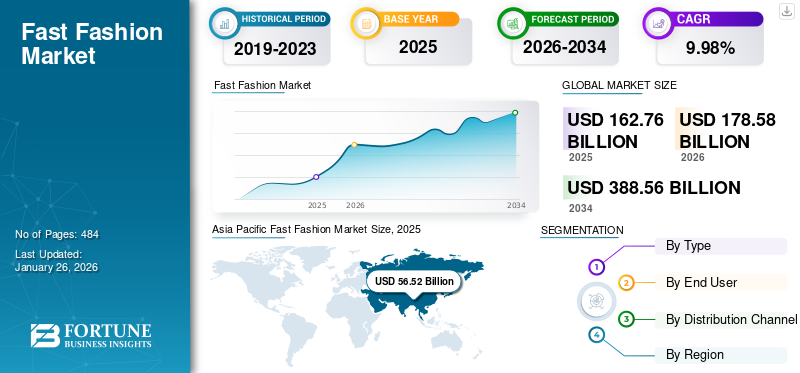
The global fast fashion market size was valued at USD 162.76 billion in 2025 and is projected to grow from USD 178.58 billion in 2026 to USD 388.56
billion by 2034, exhibiting a CAGR of 9.98% during the forecast period. Asia Pacific dominated the global fast fashion market with a market share of 34.73% in 2025.
Fast fashion manufacturers prioritize quick production of trendy apparel to make consumers accessible to such affordable products. Such mass-produced garments are made of high-end designs that encourage consumers to frequent shops for such products. In addition, the spread of information about recent fashionable goods on social media and the growing number of influencers promoting such products have significantly uplifted the product demand globally. Besides, the growing number of apparel shops offering mass-produced garments at affordable prices is driving the global market growth.
Key players operating in the global market include Industria de Diseño Textil, S.A., SHEIN, H&M Group, Fast Retailing Co., and ASOS plc. These players implement ultra-fast production cycles to produce a wide variety of products. In addition, they broaden the fast fashion retailer network to strengthen brand image worldwide.
Download Free sample to learn more about this report.
Fast Fashion Market Key Takeaways
 Global Market Size & Forecast
- 2025 Market Size: USD 162.76 Billion
- 2026 Market Size: USD 178.58 Billion
- 2034 Forecast Market Size: USD 388.56 Billion
- CAGR: 9.98% from 2026–2034
 Market Share
- Asia Pacific dominated the fast fashion market with a 34.73% share in 2025.
- The casual wear segment led the market by type with a 54.59% share.
- The women segment dominated the market by end-user with a 61.68% share.
 Key Regional Highlights
Asia Pacific
Asia Pacific led the market with USD 56.52 billion, accounting for 34.73% of global revenue in 2025.
Europe
Europe reached USD 39.37 billion, representing 24.19% of the global market in 2025.
North America
North America generated USD 34.70 billion, contributing 21.32% of global demand in 2025.
U.S.
The fast fashion market is projected to reach USD 25.80 billion by 2026.
Japan
The fast fashion market is projected to reach USD 10.01 billion by 2026.
Read More

MARKET DYNAMICS
MARKET DRIVERS
Growing Manufacturers' Collaborations with Fashion Designers and Influencers to Favor Market Growth
An increasing number of consumers express themselves through stylish wearables, and the growing number of social media influencers promoting recent fashionistas' apparel styles on social media is favoring the product demand worldwide. In addition, increasing manufacturers’ collaborations with social media influencers to promote their products is driving the fast fashion market growth. For instance, in November 2025, Zara collaborated with Ludovic de Saint-Sernin, a Paris-based fashion designer, to release a signature capsule collection of products, including ready-to-wear items, footwear, and accessories.
MARKET RESTRAINTS
Brands’ False Claims about Eco-Designs of their Products to Impact Reputation and Restrain Market Expansion
Excessive disposition of used recent fashionable apparel is severely creating waste generations in the landfills. In addition, chemical pollution and the spread of microplastics in landfills due to manufacturers’ short-term production operations are causing severe carbon emissions and environmental degradation. Governments and regulatory authorities are significantly imposing the sustainability and waste-management policies on the manufacturing companies to mitigate such issues. The brands’ consistent false greenwashing claims and eco-design transparency about their products are reducing consumers’ trust in such brands, restraining the market growth.
MARKET OPPORTUNITIES
Growing Emphasis on Size Inclusivity and Personalized Fit Solutions to Strengthen Market Growth
Manufacturers produce plus-size and gender-neutral apparel to recognize the growing importance of size inclusivity and personalized fit solutions. Increasing Generation-Z consumer demand for size-inclusive products is creating newer market growth opportunities. The companies, including H&M, ASOS, Plc., Boohoo, and PrettyLittleThing, are releasing plus-size dedicated apparel lines to enable shoppers to personalize their shopping experiences.
FAST FASHION MARKET TRENDS
Rise of Secondhand, Resale & Circular Business Models to Favor Expansion
Increasing environmental concerns of textile waste generation and the affordable concerns of consumers are encouraging fashion brands to operate with secondhand shopping, resale platforms, and circular business models. The emergence of such business models is favoring product revenue growth globally. Furthermore, the rising number of digital resale marketplaces, including Vinted, Poshmark, TreadUp, and Depop, offering garments at affordable prices, is uplifting the market growth.
MARKET CHALLENGES
Supply Chain Disruptions to Significantly Challenge Key Players’ Conduct of International Business Operations
Logistic delays, stricter delivery schedules, and supply chain disruptions, including transport delays and labor shortage due to incidences of war and natural calamities, are significantly posing challenges to the key players performing international business operations. In addition, the shortage of raw materials and their fluctuating prices are incurring additional procurement costs for the fast fashion company, hampering the business's profitability growth.
Download Free sample to learn more about this report.
Segmentation Analysis
By Type
Widespread Casual Apparel Usage Led Casual Wear Segment to Hold a Leading Market Share
By type, the market is segmented into casual wear, formal wear, and others.
The casual wear segment is projected to dominate the market, accounting for a 54.59% share in 2026. Widespread adoption of casual apparel and footwear among all age groups and generations is mainly resulting in the dominance of the casual wear segment. In addition, increasing consumers’ accessibility to the trend-responsive apparel that is available at affordable prices is driving the casual wear segmental growth.
The formal wear segment is projected to grow at the fastest rate of 10.15% during 2026-2034. Its fastest growth is attributed to the rising number of working professionals seeking comfortable blazers, trousers, and formal shirts in workplace settings. According to the World Bank Group, the global number of working professionals increased from 3.55 billion in 2022 to 3.63 billion in 2023.
To know how our report can help streamline your business, Speak to Analyst
By End-User
High Fashion Consciousness and Frequent Need for Wardrobe Upgrades Led Dominance of Women Segment
Based on end-user, the market is bifurcated into women and men.
The women segment is expected to lead the market, contributing 61.68% of the total share in 2026. Its leading share is attributed to the high women consumers’ fashion consciousness, frequent wardrobe upgrade needs, and greater product availability, compared to the men end-users. In addition, the rising number of female social media influencers promoting trending apparel suits designed for women consumers is driving the segment’s growth.
The men segment is projected to grow at the fastest CAGR of 10.62% during 2026-2034. The segment’s fastest growth is attributed to the increasing number of male fashion seekers buying style t-shirts, jeans, and jackets. Besides, consistent brands’ introduction of capsule collections of men-inspired t-shirts promoting masculinity and style is further accelerating the men segment’s growth.
By Distribution Channel
Better Shoppers' Convenience in Product Selection at Apparel Stores Led Dominance of Offline Stores Segment
Based on the distribution channel, the market is segmented into offline stores and online stores/e-commerce.
The offline stores distribution channel segment dominated the global fast fashion market with a market share of 71.21% in 2026. The segment’s leading share is attributed to the widespread physical retail presence of clothing stores & shopping malls and better shoppers’ convenience in product selection at these stores. Furthermore, consistent retailers and brands’ retail expansion efforts, including the opening of a newer apparel store chain, are positively contributing to the segmental revenue growth.
Rising adoption of online shopping of rapid fashion goods is mainly accelerating online stores/e-commerce segmental revenues at the fastest rate of 11.31% during 2026-2034. The emergence of fashion consciousness from online shopping sites and social media posts is uplifting the online sales of such products, driving the segment’s growth.
Fast Fashion Market Regional Outlook
By region, the market is categorized into North America, Europe, Asia Pacific, South America, and the Middle East & Africa.
Asia Pacific
Asia Pacific Fast Fashion Market Size, 2025 (USD Billion)
To get more information on the regional analysis of this market, Download Free sample
The Asia Pacific region exhibited a leading global market share of 34.62% in 2024. The region’s market size reached USD 56.52 billion in 2025. The region’s market is projected to grow at a fastest CAGR of 10.38% during 2026-2034. Robust apparel production facilities and greater availability of the mass-produced, fashionable garments are positively contributing to the generation of market revenues in China, India, and Southeast Asia. In addition, an increasing number of fashion brands expanding their retail presence is driving the product sales growth in the region. The Japan market is projected to reach USD 10.01 billion by 2026, the China market is projected to reach USD 20.07 billion by 2026, and the India market is projected to reach USD 12.2 billion by 2026. Asia Pacific maintained a strong presence in the global market, reaching USD 56.52 billion in 2025, accounting for 34.73% share, and is expected to reach USD 62.21 billion in 2026.
Europe
The European region exhibited a second leading global market position in 2024. Greater fashion consciousness, consistent brands’ influencer-led social media campaigns, and increasing online shopping adoption are mainly driving the market growth across the Western European region. According to the European Environmental Agency (EEA), online sales in the European textile sector increased from 5% in 2009 to 11% in 2022. Besides, the growing number of eco-conscious fashion brands investing in procuring recycled or bio-based materials for rapid fashion goods products is positively contributing to the market growth across Europe. The UK market is projected to reach USD 9.04 billion by 2026, while the Germany market is projected to reach USD 7.92 billion by 2026. The Europe region captured 24.19% of the global market in 2025, generating USD 39.37 billion in revenue, and is projected to reach USD 43.24 billion in 2026.
North America
The North America region exhibited a third leading global market share in 2024. A strong consumer preference for recently available apparel assortment and greater retail shopping infrastructure is mainly driving the product sales across the U.S. and Canada. In addition, the growing trend of e-commerce shopping of fashion goods with the emergence of subscription-based business models is creating newer market growth opportunities across Canada and Mexico. The U.S. market is projected to reach USD 25.8 billion by 2026. In 2025, the North America market stood at USD 34.7 billion, representing 21.32% of global demand, and is projected to grow to USD 38.11 billion in 2026.
The U.S. market size reached USD 21.35 billion in 2024. Increasing consumer preference for affordable fashion products of minimalistic functional designs and continuous demand for fashion-led goods are accelerating the U.S. market growth. Furthermore, an increasing number of brands adopting technology-driven inventory management and responsible production procedures is sustainably favoring the fast fashion industry growth across the country.
South America Middle East & Africa
Over the global market forecast period, the market in the South America and the Middle East & Africa regions is expected to witness a moderate growth rate from 2025 to 2032. The South America market in 2025 is set to reach a valuation of USD 19.61 billion. The rising trend of online shopping of consumer goods and the emergence of social media promoting recent fashion goods are driving market growth across the South American region.
Middle East & Africa
The Middle East & Africa market accounted for USD 12.56 billion in 2025, representing 7.71% of the global industry, and is expected to reach USD 13.57 billion in 2026.
Expansion of retail infrastructural facilities, including shopping malls and specialty apparel stores, is driving the product sales across Saudi Arabia, the UAE, and Qatar. In addition, increasing fashion consciousness and a growing number of middle-income households are positively contributing to the product revenue growth across the African region. In the Middle East & African market, South Africa is expected to reach a market value of USD 5.09 billion by 2025.
COMPETITIVE LANDSCAPE
Key Industry Players
Significant Focus on Broadening Apparel Portfolio and Retailer Partnerships to Help Key Players Build Market Position
The global market is extremely fragmented, with leading players including Industria de Diseño Textil, S.A., SHEIN, H&M Group, Fast Retailing Co., and ASOS plc. These companies focus on broadening their product portfolio across different apparel categories to strengthen their business expansion activities. Furthermore, they partner with e-commerce retailers and social media influencers to promote the brand and timely deliver products to their end-consumers. For instance, in September 2025, Industria de Diseño Textil, S.A. (Inditex) partnered with Myntra, an Indian e-commerce apparel shopping platform, to make available the company’s 1,200 styles of clothing for men and women to Myntra’s exclusive Indian customer base.
LIST OF KEY FAST FASHION COMPANIES PROFILED
- Industria de Diseño Textil, S.A. (Spain)
- SHEIN (Singapore)
- H&M Group (Sweden)
- Fast Retailing Co. (Japan)
- ASOS plc. (U.K.)
- Associated British Foods plc. (Primark) (U.K.)
- Urban Outfitters, Inc. (U.S.)
- Mango Fashion Group (Spain)
- C&A (Belgium)
- Shenzhou International (China)
KEY INDUSTRY DEVELOPMENTS
- August 2025: SHIEN established a strategic partnership with Lufthansa Cargo to explore newer opportunities in sustainable practices of air freight solutions for the distribution of eco-friendly products. The partnership enables SHIEN to sustainably lower environmental impact from its international flights and maritime shipping combined operations.
- March 2025: Fast Retailing announced expansion plans for Uniqlo, including new large-format store openings in North America and other growth markets.
- March 2025: Inditex invested USD 1,042.46 million to broaden its product distribution capabilities. Through the investment, the company developed a new Zara logistics center located in Zaragoza and capacity upgrades at Bershka and Tempe facilities.
- March 2024: Inditex expanded its sustainability and circular fashion initiatives by forming partnerships with fiber-recycling innovators, including Infinite Fiber Company and Epoch Biodesign.
- September 2022: Gap, Inc.’s Athleta brand partnered with ThredUP and Shop Premium Outlets to expand its presence in the off-price sectors of the activewear and intimate product segments.
REPORT COVERAGE
Request for Customization to gain extensive market insights.
Report Scope & Segmentation
|
ATTRIBUTE |
DETAILS |
|
Study Period |
2021–2034 |
|
Base Year |
2025 |
|
Estimated Year |
2026 |
|
Forecast Period |
2026-2034 |
|
Historical Period |
2021–2024 |
|
Growth Rate |
CAGR of 9.98% from 2026 to 2034 |
|
Unit |
Value (USD billion) |
|
Segmentation
|
By Type
|
|
By End User
|
|
|
By Distribution Channel
|
|
|
By Region
|
Frequently Asked Questions
Fortune Business Insights says that the global market value stood at USD 162.76 billion in 2025 and is projected to reach USD 388.56 billion by 2034.
In 2025, the market value stood at USD 162.76 billion.
At a CAGR of 9.98% the global market forecasted to growth during 2026-2034.
By type, the casual wear segment exhibited a leading global market share throughout the forecast period.
The growing manufacturers' collaborations with fashion designers and influencers are set to drive the global market.
Industria de Diseno Textil, S.A., SHEIN, H&M Group, Fast Retailing Co., and ASOS plc. are among the prominent players in the market.
Asia Pacific dominated the market in 2025.
The growing manufacturers emphasis on size inclusivity and personalized fit solutions is expected to favor the adoption rate of these services.



- 2021-2034
- 2025
- 2021-2024
- 484
-
(Offer valid till 30th Sep 2026)
Get 30-60 hrs Free Customization
Expand Regional and Country Coverage, Segments Analysis, Company Profiles, Competitive Benchmarking, and End-user Insights.



















Related Reports
-
US +1 833 909 2966 ( Toll Free )
-
Get In Touch With Us