Feed Acidifiers Market Size, Share & Industry Analysis, By Type (Lactic Acid, Propionic Acid, Fumaric Acid, Malic Acid, Citric Acid, Sorbic Acid, and Others), By Compound (Blended and Single), By Form (Dry and Liquid), By Animal Type (Aquaculture [Shrimp, Fish, and Others], Poultry [Boilers, Egg-layers, and Others], Ruminants [Beef Ruminants and Dairy Ruminants], Swine, and Others), and Regional Forecast, 2026-2034
 Download Free Sample
(Offer valid till 15th Oct 2026)

Feed Acidifiers Market Size and Future Outlook
 Listen to Audio Version
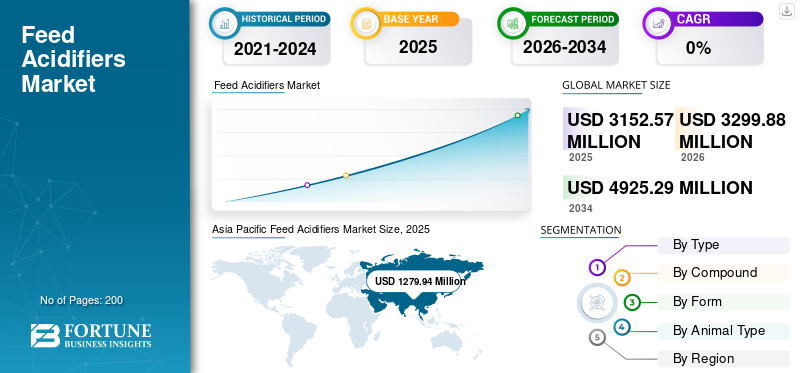
The global feed acidifiers market size was valued at USD 3,152.57 million in 2025 and is projected to grow from USD 3,299.88 million in 2026 to USD 4,925.29 million by 2034, exhibiting a CAGR of 5.13% during the forecast period. Asia Pacific dominated the global feed acidifiers market with a market share of 40.6% in 2025.
The global feed acidifiers market plays a crucial role in modern livestock nutrition, driven by the rising focus on antibiotic-free animal production, enhanced feed quality, improved gut health, and increased feed efficiency. Acidifiers, including organic acids such as lactic, propionic, citric, and fumaric acids, are widely used to improve nutrient digestibility, inhibit pathogenic bacteria, stabilize pH levels, and reduce feed spoilage.
The global demand continues to strengthen as livestock producers adopt natural alternatives to Antibiotic Growth Promoters (AGPs). This transition is reinforced by regulatory restrictions, evolving consumer preferences for safe livestock-derived foods, and the need to improve Feed Conversion Ratios (FCR) across poultry, swine, aquaculture, and ruminant operations. The market is dominated by major players, including BASF SE, Kemin Industries, DSM–Firmenich, and Novus International.
Download Free sample to learn more about this report.
Feed Acidifiers Market Key Takeaways
 Market Size & Forecast
- 2025 Market Size: USD 3,152.57 Million
- 2026 Market Size: USD 3,299.88 Million
- 2034 Forecast Market Size: USD 4,925.29 Million
- CAGR: 5.13% from 2026–2034
 Market Share
- Asia Pacific dominated the feed acidifiers market with a 40.60% share in 2025.
- The lactic acid segment held the largest market share with 32.23% in 2025.
- The dry form segment accounted for a 64.92% share in 2025.
 Key Regional Highlights
Asia Pacific
Asia Pacific generated USD 1,279.94 million in 2025.
North America
North America reached USD 669.16 million in 2025 and is projected to grow to USD 1,026.91 million by 2034.
Europe
Europe was valued at USD 459.42 million in 2025.
U.S.
Strong livestock production and increasing adoption of antibiotic-free feed continue to drive demand for feed acidifiers.
Japan
Rising demand for high-quality livestock nutrition and antibiotic-free feed additives continues to support market growth.
Read More

MARKET DYNAMICS
Market Drivers
Ban on Antibiotic Growth Promoters (AGPs) Worldwide to Boost Market Growth
The global ban on Antibiotic Growth Promoters (AGPs) in animal feed has boosted the adoption of acidifiers as alternative growth-promoting agents. Acidifiers, including organic acids such as citric acid and butyric acid, help optimize gut pH and inhibit pathogenic bacteria, thereby supporting better digestion and animal health without the risks associated with antibiotic resistance. Many regions, including the EU, the U.S., China, and India, have banned or tightened restrictions on the use of antibiotics as growth promoters in animal feed, driven by concerns over antimicrobial resistance and food safety.
- For instance, the EU banned the use of Antibiotic Growth Promoters (AGPs) in livestock feed in 2006. This landmark decision led to a significant and ongoing growing demand for safe, natural alternatives, with organic acids being among the most researched and widely adopted substitutes in animal nutrition.
Market Restraints
High Inclusion Costs and Raw Material Price Volatility to Impede Market Growth
The market faces significant challenges due to high inclusion costs and volatility in raw material prices. High costs, particularly for advanced formulations such as buffered or encapsulated acidifiers, limit adoption among price-sensitive producers, especially in developing regions and smallholder farms. Additionally, raw materials’ price volatility, especially for organic acids such as propionic, formic, and fumaric acids, directly impacts production costs, creating margin pressures that hamper wider usage and global feed acidifiers market growth.
Market Opportunities
Strong Growth Potential in the Aquaculture Sector to Unlock New Growth Opportunities
The market holds strong growth potential, driven significantly by the expanding aquaculture sector. Aquaculture's rising demand for sustainable, antibiotic-free fish protein is driving the adoption of feed acidifiers to enhance growth performance, gut health, enzyme activity, and disease resistance in aquatic species such as shrimp, tilapia, and salmon. This trend is expected to unlock new growth opportunities in the market, with aquaculture emerging as one of the fastest-growing end use segments, alongside poultry and swine.
- According to the Food and Agriculture Organization (FAO), the global aquaculture production is projected to reach 111 million metric tons (MT) by 2032, an increase of 17% or about 16 million MT from 2022 levels.
Feed Acidifiers Market Trends
Shift toward Natural and Non-Antibiotic Feed Additives to Shape the Industry
The recent trend in the market is a clear shift toward non-antibiotic and natural feed additives. This trend is driven by increasing regulatory restrictions on antibiotic growth promoters, consumer preference for antibiotic-free animal products, and rising concerns over antibiotic resistance. Acidifiers are being adopted widely as natural alternatives to antibiotics due to their benefits in improving gut health, nutrient absorption, and feed efficiency in livestock and poultry. Manufacturers are also coming up with new product launches to meet the rising product demand.
- For instance, in June 2024, Kemin Industries launched FORMYL, an advanced feed acidifier specifically designed to improve swine health and productivity in the U.S. market. It is a proprietary blend of encapsulated calcium formate and citric acid that acts as a non-antibiotic antimicrobial and feed acidifier. This product helps control pathogens, supports gut health, improves digestion, and enhances overall swine performance and profitability.
Download Free sample to learn more about this report.
SEGMENTATION ANALYSIS
By Type
Effective Antimicrobial Properties and Proven Benefits to Lead the Lactic Acid Segment Dominance
By type, the market is segmented into lactic acid, propionic acid, fumaric acid, malic acid, citric acid, sorbic acid, and others.
The lactic acid segment held a dominant global feed acidifiers market share, valued at 32.23% in 2025. This leadership is due to lactic acid's effective antimicrobial properties and proven benefits in regulating gut pH for poultry, swine, and ruminants, thus enhancing nutrient digestibility and gut health. The segment is projected to grow at a CAGR of approximately 4.95% during the forecast period, supported by the rising demand for antibiotic-free feed additives and natural growth promoters.
The propionic acid segment is expected to grow significantly with a CAGR of 6.47% during the forecast period.
To know how our report can help streamline your business, Speak to Analyst
By Compound
Superior Antibacterial Action to Lead Blended Segment Growth
On the basis of the compound, the market is segmented into blended and single.
The blended segment held a valuation of USD 1,832.75 million in 2025 and is projected to grow at a Compound Annual Growth Rate (CAGR) of 4.85% from 2026 to 2032. Blended acidifiers are the leading segment in the market due to their superior antibacterial effects, enhanced pH modulation, and proven synergy among multiple acid types. Blended acidifiers combine organic (such as lactic, fumaric, and citric) and inorganic acids to actively inhibit a broad range of pathogenic bacteria, thereby improving animal health and outperforming single-acid solutions.
The single segment is expected to grow significantly at a CAGR of 5.52% during the forecast period.
By Form
Superior Stability and Easy Handling to Fuel Dry Segment Market Leadership
On the basis of form, the market is segmented into dry and liquid.
Dry form is the dominant segment in the market. The segment captured a share of 64.92% in 2025, due to its superior stability, easier handling, and longer shelf life compared to liquid alternatives. The estimated global market size for feed acidifiers, in 2025, is approximately USD 2,046.79 million, driven by high-volume usage in poultry and swine feed formulations.
The liquid segment is anticipated to grow at a CAGR of 5.43% during the forecast period.
By Animal Type
Enhanced Milk Yield and Growth Performance to Fuel Ruminant Segment Leadership
On the basis of animal type, the market is segmented into aquaculture, poultry, ruminants, swine, and others.
The ruminants segment accounted for USD 1,283.03 million in 2025. Ruminants, including dairy and beef cattle, benefit significantly from feed acidifiers as these additives help regulate rumen pH, preventing acidosis and improving fiber digestion. This leads to enhanced milk yield and better metabolic health in dairy cattle, as well as improved growth and feed efficiency in beef cattle. The rising global demand for protein-rich foods such as meat and dairy is driving increased livestock production, particularly of ruminants.
The aquaculture segment is anticipated to grow at a CAGR of 7.13% during the forecast period.
Feed Acidifiers Market Regional Outlook
Regionally, the report covers the market analysis across North America, Europe, Asia Pacific, South America, and the Middle East & Africa.
Asia Pacific Feed Acidifiers Market Size, 2025 (USD Million)
To get more information on the regional analysis of this market, Download Free sample
Asia Pacific
Asia Pacific accounted for the largest regional market for feed acidifiers, reaching USD 1,279.94 million in 2025. The market dominance is driven by high poultry and swine populations in countries such as China, India, Vietnam, and Indonesia. Besides these, shrimp farming utilizes high-quality feed additives that boost demand. The growing numbers of commercial feed mills across Southeast Asia promote the expansion prospects of feed acidifiers.
North America
The North America market held approximately USD 669.16 million in 2025. It is projected to reach 1,026.91 million by 2034, growing at a CAGR of approximately 4.92% during the forecast period. The well-established infrastructure for feed manufacturing, high adoption of antibiotic-free production, and favorable USDA regulations and monitoring are significant contributors to this market. The U.S. leads the North American market, accounting for approximately 73.02% of regional consumption, primarily due to its large livestock base and extensive feed production. This is further expected to grow at a CAGR of approximately 4.68% between 2026 and 2032, driven by increasing awareness of animal nutrition, along with the adoption of stringent regulations against antibiotics in feed and the expansion of intensive farming.
Europe
Europe is a significant market for feed acidifiers, with an estimated value of about USD 459.42 million in 2025, which is anticipated to see a growth rate of 4.10% through 2035. Stringent European regulations on the use of antibiotics in animal feed spur the demand for acidifiers as a better alternative to enhance gut health and reduce pathogens. Stronger emphasis by the European Food Safety Authority (EFSA) guidelines on the use of alternatives to antibiotics-organic acids to counter antimicrobial resistance and ensure food safety bolsters the adoption of feed acidifiers in Europe.
South America
The growth in the livestock population, demand for value-added animal products, increased animal protein consumption, and the shift toward sustainable and efficient production of livestock are key factors driving the market in South America. Countries such as Brazil and Argentina dominate the market, as they have well-established livestock industries and a considerable production of poultry and swine.
Middle East & Africa
In the Middle East & Africa, the market growth is driven by an increasing demand for animal protein, food security concerns leading to poultry farm modernization, and government-supported livestock initiatives in countries such as Saudi Arabia and the UAE. Additionally, growing aquaculture industries in countries such as Egypt and Nigeria create further demand.
COMPETITIVE LANDSCAPE
Key Industry Players
Significant Investments in Research and Development by Key Players to Support Market Growth
The market is moderately consolidated and dominated by key global players with extensive feed additive portfolios, wide distribution networks, and significant investments in Research & Development (R&D). Leading companies include BASF SE, Cargill Inc., DSM Nutritional Products AG, Kemin Industries Inc., Perstorp Holding AB, Novus International, Inc., and Corbion NV, among others. These companies use their scale advantage, expertise in regulatory matters, and technical support teams to maintain and expand their competitive advantages and reach in the marketplace, particularly in the major regions of North America, Europe, and the Asia Pacific.
Key Players in the Feed Acidifiers Market
| Rank | Company Name |
| 1 | BASF SE |
| 2 | Cargill, Inc. |
| 3 | DSM Nutritional Products AG |
| 4 | Kemin Industries Inc. |
| 5 | Novus International, Inc. |
List of Key Feed Acidifiers Companies Profiled:
- BASF SE (Germany)
- Kemin Industries, Inc. (U.S.)
- Biomin Holding GmbH (Austria)
- Perstorp Holding AB (Sweden)
- Yara International ASA (Norway)
- Novus International, Inc. (U.S.)
- Corbion N.V. (Netherlands)
- ADDCON GmbH (Germany)
- Impextraco NV (Belgium)
- Koninklijke DSM N.V. (Netherlands)
- Cargill, Inc. (U.S.)
KEY INDUSTRY DEVELOPMENTS:
- January 2025: Jones-Hamilton Co. launched BeefUp, an acidifier designed specifically for confined cattle operations to manage pH and eliminate ammonia in manure packs, bedding, and footbaths. BeefUp is a safe mineral acid that supports better respiratory and hoof health for cattle by reducing environmental stress, minimizing secondary infections, and improving performance.
- February 2024: Addcon launched three new organic acid-based products in Indonesia through its distributor Novindo. The products are Addcon ProFeed, Formi Stable, and Addcon XL Forte. Among them, ADDCON XL Forte is a liquid broad-spectrum acidifier that fights harmful Gram-negative and Gram-positive bacteria, reduces diarrhea by up to 100%, and enhances biosecurity in feed and water treatment, leading to better animal performance and farm hygiene.
- June 2020: DSM agreed to acquire Austria's Erber Group, including its animal nutrition firms Biomin and Romer Labs, for about USD 1.1 billion. The acquisition strengthens DSM's position in animal health and nutrition, particularly in mycotoxin risk management, gut health, and feed safety diagnostics. Biomin offers enzymes, adsorbents, probiotics, acidifiers, and other additives that improve feed safety and gut performance, while Romer Labs provides diagnostic solutions for detecting mycotoxins and food/feed contaminants. This deal supports DSM’s strategic focus on higher-value specialty nutrition solutions and promoting farm sustainability.
REPORT COVERAGE
The global market report analyzes the market in depth and highlights crucial aspects such as market trends, supply chain, market dynamics, prominent companies, investment in research and development, and end-use. Besides this, the report also provides insights into the market analysis and highlights significant industry developments.
Request for Customization to gain extensive market insights.
Report Scope & Segmentation
| ATTRIBUTE | DETAILS |
| Study Period | 2021-2034 |
| Base Year | 2025 |
| Forecast Period | 2026-2034 |
| Historical Period | 2021-2024 |
| Growth Rate | CAGR of 5.13% from 2026 to 2034 |
| Unit | Value (USD Million) |
| Segmentations | By Type, Compound, Form, Animal Type, and by Region |
| Segmentation |
By Type
|
|
By Compound
|
|
|
By Form
|
|
|
By Animal Type
|
|
|
By Region
|
Frequently Asked Questions
Fortune Business Insights says that the global market was USD 3,152.57 million in 2025 and is anticipated to reach USD 4,925.29 million by 2034.
The global market will exhibit steady growth at a CAGR of 5.13% over the forecast period.
By type, the lactic acid segment led the market in 2025.
Asia Pacific held the largest market share in 2025.
Ban on Antibiotic Growth Promoters (AGPs) worldwide is the crucial factor driving the global market.
BASF SE, Kemin Industries, DSM–Firmenich, and Novus International are the leading companies in the market.
Shift toward natural and non-antibiotic feed additives is a key trend in the industry.



- 2021-2034
- 2025
- 2021-2024
- 200
-
(Offer valid till 15th Oct 2026)
Get 30-60 hrs Free Customization
Expand Regional and Country Coverage, Segments Analysis, Company Profiles, Competitive Benchmarking, and End-user Insights.














-
US +1 833 909 2966 ( Toll Free )
-
Get In Touch With Us