Fidget Toys Market Size, Share & Industry Analysis, By Product Type (Fidget Cube, Fidget Spinner, Stress Ball, and Others), By Material (Plastic, Metal, Silicone, and Others), By Distribution Channel (Hypermarket/Supermarket, Convenience Stores, E-commerce/Online, and Others), and Regional Forecast, 2026-2034
 Download Free Sample
(Offer valid till 30th Sep 2026)

KEY MARKET INSIGHTS
 Listen to Audio Version
The global fidget toys market size was valued at USD 9.01 billion in 2025. The market is expected to grow from USD 9.57 billion in 2026 to USD 17.65 billion by 2034, exhibiting a CAGR of 7.96% during the forecast period (2026-2034). North America dominated the fidget toys market with a market share of 37.25% in 2026.
Fidget toys are small objects designed to help individuals reduce stress, stay focused, and manage anxiety by providing a physical outlet for restless energy. These toys include stress balls, spinners, cubes, and sensory rings, which are frequently used by adults and children to improve concentration and support cognitive engagement. They are available in diversified textures, shapes, and functions, catering to different sensory needs and preferences. Furthermore, manufacturers such as Fun In Motion Toys, Zuru, THEPOPIT, and TonySourcing are focusing on customizable textures, colors, engravings, and logos to attract individuals. The rising availability of tech-integrated and smart-feature fidget toys on both online and offline platforms is further boosting the growth of the global market.
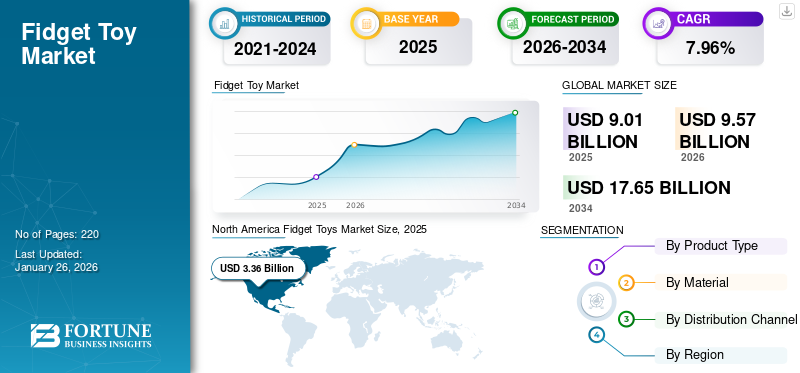
Download Free sample to learn more about this report.
Fidget Toy Market Key Takeaways
 Market Size & Forecast
- 2025 Market Size: USD 9.01 billion
- 2026 Market Size: USD 9.57 billion
- 2034 Forecast Market Size: USD 17.65 billion
- CAGR: 7.96% from 2026–2034
 Market Share
- North America dominated the market with a 37.25% share.
- The Fidget Spinner segment is projected to lead the market with a 40.02% share in 2026.
- The Plastic segment is projected to dominate the market with a 52.24% share in 2026.
 Key Regional Highlights
Asia Pacific
Asia Pacific recorded USD 2.87 billion in 2025 and is expected to grow to USD 3.07 billion in 2026.
North America
North America reached USD 3.36 billion in 2025 and is projected to grow to USD 3.57 billion in 2026.
Europe
Europe generated USD 1.82 billion in 2025 and is projected to reach USD 1.91 billion in 2026.
U.S.
U.S. market is projected to reach USD 2.93 billion by 2026.
Japan
Japan market is projected to reach USD 0.98 billion by 2026.
Read More

MARKET DYNAMICS
Market Drivers
Rising Mental Health Awareness to Drive Market Growth
The increasing consumer awareness toward mental health issues has led to an increase in demand for stress relief and focus enhancement products. Furthermore, these toys are widely accepted for their ability to relieve anxiety and improve focus, particularly among individuals with attention deficit hyperactivity disorder (ADHD), autism spectrum disorder, and other sensory needs. The increasing use of fidget toys in schools, the workplace, and by therapists as part of wellness and productivity strategies drives the global fidget toys market growth. In addition, the decreasing stigma associated with mental health challenges has empowered more individuals to embrace coping aids such as fidget toys. The rising availability of customizable options from manufacturers allows individuals to select colors, designs, and even engravings, thereby creating unique and meaningful experiences, further boosting product demand.
MARKET RESTRAINT
Stringent Regulatory & Compliance Hurdles to Restrain Market Growth
Fidget toys are also considered therapeutic tools, which means they must comply with strict safety standards such as EN 71 regulations in Europe and the Consumer Product Safety Improvement Act (CPSIA) in the U.S. These rules and regulations mandate severe testing for choking hazards, durability, and toxicity, especially for products targeted at kids. Furthermore, meeting this complex government standard involves high financial costs and considerable time, which poses a key obstacle for small and medium-sized manufacturers. In addition, failure to comply with these rules and regulations leads to product bans, recalls, lawsuits, and damage to consumer trust and brand reputation. The strict guidelines slow down product launches and also restrict international expansion, which further limits the overall potential of the global market.
MARKET OPPORTUNITY
Rising Technological Advancements in Fidget Toys to Favor Market Expansion
The increasing technological advancement in fidget toys by major players is transforming simple sensory tools into innovative and interactive products. These toys are now being integrated with advanced features such as motion sensors, LED lights, haptic feedback, Bluetooth connectivity, and app-based tracking systems. These smart features help in enhancing user engagement and also in providing real-time feedback on focus level, hand movements, and stress reduction, making it more appealing to both healthcare professionals and consumers. Furthermore, these technology-based solutions are being significantly used in educational and therapeutic settings, offering high benefits for individuals with autism spectrum disorder, ADHD, and sensory processing issues, thereby boosting product demand. The inclusion of AI and machine learning is projected to personalize user experience by suggesting settings based on behavioral patterns, which further drives global market growth.
FIDGET TOYS MARKET TREND
Surging Social Media Advertising by Manufacturers to Favor Market Expansion
The growing use of social media advertisement by manufacturers such as Fun In Motion Toys, Momentum Elastomers, Fun In Motion Toys, and TonySourcing on digital platforms such as Facebook, LinkedIn, Instagram, and TikTok further drives global market growth. Rising influencer marketing, visual storytelling, and targeting ads allow companies to reach specific audiences, improve brand awareness, and build an emotional connection with consumers. Furthermore, fidget toy brands also use social media advertisements to gain valuable insights into consumer behavior, feedback, and preferences. This data helps in creating effective marketing strategies, tailoring content, and making data-driven decisions to stay competitive in the global market.
Download Free sample to learn more about this report.
SEGMENTATION ANALYSIS
By Product Type
Rising Use of Fidget Spinners to Improve Concentration and Reduce Stress to Boost the Segment’s Growth
Based on product type, the market is divided into fidget cube, fidget spinner, stress ball, and others.
In 2026, the fidget spinner segment is projected to lead the market with a 40.02% share, owing to its popularity as a stress relief and focus-improving tool. The increasing use of fidget spinners to reduce nervous energy, enhance concentration, and manage stress, particularly in high-pressure environments such as schools and offices, boosts the segment’s growth. Furthermore, these spinners are portable, affordable, and available in diversified colors and designs, which attracts a large number of consumers across the globe. The combination of affordability, functionality, and trendiness is boosting demand for fidget spinners in both online and physical markets globally.
To know how our report can help streamline your business, Speak to Analyst
The fidget cube segment is expected to grow at a CAGR of 6.45% over the forecast period.
By Material
Cost-effective and Lightweight Features of Plastic Material Boosted the Segment’s Growth
Based on material, the market is segmented into plastic, metal, silicone, and others.
The plastic segment is projected to dominate the market with a share of 52.24% in 2026. Plastic is durable, cost-effective, and lightweight, making it perfect for manufacturing fidget toys such as stress balls, spinners, and pop-its. These toys are widely used for improving concentration, releasing stress, and sensory stimulation, especially amongst teenagers, children, and individuals with ADHD or autism. The plastic fidget toys are available in a diverse variety of colors, textures, and shapes, making them more fun and engaging. Their low manufacturing cost makes them more accessible to a wider audience, while their portability ensures convenience of use at work, home, and school.
The silicone segment is projected to record the highest CAGR of 8.09% during the forecast period.
By Distribution Channel
Hypermarket/Supermarket Segment Leads the Global Market Owing to the Increasing Consumer Footfall in Retail Stores
Based on distribution channel, the market is divided into hypermarket/supermarket, convenience stores, e-commerce/online, and others. The hypermarket/supermarket segment is expected to lead the market, contributing 38.76% globally in 2026 owing to increasing footfall, convenience, and competitive pricing. These retail stores attract a large number of daily shoppers, which increases the visibility of fidget toys and fuels impulse buying, especially by parents, guardians, and children. In addition, they provide competitive prices and frequent discounts, making toys more cost-effective compared to other stores.
The e-commerce/online segment is projected to record the highest CAGR of 8.77% over the forecast period.
GLOBAL FIDGET TOYS MARKET REGIONAL OUTLOOK
Geographically, the global market is segmented into North America, Europe, Asia Pacific, South America, and the Middle East & Africa.
North America Fidget Toys Market Size, 2025 (USD Billion)
To get more information on the regional analysis of this market, Download Free sample
North America
The North America market generated USD 3.36 billion in 2025, representing 37.25% of the global market landscape, and is expected to reach USD 3.57 billion in 2026. The North America region dominates the global market. The increasing consumer awareness of mental health and the rising diagnosis of conditions such as anxiety, ADHD, and autism, especially amongst young adults and children, fuels product demand. These toys are widely used as therapeutic aids in schools, homes, and therapy centers across countries such as the U.S. and Canada.
The U.S. market is projected to reach USD 2.93 billion by 2026. The demand for fidget toy products is rising in the U.S. owing to rising mental health awareness and increasing academic accommodations. The increasing number of physical retail outlets, such as Walmart and Target, offering a wide selection of toys at affordable prices and great quality, further boosts market growth. For instance, in January 2024, Walmart Inc., a U.S.-based retail corporation, announced plans to build or convert more than 150 stores in the U.S. Furthermore, the easy availability of new and innovative product designs in both online and offline stores in the country keeps consumers engaged and encourages repeat purchases.
Asia Pacific
Asia Pacific accounted for USD 2.87 billion in 2025, representing 31.81% of the global market share, and is projected to reach USD 3.07 billion in 2026. The Asia Pacific region is expected to rise with the highest CAGR over the forecast period, owing to rising disposable income, strong digital influence from social media, and a surging working population. The increasing urbanization and rising economic growth in countries such as China, India, and Australia are boosting purchasing power and fueling product demand. According to the India Brand Equity Foundation (IBEF), India’s urban population is significantly growing, and it is projected that urban areas in India will accommodate about 40% of the population by 2030. The Japan market is projected to reach USD 0.98 billion by 2026, and the China market is projected to reach USD 0.47 billion by 2026.
Europe
Europe contributed 20.17% to the global market in 2025, with a valuation of USD 1.82 billion, and is projected to reach USD 1.91 billion in 2026. The Europe region is expected to grow with a significant compound annual growth rate (CAGR) over the fidget toys market forecast period. The rising consumer awareness toward mental health and increasing support for neurodivergent individuals drive market growth. The popularity of sustainable, high-quality, and non-toxic fidget toys appeals to Europe’s environmentally conscious consumers, which further boosts product demand. The UK market is projected to reach USD 0.27 billion by 2026, while the Germany market is projected to reach USD 0.35 billion by 2026.
South America and the Middle East & Africa
In 2025, Middle East & Africa held 3.99% of the global market, reaching a valuation of USD 0.36 billion, and is projected to grow to USD 0.37 billion in 2026.
South America maintained a strong presence in the global market, reaching USD 0.61 billion in 2025, accounting for 6.78% share, and is expected to reach USD 0.64 billion in 2026.
South America and the Middle East & Africa regions are projected to rise with a substantial annual growth rate CAGR over the forecast period. The easy availability of toys in online sales channels such as Amazon, Mercado Livre, Noon, and Magazine Luiza fuels the product demand. The rising social media advertisements by manufacturers on digital platforms such as TikTok, YouTube, and Instagram help fidget toy brands reach millions of potential customers quickly through viral content, challenges, and user-generated videos, which further boost market growth.
COMPETITIVE LANDSCAPE
Key Industry Players
Key Players Focusing On Expansion to Strengthen Their Presence
Growing competition among prominent players encourages them to strengthen brand loyalty and expand their presence to stay competitive. Prominent players in the market are aiming to launch new product offerings and enhance their product reach across the countries to remain competitive in the national and international markets. Furthermore, key players in the market are focusing on social media marketing and e-commerce sales channels to enhance their consumer reach and product sales globally.
LIST OF KEY COMPANIES PROFILED IN THIS REPORT
- Zuru (China)
- THEPOPIT (China)
- TonySourcing (China)
- Paras Enterprises (India)
- EDNTOY (China)
- Spin Master (Canada)
- Fun In Motion Toys (U.S.)
- Tangle Creations (U.S.)
- Momentum Elastomers (India)
- Funskoolindia (India)
KEY INDUSTRY DEVELOPMENTS
- September 2023 - Tangle Creations California, a U.S.-based toy manufacturing company, launched an innovative variation of the classic fidget toy with Tangle Furry Fidget Friends. The product line-up contains the Wonder Series, featuring Zonk, Skye, Uni, Chay, and Wisdom.
REPORT COVERAGE
The market report provides a detailed market analysis and focuses on key aspects, such as competition landscape, companies’ market share, market dynamics, regional analysis, product type, material, and distribution channel. Besides this, it offers insights into various fidget toys market trends and highlights key industry developments. In addition to the above-mentioned factors, the market reports encompass several other factors that have contributed to the growth of the market in recent years.
Request for Customization to gain extensive market insights.
Report Scope & Segmentation
|
ATTRIBUTE |
DETAILS |
|
Study Period |
2021-2034 |
|
Base Year |
2025 |
|
Estimated Year |
2026 |
|
Forecast Period |
2026-2034 |
|
Historical Period |
2021-2024 |
|
Growth Rate |
CAGR of 7.96% from 2026 to 2034 |
|
Unit |
Value (USD Billion) |
|
Segmentation |
By Product Type · Fidget Cube · Fidget Spinner · Stress Ball · Others |
|
By Material · Plastic · Metal · Silicone · Others |
|
|
By Distribution Channel · Hypermarket/Supermarket · Convenience Stores · E-commerce/Online · Others |
|
|
By Region Nrth America (By Product Type, Material, Distribution Channel, and Country) · U.S. (By Product Type) · Canada (By Product Type) · Mexico (By Product Type) Europe (By Product Type, Material, Distribution Channel, and Country) · Germany (By Product Type) · France (By Product Type) · Italy (By Product Type) · Spain (By Product Type) · U.K. (By Product Type) · Russia (By Product Type) · Rest of Europe (By Product Type) Asia Pacific (By Product Type, Material, Distribution Channel, and Country) · China (By Product Type) · India (By Product Type) · Japan (By Product Type) · Australia (By Product Type) · Rest of Asia Pacific (By Product Type) South America (By Product Type, Material, Distribution Channel, and Country) • Brazil (By Product Type) • Argentina (By Product Type) • Rest of South America (By Product Type) Middle East & Africa (By Product Type, Material, Distribution Channel, and Country) • South Africa (By Product Type) • UAE (By Product Type) • Rest of Middle East & Africa (By Product Type) |
Frequently Asked Questions
Fortune Business Insights says that the market size was valued at USD 9.57 billion in 2026 and is projected to reach USD 17.65 billion by 2034.
In 2025, the North America market value stood at USD 3.36 billion.
Recording a CAGR of 7.96%, the market will exhibit steady growth over the forecast period of 2026-2034.
Based on product type, the fidget spinner segment is expected to lead the market.
Rising mental health awareness is the key factor driving the market.
Zuru, THEPOPIT, TonySourcing, Paras Enterprises, and Others are the major players in the market.
North America dominated the fidget toys market with a market share of 37.25% in 2026.
Rising technological advancements are expected to drive the adoption of this product.



- 2021-2034
- 2025
- 2021-2024
- 220
-
(Offer valid till 30th Sep 2026)
Get 30-60 hrs Free Customization
Expand Regional and Country Coverage, Segments Analysis, Company Profiles, Competitive Benchmarking, and End-user Insights.



















Related Reports
-
US +1 833 909 2966 ( Toll Free )
-
Get In Touch With Us