Fire-Rated Architecture Glass Ceramic Market Size, Share & Industry Analysis, By Application (Doors, Windows, Partitions, Corridors & Stairwells, and Others), By End-use (Residential, Commercial, Institutional & Public, and Industrial & Specialty Buildings), and Regional Forecast, 2026-2034
 Download Free Sample
Fire-Rated Architecture Glass Ceramic Market Size and Future Outlook
 Listen to Audio Version
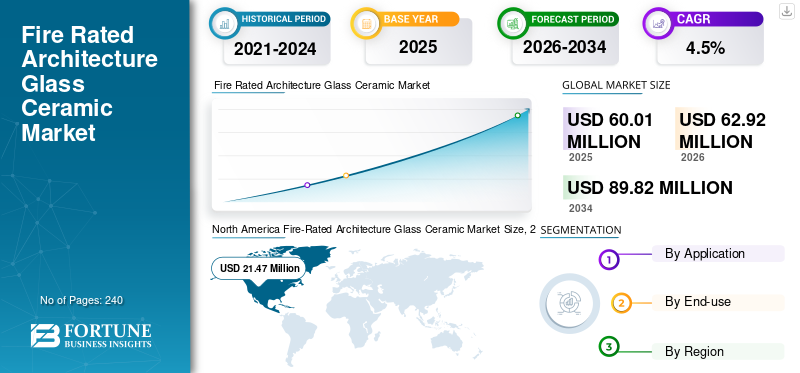
The global fire-rated architecture glass ceramic market size was valued at USD 60.01 million in 2025. The market is projected to grow from USD 62.92 million in 2026 to USD 89.82 million by 2034, growing at a CAGR of 4.5% during the forecast period. North America dominated the fire-rated architecture glass ceramic market with a market share of 35.78% in 2025.
Fire-rated architectural glass ceramic is a transparent, heat-resistant ceramic glass material designed for use in fire-rated building applications. It is engineered to withstand high temperatures, sudden thermal shock, flames, smoke, and hot gases for a specified fire-rating period while allowing visibility and daylight transmission. The global market is driven by increasing adoption of certified fire-rated glazing in commercial, institutional, public, and high-rise residential buildings. Demand is supported by stricter fire-safety codes, renovation of older buildings, replacement of wired or non-compliant glazing, and the growing preference for transparent fire barriers in modern building design. The product is primarily used in doors, windows, partitions, corridors, stairwells, sidelites, transoms, borrowed lites, and other fire-rated openings where both visibility and fire protection are required.
The market remains a specialized segment within architectural glazing, as these products are used only in selected fire-rated openings rather than across general façades or standard windows. As a result, growth is closely linked to commercial construction, institutional infrastructure, healthcare and education projects, public building upgrades, and renovation activity. Value growth is expected to remain slightly higher than volume growth due to the rising use of filmed, laminated, safety-rated, and certified variants, especially in North America, Europe, and premium construction projects across Asia Pacific and the Middle East.
The market is supported by several major players, including SCHOTT Group, Nippon Electric Glass Co. Ltd., and Vetrotech Saint-Gobain International AG.
Download Free sample to learn more about this report.
fire-rated architecture glass ceramic market KEY TAKEAWAYS
 Global Market Size & Forecast
- 2025 Market Size: USD 60.01 Million
- 2026 Market Size: USD 62.92 Million
- 2034 Forecast Market Size: USD 89.82 Million
- CAGR: 4.5% from 2026-2034
 Market Share
- North America dominated with a revenue share of 35.78% in 2025.
- Doors accounted for the largest market share in 2025.
- Commercial segment is expected to dominate the market during the forecast period.
 Key Regional Highlights
North America
North America led the market with USD 21.47 Million in 2025.
Europe
Europe is projected to reach USD 13.51 Million in 2026.
Asia Pacific
Asia Pacific reached USD 18.30 Million in 2025.
U.S.
Estimated to reach USD 17.27 Million in 2026.
Japan
Estimated to reach USD 3.43 Million in 2026.
Read More

fire-rated architecture glass ceramic market TRENDS
Rising Adoption of Transparent Fire-safe Building Designs to Support Market Growth
The fire-rated architecture glass ceramic market is experiencing growing demand from projects requiring both life-safety compliance and visual transparency. Commercial offices, hospitals, schools, airports, government buildings, hotels, and high-rise residential projects are increasingly using fire-rated glass ceramic in doors, sidelites, transoms, borrowed lites, corridors, stairwells, partitions, and internally rated windows. This trend is supported by the growing preference for open, transparent, and well-lit interiors without compromising fire compartmentation and evacuation safety.
The product is gaining preference in applications where traditional opaque fire-rated barriers reduce visibility, daylight access, and design flexibility. Architects and specifiers are increasingly considering fire-rated glazing as part of interior safety design, especially in corridors, stairwells, lobbies, healthcare facilities, educational buildings, and transportation infrastructure. As a result, demand is shifting toward certified, clear, and impact-rated glass-ceramic products that meet both fire-rating and safety requirements.
This trend is expected to support higher adoption of premium fire-rated glass-ceramic products, particularly in regions with strict building codes and mature project specification practices, such as North America and Europe. In Asia Pacific and the Middle East, growth is being supported by commercial construction, high-rise development, and premium infrastructure projects. Hence, manufacturers and system suppliers that offer certified products with comprehensive documentation, system compatibility, and architectural design flexibility are likely to strengthen their competitive positions.
MARKET DYNAMICS
MARKET DRIVERS
Download Free sample to learn more about this report.
Stricter Fire Safety Regulations and Building Codes to Drive Market Growth
Modern building codes increasingly require fire-rated doors, windows, partitions, sidelites, transoms, and glazed openings to perform as part of tested fire-protection assemblies. This is especially important in commercial buildings, healthcare facilities, schools, airports, hotels, high-rise buildings, and public infrastructure, where fire compartmentation, safe evacuation routes, and smoke/flame containment are critical. As a result, architects and contractors are shifting from ordinary glass or outdated wired glass toward certified fire-rated glazing materials that can maintain transparency while meeting required fire ratings.
Fire-rated architecture glass ceramic benefits from this regulatory trend as it combines visibility, daylight transmission, thermal-shock resistance, and code-compliant fire performance. Unlike conventional glazing, fire-rated glass ceramic is designed to withstand high temperatures and sudden cooling from sprinklers or firefighting water, making it suitable for fire-rated doors, windows, corridors, stairwells, and compartment walls. The growing need for tested and listed products also favors established manufacturers such as SCHOTT, Nippon Electric Glass, and Vetrotech Saint-Gobain, whose product portfolios are backed by recognized fire-test standards, impact-safety options, and certified compatibility with fire-rated framing assembly.
Overall, building owners and specifiers are increasingly prioritizing products that are tested, labeled, compatible with fire-rated framing systems, and supported by technical documentation. This raises demand for premium fire-rated architectural glass ceramic, particularly in projects where transparent design must be balanced with life-safety requirements.
MARKET RESTRAINTS
Availability of Substitutes and Emerging Alternative Materials to Restrain Market Growth
The availability of substitute fire-rated materials is constraining growth in the global fire-rated architecture glass ceramic market. Although glass ceramic offers strong passive fire protection solutions, thermal shock resistance, transparency, and architectural aesthetics, several alternative materials can meet fire-rated opening requirements in certain applications. These substitutes include intumescent laminated fire-resistant glass, specialty tempered fire-rated glass, wired glass, fire-rated glass blocks, opaque fire-rated walls, and gypsum-board fire partitions. In many projects, especially cost-sensitive commercial buildings, renovation projects, and regional construction, buyers may choose these alternatives when they meet code requirements at a lower overall system cost.
Intumescent laminated fire-resistant glass is one of the strongest substitutes as it provides both fire integrity and fire-insulation performance. This gives it an advantage in applications that require radiant and conductive heat control, such as fire-rated walls, exit routes, and compartmentation areas. Pilkington describes Pyrostop as a clear, laminated, fully insuSouthg, fire-resistant safety glass that blocks conductive and radiant heat while maintaining visibility. This type of product can reduce the use of fire-rated glass ceramic in applications where higher insulation performance is more important than the slim profile or thermal-shock resistance offered by glass ceramic.
Overall, substitute products and emerging alternative materials continue to restrain market growth by exerting pricing pressure and limiting the applications in which glass ceramic is the preferred solution. The impact is strongest in price-sensitive projects, fire-resistive wall applications, and installations where non-transparent or non-ceramic fire-related products can satisfy code requirements.
MARKET OPPORTUNITIES
Rising Construction Activity Across Asia Pacific and Middle East Creates Opportunity for Market Growth
Rising construction activity across Asia Pacific and the Middle East is creating strong opportunities for the market. These regions are witnessing sustained investment in transport infrastructure, commercial buildings, airports, healthcare facilities, education campuses, hospitality assets, mixed-use developments, and public infrastructure. The Asian Development Bank estimates that developing Asia needs around USD 1.7 trillion per year in infrastructure investment through 2030 to maintain growth, reduce poverty, and address climate-related challenges. This scale of investment supports demand for advanced building materials that improve safety, code compliance, visibility, and architectural quality. India is a strong example, with the country’s National Infrastructure Pipeline projecting infrastructure investment of around USD 116 million during FY2020-FY2025. These investments cover major sectors such as transport, urban development, railways, energy, and social infrastructure. For the fire-rated architecture glass ceramic market, this is important as airports, metro stations, hospitals, schools, public buildings, and commercial complexes require fire-rated doors, windows, partitions, stairwells, sidelites, transoms, and compartmentalized corridors.
The Middle East also presents substantial growth opportunities, supported by official national development programs and large master-planned projects. In Saudi Arabia, the Public Investment Fund states that its giga-projects are designed to stimulate the economy beyond real estate and infrastructure and support economic diversification. Similarly, the UAE Government states that the Dubai 2040 Urban Master Plan aims to upgrade urban areas, improve resource efficiency, develop inclusive communities, expand green and leisure spaces, and promote sustainable mobility.
Developers in Asia Pacific and the Middle East are increasingly adopting international safety practices and premium building specifications, especially in airports, hospitals, schools, hotels, high-rise commercial buildings, and mixed-use districts. As construction markets in these regions continue to expand, manufacturers such as SCHOTT, Nippon Electric Glass, and Vetrotech Saint-Gobain have opportunities to strengthen market growth.
MARKET CHALLENGES
High Product and Compliance Costs Limit Product Adoption
A key challenge for the fire-rated architecture glass ceramic market is the high cost of certified products and assembly-level compliance. The product is more expensive than standard glass and several alternative fire-rated solutions due to specialized raw materials, controlled manufacturing, certification testing, safety filming, lamination, labeling, cutting, and integration with approved frames and door/window systems. This makes adoption more selective, especially in price-sensitive construction markets.
The market is also constrained by the fact that fire-rated glazing is not purchased as a standalone glass product. It usually needs to be used as part of a certified assembly, including approved frames, doors, partitions, or window systems. Local fire codes, impact safety requirements, hose-stream tests, labeling standards, and installation rules differ across regions, making product approval and project acceptance more complex. This increases the importance of technical documentation, certified processors, and trained installation partners.
Due to these factors, adoption can be limited in smaller projects, residential buildings, and developing markets where cost sensitivity is high, and awareness of certified fire-rated glazing remains low. In such cases, contractors may choose opaque fire-rated walls, metal doors, wired glass, or alternative fire-rated glazing systems when budgets are tight. Therefore, market participants need to reduce adoption barriers by strengthening regional fabrication networks, improving lead times, offering project-ready formats, and supporting architects, consultants, and contractors with clear compliance documentation.
Segmentation Analysis
By Application
Doors Segment Accounted for the Largest Market Share due to Replacement of Older Glazing Systems
Based on application, the market is segmented into doors, windows, partitions, corridors & stairwells, and others.
The doors segment accounted for the largest fire-rated architecture glass ceramic market share in 2025 by volume, driven by fire code requirements for compartmentation, safe evacuation, and visibility through fire-rated openings. Demand is especially strong in hospitals, schools, offices, hotels, public buildings, and transport facilities, where fire-rated doors are widely installed in corridors, stairwells, service areas, and occupancy separation zones. Growth is further supported by the replacement of older wired glass and the increasing use of impact-safety-rated ceramic glass in door assemblies. Furthermore, this segment is projected to exhibit a compound annual growth rate (CAGR) of 4.4% throughout the forecast period.
Windows account for a significant share of the market, supported by demand for borrowed lites, interior-rated windows, observation windows, transoms, and selected exterior fire-rated openings. Segment growth is driven by the need to improve visibility, daylighting, and interior openness while maintaining fire separation. However, the segment accounts for a smaller share than doors, as fire-rated ceramic glass is not generally used in façade glazing; it is limited to code-required openings. Demand is strongest in North America and Europe, where fire-safety standards are well-established, and in Asia Pacific, where commercial, healthcare, and education infrastructure development continues to expand. Moreover, this segment is expected to grow at a CAGR of 4.1% throughout the forecast period.
By End-use
To know how our report can help streamline your business, Speak to Analyst
Commercial Segment to Dominate the Market due to High Demand from Commercial Building Projects
In terms of end-use, the market is categorized into residential, commercial, institutional & public, and industrial & specialty buildings.
The commercial segment is expected to account for the largest market share during the forecast period. Demand is driven by offices, hotels, malls, retail complexes, airports, mixed-use developments, corporate campuses, transport hubs, and hospitality projects. These buildings contain a high number of fire-rated doors, corridor openings, stairwells, internal windows, and glazed partitions. Growth is supported by commercial renovation activities, premium office interiors, hospitality development, mixed-use construction, and the rising use of transparent fire-rated barriers. Commercial buyers often prefer glass solutions that balance safety, visibility, and design quality, making fire-rated glass ceramic attractive in premium projects. Furthermore, the segment is projected to grow at a compound annual growth rate (CAGR) of 4.9% over the study period.
The institutional & public segment is expected to grow significantly during the forecast period. The segment includes hospitals, schools, universities, government buildings, laboratories, transport facilities, public offices, and civic infrastructure. Demand is highly code-driven, as these buildings are subject to strict life-safety, evacuation, and compartmentation requirements. Growth is supported by healthcare expansion, educational infrastructure, public building renovations, airport and transit projects, and fire safety upgrades. Hospitals and schools are particularly important as they require fire-rated corridor doors, stairwells, observation windows, smoke barriers, and compartmentation systems. As a result, this segment is expected to remain one of the most stable sources of demand. Moreover, this segment is projected to grow at a compound annual growth rate (CAGR) of 4.3% over the forecast period.
fire-rated architecture glass ceramic market Regional Outlook
By geography, the market is categorized into North America, Europe, Asia Pacific, South America, and the Rest of the World.
Asia Pacific
North America Fire-Rated Architecture Glass Ceramic Market Size, 2025 (USD Million)
To get more information on the regional analysis of this market, Download Free sample
In 2024, the Asia Pacific region held the second-largest market share at USD 17.22 million and maintained its leadership in 2025 at USD 18.30 million. Asia Pacific is the fastest-growing regional market, supported by urbanization, commercial construction, high-rise residential development, airports, hospitals, schools, hotels, and mixed-use projects. China, India, Japan, South Korea, Southeast Asia, and Australia represent important demand centers, although adoption levels and pricing vary widely.
China Fire-Rated Architecture Glass Ceramic Market
The Chinese market is projected to reach USD 7.59 million in 2026. China is a major market due to large-scale urban construction, high-rise commercial and residential buildings, hospitals, schools, transport infrastructure, and mixed-use developments. Demand growth is supported by fire-safety upgrades and premium construction, though pricing remains more competitive due to local supply and cost-sensitive procurement.
Japan Fire-Rated Architecture Glass Ceramic Market
The Japanese market is estimated to reach around USD 3.43 million in 2026, accounting for roughly 5.5% of global revenues.
India Fire-Rated Architecture Glass Ceramic Market
The Indian market is estimated to reach around USD 2.67 million in 2026, accounting for roughly 4.2% of global revenues.
Europe
Europe is expected to experience substantial fire-rated architecture glass ceramic market growth in the coming years. The region is projected to grow at a CAGR of 3.2% over the forecast period. The market is expected to reach USD 13.51 million in 2026. Europe is a mature and regulation-driven market with strong demand from public buildings, institutional infrastructure, commercial renovations, transport hubs, and healthcare facilities. Growth is supported by renovation of older buildings, public infrastructure upgrades, hospital and education projects, and demand for transparent compartmentation in commercial interiors. However, slower growth in new construction and economic pressures in parts of Europe may limit market expansion. The region remains attractive due to higher-value certified products and strong adoption of fire-rated glazing systems.
U.K. Fire-Rated Architecture Glass Ceramic Market
The U.K. market is estimated to reach around USD 2.22 million in 2026, accounting for roughly 3.5% of global revenues.
Germany Fire-Rated Architecture Glass Ceramic Market
Germany’s market is estimated to reach around USD 3.34 million in 2026, accounting for roughly 5.3% of global revenues.
North America
North America is estimated to capture the largest market share, supported by strong code enforcement, UL-listed products, certified fabricators, and well-established fire-rated door and glazing systems. The U.S. accounts for the majority of regional demand, driven by commercial buildings, healthcare facilities, schools, government buildings, airports, and high-rise residential projects. Market growth is driven by strict fire-safety compliance, the replacement of older wired glass, the renovation of public buildings, and growing demand for impact-safety-rated fire glass. Although growth is expected to remain moderate and broadly aligned with construction activity, recurring renovation projects and compliance-driven upgrades will continue to support market expansion.
U.S. Fire-Rated Architecture Glass Ceramic Market
Given the U.S. dominance in the region, the U.S. market is estimated to reach around USD 17.27 million in 2026, accounting for roughly 27.4% of global sales.
South America and Rest of the World
South America is an emerging market for fire-rated architecture glass ceramic. Demand is concentrated in Brazil, Mexico, Chile, Colombia, and other major urban markets, mainly across commercial buildings, airports, hospitals, malls, hotels, and premium residential projects. Growth is supported by urban development, modernization of commercial infrastructure, investment in healthcare, and the import of fire-rated glazing products. The South America market is projected to reach USD 13.14 million in 2026.
The Rest of World market is led by GCC countries, particularly the UAE and Saudi Arabia, where demand is driven by hotels, airports, mixed-use towers, commercial developments, hospitals, and public infrastructure projects.
Middle East Fire-Rated Architecture Glass Ceramic Market
The Middle East market is estimated to touch USD 2.80 million in 2026, accounting for approximately 4.4% of global revenues.
COMPETITIVE LANDSCAPE
Key Industry Players
Key Players Compete on Certified Fire Performance to Gain Competitive Edge
The global fire-rated architecture glass ceramic market is moderately concentrated, with a limited number of established players accounting for a major share of the certified product supply. SCHOTT, Nippon Electric Glass, and Vetrotech Saint-Gobain are among the key companies, offering relevant fire-rated glass ceramic solutions, such as PYRAN, FireLite, and KERALITE-type. These companies compete mainly on certified fire performance, optical clarity, impact-safety variants, product documentation, assembly compatibility, and relationships with fire-rated door, window, partition, and glazing system suppliers.
Competition is driven by glass-ceramic manufacturing capability and by the ability to support specification-led projects. Manufacturers with strong certification portfolios, established fabricator networks, reliable supply chains, and technical support for architects, consultants, OEMs, and contractors have a stronger competitive position. Downstream players, including processors, fabricators, distributors, and fire-rated glazing system providers, also influence competition by controlling cut-to-size processing, filming, lamination, labeling, framing, and project-level approvals.
The market also faces competitive pressure from both within and outside the glass-ceramic segment. Within the segment, SCHOTT and Nippon Electric Glass Co. Ltd. are positioned as leading specialist suppliers, while Vetrotech Saint-Gobain benefits from its broader capabilities in fire-rated glazing and systems. Outside the segment, intumescent laminated fire-rated glass, wired glass, opaque fire-rated walls, and metal fire-rated doors serve as substitute solutions, depending on project fire-rating, budget, design preferences, and local code requirements. Therefore, companies that combine certified product performance with strong channel partnerships and project specification support are expected to maintain a stronger competitive position.
LIST OF KEY FIRE-RATED ARCHITECTURE GLASS CERAMIC COMPANIES PROFILED
- SCHOTT Group (Germany)
- Nippon Electric Glass Co. Ltd. (Japan)
- Vetrotech Saint-Gobain International AG (Switzerland)
- Technical Glass Products (U.S.)
- Tecfire Group (Spain)
- Ray-Bar Engineering Corp. (U.S.)
- SAFTI FIRST (U.S.)
- NSG Group (Japan)
- Pyroguard Ltd. (U.K.)
- Unicel Architectural Corp. (Canada)
KEY INDUSTRY DEVELOPMENTS
- April 2026: Nippon Electric Glass and Electric Glass Building Materials announced the launch of FireLite F Airity, a new addition to the FireLite fire-rated glass line. The product combines FireLite glass-ceramic with posica kukkiri film to improve natural color reproduction while maintaining fire protection and impact-safety features.
- November 2025: Technical Glass Products announced that FireLite, its fire-rated glazing material, was registered with an Environmental Product Declaration. This development improves transparency around the product’s life-cycle environmental impact and supports use in green building and LEED-focused projects.
- November 2025: NEG announced that FireLite and FireLite Plus obtained SuMPO EPD environmental labels, improving transparency around environmental impact from raw material procurement to factory shipment and supporting sustainable building material selection.
- June 2024: Vetrotech’s fire-resistance testing subsidiary IFTS introduced a new 4 x 4 m test furnace, enabling full-size system and application testing for fire-protection doors, side panels, transom lights, and partition walls. This strengthens Vetrotech’s technical support and product development capabilities for fire-rated glazing systems.
REPORT COVERAGE
The global fire-rated architecture glass ceramic market analysis provides an in-depth study of market size & forecast by all the market segments included in the report. It includes details on market dynamics and trends expected to drive the market during the forecast period. It offers information on technological advancements, new product launches, key industry developments, and partnerships, mergers & acquisitions. The market research report also includes a detailed competitive landscape, with market share information and profiles of key market players.
Request for Customization to gain extensive market insights.
Report Scope & Segmentation
| ATTRIBUTE | DETAILS |
| Study Period | 2021-2034 |
| Base Year | 2025 |
| Estimated Year | 2026 |
| Forecast Period | 2026-2034 |
| Historical Period | 2021-2024 |
| Growth Rate | CAGR of 4.5% from 2026 to 2034 |
| Unit | Value (USD Million) and Volume (Thousand Sqm) |
| Segmentation | By Application, End-use, and Region |
| By Application |
|
| By End-use |
|
| By Geography |
|
Frequently Asked Questions
Fortune Business Insights says that the global market size was valued at USD 60.01 million in 2025 and is projected to reach USD 89.82 million by 2034.
Recording a CAGR of 4.5%, the market is slated to exhibit steady growth during the forecast period.
By end-use, the commercial segment is expected to lead the market.
North America is poised to hold the highest market share.
Stricter fire safety regulations and building codes are some of the key factors driving market growth.



- 2021-2034
- 2025
- 2021-2024
- 240
Get 30-60 hrs Free Customization
Expand Regional and Country Coverage, Segments Analysis, Company Profiles, Competitive Benchmarking, and End-user Insights.


















Related Reports
-
US +1 833 909 2966 ( Toll Free )
-
Get In Touch With Us