Fitness & Strength Training Equipment Market Size, Share & Industry Analysis, By Product (Cardio Equipment, Strength Training Equipment, Functional Training Equipment, and Others), By Distribution Channel (Specialty Sports Retail Stores, Online Retail, Hypermarkets & Supermarkets, Department Stores, Institutional/Direct Sales (B2B), and Others), and Regional Forecast, 2026-2034
 Download Free Sample
(Offer valid till 31st Oct 2026)

Fitness & Strength Training Equipment Market Size and Future Outlook
 Listen to Audio Version
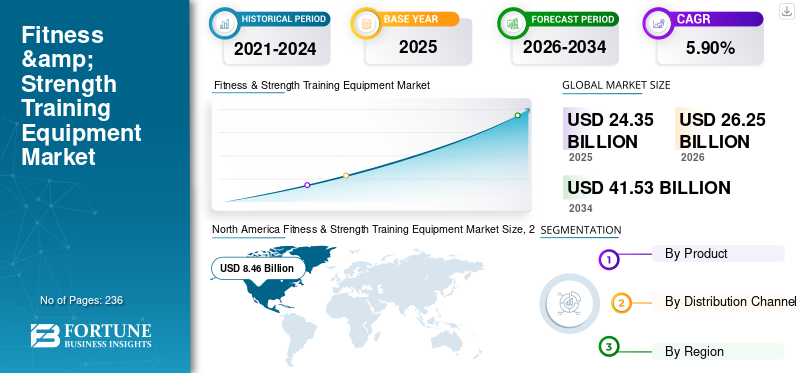
The global fitness & strength training equipment market size was valued at USD 24.35 billion in 2025 and is projected to grow from USD 26.25 billion in 2026 to USD 41.53 billion by 2034, exhibiting a CAGR of 5.90% during the forecast period. North America dominated the fitness & strength training equipment market with a market share of 34.74% in 2025.
Fitness and strength training equipment provide physical & mental health benefits, including increased muscle mass, improved bone density, better metabolism, and reduced injury risk. The growing emphasis on healthy lifestyles and multiple fitness activities is driving demand for these products. In addition, the growing number of gyms and fitness centers buying large quantities of technologically advanced exercise equipment to maintain the required facility ambience is driving product sales across many countries.
Key companies in the global market include Johnson Health Tech Co., Ltd., Technogym S.p.A., Peloton Interactive, Inc., iFIT Health & Fitness Inc., and Life Fitness, LLC.
Download Free sample to learn more about this report.
Fitness & Strength Training Equipment Market Key Takeaways
 Global Market Size & Forecast
- 2025 Market Size: USD 24.35 billion
- 2026 Market Size: USD 26.25 billion
- 2034 Forecast Market Size: USD 41.53 billion
- CAGR: 5.90% from 2026–2034
 Market Share
- North America dominated the fitness & strength training equipment market with a 34.74% share in 2025.
- The cardio equipment segment accounted for a 35.56% market share in 2025.
- The online retail segment held a leading market share of 40.86% in 2025.
 Key Regional Highlights
North America
North America held the leading market position in 2025 and is projected to reach USD 9.02 billion by 2026.
Asia Pacific
Asia Pacific accounted for 28.51% of the global market in 2025, with a market size of USD 6.94 billion.
Europe
Europe represented 28.09% of the global market in 2025 and is projected to reach USD 7.26 billion by 2026.
U.S.
The market size reached USD 7.00 billion in 2025.
Japan
The market was valued at approximately USD 1.27 billion in 2025.
Read More

FITNESS & STRENGTH TRAINING EQUIPMENT MARKET TRENDS
Rising Demand for Connected Technology-based Fitness Equipment to Augment Market Growth
IoT-based fitness equipment enhances user workouts with data-driven experiences through digital displays, embedded sensors, Bluetooth/Wi-Fi connectivity, and AI-powered software applications. The rising demand for smart and connected IoT technology-based fitness equipment designed for users to personalize their workout sessions is augmenting the global market growth. In addition, the growing number of premium gyms seeking smart fitness products to help operators manage equipment usage, maintenance schedules, and member engagement through centralized digital platforms is driving demand for these products.
MARKET DYNAMICS
MARKET DRIVERS
Download Free sample to learn more about this report.
Increasing Participation in Gym and Strength Training Programs to Drive Product Demand
The growing global demand for gym memberships and strength-training programs for muscle building, weight management, and overall fitness is driving facility operators’ demand for these products. In addition, the growing number of fitness influencers, social media fitness communities, and structured training programs encouraging individuals to adopt resistance training practices is positively contributing to the global fitness & strength training equipment market growth. According to the Health & Fitness Association, in 2023, 1 in 4 (24.9%) Americans aged 6 and older held a fitness facility membership, which increased by 5.6% in 2024.
MARKET RESTRAINTS
High Cost of Advanced Fitness Equipment to Restrain Market Growth
The high cost of advanced fitness equipment is reducing demand among small-scale gyms, independent fitness studios, and price-sensitive consumers. In addition, uncertain repair and maintenance costs associated with the smart exercise machines used in gym facilities are incurring additional operational costs on gym equipment operators, restraining global market growth. Space constraints and high exercise bike prices are negatively affecting demand among budget-conscious homeowners.
MARKET OPPORTUNITIES
Rising Demand for Premium-based Strength Training Equipment to Create New Market Growth Opportunities
Manufacturers are producing equipment made of advanced materials, precision engineering, improved biomechanics, and enhanced ergonomic designs to deliver better training efficiency, safety, and user comfort. The rising demand for high-quality, durable, and performance-oriented premium equipment in commercial gyms is creating new market growth opportunities. In addition, the growing number of consumers seeking premium equipment with customizable weight systems, high-grade steel frames, improved grip textures, premium upholstery, and aesthetically appealing designs is driving global market expansion.
MARKET CHALLENGES
Intense Competition from Local Manufacturers Offering Products at Competitive Prices to Challenge Key Players' Business Expansion
Intense competition from local manufacturers offering fitness & strength training products at competitive prices is negatively impacting the key players’ product sales across many countries. Furthermore, the growing number of small manufacturers offering cheaper-priced dumbbells, benches, and functional training accessories is hindering sales of premium products globally.
Segmentation Analysis
By Product
Significant Emphasis on Maintaining Cardio Health Led to Dominance of Cardio Equipment Segment
By product, the market is segmented into cardio equipment, strength training equipment, functional training equipment, and others.
The cardio equipment segment accounted for the leading global fitness & strength training equipment market share with 35.56% in 2025. Cardiovascular training helps individuals maintain healthy sugar & blood pressure levels and improve cardiovascular health. Significant emphasis on maintaining cardio health, and the high number of individuals seeking cardio exercise equipment to treat their cardio diseases, are generating considerable segmental revenues. In addition, advancements in the development of smart treadmills and stationary bikes equipped with digital panels and smartphone connectivity are augmenting the segment’s growth.
To know how our report can help streamline your business, Speak to Analyst
The functional training equipment segment is projected to grow at the fastest rate of 6.54% from 2026 to 2034. The functional training equipment, including kettlebells, resistance bands, medicine balls, suspension trainers, sleds, and training rigs, better supports dynamic, multi-joint movements that improve strength, balance, flexibility, and overall athletic performance. The growing popularity of high-intensity, full-body, performance-oriented workout programs that use functional equipment is driving the segment’s growth.
By Distribution Channel
Greater Online Shopping Convenience Led Online Retail Segment’s Dominance
Based on distribution channel, the market is segmented into specialty sports retail stores, online retail, hypermarkets & supermarkets, department stores, institutional/direct sales (B2B), and others.
The online retail segment exhibited a leading global market share with 40.86% in 2025. The segment is growing at the fastest CAGR of 6.89% from 2026 to 2034. Online marketplaces, brand sites, and e-commerce platforms enable consumers to compare fitness equipment types, prices, specifications, and customer reviews before purchasing. Greater online shopping convenience is driving significant revenue growth for the online retail segment. In addition, rising demand for home gym facilities is driving online shopping for gym machines at discounted rates, favoring the segment’s growth.
The institutional/direct sales (B2B) segment is growing at the second-fastest CAGR of 6.03% from 2026 to 2034. The expanding number of commercial fitness centers, health clubs, hotels, corporate wellness facilities, and other settings ordering commercial-grade, durable exercise machines is driving the segment’s growth.
Fitness & Strength Training Equipment Market Regional Outlook
By region, the market is categorized into North America, Europe, Asia Pacific, South America, and the Middle East & Africa.
North America
North America Fitness & Strength Training Equipment Market Size, 2025 (USD Billion)
To get more information on the regional analysis of this market, Download Free sample
The North America region held a leading global market share with 34.72% in 2025. The North American market size is estimated to reach USD 9.02 billion by 2026. Growing awareness of health and wellness, a strong gym culture, and higher adoption of products across consumer and commercial end-users are driving significant product revenues across the region. In addition, the growing number of consumers seeking to replace their existing equipment with technologically advanced products is augmenting the region’s market growth.
U.S. Fitness & Strength Training Equipment Market
The U.S. market size reached USD 7.00 billion in 2025. The U.S. market accounted for around 28.75% of the global market sales in 2025. The increasing gym membership rate and widespread adoption of structured workout routines among consumers are driving market growth across the U.S.
Europe
The European region held third place in global market share with 28.09% in 2025. The region’s market size to reach USD 7.26 billion in 2026. The region is expected to maintain its international market position during the forecast period (2026-2034). The growing popularity of enrolling in functional training zones and strength-focused workout programs, encouraging consumers to purchase racks, free weights, and multifunctional training systems, is driving market growth across Europe. In addition, the growing number of gyms offering discounted membership rates is positively contributing to product revenue growth across the region. Besides, the rising demand for subscription-based fitness services, enabling consumers to personalize workouts, is driving European market growth.
U.K. Fitness & Strength Training Equipment Market
The U.K. market was valued to be around USD 1.21 billion in 2025, representing approximately 4.95% of global product revenues.
Germany Fitness & Strength Training Equipment Market
Germany’s market reached approximately USD 1.27 billion in 2025, equivalent to around 5.19% of global product sales.
Asia Pacifia
The Asia Pacific region held the second-largest global market share with 28.51% and a market size of USD 6.94 billion in 2025. The region’s market is projected to grow at the second-fastest rate of 7.08% during 2026-2034. The growing expansion of modern fitness centers, boutique gyms, and wellness clubs is driving the product demand across China, Japan, South Korea, and India. In addition, rising disposable incomes and the growing number of social media influencers promoting the benefits of body workouts are positively contributing to product sales growth across the region.
Japan Fitness & Strength Training Equipment Market
The Japanese market was valued at around USD 1.27 billion in 2025, accounting for roughly 5.20% of global product revenues.
China Fitness & Strength Training Equipment Market
China’s market is projected to be one of the largest in the Asia Pacific, with revenues valued at around USD 2.53 billion in 2025, representing roughly 10.39% of global product sales. The growing number of Chinese consumers adopting home fitness solutions is driving demand for compact strength-training equipment, adjustable weights, and training systems nationwide.
India Fitness & Strength Training Equipment Market
The Indian market was valued at around USD 1.38 billion in 2025, accounting for roughly 5.68% of global market revenues.
South America
Over the global market forecast period, the South American market is expected to grow at a moderate rate from 2026 to 2034. The South America market reached a valuation of USD 1.23 billion in 2025. The growing influence of fitness culture, rising sports participation rates, and social media-driven wellness trends is boosting product demand across the region. In addition, the rising popularity of gym-based workouts across Argentina, Brazil, and Colombia is favoring the region’s market growth.
Brazil Fitness & Strength Training Equipment Market
The Brazilian market was valued at around USD 0.62 billion in 2025, accounting for roughly 2.54% of global market revenues.
Middle East & Africa
The Middle East & Africa region’s market is projected to grow at the fastest rate of 8.02% during 2026-2034. Governmental investment in building fitness & sports infrastructure and the expanding base of luxury gyms, premium fitness clubs, and hotel fitness facilities, along with the installation of high-quality exercise equipment, are driving market growth across the region. In the Middle East & African market, Saudi Arabia is expected to reach a market value of USD 0.194 billion by 2025.
South Africa Fitness & Strength Training Equipment Market
The South African market reached approximately USD 0.188 billion in 2025, accounting for roughly 0.78% of the global market revenues.
COMPETITIVE LANDSCAPE
Key Industry Players
Significant Focus on Product Innovation and Distribution Network Building to Uplift Key Players’ Market Position
The key players operating in the global market are Johnson Health Tech Co., Ltd., Technogym S.p.A., Peloton Interactive, Inc., iFIT Health & Fitness Inc., and Life Fitness, LLC. These players consistently focus on strengthening their distribution network to maintain their global market position. In addition, they establish strategic partnerships with technology companies to produce innovative products.
LIST OF KEY FITNESS & STRENGTH TRAINING EQUIPMENT COMPANIES PROFILED IN REPORT
- Johnson Health Tech Co., Ltd. (U.S.)
- Technogym S.p.A. (Italy)
- Peloton Interactive, Inc. (U.S.)
- iFIT Health & Fitness Inc. (U.S.)
- Life Fitness, LLC (U.S.)
- Core Health & Fitness, LLC (U.S.)
- BowFlex Inc. (U.S.)
- TRUE Fitness Technology, Inc. (U.S.)
- Torque Fitness LLC (U.S.)
- Shuhua Sports Co., Ltd. (China)
KEY INDUSTRY DEVELOPMENTS
- March 2026: Jerai Fitness Limited, an exercise products manufacturer, partnered with Plus Fitness India to broaden its product distribution capabilities across the partnered company’s 100 gyms located across India.
- October 2025: Firstcry through its Globalbees Brands Private Limited subsidiary acquired 14.91% stake in the Dynamic IT Solution Private Limited to strengthen its position in the fitness equipment and sports products industry.
- July 2025: iFIT expanded its partnership with Ergatta to develop fitness products featuring game-based content. These products include bikes, rowers, and treadmills.
- May 2025: Sunny Health & Fitness acquired JLL Fitness, a U.K.-based performance-driven products brand to broaden its product portfolio and expand its business presence in the home & commercial fitness products industry.
- April 2025: Interactive Strength Inc. acquired Wattbike, a U.K.-based indoor cycling brand, to become a distributor of fitness equipment for the widely attended trade shows held across the U.S.
- December 2024: Sunny Health & Fitness, a cardio equipment maker, launched the Sunny Strength Line, including heavy-duty machines, stylish free weights, dumbbells, bars, and accessories.
REPORT COVERAGE
The global fitness & strength training equipment market analysis provides an in-depth study of market insights, market size, and forecast by distribution channel, as well as all other market segments included in the report. In addition, the report outlooks market dynamics, consumer preferences for products, and market trends expected to drive the market during the forecast period. The report on the market includes information on technological advancements, new product launches, key developments in the industry, and details on partnerships, mergers & acquisitions. The market research report also encompasses a detailed competitive landscape with information on the market share and profiles of key operating players.
Request for Customization to gain extensive market insights.
Report Scope & Segmentation
| ATTRIBUTE | DETAILS |
| Study Period | 2021-2034 |
| Base Year | 2025 |
| Estimated Year | 2026 |
| Forecast Period | 2026-2034 |
| Historical Period | 2021-2024 |
| Growth Rate | CAGR of 5.90% from 2026 to 2034 |
| Unit | Value (USD Billion) |
| Segmentation | By Product, Distribution Channel, and Region |
| By Product |
|
| By Distribution Channel |
|
| By Region |
|
Frequently Asked Questions
Fortune Business Insights says that the global market value stood at USD 24.35 billion in 2025 and is projected to reach USD 41.53 billion by 2034.
In 2025, the North Americas market value stood at USD 8.46 billion.
At a CAGR of 5.90%, the global fitness & strength training equipment market projected to grow during 2026-2034.
By product, the cardio equipment segment is projected to hold the leading global market share throughout the forecast period.
Increasing participation in gym and strength training programs is driving market growth.
Johnson Health Tech Co., Ltd., Technogym S.p.A., Peloton Interactive, Inc., iFIT Health & Fitness Inc., and Life Fitness, LLC. are among the top players in the market.
North America held the largest market share in 2025.
The rising demand for premium strength-training equipment is creating new market growth opportunities.



- 2021-2034
- 2025
- 2021-2024
- 236
-
(Offer valid till 31st Oct 2026)
Get 30-60 hrs Free Customization
Expand Regional and Country Coverage, Segments Analysis, Company Profiles, Competitive Benchmarking, and End-user Insights.



















Related Reports
-
US +1 833 909 2966 ( Toll Free )
-
Get In Touch With Us