Flexible Lid Stock Packaging Market Size, Share & Industry Analysis By Material (Plastic, Aluminum Foil, Paper, and Hybrid), By Product Type (Pints/Cups, Trays & Containers, Bottles, Blister Packs, and Others), By End Use (Food & Beverages, Pharmaceuticals, Pet Care, Personal Care & Cosmetics, and Others), and Regional Forecast, 2026-2034
 Download Free Sample
(Offer valid till 31st Oct 2026)

KEY MARKET INSIGHTS
 Listen to Audio Version
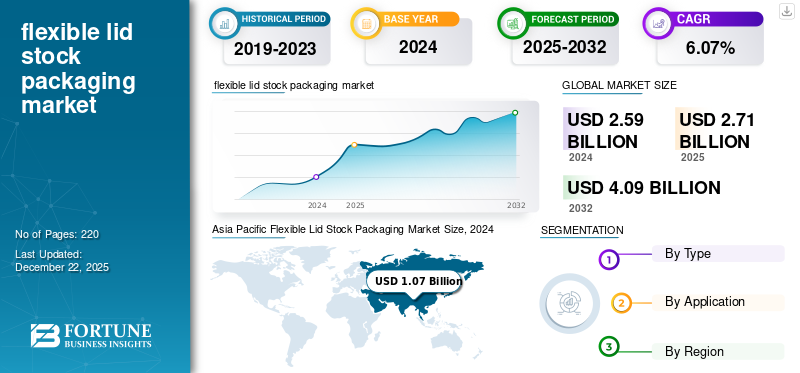
The global flexible lid stock packaging market size was valued at USD 2.71 billion in 2025. It is projected to grow from USD 2.85 billion in 2026 and reach USD 4.68 billion by 2034, exhibiting a CAGR of 6.39% during the forecast period. Asia Pacific dominated the flexible lid stock packaging market with a market share of 41.83% in 2025.
Flexible lid stock packaging consists of thin, adaptable films utilized to seal various containers, particularly in the food, pharmaceutical, and personal care sectors. These films offer a protective shield, help preserve the freshness of products, and extend shelf life by blocking contaminants. Typically, they are crafted from substances such as aluminum foil, polyester, or laminated plastics and can be sealed to containers using heat. Commonly used materials include plastics such as polyethylene (PE) and polypropylene (PP), aluminum foil, and sometimes paper or non-woven materials. These are chosen for their flexibility, durability, and ability to be sealed effectively.
Flexible lid stock packaging solutions effectively serve as a protective layer for a range of trays, containers, and cups, maintaining the safety and freshness of the items inside. Widely utilized in the food sector, these films create an airtight seal, protecting against external contaminants, oxygen, and moisture, which in turn enhances the shelf life of perishable items. Lidding films are ruling over industries owing to their effectiveness in shielding contents against environmental elements.
Download Free sample to learn more about this report.
FLEXIBLE LID STOCK PACKAGING MARKET KEY TAKEAWAYS
 Global Market Size & Forecast
- 2025 Market Size: USD 2.71 billion
- 2026 Market Size: USD 2.85 billion
- 2034 Forecast Market Size: USD 4.68 billion
- CAGR: 6.39% from 2026–2034
 Market Share
- Asia Pacific dominated the flexible lid stock packaging market with a 41.83% share in 2025.
- The plastic segment is projected to account for 52.63% of the market in 2026.
- The trays & containers segment is expected to hold 43.65% of the global market in 2026.
 Key Regional Highlights
Asia Pacific
Asia Pacific the market reached USD 1.13 billion in 2025 and is projected to grow to USD 1.20 billion in 2026.
North America
North America the market was valued at USD 0.72 billion in 2025 and is expected to reach USD 0.75 billion in 2026
Europe
Europe the market reached USD 0.61 billion in 2025 and is projected to grow to USD 0.64 billion in 2026.
U.S.
The market is projected to reach USD 0.66 billion in 2026.
Japan
The market is projected to reach USD 0.19 billion in 2026.
Read More

Constania Flexibles and Winpak are the leading manufacturers, accounting for the largest global market share.
MARKET DYNAMICS
MARKET DRIVERS
Mounting Demand for Lid Stock Packaging in Food & Beverages Sector to Drive Market Growth
The global flexible lid stock packaging has gained significant traction worldwide, fueled by the increasing demand for effective packaging products across the food and beverages sector. The lid stocks serve as a protective layer over cups, bottles, containers, and trays, ensuring product safety, prolonged shelf life, as well as enhanced consumer appeal.
Lidding films or lid stock packaging used in food and beverage packaging provide a variety of advantages, mainly focused on prolonging shelf life, upholding product quality, and improving safety and convenience for eco conscious consumers. These films serve as protective barriers against oxygen, moisture, and contaminants, helping to avoid spoilage and retain the freshness and taste of food items.
Lidding films are widely utilized for sealing fresh fruits and vegetables, prepared meals, dairy items, drinks, and frozen goods. They help maintain product freshness, protect against contamination, and provide evidence of tampering. In addition, they allow for straightforward opening and resealing, enhancing the overall experience for consumers.
Growing Pharmaceutical Sector to Fuel Global Packaging Market Expansion
Lidding films or lid stock packaging play an essential role in the packaging of pharmaceuticals by preserving product sterility, integrity, and longevity. They are utilized to seal different types of containers, such as medical trays, blister packs, and pouches, creating a protective barrier against contamination, moisture, and oxygen. Additionally, these films aid in tamper evidence and guarantee product safety throughout storage and transportation.
Lid stock packaging is used to form the lidding material in blister packs, which are commonly used for tablets, capsules, and other solid dosage forms, providing a secure and tamper-evident seal. They also seal medical trays containing surgical instruments, diagnostic devices, or pharmaceutical kits, ensuring a sterile environment for the contents.
The growing pharmaceutical sector worldwide is majorly seeking efficient packaging solutions that can provide excellent barrier properties against oxygen, moisture, and other contaminants, preserving the stability and efficacy of pharmaceutical products. This propels the demand for lidding films in the pharma industry.
MARKET RESTRAINTS
Environmental Concerns and Economic Fluctuations Could Hinder the Growth of the Market
While the flexible lid packaging market is gaining traction due to factors such as increasing consumer demand for packaged food, technological advancements, and the growth of pharmaceutical sectors, it is also facing significant challenges that are hindering flexible lid stock packaging market.
Environmental sustainability has become a critical issue globally and the packaging industry is under increasing scrutiny for its role in environmental degradation. Packaging solutions, particularly single-use plastics, are a significant contributor to pollution, waste, and resource depletion. The growing awareness around climate change and environmental sustainability is pushing both consumers and governments to demand eco-friendly solutions.
Moreover, the environmental impact of plastic packaging is substantial, especially when it comes to single-use plastics. Many plastics are non-biodegradable and end up in landfills or oceans, where they pose a serious threat to wildlife and ecosystems. This has led to widespread calls for reducing plastic waste, and many governments have started to implement bans or taxes on certain types of plastic packaging.
MARKET OPPORTUNITIES
Escalating Demand for Sustainable and Eco-Friendly Packaging Offers Potential Growth Opportunities
As consumers and governments push for more environmentally friendly products, there is a soaring demand for sustainable packaging options, such as compostable materials, biodegradable plastics, and recyclable packaging. Brands are increasingly designing packaging solutions that can be recycled, reused, or repurposed to adopt circular economy practices, reducing waste and generating new business opportunities in the process.
The sustainability trend in flexible lid stock packaging is reshaping the industry, driven by the growing environmental awareness, regulatory pressure, and consumer preferences shift toward convenience. Modern consumers, especially Gen Z and millennials, are actively seeking brands that demonstrate environmental responsibility. This is pushing companies to replace conventional plastic films with more sustainable alternatives, such as the use of aluminum or paper for the manufacturing of lid stocks.
MARKET CHALLENGES
Rising Material Costs and Competitive Pressures Can Create Challenges for Market Growth
Industry players face difficulties that arise from fluctuating raw material prices, especially for resins and aluminum foil, affecting production expenses and profit margins. Complicated recycling systems and variable international regulations impede the implementation of eco-friendly mono-material options. Disruptions in the supply chain, a lack of workforce, and increasing logistics expenses create operational strain. Swift technological advancements necessitate ongoing investment in equipment and material innovation, presenting challenges for smaller companies. Moreover, fulfilling various sealing, barrier, and safety standards in food and healthcare industries complicates the design process. Increasing competition heightens pricing pressures, while maintaining a balance of functionality, sustainability, and cost effectiveness continues to be a lasting challenge in the industry.
FLEXIBLE LID STOCK PACKAGING MARKET TRENDS
Rising Demand for Convenience and Safety Drives Innovation in the Market
The global flexible lid stock packaging sector is witnessing consistent growth, fueled by increasing demand for convenience foods, longer shelf-life options, and eco-friendly packaging. The growing use of mono-material recyclable designs, peel-reseal features, and high-barrier films showcases regulatory demands and consumer desire for environmentally friendly choices. Growth in ready-meal, dairy, meat, and medical packaging markets drives advancements in seal-through-contamination technology and digital printing for improved traceability. Regional production growth and diversified sourcing approaches further help improve supply chain robustness. In addition, online shopping and refrigerated meal delivery increase product demand, as brand owners emphasize packaging that integrates functionality, safety, and sustainability to address changing global food and healthcare market requirements.
Download Free sample to learn more about this report.
IMPACT OF COVID-19 ON THE GLOBAL FLEXIBLE LID STOCK PACKAGING MARKET
The COVID-19 pandemic greatly transformed the global flexible lid stock packaging industry. The initial disruptions during the period included supply chain bottlenecks, shortages of raw materials, and a significant drop in foodservicef demand, counterbalanced by increased requirements for retail grocery, healthcare, and e-commerce packaging. Increased hygiene and safety worries boosted the need for tamper-proof, high-barrier, and resealable lids, as extended shelf life became essential. Companies and converters focused on recyclable and biodegradable material designs, digital printing, and robust supply chains. Between 2022 and 2025, the demand leveled off at elevated levels compared to pre-pandemic times, fueled by the rise of convenience foods, sustainability regulations, and growth in regional manufacturing, while consistently prioritizing reliability, safety, and circular packaging options.
SEGMENTATION ANALYSIS
By Material
Plastic Segment Leads Due to Benefits of Enhanced Product Freshness and Shelf Life
Based on material, the market is segmented into plastic, aluminum foil, paper, and hybrid.
Plastic is the dominating material segment in the global market and is expected to grow in the upcoming years. Plastic lidding films offer several benefits in packaging, particularly for food products. They enhance product freshness and shelf life by providing a barrier against oxygen and moisture and can also improve consumer convenience and brand presentation. The plastic segment is projected to dominate the market with a share of 52.63% in 2026.
Aluminum foil is the second-dominating material segment in the global market. Aluminum lid stock offers a robust shield against moisture, oxygen, light, and various contaminants, aiding in preserving food freshness and preventing spoilage.
By Product Type
Trays & Containers Segment Bags Leading Share Owing to their Vacuum and Heat-Sealing Capabilities
Based on product type, the market is segmented as pints/cups, trays & containers, bottles, blister packs, and others.
The trays & containers segment dominates the global flexible lid stock packaging market share. The segment is anticipated to foresee noteworthy growth over the forecast period. Trays and containers are versatile and can accommodate various products, such as antipasto, meats, cheeses, olives, mushrooms, and both roasted and chargrilled items. These meat trays offer vacuum and heat-sealing capabilities. The trays & containers segment is projected to dominate the market with a share of 43.65% in 2026.
The pints/cups segment is the second-dominating product type segment. Food cups and pints, particularly disposable ones, offer several benefits, including convenience, hygiene, and cost-effectiveness, especially for events and takeout services. Such benefits increase its usage in the food sector.
By End Use
To know how our report can help streamline your business, Speak to Analyst
Food & Beverage Segment Dominates Owing to Rising Product Usage for Maintaining Food Freshness
Based on end use, the market is segmented as food & beverages, pharmaceuticals, pet care, personal care & cosmetics, and others.
The food & beverages segment is the dominating end-use segment. The segment will experience noteworthy growth due to the rapidly growing food and beverage sector and increasing product usage. Lidding films serve as a protective layer against moisture, oxygen, and various contaminants, maintaining the freshness and flavor of frozen, ready-to-eat meat as well as baked products. In 2026, the food & beverages segment is projected to lead the market with a 59.54% share.
The pharmaceuticals segment is the second leading end-use segment. Lidding films are widely used in unit-dose product packaging, assuring the accuracy of medication dosage. Their strong seal integrity, barrier properties, and compatibility with various substrates make them ideal for blister packs, sachets, and other pharmaceutical applications. In addition, the growing emphasis on patient safety, child-resistant packaging, and compliance with stringent regulatory standards is further driving demand.
FLEXIBLE LID STOCK PACKAGING MARKET REGIONAL OUTLOOK
The market has been studied geographically across five main regions: North America, Europe, Asia Pacific, Latin America, and the Middle East & Africa.
North America
Asia Pacific Flexible Lid Stock Packaging Market Size, 2025 (USD Billion)
To get more information on the regional analysis of this market, Download Free sample
Rising Demand from Food and Pharmaceutical Sectors Drives North America Market Growth
North America contributed approximately USD 0.72 billion to the global market in 2025, accounting for 26.64% share, and is expected to reach USD 0.75 billion in 2026. The North American market is a significant sector within the broader global packaging industry, with diverse applications across food, beverage, pharmaceuticals, and personal care sectors. The market has been growing steadily, with increasing demand from both the food and pharmaceutical sectors. The U.S. market is valued at USD 0.66 billion by 2026.
- The rising utilization of flexible packaging in the U.S. also drives market growth. According to the Flexible Packaging Association, the largest market for flexible packaging in the U.S. is food (retail and institutional), making up about 50% of shipments. Other markets for flexible packaging include personal care – 5%; pet food – 2%; beverages – 6%; other non-food – 9%; consumer products – 2%; industrial applications – 7%; and medical and pharmaceutical – 16%. The soaring demand for flexible and personalized packaging is poised to drive the market growth in North America.
Europe
Shifting Consumer Lifestyles and Technological Advancements Propel Europe Market Growth
In 2025, the Europe market stood at USD 0.61 billion, representing 22.54% of global demand, and is projected to grow to USD 0.64 billion in 2026. The European flexible lid stock packaging market presents numerous opportunities, especially in sustainability, innovation, and compliance with regulatory frameworks. With technological advancements and e-commerce growth further accelerating market dynamics, the sector offers plenty of growth potential for companies that innovate and adapt to these shifts. The greater convenience, flexibility, and cost-effective features of the packaging better fit the changing lifestyle needs of consumers, driving market growth. The UK market is expected to reach USD 0.06 billion by 2026, while the Germany market is assessed at USD 0.16 billion by 2026.
- The European Commission recently adopted a strategy for plastics that aims at significantly improving capacity for plastic recycling, with a target of 55% of the EU's total plastic waste recycled by 2025. With the goal of ensuring 100% recyclable plastic by 2030, the European Union is leading the world's governing bodies in a drive to accept and adopt recyclates.
Asia Pacific
Economic Growth, Sustainability Trends, and Plastic Bans Fuel Expansion of the Asia Pacific Market
The Asia Pacific region captured 41.83% of the global market in 2025, generating USD 1.13 billion in revenue, and is projected to reach USD 1.2 billion in 2026. The Asia Pacific region is the leading region in the global market and is projected to see significant growth over the upcoming years. The packaging sector in Asia Pacific is vibrant and varied, propelled by swift economic development, shifting consumer preferences, and advancing technology. Businesses in the Asia Pacific region are prioritizing materials such as paper, bioplastics, and biodegradable plastics. There is a substantial opportunity for packaging companies to innovate in this domain, especially in light of bans on single-use plastics in nations such as India, China, and Australia. The Japan market is forecast to attain USD 0.19 billion by 2026, the China market is set to reach USD 0.39 billion by 2026, and the India market is anticipated to achieve USD 0.27 billion by 2026.
- World Bank projects 5.0% in 2024 easing to 4.0% in 2025 (China 4.0%, Indonesia 4.7%, Philippines 5.3%, and Vietnam 5.8%). Bigger food & FMCG bases typically lift demand for lidding films in retail/modern trade.
Latin America
Rising Middle-Class Incomes and Evolving Preferences Drive Growth in Latin American Market
Latin America recorded a market size of USD 0.15 billion in 2025, capturing 5.68% of the global market share, and is projected to reach USD 0.16 billion in 2026. The flexible lid stock packaging market in Latin America is rapidly changing, propelled by shifts in consumer preferences, economic growth, and advancements in technology. The growing middle class in nations such as Brazil, Mexico, and Argentina is fueling a higher demand for packaged goods. With rising disposable incomes, consumers are choosing more convenient, ready to eat meals, and upscale packaged options.
- According to AMVO, in 2024, Mexico’s retail e-commerce market touched a value of MXD 789.7 billion (USD 39 billion), representing a 20% surge compared to the 2023 value of MXD 658 billion and marking six consistent years of robust double-digit growth. The penetration of online shopping surged to 84%, surpassing the global average (60%) and countries such as India (63%). More than 67 million consumers made at least one online purchase in the last year, with 60% shopping monthly.
Middle East & Africa
Sustainability Policies and Booming F&B Sector Accelerate Growth in the Middle East & Africa Market
In 2025, Middle East & Africa generated USD 0.09 billion, contributing 3.32% to global market revenue, and is projected to grow to USD 0.09 billion in 2026. The market in the Middle East and Africa is evolving rapidly. Brands are increasingly adopting packaging solutions that can be reused or recycled. This is being fueled by government policies in various countries in the region and the consumer demand for sustainable options.
The rapidly growing food and beverages sector in the region also influences the growth of the packaging market. The massive expansion is especially prominent in the GCC countries, where the food and beverage sector benefits from robust economic infrastructure, favorable business conditions, and a growing focus on health and wellness among consumers. Innovations emphasizing sustainability and catering to consumer preferences for health-conscious and convenient options are critical.
- Saudi Arabia (Ministry of Tourism), 116 million visitors in 2024 (+6% YoY); official report cites record tourism spend—expands HORECA and convenience channels that rely on sealed ready-meals, dairy, and desserts.
COMPETITIVE LANDSCAPE
KEY INDUSTRY PLAYERS
Key Market Participants Launch New Products to Embrace Growth Opportunities
The global market is highly competitive and fragmented. A few significant players are dominating the market by offering innovative packaging solutions in the packaging industry. These key players constantly emphasize on the expansion of their clientele base across regions through innovation in their existing product ranges. The market report also highlights the major developments by manufacturing companies.
Major players in the industry include Tekni-Plex, Inc., Huhtamaki, Constantia Flexible, Sealed Air, Mas Flexible. Several other companies are focused on market scenarios and delivering advanced metal packaging solutions.
List of Key Flexible Lid Stock Packaging Companies Profiled
- Tekni-Plex, Inc. (U.S.)
- Huhtamaki (Finland)
- Constantia Flexible (Austria)
- Sealed Air (U.S.)
- Mas Flexible (Turkey)
- Berry Global (U.S.)
- Amcor plc (Switzerland)
- Elite Packaging (U.S.)
- Safepack (India)
- DuPont (U.S.)
- Wipak (Canada)
- KM Packaging Services Ltd. (U.K.)
- TOPPAN Packaging Americas Holdings, Inc. (Japan)
- Momar Industries (U.S.)
- Profol GmbH (Germany)
KEY INDUSTRY DEVELOPMENTS
- In July 2025, Greiner Packaging launched Click On and Click In sealing lids, which are mono-material packaging solutions aimed at improving sustainability and convenience by removing the necessity for aluminum foil while guaranteeing resealability and recyclability for a range of products. Sealing lids operate on a two-component principle: a cup and a lid. This enables the intentional exclusion of a third component such as aluminum foil. The benefit is that both elements can be constructed from the same material, such as PP, PET, or r-PET.
- In June 2025, KM Packaging introduced K-Peel 4G, a new specification for mono PET lidding film. K-Peel 4G features a low seal initiation temperature and can create seals even when there is contamination present. It achieves clean peels at temperatures as low as 110°C with a dwell time of 0.3 seconds. This low seal initiation temperature also ensures compatibility with all PET trays, delivering clean and robust peels for both APET and rPET trays. K-Peel 4G is particularly effective for trays that pose sealing difficulties due to their thickness or limited sealing area.
- In October 2024, Chadwicks declared the launch of sustainable lidding to the Scandinavian market. Chadwick's innovative line of eco-friendly lidding features a novel product that will be presented at Scanpack in Sweden: the rPET pre-cut lidding films. These incorporate up to 50% post-consumer resin (PCR), which decreases reliance on virgin plastics to lower carbon emissions. It is certified for food contact and is appropriate for butter, dips, spreads, yoghurts, and beverages, delivering the same quality as traditional PET pre-cut lidding.
- In March 2024, the material manufacturer, Parkside, introduced its newest innovation in flexible packaging, the Popflex lidding film, offering a recyclable solution for growers and packers of fresh produce. This film is designed to be welded and sealed to a compatible PET tray, ensuring it remains attached during the recycling process and minimizing the likelihood of PET contaminating the recycling streams for PP and PE. As a result, this new product received OPRL certification for recyclability in curbside collection programs, allowing consumers to conveniently dispose of the entire package in their recycling bin after use.
- In September 2022, Sappi Rockwell Solutions, a specialist in heat seal coatings, introduced a lightweight, recyclable lidding film tailored specifically for the fresh produce sector. The RockFruit lidding film range is highly adaptable and offers a robust, peelable seal on various substrates, including rPET, aPET, PVC, and aPET-lined paperboard. This film can be manufactured with variants containing 30% and 60% post-consumer recycled content to assist customers in the soft fruit industry in minimizing their environmental footprint.
INVESTMENT ANALYSIS AND OPPORTUNITIES
Sustainable packaging continues to gain momentum in North America. Reflecting this trend, MontClerc Capital has invested in Polykar to fuel the company’s next phase of growth. In August 2025, MontClerc Capital has made a significant strategic investment in Polykar, a leading Canadian manufacturer of sustainable flexible packaging solutions, by acquiring a minority stake to support the company’s growth in North America. The investment will enable Polykar to expand its production capacity and accelerate the development of innovative, environmentally friendly packaging solutions to meet rising market demand.
REPORT COVERAGE
The market research report provides a detailed market analysis. It focuses on key aspects such as top key players, competitive landscape, product/service types, market segments, Porter's five forces analysis, and leading market segments. Besides, the report offers insights into the market trends and highlights key industry developments. In addition to the abovementioned factors, the report encompasses several factors that have contributed to the market size and growth in recent years.
Request for Customization to gain extensive market insights.
REPORT SCOPE & SEGMENTATION
|
ATTRIBUTE |
DETAILS |
|
Study Period |
2021-2034 |
|
Base Year |
2025 |
|
Estimated Year |
2026 |
|
Forecast Period |
2026-2034 |
|
Historical Period |
2021-2024 |
|
Growth Rate |
CAGR of 6.39% from 2026 to 2034 |
|
Unit |
Value (USD Billion) |
|
Segmentation |
By Material
|
|
By Product Type
|
|
|
By End Use
|
|
|
By Region
|
Frequently Asked Questions
As per a study by Fortune Business Insights, the market was valued at USD 2.71 billion in 2025.
The market will likely grow at a CAGR of 6.39% over the forecast period (2026-2034).
By end-use, the food & beverages segment is the leading segment in the market over the forecast period.
The Asia Pacific market size stood at USD 1.13 billion in 2025.
The rising demand for lid stock packaging in the food & beverages sector is a key factor driving market growth.
Some of the top players in the market are Tekni-Plex, Inc., Huhtamaki, Constantia Flexible, Sealed Air, Mas Flexible, and others.
The global market size is expected to reach USD 4.68 billion by 2034.



- 2021-2034
- 2025
- 2021-2024
- 220
-
(Offer valid till 31st Oct 2026)
Get 30-60 hrs Free Customization
Expand Regional and Country Coverage, Segments Analysis, Company Profiles, Competitive Benchmarking, and End-user Insights.










Related Reports
-
US +1 833 909 2966 ( Toll Free )
-
Get In Touch With Us