Floor Scrubber Battery Market Size, Share & Industry Analysis, By Battery Chemistry (Flooded Lead-Acid, Sealed Lead-Acid, Gel Batteries, Lithium-Ion, and Others), By Battery Capacity (Below 100 Ah, 100–200 Ah, 200–300 Ah, and Above 300 Ah), By End User (Healthcare, Warehousing & Logistics, Commercial, Industrial, Retail, and Others), and Regional Forecast, 2026-2034
 Download Free Sample
Floor Scrubber Battery Market Size and Future Outlook
 Listen to Audio Version
The floor scrubber battery market size was valued at USD 1.36 billion in 2025. The market is projected to grow from USD 1.45 billion in 2026 to USD 2.30 billion by 2034, with a CAGR of 5.91% over the forecast period. North America dominated the floor scrubber battery market with a market share of 34.55% in 2025.
A floor scrubber battery is a rechargeable power source that powers battery-powered floor scrubber machines, efficiently cleaning floors and maintaining hard floor surfaces in commercial, industrial, and institutional facilities. These batteries supply electrical energy to power the scrubber's motors, brushes, water pumps, and control systems, enabling efficient cleaning without a direct power connection. Floor scrubber batteries are typically available in different chemistries, including flooded lead-acid, AGM, gel, and lithium-ion, depending on the machine type and operational requirements. They are designed to deliver consistent power, long runtime, and durability to support continuous cleaning operations in environments such as warehouses, hospitals, retail stores, and airports. The performance of these batteries directly influences machine productivity, charging frequency, and overall maintenance requirements.
The market growth is primarily driven by increasing adoption of mechanized cleaning equipment across commercial, industrial, and institutional facilities to improve operational efficiency and hygiene standards. The rapid expansion of warehouses, logistics centers, and large commercial infrastructures has significantly increased the demand for battery-powered floor scrubbers that require reliable energy storage solutions. Additionally, the rising shift toward lithium-ion batteries, which offer longer lifecycles, faster charging, and lower maintenance than traditional lead-acid batteries, is supporting market growth. The increasing deployment of autonomous and robotic floor-cleaning machines in large facilities is further accelerating demand for advanced battery technologies.
Tennant Company, Nilfisk Group, Alfred Kärcher, Diversey Holdings, and Hako Group are among the leading companies in this market. They are increasingly focusing on technological innovation, energy efficiency, and automation to enhance cleaning productivity and reduce operational costs. Many manufacturers are integrating advanced battery technologies, particularly lithium-ion systems, to improve machine runtime, enable faster charging, and minimize maintenance requirements. In addition, companies are expanding their portfolios of autonomous and robotic floor scrubbers to address the growing demand for automated cleaning solutions in large facilities such as warehouses, airports, and commercial buildings.
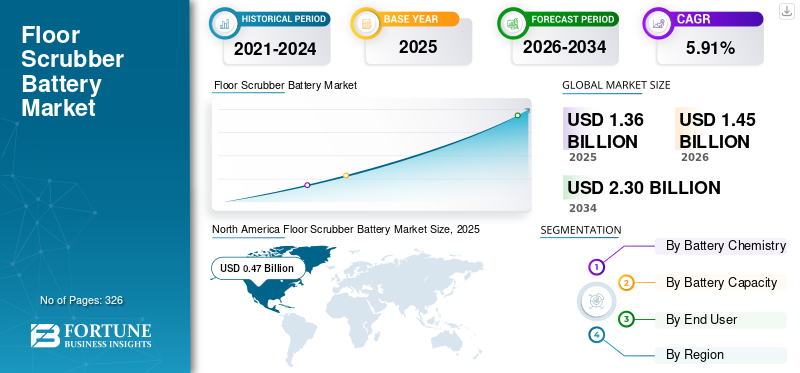
Download Free sample to learn more about this report.
FLOOR SCRUBBER BATTERY MARKET KEY TAKEAWAYS
 Global Market Size & Forecast
- 2025 Market Size: USD 1.36 billion
- 2026 Market Size: USD 1.45 billion
- 2034 Forecast Market Size: USD 2.30 billion
- CAGR: 5.91% from 2026–2034
 Market Share
- North America dominated the floor scrubber battery market with a 34.55% share in 2025.
- The flooded lead-acid segment accounted for 34.96% of the market in 2025.
- The warehousing & logistics segment held the largest share at 24.61% in 2025.
 Key Regional Highlights
North America
North America the market reached USD 0.47 billion in 2025, driven by widespread adoption of battery-powered floor scrubbers across warehouses, hospitals, airports, and retail facilities.
Europe
Europe valued at USD 0.34 billion in 2025, the region benefits from strict hygiene regulations and growing adoption of energy-efficient cleaning equipment.
Asia Pacific
Asia Pacific the market stood at USD 0.38 billion in 2025, supported by rapid urbanization, industrial growth, and expanding commercial infrastructure.
U.S.
The market was valued at USD 0.41 billion in 2025 and is projected to reach USD 0.43 billion in 2026, fueled by strong demand from logistics, healthcare, and retail sectors.
Japan
The market increased from USD 0.048 billion in 2025 to USD 0.052 billion in 2026, driven by automation trends and high hygiene standards.
Read More

Floor Scrubber Battery Market Trends
Increasing Adoption of Autonomous and Smart Cleaning Equipment is Amplifying Market Growth
A key trend reshaping the market is the growing adoption of autonomous and smart floor-cleaning equipment across large commercial and industrial facilities. Businesses are increasingly integrating automation into facility management operations to reduce labor dependency and improve cleaning efficiency. Autonomous floor scrubbers equipped with sensors, navigation systems, and AI-based mapping technologies can clean up to 60,000–80,000 square feet in a single cleaning cycle, making them highly suitable for warehouses, airports, and shopping malls.
In addition, modern cleaning machines are being integrated with IoT-based fleet management systems that allow operators to monitor battery status, machine usage, and maintenance schedules in real time. These machines rely heavily on high-performance batteries that support frequent charging and extended runtimes. As labor shortages continue to affect facility management operations across several countries and large facilities increasingly adopt automation. Thus, demand for reliable, efficient battery systems for autonomous floor scrubbers is expected to grow steadily worldwide.
MARKET DYNAMICS
Market Drivers
Download Free sample to learn more about this report.
Growth of Large Logistics and Distribution Facilities to Push Market Growth
The rapid expansion of logistics and distribution infrastructure worldwide is a major driver for the floor scrubber battery market growth. Modern warehouses and fulfillment centers often span extremely large floor areas and require continuous cleaning to maintain safety and operational efficiency. Some global logistics operators manage portfolios exceeding 1 billion square feet of warehouse space, reflecting the massive scale of modern distribution networks. These facilities typically operate multiple shifts and rely heavily on mechanized cleaning equipment such as ride-on and autonomous floor scrubbers powered by high-capacity batteries. Large logistics centers may cover hundreds of thousands of square feet, significantly increasing demand for battery-powered cleaning equipment with long runtime and reliable performance. The ongoing growth of e-commerce, manufacturing supply chains, and third-party logistics providers continues to drive the construction of new warehouses globally, thereby increasing the demand for floor scrubber machines and their associated battery systems.
Market Restraints
Continued Reliance on Cost-Effective Traditional Battery Systems To Limit Market Expansion
A key restraint in the global market is the continued reliance on traditional lead-acid battery technology in many facilities. Lead-acid batteries remain widely used because they offer a lower upfront purchase cost and well-established recycling infrastructure. However, their technical limitations, such as shorter cycle life and longer charging times, can restrict operational efficiency in high-utilization cleaning environments. For example, lead-acid batteries typically provide only 300–500 charge cycles, while lithium-ion batteries can exceed 1,000–5,000 cycles, significantly extending service life. Lead-acid systems also require longer charging times and more maintenance, including monitoring electrolyte levels and managing sulfation. Despite these limitations, many organizations continue to choose lead-acid batteries due to their lower initial cost and familiarity within the industry. This ongoing reliance on conventional battery technologies slows the adoption of advanced battery solutions and limits the pace of market transition toward higher-performance energy storage systems.
Market Opportunities
Growth of Robotic Floor Scrubbers to Create New Growth Avenues
The increasing deployment of autonomous and robotic cleaning machines presents a significant opportunity for the market. Large commercial and industrial facilities are adopting robotic floor scrubbers to address labor shortages and improve cleaning efficiency. These machines rely entirely on advanced battery systems to operate autonomously for extended periods. Lithium-ion battery technology is particularly well-suited for robotic cleaning applications due to its higher energy density and lightweight structure. Lithium-ion batteries can deliver 150–200 Wh/kg of energy density, compared with 30–50 Wh/kg for traditional lead-acid batteries, enabling smaller and lighter power systems with longer runtime. The ability to support opportunity charging and frequent charge cycles also makes lithium batteries ideal for autonomous equipment that must operate continuously throughout the day. As commercial buildings, airports, and logistics facilities increasingly integrate automation into their operations, demand for reliable, high-performance battery solutions for robotic cleaning machines is expected to expand substantially in the coming years.
Market Challenges
High Upfront Cost of Advanced Battery Systems to Limit Market Growth
Despite technological advantages, the relatively high initial cost of advanced battery systems remains a key challenge for the market. Lithium-ion batteries, which offer superior performance and lifespan, generally require a significantly higher upfront investment than lead-acid alternatives. In many applications, lithium-ion battery packs can cost two to three times more than conventional lead-acid batteries, creating a financial barrier for small and medium-sized businesses. Although lithium-ion batteries can last 10–15 years, compared with 3–5 years for typical lead-acid batteries, many organizations still prioritize lower initial capital expenditure when purchasing cleaning equipment. This cost sensitivity is particularly evident in developing markets where budget constraints influence equipment purchasing decisions. As a result, battery manufacturers and equipment suppliers must balance technological advancement with cost competitiveness to accelerate the adoption of high-performance battery technologies in commercial and industrial cleaning applications.
Segmentation Analysis
By Battery Chemistry
Lower Upfront Cost and Strong Compatibility Flooded Lead-Acid Batteires Leads to Segment Growth
Based on battery chemistry, the market is segmented into flooded lead-acid, sealed lead-acid, gel batteries, lithium-ion, and others.
Flooded lead-acid accounted for approximately 34.96% of the market share in 2025. Flooded lead-acid batteries hold the largest floor scrubber battery market share. This is mainly due to their lower upfront cost and strong compatibility with traditional walk-behind and ride-on scrubber machines. These batteries are commonly used in industrial cleaning environments where cost sensitivity is high, and equipment fleets are large. In addition, flooded lead-acid batteries can deliver 500–800 charge cycles, which is sufficient for many commercial cleaning operations. Although they require regular maintenance, such as water refilling and ventilation, their affordability and established supply chains continue to support strong adoption across developing and cost-focused markets.
Lithium-ion is predicted to grow with a CAGR of 6.80% during the forecast period.
To know how our report can help streamline your business, Speak to Analyst
By Battery Capacity
Wide Installation in Telecom Sector Leads to 100–200 Ah Segment Dominance
Based on battery capacity, the market is segmented into below 100 Ah, 100–200 Ah, 200–300 Ah, and above 300 Ah.
100–200 Ah accounts for approximately 33.36% of the market share. The segment leads the market as it offers a balance between storage capacity, cost, and operational flexibility. Batteries in this capacity range are widely used in telecom tower backup systems, medium-sized UPS installations, residential solar storage systems, and commercial backup power applications. Their moderate capacity allows them to provide power for several hours without significantly increasing system weight or footprint. Due to this versatility, they remain the most commonly deployed capacity range across telecom, renewable energy storage, and industrial backup power systems.
Below 100 Ah segment is expected to grow at a CAGR of 6.69% during the forecast period.
By End User
Rapid Expansion of E-Commerce Sector to Propel Warehousing & Logistics Segment Growth
Based on end user, the market is segmented into healthcare, warehousing & logistics, commercial, industrial, retail, and others.
The warehousing & logistics segment accounted for the largest share of 24.61% in the market in 2025. Warehousing and logistics facilities are gaining market share as e-commerce fulfillment centers and large distribution hubs expand rapidly. These facilities operate across large floor areas and often require heavy-duty ride-on or industrial cleaning machines powered by high-capacity batteries. As logistics operations run multiple shifts per day, demand for reliable battery systems and automated cleaning solutions continues to increase, supporting the steady growth of this segment.
The commercial segment is the second-largest, with a 23.08% share in 2025.
Floor Scrubber Battery Market Regional Outlook
By geography, the market has been studied across North America, Europe, Asia Pacific, Latin America, and Middle East & Africa.
North America
North America Floor Scrubber Battery Market Size, 2025 (USD Billion)
To get more information on the regional analysis of this market, Download Free sample
North America is the dominant region globally, with a market valued at USD 0.47 billion in 2025, accounting for approximately 34.57% of the market. North America is a mature, technologically advanced market, driven by the widespread adoption of automated cleaning equipment across commercial and industrial facilities. The region has a large installed base of floor scrubbers used in warehouses, hospitals, airports, and retail chains. The U.S. alone operates more than 20 million square meters of warehouse space in major logistics hubs, which requires frequent mechanized cleaning to maintain safety and hygiene standards. High labor costs in the region have accelerated the shift from manual cleaning to automated floor scrubbers, most of which rely on rechargeable battery systems. In addition, the region has seen rapid growth in large retail outlets and distribution centers driven by e-commerce expansion. Healthcare infrastructure also significantly influences equipment usage, with over 6,000 hospitals operating in the U.S. that require strict sanitation practices. These factors collectively sustain strong demand for reliable, long-duration battery systems for floor-cleaning machines across the region.
U.S. Floor Scrubber Battery Market
The U.S. market was valued at USD 0.41 billion in 2025 and is expected to reach USD 0.43 billion in 2026. The country has a highly developed commercial and industrial infrastructure that supports strong demand for floor scrubber batteries. Large logistics warehouses, healthcare facilities, airports, and retail chains widely use battery-powered floor scrubbers to maintain hygiene and operational efficiency in large indoor spaces.
Europe
Europe accounted for USD 0.34 billion in 2025, representing approximately 24.62% of global revenues. Europe is characterized by stringent regulatory standards on workplace hygiene, environmental sustainability, and energy efficiency, which have encouraged the use of battery-powered cleaning equipment. Many European facilities prefer electric floor scrubbers as they produce lower noise and emissions compared with traditional corded equipment. The region has a large network of commercial buildings and public infrastructure, including more than 1.5 million retail outlets across the European Union, which require regular cleaning operations. Industrial facilities also play a key role in driving demand, as Europe hosts over 2.3 million manufacturing enterprises, many of which use mechanized floor cleaning systems in production areas. Countries such as Germany, the U.K., France, and Italy are major adopters of advanced cleaning technologies. Additionally, airports, railway stations, and large shopping complexes across Europe rely heavily on automated floor scrubbers to maintain hygiene standards. This widespread use of cleaning equipment supports consistent demand for durable and high-performance battery solutions in the region.
Germany Floor Scrubber Battery Market
German market was valued USD 0.085 billion in 2025 and is predicted to reach USD 0.090 billion in 2026. Germany's strong industrial and manufacturing base supports the widespread use of mechanized cleaning equipment in production facilities and logistics warehouses. Strict workplace safety standards and advanced facility management practices continue to drive demand for reliable battery systems in floor scrubbers.
U.K. Floor Scrubber Battery Market
The U.K. market was valued at USD 0.050 billion in 2025 and is expected to reach USD 0.053 billion in 2026. The U.K. has a strong demand for automated floor cleaning equipment across transportation hubs, healthcare institutions, and commercial buildings. The growing emphasis on facility hygiene and efficient building maintenance has driven the adoption of battery-powered floor scrubbers across public and private infrastructure.
Asia Pacific
The Asia Pacific market was valued at USD 0.38 billion in 2025, accounting for approximately 28.06% of global revenues. Asia Pacific is experiencing rapid growth in the adoption of floor-cleaning equipment driven by urbanization, industrial expansion, and the development of modern commercial infrastructure. Developing countries such as China, India, and Japan are witnessing large investments in logistics hubs, manufacturing plants, airports, and shopping malls, all of which require efficient cleaning operations. China alone has over 1,200 large logistics parks and thousands of distribution centers, creating substantial demand for industrial floor scrubbers and their battery systems. Similarly, India has experienced a rapid expansion of organized retail, with more than 70 large shopping malls added annually in major cities, increasing the need for automated cleaning equipment. Rising labor costs in some urban areas and greater awareness of workplace hygiene have further encouraged businesses to adopt battery-powered cleaning machines instead of manual methods. As commercial infrastructure continues to expand across the region, the demand for reliable floor scrubber batteries is steadily increasing.
China Floor Scrubber Battery Market
China remains the dominant contributor in Asia Pacific region, reached a value of USD 0.17 billion in 2025 and predicted to showcase USD 0.18 billion revenue in 2026. China has a large and expanding market driven by rapid industrialization and urban infrastructure development. Manufacturing plants, logistics centers, and large commercial complexes increasingly rely on battery-powered floor scrubbers to efficiently maintain large operational spaces.
India Floor Scrubber Battery Market
India market reached USD 0.070 billion in 2025 and will be reaching a revenue share of USD 0.075 billion in 2026. India is an emerging market where the adoption of mechanized cleaning equipment is increasing across industrial facilities, retail centers, and transportation infrastructure. Growing urbanization and the modernization of facility management practices are driving demand for floor scrubber batteries.
Japan Floor Scrubber Battery Market
Japan was valued at USD 0.048 billion in 2025 and will reach USD 0.052 billion in 2026. Japan's market is influenced by its advanced technological environment and strong focus on automation. Commercial complexes, transportation facilities, and healthcare institutions widely adopt automated cleaning equipment to improve efficiency and maintain strict hygiene standards.
Latin America
Latin America market accounted for USD 0.10 billion in 2025, or approximately 7.42% of global revenues. Latin America is gradually adopting mechanized cleaning technologies as commercial and industrial infrastructure expands across the region. Countries such as Brazil and Mexico are seeing increasing development of large retail complexes, logistics warehouses, and manufacturing facilities that require efficient floor maintenance. Brazil has more than 600 large shopping centers and retail complexes, where automated floor cleaning equipment is commonly used to maintain hygiene standards and improve operational efficiency. Airports and hospitality facilities are also contributing to the growing demand for floor scrubbers and their battery systems, particularly in major tourist destinations. Industrial parks and manufacturing plants across the region are increasingly replacing manual cleaning methods with battery-powered equipment to improve productivity and safety. Although adoption is still developing compared to more mature markets, rising investments in commercial real estate and infrastructure projects are gradually expanding the use of floor scrubbers and associated battery technologies throughout Latin America.
Middle East & Africa
The Middle East & Africa market were valued at USD 0.07 billion in 2025. The Middle East & Africa region is witnessing growing adoption of automated cleaning equipment driven by large infrastructure projects, tourism expansion, and the modernization of commercial facilities. Gulf countries such as the United Arab Emirates and Saudi Arabia have developed numerous large shopping malls, airports, and hospitality complexes that require advanced cleaning solutions. The Middle East hosts over 1,200 large shopping malls and commercial complexes, many of which use automated floor scrubbers for daily maintenance. Airports are another major driver, as the region operates more than 90 international airports, where continuous cleaning operations are necessary to maintain passenger safety and cleanliness standards. Large hotels and tourism facilities also rely heavily on mechanized cleaning equipment to maintain high service quality. In Africa, urbanization and industrial development are gradually increasing the adoption of automated cleaning technologies in manufacturing plants and public facilities, driving the demand for floor scrubber batteries across the region.
GCC Floor Scrubber Battery Market
The GCC market reached USD 0.033 billion in 2025 and expected to reach USD 0.035 billion in 2026. GCC countries are experiencing increasing adoption of automated cleaning technologies as commercial infrastructure, tourism facilities, and transportation hubs rapidly develop. Large shopping complexes, hotels, and airports are major users of battery-powered floor scrubbers in the region.
COMPETITIVE LANDSCAPE
KEY INDUSTRY PLAYERS
Technological Advancement and Sustainable Initiatives by Key Players are Enhancing Market Competition
Leading companies such as Tennant Company, Nilfisk Group, Alfred Kärcher, Diversey Holdings, and Hako Group are actively strengthening their position in the floor cleaning equipment industry through continuous innovation, sustainability initiatives, and expansion of automated cleaning solutions. These companies are investing heavily in research and development to introduce advanced floor scrubbers equipped with automation, IoT connectivity, and energy-efficient battery technologies. Many players are also expanding their product portfolios to include robotic and autonomous cleaning machines that reduce labor dependency and improve operational efficiency in large facilities. In addition, companies are focusing on eco-friendly cleaning solutions that reduce water and energy consumption while maintaining high cleaning performance. Strategic partnerships, acquisitions, and global distribution expansion are also common approaches these firms use to strengthen market presence and address the growing demand for automated, sustainable cleaning technologies worldwide.
List of Key Floor Scrubber Battery Companies Profiled
- Tennant Company (U.S.)
- Nilfisk Group (Denmark)
- Alfred Kärcher SE (Germany)
- Hako Group (Germany)
- Diversey Holdings Ltd. (U.S.)
- Comac S.p.A. (Italy)
- Fimap S.p.A. (Italy)
- Numatic International Ltd. (U.K.)
- Amano Corporation (Japan)
- Eureka S.p.A. (Italy)
KEY INDUSTRY DEVELOPMENTS
- January 2026: Alfred Kärcher announced continued investment in its global sales network and cleaning technology portfolio following strong financial performance in 2025. The company reported USD 3.93 billion in revenue for 2025, reflecting steady growth and ongoing expansion of its cleaning equipment solutions worldwide. These investments include strengthening distribution channels and advancing professional cleaning systems used in industrial and commercial facilities.
- June 2025: Tennant emphasized the growing deployment of autonomous floor scrubbers and smart cleaning technologies across warehouses, factories, and logistics centers. The company promoted its robotic cleaning systems integrated with lithium-ion batteries and AI-based navigation to improve operational efficiency and reduce labor dependency in large facilities.
- December 2024: Tennant Company announced the launch of lithium-ion battery-powered versions of its T12 and T16 floor scrubbers, expanding its portfolio of advanced cleaning equipment. The introduction of lithium-ion technology aims to improve machine productivity by offering longer operating cycles, faster charging, and reduced maintenance compared with traditional battery systems. This development also supports customers' sustainability objectives by providing more energy-efficient cleaning solutions for industrial and commercial facilities.
- September 2024: Tennant announced the launch of its latest innovations: the T981 and T1581 flatbed receivers. They are designed to meet the requirements of manufacturing environments, and these new light industrial floor protection solutions are intended to increase efficiency, improve health and safety, and create jobs.
- January 2024: East Penn Manufacturing launched Power2Recycle, an environmentally friendly initiative to raise consumer engagement in the proper recycling of lead-acid batteries.
REPORT COVERAGE
The report provides a comprehensive analysis of the market, focusing on key aspects such as leading companies, product processes, and Porter's Five Forces. Additionally, the report provides valuable insights into market trends and highlights key industry developments. In addition to the factors mentioned above, the report also encompasses several factors that contributed to the market's growth in recent years.
Request for Customization to gain extensive market insights.
REPORT SCOPE & SEGMENTATION
| ATTRIBUTE | DETAILS |
| Study Period | 2021-2034 |
| Base Year | 2025 |
| Estimated Year | 2026 |
| Forecast Period | 2026-2034 |
| Historical Period | 2021-2024 |
| Growth Rate | CAGR of 5.91% from 2026 to 2034 |
| Unit | Value (USD Billion) |
|
Segmentation |
By Battery Chemistry
|
|
By Battery Capacity
|
|
|
By End User
|
|
|
By Region
|
Frequently Asked Questions
According to Fortune Business Insights, the global market value stood at USD 1.36 billion in 2025 and is projected to reach USD 2.30 billion by 2034.
In 2025, the North America market value stood at USD 0.47 billion.
The market is expected to grow at a CAGR of 5.91% over the forecast period of 2026-2034.
By battery chemistry, the lithium-ion segment is expected to lead the market.
The growth of large logistics and distribution facilities is driving market expansion.
Tennant Company, Nilfisk Group, Alfred Kärcher, Diversey Holdings, and Hako Group are the major players in the global market.
North America dominated the market in 2025.



- 2021-2034
- 2025
- 2021-2024
- 326
Get 30-60 hrs Free Customization
Expand Regional and Country Coverage, Segments Analysis, Company Profiles, Competitive Benchmarking, and End-user Insights.



















Related Reports
-
US +1 833 909 2966 ( Toll Free )
-
Get In Touch With Us