FMCG Packaging Market Size, Share & Industrial Analysis, By Material (Plastic, Paper & Paperboard, Metal, Glass, and Others), By Product Type (Bags & Pouches, Clamshells, Bottles & Jars, Boxes & Cartons, Cans, Sachets & Stick Packs, Film & Laminates, and Others), By End-use Industry (Food [Fruits & Vegetables, Meat, Poultry & Sea Food, Agricultural Produce, and Others], Beverage [Alcoholic and Non-alcoholic], Personal Care & Cosmetic, Home Care, Tobacco, Pharmaceutical, and Others), and Regional Forecast, 2026-2034
 Download Free Sample
(Offer valid till 30th Sep 2026)

KEY MARKET INSIGHTS
 Listen to Audio Version
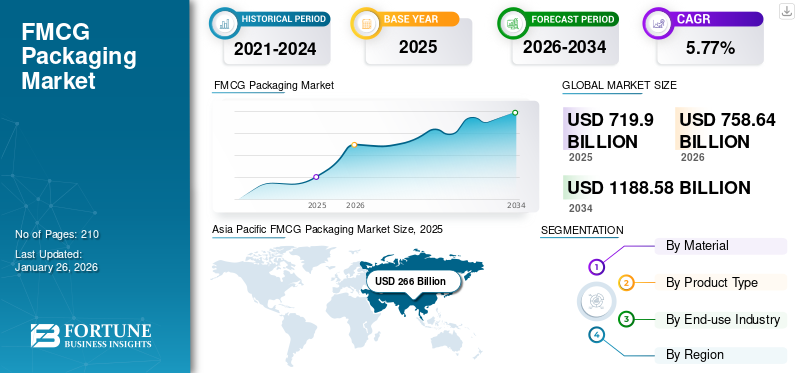
The global FMCG packaging market size was valued at USD 719.9 billion in 2025 and is projected to grow from USD 758.64 billion in 2026 to USD 1188.58 billion by 2034, exhibiting a CAGR of 5.77% during the forecast period. Asia Pacific dominated the fmcg packaging market with a market share of 36.95% in 2025. Moreover, the FMCG packaging market in the U.S. is projected to grow significantly, reaching an estimated value of USD 231.50 billion by 2032, driven by the growing demand for economical, convenient, and durable packaging solutions for many different industries.
Fast-moving consumer goods are short-lived products that can be sold quickly and at relatively low cost, with very low profit margins and high sales volumes. Packaging plays a crucial role as it maintains the freshness of products, thereby promoting the growth of the FMCG packaging industry. FMCG products are used daily and purchased repeatedly by consumers. Therefore, the packaging for such products must have a balance between eye-catching design and cost-effective packaging. Continuous innovation in packaging to improve the visual appearance of products and attract customers is contributing to the market’s growth.
During the COVID-19 pandemic, the global economy witnessed inflation, which impacted the growth in consumer spending patterns. The hike in product prices led to the negative development of this market. In terms of volume sales in fast-moving consumer goods and the shopping frequency of consumers, most of the markets globally witnessed a dip. Online and mobile shopping in categories such as food, beverages, grocery, and other essentials have helped the market grow in the post-pandemic phase.
Download Free sample to learn more about this report.
Global FMCG Packaging Market Key Takeaways
 Market Size & Forecast
- 2025 Market Size: USD 719.9 Billion
- 2026 Market Size: USD 758.64 Billion
- 2034 Forecast Market Size: USD 1,188.58 Billion
- CAGR: 5.77% from 2026–2034
 Market Share
- Asia Pacific dominated the FMCG packaging market with a 36.95% share in 2025.
- The plastic segment is projected to account for 42.47% of the market in 2026.
- The food segment is projected to account for 31.56% of the market in 2026.
 Key Regional Highlights
Asia Pacific
Generated USD 266 billion in 2025 and is projected to reach USD 282.98 billion in 2026.
North America
Generated USD 203.45 billion in 2025 and is projected to reach USD 213.43 billion in 2026.
Europe
Generated USD 151.64 billion in 2025 and is projected to reach USD 159.91 billion in 2026.
U.S.
The FMCG packaging market is projected to reach USD 174.59 billion by 2026.
Japan
The FMCG packaging market is projected to reach USD 45.67 billion by 2026.
Read More

FMCG Packaging Market Trends
Rising Awareness and Demand for Sustainable Packaging is Trending in the FMCG Packaging Market
One of the most notable trends in the FMCG industry is the shift toward sustainable packaging. With rising environmental concerns, consumer preferences have changed, and they increasingly seek eco-friendly options. Brands are responding by using recyclable materials, reducing packaging waste, and opting for minimalist designs that convey simplicity and sustainability. Asia Pacific witnessed a growth from USD 235.74 billion in 2023 to USD 250.24 billion in 2024.
Food manufacturers are also initiating and integrating recycled content in their FMCG packaging to reduce the company's carbon footprint and satisfy consumer demand. For instance, Danone, one of the leading multi-local food and beverage companies, signed the Global Commitment on Plastics, fronted by the Ellen MacArthur Foundation, in collaboration with the UN Environment Program to lower carbon emissions and use 100% circular packaging. Moreover, in 2021, 84% of the packaging used by Danone was compostable, recyclable, or reusable.
Download Free sample to learn more about this report.
FMCG Packaging Market Growth Factors
Increasing Demand for Anti-Counterfeiting FMCG Packaging Thrives Market Growth
Although the world has become more global in terms of trade, business, and economics, globalization has led to an ever-growing problem of illegal activity. Counterfeit food and drinks can cause a threat to consumers' health. Meanwhile, counterfeit cleaning products and toiletries can cause adverse reactions from both their users and the environment. Counterfeit FMCG products put consumers at risk, damage a brand's reputation, disrupt supply chains, and cost companies both sales and consumer trust.
Since FMCG tends to sell quickly, its inventory moves rapidly, and so does its production, and it can often move across international borders. Therefore, tracking supply chains can become a logistical nightmare, making it easier for counterfeits to enter. FMCG products can be packed and labeled in such ways that are hard to replicate. This may include using unique holograms, designs, watermarks, or special materials that are difficult to counterfeit. FMCG products can be traced and tracked along the complete supply chain using technologies such as QR codes, barcodes, or RFID tags. This can help detect counterfeit products and prevent them from entering the supply chain, contributing to the lucrative FMCG packaging market growth.
Augmenting Demand for Personal Care & Cosmetics Products Drives Personal Care Market’s Growth
The primary factor driving the personal care market is the growing focus among individuals on personal hygiene and skin health. This is especially true for the large population of young people, who are increasingly becoming more aware of the significance of caring for their skin. In addition, the availability of a wide range of affordable and effective beauty and personal care products is also helping to drive the growth of the market. The major players in the market are focusing on product innovation and new product launches to meet the changing needs of consumers.
Sustainability has played a crucial role in shaping consumer behavior. In a growing region such as Asia Pacific, sustainable packaging regulations are increasingly becoming a mandatory standard, with responsibilities extending across the lifecycle of cosmetic products, including recyclable packaging and sustainable disposal. This has increased the demand for eco-friendly packaging products.
The surging number of mobile users and penetration of the internet has increased the influence of social media on people and also helped the e-commerce industry to thrive. The rising e-commerce industry has contributed to the increased sales of personal care & cosmetics products, hence contributing to the growth of this market.
RESTRAINING FACTORS
Non-Biodegradability of Plastic is Impeding the Market’s Growth
Plastics are non-degradable materials, and the decay of this material is not accessible as it can take centuries and pollute the environment. The molecules in the plastic material are created through the strong binding of intermolecular forces.
Plastic used for human consumption, such as food packaging bags, contains harmful components. Improper disposal of packaging causes many dangerous drawbacks and leads to plastic leaking into natural water bodies.
Furthermore, the lack of infrastructure for the recycling of plastic packaging in emerging nations due to a lack of capital and advanced technology is one factor hampering the growth of this market.
FMCG Packaging Market Segmentation Analysis
By Material Analysis
Increasing Use of Bioplastics in the Manufacturing of FMCG Packaging Products is Enhancing the Plastic Segment’s Growth
The market is segmented by material into plastic, paper and paperboard, metal, glass, and others.
Plastic is the dominating segment and holds the largest FMCG packaging market share. The durability and mechanical strength provided by plastic packaging products such as bags & pouches, and bottles, among others, are enhancing the growth of this segment. The augmenting demand for products that have lesser environmental impacts has led to the rise in the use of bioplastic as a raw material. The thriving market for such products is contributing to the segment’s growth.
- The plastic segment led the market accounting for 42.47% market share in 2026.
Paper and paperboard are the second dominating segment of this market. The easy availability of paper and its sustainable nature are enhancing its growth.
To know how our report can help streamline your business, Speak to Analyst
By Product Type Analysis
Growing demand for flexible FMCG packaging owing to its benefits Drives Bags & Pouches Growth
The market is segmented by product type into bags and pouches, clamshells, bottles and jars, boxes and cartons, cans, sachets and stick packs, film and laminates, and others.
The Bags and pouches segment will account for 25.06% market share in 2026. Flexible packaging has become more common and desirable in today’s market, as it is convenient, economical, and durable. This leads to the high demand for bags and pouch packaging in many different industries, such as food and beverage, personal care, home care, and others. The bags and pouches are lightweight and easy to transport, and many are resealable, contributing to the growth of this segment.
Boxes and cartons are the second-dominating segment of the market. The surging use of these products as secondary packaging is bolstering its growth.
By End-use Industry Analysis
Changing Consuming Patterns of People is Thriving the Food Segment’s Growth
The market is segmented by end-use industry into food, beverage, personal care andcosmetics, home care, tobacco, pharmaceutical, and others.
The Food segment is expected to account for 31.56% of the market in 2026. The increasing population globally has raised the demand for food, and people's changing preferences toward healthy consumption are boosting the growth of this segment. The growing demand for packed and ready meals is one of the primary factors for the segment’s growth.
Personal care is the second dominating segment of this market. The increasing awareness of people regarding their appearances is boosting the segment’s growth.
REGIONAL INSIGHTS
The market is analyzed across North America, Europe, Asia Pacific, Latin America, and the Middle East & Africa.
Asia Pacific
Asia Pacific FMCG Packaging Market Size, 2025 (USD Billion)
To get more information on the regional analysis of this market, Download Free sample
In 2025, Asia Pacific represented USD 266 billion, accounting for 36.95% of the worldwide market, and is expected to reach USD 282.98 billion in 2026. Asia Pacific region holds the largest share of the market. The increasing industrialization and urbanization in India and China, along with the Southeastern countries such as Indonesia and Singapore, has raised the purchasing power of customers, leading to the high expenditure on FMCG products, hence thriving the growth of this region. The Japan market is projected to reach USD 45.67 billion by 2026, the China market is projected to reach USD 79.18 billion by 2026, and the India market is projected to reach USD 65.65 billion by 2026.
North America
The North America market accounted for USD 203.45 billion in 2025, representing 28.36% of the global industry, and is expected to reach USD 213.43 billion in 2026. North America is experiencing significant growth due to the well-established pharmaceutical industry and the increased demand for food in the area. The high purchasing power of the people and their spending on FMCG goods are among the leading reasons for growth. The U.S. market is projected to reach USD 174.59 billion by 2026.
Europe
Europe recorded a market size of USD 151.64 billion in 2025, capturing 21.06% of the global market share, and is expected to reach USD 159.91 billion in 2026. Europe will experience steady growth during the forecasted period. The high demand for alcoholic and non-alcoholic beverages due to the climatic conditions and healthy life adoptions is driving the region’s growth. The UK market is projected to reach USD 33.25 billion by 2026, while the Germany market is projected to reach USD 35.31 billion by 2026.
Middle East & Africa
Middle East & Africa contributed 5.69% to the global market in 2025, with a valuation of USD 40.97 billion, and is expected to reach USD 42.58 billion in 2026.
Latin America
The Latin America market was valued at USD 57.84 billion in 2025, capturing 8.03% of global revenue, and is expected to reach USD 59.74 billion in 2026.
List of Key Companies in the FMCG Packaging Market
Key Participants in the Market Witnessing Significant Growth Opportunities
The global FMCG packaging market is highly fragmented and competitive. In terms of market share, the few major players dominate by offering innovative FMCG packaging in the packaging industry. They are constantly focusing on expanding their customer base across the regions and innovation. Major players in the market include Amcor, Huhtamaki, Berry Global, Sealed Air, Sonoco Products Company, and others. Numerous other players operating in the industry are focused on delivering advanced packaging solutions.
LIST OF KEY COMPANIES PROFILED:
- Amcor (Switzerland)
- Berry Global Inc. (U.S.)
- WestRock Company (U.S.)
- Sealed Air Corporation (U.S.)
- Sonoco Products Company (U.S.)
- Ball Corporation (U.S.)
- Mondi Plc (U.K.)
- Huhtamaki Oyj (Finland)
- Ardagh Group S.A. (Luxembourg)
- DS Smith (U.K.)
- Nampak Ltd. (South Africa)
- Berry Astrapak (South Africa)
- Constantia Flexibles (Austria)
- Stora Enso Oyj (Finland)
- Graham Packaging Company (U.S.)
- Toyo Seikan Group Holdings Ltd. (Japan)
KEY INDUSTRY DEVELOPMENTS:
- September 2023: Mondi and Veetee launched the first paper-based packaging for dry rice in the U.K. market. The packaging is manufactured from Mondi’s recyclable FunctionalBarrier Paper and offers a secure and robust alternative to the industry standard plastic packs.
- October 2022: Sidel launched its 1SKIN™ bottle, the future of sustainable packaging for sensitive drinks. The bottles are labeled less and manufactured using PET bottles. The bottles are easily recyclable and help reduce the company’s carbon footprint.
- April 2022: Amcor launched sustainable high shield laminates for the pharmaceutical packaging industry portfolio. The new high shield innovations include sustainable pharmaceutical stick pack, sachet, and strip pack packaging, offering choices in both paper-based and polyolefin-based materials.
- October 2021: AR Packaging launched a fully recyclable fiber-based tray for high-barrier applications to reduce plastics for the packaging of chilled food and ready meals. The tray is made of sustainably sourced carton board and sealed with thin barrier mono films to safeguard product protection and extended shelf-life.
- July 2020: Aptar Food + Beverage, which is a part of Aptar Group, announced the market launch of SEAWELL™, an active packaging system designed to maintain seafood quality and freshness. The active packaging system has incorporated technology that absorbs extra liquids that would otherwise gather around the seafood, causing product breakdown and negatively impacting shelf life.
REPORT COVERAGE
The research report provides a detailed analysis of the market and focuses on key aspects such as leading companies, competitive landscape, product/service types, Porter’s five forces analysis, and leading end-use industries of the product. Besides, the report offers insights into the market trends and highlights key industry developments. In addition to the above factors, the report encompasses several factors that contributed to the market's growth in recent years.
Request for Customization to gain extensive market insights.
Report Scope & Segmentation
|
ATTRIBUTE |
DETAILS |
|
Study Period |
2021-2034 |
|
Base Year |
2025 |
|
Forecast Period |
2026-2034 |
|
Historical Period |
2021-2024 |
|
Growth Rate |
CAGR of 5.77% from 2026 to 2034 |
|
Unit |
Value (USD Billion) |
|
Segmentation |
By Material
|
|
By Product Type
|
|
|
By End-use Industry
|
|
|
By Region
|
Frequently Asked Questions
The Fortune Business Insights study shows that the global market was USD 719.9 billion in 2025.
The global market is projected to grow at a CAGR of 5.77% over the forecast period.
The Asia Pacific market size stood at USD 266 billion in 2025.
Based on material, the plastic segment leads the global market due to the increasing use of bioplastics in the manufacturing of packaging.
The global market size is expected to reach USD 1188.58 billion by 2034.
The key market drivers are augmenting demand for personal care & cosmetics products and a rise in the demand for anti-counterfeiting packaging.
The top players in the market are Amcor, Huhtamaki, Berry Global, Sealed Air, and Sonoco Products Company, among others.



- 2021-2034
- 2025
- 2021-2024
- 210
-
(Offer valid till 30th Sep 2026)
Get 30-60 hrs Free Customization
Expand Regional and Country Coverage, Segments Analysis, Company Profiles, Competitive Benchmarking, and End-user Insights.








Related Reports
-
US +1 833 909 2966 ( Toll Free )
-
Get In Touch With Us