Food Grade Lubricants Market Size, Share & Industry Analysis, By Type (Synthetic Oil, Mineral Oil, Bio Based Oil, and Others), By Application (Food {Bakery, Dairy, Meat, poultry & seafood, Confectionery, Sauces and Dressing, and Others}, By Beverages {Carbonated soft drinks, Fruit Beverages, Sports Drinks, Alcoholic Beverages, and Others}, and Pharmaceuticals), and Regional Forecast, 2026-2034
 Download Free Sample
(Offer valid till 15th Oct 2026)

Food Grade Lubricants Market Size and Future Outlook
 Listen to Audio Version
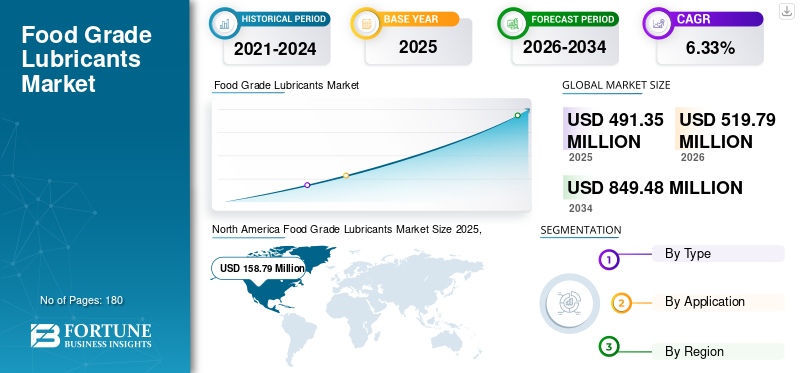
The global food grade lubricants market size was valued at USD 491.35 million in 2025 and is projected to grow from USD 519.79 million in 2026 to USD 849.48 million by 2034, exhibiting a CAGR of 6.33% during the forecast period. North America dominated the global food grade lubricants market with a market share of 32.31% in 2025.
Food-grade lubricants are specialized lubricants that are designed for use in the food, beverage, and pharmaceutical industries. They are safe for use in areas where there is a possibility of incidental food contact with the lubricant. It ensures the safe, hygienic, and reliable operation of machinery and prevents contamination of food products. Food-grade lubricants are essential for maintaining environment's compliance with food safety standards, ensuring that all machinery operates hygienically and meets regulatory requirements for safe food production. As demand for processed food continues to increase, the use of such lubricants is expected to rise in the future.
Companies such as Exxon Corporation, Total Energies SE, Chevron Corporation, and others are some of the key players operating in this market. These companies are investing in new product developments in this category, which is boosting product sales and supporting market growth.
Download Free sample to learn more about this report.
Food Grade Lubricants Market KEY TAKEAWAYS
 Market Size & Forecast
- 2025 Market Size: USD 491.35 million
- 2026 Market Size: USD 519.79 million
- 2034 Forecast Market Size: USD 849.48 million
- CAGR: 6.33% from 2026–2034
 Market Share
- North America dominated the food grade lubricants market with a 32.31% share in 2025.
- The mineral oil segment accounted for the largest market share in 2025.
- The food segment is expected to account for the largest market share in 2024.
 Key Regional Highlights
North America
North America is the largest consumer of food grade lubricants globally and is projected to reach USD 168.17 million in 2026.
Europe
Europe is expected to reach USD 150.43 million by 2026, maintaining its position as the second-largest regional market.
Asia Pacific
Asia Pacific was valued at USD 116.58 million in 2025 and is projected to reach USD 123.75 million in 2026, driven by strong industrial growth.
U.S.
U.S. The food grade lubricants market is estimated to reach USD 140.79 million, supported by a well-established food processing industry.
Japan
Japan Rising demand for high-quality food production, advanced manufacturing practices, and processed food products is expected to drive market growth.
Read More

MARKET DYNAMICS
MARKET DRIVERS
Growing Adoption of Automation and Advanced Machinery in Food Manufacturing Supports Market Growth
Food, beverages, and pharmaceutical manufacturing companies are using these lubricants as they are safe and reduce the risk of food contamination. As more companies adopt automation processes in their manufacturing units, the use of such products in processing industries is increasing rapidly. With the growth in automation, such lubricants are required to run high-speed machinery. As the consumption of packaged, industrially produced food products increases, their usage is expected to continue rising in the future.
MARKET RESTRAINTS
High Cost of Food Grade Lubricants to Impede Market Growth
The cost of food lubricants, such as synthetic and specialty lubricants, is high. Hence, cost-conscious food manufacturers opt for other non-food-grade, more economical alternatives. Moreover, awareness about different food-grade lubricants in several emerging economies remains limited, leading some manufacturers to use non-food-grade lubricants in their manufacturing and processing plants.
MARKET OPPORTUNITY
Growing regulatory Pressure Creates Opportunity for Market Growth
Several countries are increasing enforcement on food safety standards such as HACCP, ISO 22000 / FSSC 22000 and others, leading to an increase in demand for food grade lubricants in emerging economies such as China, India, Brazil and others. As awareness about the need for regulatory alignment with global standards increases across emerging economies, manufacturers are expected to replace non-food-grade lubricants with food-grade products in food processing industries. This trend creates an opportunity for lubricant manufacturers to expand their production lines in such countries and increase sales.
FOOD GRADE LUBRICANTS MARKET TRENDS
Launch of New Improved Product Formulations is the Key Market Trend
Food manufacturers are increasingly using lubricants that are odorless, tasteless, allergen-free, making them suitable for use in dairy processing, confectionery, bakery, infant formula, and nutraceutical product manufacturing. Therefore, lubricant manufacturers are launching new, ultra-pure formulations that help minimize contamination risks. The growing demand for bio-based fuels is another major trend gaining popularity among food manufacturers in Europe, North America, and the Asia Pacific countries.
Download Free sample to learn more about this report.
Segmentation Analysis
By Type
Mineral Oil Segment Account For Major Market Share as they are Economical Compared to Other Types
The market is segmented by form into synthetic oil, mineral oil, bio-based oil, and others.
The mineral oil segment accounted for the largest market share in 2025. These products have high thermal stability and are economical compared than other types, which makes them suitable for the food and beverage industry. They are highly reliable, offer strong performance, and are widely used in the food processing industry, which is highly automated.
Bio-based lubricants are another major segment that is expected to grow by 7.51% during the forecast period. As there is a rising demand for renewable alternatives in Canada and the U.S., the usage of this lubricant type is expected to increase in the future.
To know how our report can help streamline your business, Speak to Analyst
By Application
Food Segment to Account For the Major Market Share Due To Growing Consumption of Industrially Processed Seafood
The market is segmented by application into food, beverages, and pharmaceuticals. Food is further segmented into bakery, dairy, meat, poultry & seafood, confectionery, sauces and dressing, and others. Beverages are further segmented into beverages, carbonated soft drinks, fruit beverages, sports drinks, alcoholic beverages, and others.
The food segment is expected to account for the largest market share in 2024. Global consumption of industrial processed seafood, meat, dairy, and other products is increasing rapidly. As these industries employ heavy machinery for production, a high volume of lubricants is used in their operations.
The beverages segment is another major segment that is expected to grow by 6.06% during the forecast period. The growing demand for beverage consumption is expected to fuel industrial production, in turn will support increased usage of lubricants.
Food Grade Lubricants Market Regional Outlook
By geography, the market is categorized into Europe, North America, Asia Pacific, South America, and the Middle East & Africa.
North America
The market in North America is estimated to reach USD 168.17 million in 2026 and is the largest user of food grade lubricants in the world. North American countries have stringent regulatory guidelines that food manufacturers must follow to ensure food safety. Several meat and poultry plants, dairy plants, and beverage companies are expanding in the region, and more manufacturers are adopting advanced automation and machinery for production, which further supports the consumption of lubricants. In 2026, the U.S. market is estimated to reach USD 140.79 million. The U.S. has stringent food safety guidelines that food manufacturers must follow in their manufacturing units. As the country is home to some of the largest food manufacturing companies globally, they must remain compliant with these regulatory guidelines, which supports market growth in the country.
North America Food Grade Lubricants Market Size 2025,(USD Million)
To get more information on the regional analysis of this market, Download Free sample
Europe
The market in Europe is estimated to reach USD 150.43 million by 2026 and secure the position of the second-largest region in the market. Similar to the U.S., European countries adhere to stringent safety standards and quality control procedures to ensure food safety and hygiene. Moreover, the region has one of the highest levels of food manufacturing automation, resulting in increased lubricant usage in these factories. With the growing usage of such products, manufacturers are shifting from mineral-based lubricants to bio-based lubricants as they are safe for use in food processing environments. During the forecast period, the region is projected to record a growth rate of 6.11%. Backed by these factors, countries such as Germany are expected to reach a valuation of USD 31.6 million, France USD 24.3 million, and the U.K. USD 16.8 million in 2026.
The food grade lubricants market in Asia Pacific is valued at USD 116.58 million in 2025, and is one of the fastest-growing markets globally. The market is estimated to reach USD 123.75 million by 2026. With the growth in disposable income of the population in the region, more consumers are purchasing packaged food as they are convenient and easy to prepare and consume. With strong growth potential, food manufacturers are expanding their food processing capabilities to meet the increasing demand for food. Hence, the demand for such products in the region is expected to increase during the forecast period. In this region, China and India are estimated to reach USD 45.39 million and USD 20.04 million, respectively, in 2025.
South America is expected to experience significant growth in the market over the forecast period. The market in South America in 2026 is set to reach USD 44.29 million. With the growth of export-oriented industries in the region, the demand for export-oriented certification is expected to increase. Manufacturers are upgrading their production practices to ensure compliance with market requirements.
In the Middle East & Africa, Turkey's food grade lubricants market is forecast to grow at a CAGR of 5.36% during the forecast period. Turkey is one of the leading users of food lubricants owing to the large food-based industries in the region. The country exports a significant portion of its food products to the European market, which leads to high usage of EU regulatory-compliant lubricants.
COMPETITIVE LANDSCAPE
Key Industry Players
Key Players are Opting New Product Launch and Base Expansion Strategies to Boost Their Sales
The food grade lubricants industry exhibits a semi-consolidated structure, with intense competition among regional and local players operating in this segment. New product innovations and base expansion are some of the key strategies opted by prominent market players to boost their sales and market presence in new markets. With the growing demand for safe and hygienic processed food, several manufacturing companies are adopting food safe lubricants in their factories. The use of advanced manufacturing and production technologies is helping companies improve overall product formulations.
LIST OF KEY FOOD GRADE LUBRICANTS PROFILED
- Exxon Corporation (U.S.)
- TotalEnergies SE (France)
- FUCHS Petrolub AG (Germany)
- Chevron Corporation (U.S.)
- The DOW Chmical Company (U.S.)
- SKF (Sweden)
- JAX INC (U.S.)
- Petro-Canada Lubricants (Canada)
- Nye Lubricants (U.S.)
- LANXESS (Germany)
KEY INDUSTRY DEVELOPMENTS
- April 2025 – CRC industries launched their new food grade lubricants, grease, and cleaners in the market. The products are NSF certified and incorporate innovative solutions for the food industry.
- April 2025: Engen Petroleum Limited launched synthetic food grade lubricants designed for use in bakery, beverage, and pharmaceuticals industries.
- February 2025: METALUBE one of the leading lubricant manufacturers launched new generation food grade NSF registered high performance chain oils in the market. This product is designed to increase food processing equipment effectiveness.
- June 2025 – Interflon launched food grade lubricant named Interflon Food Lube 3H. This product is suitable for bakeries, meat and poultry processors, dairies, and other food industry applications.
- March 2024: ROCOL, one of the leading food lubricant manufacturing company, reformulated its lubricant procut line and removed per- and polyfluroalkyl substances from its product line.
REPORT COVERAGE
The global market research provides an in-depth study of market size & forecast by all segments included in the report. Food Grade Lubricants market analysis includes details on the market dynamics and market trends expected to drive the market during the forecast period. It offers information on the technological advancements, new product launches, key industry developments, and details on partnerships, mergers & acquisitions. The market demand also encompasses detailed competitive landscape with information on the market segmentation, market share and profiles of key operating players.
Request for Customization to gain extensive market insights.
Report Scope & Segmentation
| Attribute | Details |
| Study Period | 2021-2034 |
| Base Year | 2025 |
| Forecast Period | 2026-2034 |
| Historical Period | 2021-2024 |
| Growth Rate | CAGR of 6.33% from 2026-2034 |
| Unit | Value (USD Million) |
| Segmentation | ByType, Application, and Region |
| By Type |
|
| By Application |
|
| By Geography |
North America (By Type, Application, and Country)
Europe (By Type, Application and Country)
Asia Pacific (By Type, Application, and Country)
South America (By Type, Application, and Country)
Middle East and Africa (By Type, Application, and Country)
|
Frequently Asked Questions
Fortune Business Insights says that the global market value stood at USD 491.35 million in 2025 and is projected to reach USD 849.48 million by 2034.
In 2025, the market value stood at USD 158.79 million.
The market is expected to exhibit a CAGR of 6.33% during the forecast period (2026-2034).
By type, the mineral oil segment led the global market in 2025.
Growing adoption of automation and advanced machinery in food manufacturing is a key factor driving the market.
Exxon Corporation, Total Energies SE, Chevron Corporation, and others are a few of the players in the Food Grade Lubricants market.
North America holds the largest market share.
Launch of new improved product formulations is the key market trend.



- 2021-2034
- 2025
- 2021-2024
- 180
-
(Offer valid till 15th Oct 2026)
Get 30-60 hrs Free Customization
Expand Regional and Country Coverage, Segments Analysis, Company Profiles, Competitive Benchmarking, and End-user Insights.



















Related Reports
-
US +1 833 909 2966 ( Toll Free )
-
Get In Touch With Us