Food Trucks Market Size, Share & Industry Analysis, By Truck Type (Box-Type Food Trucks, Buses & Vans, Expandable Food Trucks, and Others), By Size (Small, Medium, and Large), and By Food Type (Fast Food, Barbeque & Snacks, Desserts & Confectionary, Bakery, and Others), By Powertrain (ICE and Electric & Others), and Regional Forecast, 2026-2034
 Download Free Sample
(Offer valid till 15th Oct 2026)

KEY MARKET INSIGHTS
 Listen to Audio Version
The global food trucks market size was valued at USD 2.71 billion in 2025 and is projected to grow from USD 2.88 billion in 2026 to USD 4.17 billion by 2034, exhibiting a CAGR of 4.7% during the forecast period. Asia Pacific dominated the global market with a market share of 24.35% in 2025.
The market represents a dynamic segment of the mobile food services industry, characterized by flexible, compact, and cost-efficient culinary operations. Food trucks serve as an accessible entry point for entrepreneurs and established foodservice brands seeking to expand into new locations without the high capital investment required for traditional brick-and-mortar restaurants. The market encompasses specialized vehicles equipped for cooking, refrigeration, storage, and point-of-sale functions, enabling vendors to deliver diverse cuisines across urban centers, commercial districts, campuses, and event-based environments.
The competitive landscape of the market consists of a mix of specialized vehicle manufacturers and custom fabrication companies that design, engineer, and retrofit trucks to meet regulatory and operational requirements. Key players include Prestige Food Trucks, M&R Specialty Trailers and Trucks, Prime Design Food Trucks, VS Veicoli Speciali, Foodtrucknación, and Karpatia Trucks. These companies compete on design quality, compliance with health and safety standards, interior customization, integration of energy-efficient systems, and after-sales support.
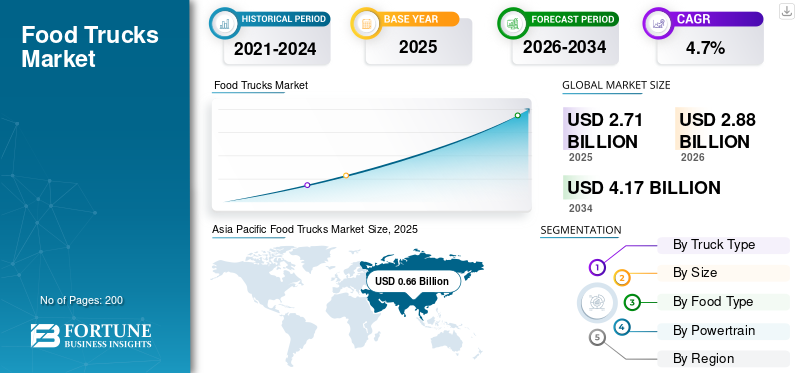
Download Free sample to learn more about this report.
Food Trucks Market KEY TAKEAWAYS
 Market Size & Forecast
- 2025 Market Size: USD 2.71 billion
- 2026 Market Size: USD 2.88 billion
- 2034 Forecast Market Size: USD 4.17 billion
- CAGR: 4.7% from 2026–2034
 Market Share
- Asia Pacific dominated the market with a 24.35% share in 2025.
- Expandable food trucks segment is projected to grow at a CAGR of 8.5%.
- Large food trucks segment is projected to grow at a CAGR of 5.5%.
 Key Regional Highlights
Asia Pacific
Asia Pacific Rapid urbanization, strong street food culture, and rising government support driving fastest market growth.
Europe
Europe 25.8% share in 2025. Growth supported by festivals, tourism, and demand for gourmet and artisanal street food.
North America
North America Market dominance driven by mature food truck ecosystem, strong entrepreneurship, and widespread consumer acceptance.
U.S.
U.S. Mature food truck market supported by corporate catering, festivals, and improving regulatory frameworks.
Japan
Japan Popular in corporate campuses and entertainment districts, driven by urban food culture and convenience demand.
Read More

FOOD TRUCKS MARKET TRENDS
Integration of Digital Tools and Smart Operational Technologies is One of Significant Market Trends
Operators increasingly use mobile apps & social media, digital menus, online ordering systems, and real-time GPS tracking to improve service efficiency and attract tech-savvy consumers. These tools allow customers to locate trucks, place pre-orders, track wait times, and receive promotional updates, strengthening customer loyalty and increasing sales predictability. Digital point-of-sale systems help vendors analyze peak demand periods, refine menus, and adjust pricing strategies. Manufacturers are also integrating IoT-enabled sensors for temperature monitoring, equipment diagnostics, and energy consumption tracking, improving both food safety and operational reliability.
- In August 2024, OLHSO unveiled an automated mobile restaurant concept designed to operate with minimal human intervention by using robotics, software-driven cooking processes, and integrated digital ordering systems.
MARKET DYNAMICS
MARKET DRIVERS
Rising Urban Consumer Demand for Convenient and Affordable Mobile Dining Accelerates Market Expansion
Urbanization is reshaping consumer dining habits, leading to strong momentum for food trucks as flexible and cost-efficient alternatives to traditional restaurants. As metropolitan populations grow, demand increasingly shifts toward quick-service, on-the-go meal formats that offer variety and value without compromising quality. Food trucks fulfill this need by delivering curated culinary experiences in high-traffic locations such as business districts, transit hubs, college campuses, public events, and recreational venues. Their low overhead structure allows vendors to offer competitive pricing, making mobile kitchens attractive to budget-conscious consumers.
MARKET RESTRAINTS
Stringent Regulatory Requirements and Operating Restrictions Limit Market Growth Potential
One of the key challenges restraining market expansion is the complexity and inconsistency of regulatory frameworks governing food trucks industry operations. Licensing rules, parking permits, zoning restrictions, food safety inspections, and commissary requirements vary significantly across cities and regions. This regulatory fragmentation increases operating costs and often leads to delays in market entry for new vendors. Many jurisdictions require food trucks to maintain fixed-base commercial kitchens, comply with strict waste management protocols, or limit operating hours, all of which reduce operational flexibility. These regulatory burdens constrain the market by discouraging small business participation and impeding rapid expansion of food truck fleets. Vendors often face limitations on where they can park or serve the customer base, especially near established restaurants, which lobby for protective zoning measures.
- In December 2025, Paso Robles City Council moved forward with updates to food truck regulations, aiming to clarify permitting requirements and improve operational standards for mobile vendors.
MARKET OPPORTUNITIES
Expansion of Electrified and Eco-Efficient Food Truck Platforms Creates New Growth Opportunities
The growing global emphasis on sustainability presents a significant opportunity for food truck manufacturers and operators. Governments and municipalities are encouraging low-emission mobility and energy-efficient foodservice infrastructure, accelerating the shift toward electric and hybrid food trucks. This transition reduces dependence on diesel generators, lowers operational costs, and enhances compliance with emerging environmental regulations. Manufacturers adopting battery-powered refrigeration units, rooftop solar panels, and induction-based cooking equipment are well positioned to attract environmentally conscious vendors and corporate clients.
- In March 2024, VS Veicoli Speciali highlighted a new range of lightweight, eco-efficient food trucks incorporating solar-assisted power systems. The models aim to reduce operating costs and emissions.
MARKET CHALLENGES
Rising Operational Costs and Supply Chain Volatility Pose Challenges to Food Truck Profitability
Despite growing food trucks market demand, rising operating costs remain a significant challenge for food truck businesses. Fuel price fluctuations, higher vehicle maintenance expenses, and increasing food ingredient costs directly affect profit margins. Global supply chain disruptions, shortages of stainless steel, refrigeration components, and commercial kitchen equipment, also influence manufacturing lead times and vehicle pricing. For operators, inflation-driven increases in raw material and labor costs require menu adjustments that may not always align with consumer price expectations.
Download Free sample to learn more about this report.
Segmentation Analysis
By Truck Type
Cost Efficiency and Superior Operational Characteristics to Drive Growth of Box-Type Food Truck Segment
The truck type segment covers box-type food trucks, buses & vans, expandable food trucks, and others.
Box-type food trucks hold the largest market share during the food trucks market forecast period. These trucks are expected to witness steady growth due to their versatility, cost-effectiveness, and suitability for a wide range of cuisines. Their rectangular structure provides ample interior space, allowing efficient placement of cooking appliances, refrigeration units, storage racks, and service counters. This configuration supports smooth workflow operations, making box-type trucks attractive for fast-food vendors, catering services, and multi-menu operators.
- In April 2025, Boys & Girls Clubs of Northwest San Diego launched Lunch Box food trucks as a part of the club’s youth workforce development program.
Expandable food trucks are expected to grow at a CAGR of 8.5% within the forecast period. These trucks appeal to operators offering specialized cuisines, high-volume catering, or experiential dining concepts that require additional workspace or service areas.
To know how our report can help streamline your business, Speak to Analyst
By Size
Superior Navigational Capabilities Coupled With Operational Efficiency Will Influence Growth of Medium Segment
In terms of size, the market is divided into small, medium, and large.
The medium segment is expected to dominate the market due to their balanced ratio of mobility, capacity, and operational efficiency. These food trucks offer sufficient interior space to accommodate standard cooking appliances, refrigeration, and storage, making them suitable for most fast-food concepts, dessert vendors, and beverage operations. Their size allows operators to navigate congested urban streets while still supporting moderate-volume service. The food trucks market growth is supported by increasing adoption among first-time entrepreneurs seeking cost-effective yet functional vehicles that comply with city parking regulations.
The large segment is expected to grow at a CAGR of 5.5% within the forecast period. These trucks are particularly favored by gourmet brands, catering companies, barbecue concepts, and multi-station food vendors that require additional preparation and storage capacity.
By Food Type
Increasing Demand for Easy-to-consume Foods Reinforce Fast Food Segment’s Dominance
By food type, the market is segmented into fast food, barbeque & snacks, desserts & confectionary, bakery, and others.
The fast food segment dominates the market owing to rising demand for quick, affordable, and familiar meals. Fast-food trucks excel in serving high-traffic locations and events where rapid turnaround is essential. Growth is supported by increasing urban mobility, busy lifestyles, and a preference for handheld, easy-to-consume food options such as burgers, sandwiches, tacos, and fried snacks. Operators benefit from standardized menus that simplify procurement and reduce preparation time.
- In May 2024, Mason Jar Food Co. launched a fast food truck Haliburton County, Canada. It provides poutine, sweet potato fries, hot dogs and smash burgers.
The desserts & confectionary segment is expected to grow at a CAGR of 5.6% within the forecast period. This segment benefits from high-margin offerings such as gourmet ice cream, waffles, pastries, crepes, and specialty beverages. Dessert trucks thrive in family-oriented events, tourist destinations, night markets, and corporate gatherings where customers seek indulgent, occasion-based purchases.
By Powertrain
Widespread Availability and Low Cost Will Drive Growth of ICE Segment in Next Few Years
On the basis of propulsion, the market is divided into ICE and electric & others.
The ICE segment is expected to dominate the market. Diesel and petrol engines offer strong torque, making them suitable for heavier trucks equipped with full-service kitchens. Many operators prefer ICE trucks for their reliability, easy maintenance, and ability to support high electrical loads using auxiliary generators. Growth in this segment will remain steady in the near term due to the large installed base of conventional commercial vehicles that can be retrofitted as food trucks.
The electric & others segment is expected to grow at a CAGR of 22.3% within the forecast period. Electric and alternative-fuel food trucks are gaining traction as sustainability emerges as a core purchasing criterion for both operators and event organizers. Electric trucks offer zero tailpipe emissions, reduced noise levels, and lower operating costs over the vehicle lifecycle.
Food Trucks Market Regional Outlook
By region, the market is categorized into Asia Pacific, Europe, North America, and the Rest of the World.
Asia Pacific
Asia Pacific Food Trucks Market Size, 2025 (USD Billion)
To get more information on the regional analysis of this market, Download Free sample
Asia Pacific will grow at the highest CAGR of 7.8% within the forecast period. This region is emerging as one of the fastest growing markets for food trucks, supported by rapid urbanization, expanding middle-class populations, and the region’s long-standing street food heritage. Countries such as China, India, Japan, South Korea, Australia, and Thailand are promoting food trucks as part of tourism development and urban revitalization initiatives. Governments are increasingly formalizing food truck policies, providing designated vending zones, and supporting start-up operators. Growth is also driven by rising demand for hygienic and standardized street food alternatives. In developed markets such as Japan and South Korea, food trucks are popular at corporate campuses and entertainment districts, while in emerging markets such as India, they serve as accessible platforms for first-time entrepreneurs.
- In May 2025, Korean food truck Bibim Box introduced home-cooked Korean food with bold flavors with help from Boston's Commonwealth Kitchen.
North America
The North America market will remain dominant during the forecast period. North America remains one of the most mature and dynamic markets for food trucks, driven by a well-established street food culture and a strong entrepreneurial landscape. The region benefits from a high number of independent operators, supportive event ecosystems, and widespread consumer acceptance of mobile dining. Major cities such as Los Angeles, New York, Austin, and Vancouver have cultivated vibrant food truck communities that attract both residents and tourists. Growth is further supported by the expansion of corporate catering, university partnerships, and festival-based deployments.
U.S. Food Trucks Market
The U.S. food trucks market growth is characterized by customized truck fabrication, technological integration, and high-quality kitchen installations. While regulatory requirements vary across states and cities, increasing efforts toward standardized licensing and designated food truck zones are improving operational efficiency.
- In October 2019, Ono Food Co. launched advanced robotics enabled food trucks in Los Angeles.
Europe
Europe is experiencing steady growth during the forecast period. Europe food trucks market share was 25.8% in 2025. Countries such as Germany, the U.K., France, Italy, and Spain are witnessing strong expansion, driven by cultural festivals, urban food markets, and tourism activities. European vendors often emphasize artisanal, gourmet, and regional specialty foods, aligning with consumer preferences for authenticity and premium experiences. Regulations in Europe tend to be stricter regarding hygiene and vehicle standards, but ongoing harmonization at the municipal level is improving market accessibility. The rise of electric mobility is also supporting adoption of eco-friendly food trucks, particularly in Western Europe where low-emission zones are expanding.
Germany Food Trucks Market
The market in Germany is expected to grow steadily, supported by rising consumer acceptance of street food, expanding food festivals, and increased demand for flexible dining options in urban areas. Municipal support for regulated food truck zones and strong event-based catering demand will further support market expansion.
Rest of Europe Food Trucks Market
Manufacturers in Italy, the Netherlands, and Eastern Europe are gaining visibility for their high-quality craftsmanship and modular designs. As experiential dining and mobile retail concepts evolve, Europe is expected to become a key hub for premium food truck innovation.
Rest of the World
The market across Latin America and the Middle East & Africa is witnessing growing interest in food trucks, supported by tourism growth, lifestyle shifts, and increasing demand for affordable dining options. Countries such as Brazil, Mexico, the UAE, and South Africa are promoting food trucks through food festivals, beachfront markets, and community events. The expansion of shopping malls, theme parks, and entertainment venues also provides structured environments for food truck deployment. In the Middle East, food trucks are becoming integral to night markets and waterfront developments, with governments encouraging small business participation. However, challenges such as inconsistent regulatory frameworks, limited financing options, and high vehicle import duties may slow adoption in certain markets. Despite these constraints, the rising popularity of global street food trends and the growth of youth entrepreneurship are expected to stimulate further expansion across the region.
COMPETITIVE LANDSCAPE
Key Industry Players
Custom Builds and Ability to Cater Diverse Needs Will form Basis of Market Expansion
Key players active in this market include Cruising Kitchens, Prestige Food Trucks, M&R Specialty Trailers and Trucks, Prime Design Food Trucks, VS Veicoli Speciali, and Food Truck Builder. Leading players are increasingly focusing on customization depth and modular design strategies, allowing operators to tailor kitchen layouts, equipment configurations, and power systems based on menu requirements and local regulations. Several manufacturers are investing in energy-efficient and electric-ready truck designs to address sustainability expectations and future emission norms. Strategic partnerships with commercial kitchen equipment suppliers and digital service providers are also being used to enhance functionality and streamline operations for end users.
- In August 2025, Cruising Kitchens announced relocation of headquarters and operations to San Antonio to consolidate operations and streamline production processes.
LIST OF KEY FOOD TRUCKS COMPANIES PROFILED
- Prestige Food Trucks (U.S.)
- M&R Specialty Trailers and Trucks (U.S.)
- Custom Concessions (U.S.)
- Prime Design Food Trucks (Canada)
- VS Veicoli Speciali (Italy)
- Karpatia Trucks (Netherlands)
- Cruising Kitchens (U.S.)
- Superior Trailers (U.S.)
- Saltrino (Poland)
- Food Truck Passion (Spain)
KEY INDUSTRY DEVELOPMENTS
- April 2025: DonutNV Franchising, Inc. launched a battery-powered food truck kitchen for its franchise network, providing a quieter alternative to conventional generator-powered mobile kitchens nationwide. The strategic objective was to expand franchise flexibility and operating locations. Capabilities involved battery power storage, mobile kitchen electrification, generator-free operation, and energy management, and low-emission food truck deployment.
- May 2025: Ansa announced a partnership with Scream Truck to integrate its stored-value digital wallet solution across the experiential food-truck fleet, supporting nationwide franchising and customer loyalty. The strategic objective was to increase repeat visits and streamline payments. Capabilities involved digital wallets, Shopify integration, stored-value payments, loyalty rewards, and digital food-truck transactions.
- January 2026: Premier Food Trucks introduced an integrated battery-powered kitchen system that eliminated traditional generators from mobile food-service vehicles, enabling quieter and cleaner operations. The strategic objective was to reduce generator dependence and operating requirements. Capabilities involved battery storage, power management, mobile kitchen electrification, energy distribution, and electric food-truck infrastructure.
- January 2026: Cousins Maine Lobster announced the grand opening of a new food truck in Charlotte, North Carolina, marking its fourth truck in the state and returning the brand to the market. The strategic objective was to expand its regional franchise footprint. Capabilities involved mobile food preparation, refrigerated storage, point-of-sale systems, fleet mobility, and food-truck operations.
- October 2025: The army & Air Force Exchange Service (AAFES) announced the opening of its first food truck in Poland. It offers sandwiches, pita wraps, rice bowls, salads and breakfast items.
- July 2025: U.S. Bureau of Labor Statistics highlighted that food trucks are driving rapid employment growth in the mobile food businesses sector.
- May 2025: Governor Kevin Stitt signed the Food Truck Freedom Act which will allow mobile food vendors with a valid state food establishment license to operate anywhere in Oklahoma.
- August 2021: Canadian firm Apollo retrofitted a Ford F59 truck to serve street food for U.K. foodservice operator, Libertine Burger.
- May 2020: U.S. army announced that its food truck program is expanded in Germany.
REPORT COVERAGE
Request for Customization to gain extensive market insights.
Report Scope & Segmentation
|
ATTRIBUTE |
DETAILS |
|
Study Period |
2021-2034 |
|
Base Year |
2025 |
|
Estimated Year |
2026 |
|
Forecast Period |
2026-2034 |
|
Historical Period |
2021-2024 |
|
Growth Rate |
CAGR of 4.7% from 2026-2034 |
|
Unit |
Value (USD Billion) |
|
Segmentation |
By Truck Type, Size, Food Type, Powertrain, and Region |
|
By Truck Type |
· Box-Type Food Trucks · Buses & Vans · Expandable Food Trucks · Others |
|
By Size |
· Small · Medium · Large |
|
By Food Type |
· Fast Food · Barbeque & Snacks · Desserts & Confectionary · Bakery · Others |
|
By Powertrain |
· ICE · Electric & Others |
|
By Region |
· North America (By Truck Type, By Size, By Food Type, By Powertrain, and By Country) o U.S. (By Powertrain) o Canada (By Powertrain) o Mexico (By Powertrain) · Europe (By Truck Type, By Size, By Food Type, By Powertrain, and By Country) o Germany (By Powertrain) o U.K. (By Powertrain) o France (By Powertrain) o Rest of Europe (By Powertrain) · Asia Pacific (By Truck Type, By Size, By Food Type, By Powertrain, and By Country) o China (By Powertrain) o Japan (By Powertrain) o India (By Powertrain) o South Korea (By Powertrain) o Rest of Asia Pacific (By Powertrain) · Rest of the World (By Truck Type, By Size, By Food Type, By Powertrain) |
Frequently Asked Questions
Fortune Business Insights says that the global market value stood at USD 2.71 billion in 2025 and is projected to reach USD 4.17 billion by 2034.
In 2025, the market value stood at USD 0.66 billion.
The market is expected to exhibit a CAGR of 4.7% during the forecast period.
The box-type food trucks segment led the market by truck type.
The rising demand for convenient dining will drive the market growth.
Key players in the global market include Cruising Kitchens, Prestige Food Trucks, M&R Specialty Trailers and Trucks, Prime Design Food Trucks, VS Veicoli Speciali, and Food Truck Builder.
Asia Pacific held the largest share in the market in 2025.



- 2021-2034
- 2025
- 2021-2024
- 200
-
(Offer valid till 15th Oct 2026)
Get 30-60 hrs Free Customization
Expand Regional and Country Coverage, Segments Analysis, Company Profiles, Competitive Benchmarking, and End-user Insights.




















-
US +1 833 909 2966 ( Toll Free )
-
Get In Touch With Us