Football (Soccer) Equipment Market Size, Share & Industry Analysis, By Product (Match Balls, Goals & Nets, Training Accessories, and Protective Equipment), By Distribution Channel (Specialty Sports Retail Stores, Online Retail, Hypermarkets & Supermarkets, Department Stores, Institutional/Direct Sales (B2B), and Others), and Regional Forecast, 2026-2034
 Download Free Sample
(Offer valid till 30th Sep 2026)

Football (Soccer) Equipment Market Size and Future Outlook
 Listen to Audio Version
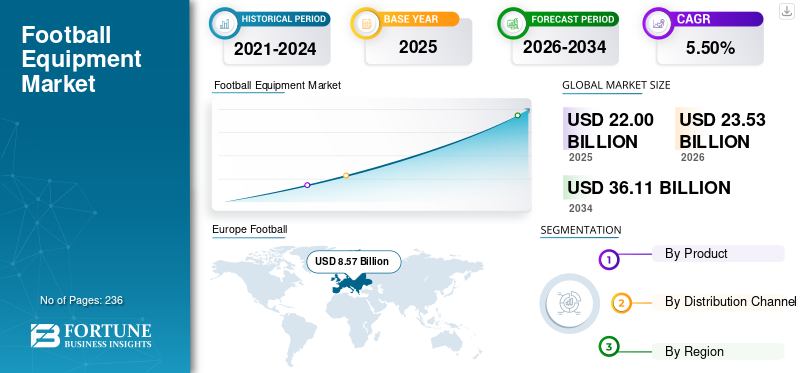
The global football (soccer) equipment market size was valued at USD 22.00 billion in 2025 and is projected to grow from USD 23.53 billion in 2026 to USD 36.11 billion by 2034, exhibiting a CAGR of 5.50% during the forecast period. Europe dominated the football equipment market with a market share of 38.95% in 2025.
The soccer equipment industry offers a wide range of products, including balls, cones, agility ladders, resistance bands, and more. This equipment is made from high-quality materials, which enhance users’ soccer performance and ensure safety while playing. Ergonomically designed shin guards and gloves better protect users from high-speed ball hits. Manufacturers focus on producing high-performance polyester, plastic, cotton, and other material-based goods to enhance athletes’ performance in soccer. Latex- and butyl-based bladder soccer balls deliver superior rebound, enabling professional players to perform effectively. Tianjin Bladder Technology Co., Ltd., a bladder manufacturer, is developing advanced rubber-mixing technology and innovative compound-based soccer-ball bladders in Tianjin City, China.
Key companies in the market include Adidas AG, Nike, Inc., PUMA SE, New Balance Athletics, Inc., and Mizuno Corporation.
Download Free sample to learn more about this report.
Football Equipment Market Key Takeaways
 Market Size & Forecast
- 2025 Market Size: USD 22.00 billion
- 2026 Market Size: USD 23.53 billion
- 2034 Forecast Market Size: USD 36.11 billion
- CAGR: 5.50% from 2026–2034
 Market Share
- Europe dominated the football (soccer) equipment market with a 38.95% share in 2025.
- The match balls segment accounted for 37.74% of the global market share in 2025.
- The specialty sports retail stores segment held a leading 37.32% share of the market in 2025.
 Key Regional Highlights
Europe
Europe generated USD 8.57 billion in revenue in 2025.
Asia Pacific
Asia Pacific accounted for 32.17% of the global market in 2025.
North America
North America held a 7.70% share of the global market in 2025 and is projected to reach USD 1.80 billion by 2026.
U.S.
The U.S. football (soccer) equipment market was valued at USD 0.93 billion in 2025.
Japan
Japan’s football (soccer) equipment market was valued at USD 0.50 billion in 2025.
Read More

FOOTBALL (SOCCER) EQUIPMENT MARKET TRENDS
Increasing Popularity of Soccer Balls of Urban Formats to Augment Market Growth
The growing popularity of urban soccer formats, including 5-a-side, 7-a-side, futsal, and street football, is driving global market expansion. In addition, increasing demand for modular goal systems suitable for small-sized football fields, coupled with the growing number of schools, community centers, sports complexes, and commercial turf facilities that prefer compact soccer pitches, is driving the football (soccer) equipment market growth.
MARKET DYNAMICS
MARKET DRIVERS
Download Free sample to learn more about this report.
Increasing Soccer Sports Participation to Drive Product Demand
The growing number of soccer participants, spanning grassroots, school, amateur, and professional levels, is driving product demand across many countries. In addition, the increasing participation of women in soccer is boosting product sales across many countries. According to the Department of Health, Disability, and Ageing, Australian Government, in 2024, inspired by the FIFA Women's World Cup 2023 and the Matildas' success, over 23,000 women and girls played soccer, bringing the total to 158,000 women & girls playing football in Australia. Besides, the government and federations’ promotion of soccer activities is increasing demand for newer products and driving the global market growth.
MARKET RESTRAINTS
High Competition from Unorganized Manufacturers to Restrain Market Growth
The high cost of unorganized equipment manufacturers offering products at lower prices is negatively impacting the key players’ product sales across many countries. In addition, the increasing commoditization of sports equipment across the mass and mid-price ranges is hindering key players’ sales of professional-grade products, thereby restraining global market expansion.
MARKET OPPORTUNITIES
Manufacturers’ Provision of Sustainability-Focused Soccer Equipment to Create New Market Growth Opportunities
The consistent provision of soccer equipment made of sustainable materials, including recycled plastics, bio-based fibers, and natural rubber, is creating new market growth opportunities. In addition, the increasing consumer demand for ethically produced, federation-certified goods that contribute to environmental sustainability is creating new avenues for market growth. The growing number of manufacturers focusing on injury prevention is driving the demand for advanced protective gear worldwide.
MARKET CHALLENGES
Seasonal Soccer Equipment Demand Fluctuations to Challenge Key Players' Business Expansion
Seasonal fluctuations in soccer equipment demand are causing challenges for key players in managing inventory and logistics costs. Uncertain winter conditions reduce the field usage among soccer players. These adverse weather conditions are causing damage to the soccer courts, hindering institutional product sales. Besides, increasing fuel prices and supply chain complexities are negatively impacting the key players’ business profitability.
Segmentation Analysis
By Product
High Purchasing Frequency and Universal Usage to Drive Match Ball Sales
By product, the market is segmented into match balls, goals & nets, training accessories, and protective equipment.
The match balls segment accounted for the leading global football (soccer) equipment market share of 37.74% in 2025. Its major share is attributed to a high purchasing frequency, a broad customer base, and universal use of match balls for both organized and informal play, compared to its counterparts. In addition, the growing number of school students participating in soccer, which requires extensive use of match balls, is driving the segment’s growth.
To know how our report can help streamline your business, Speak to Analyst
The training accessories segment is projected to grow at the fastest rate of 5.75% from 2026 to 2034. The increasing professionalization of coaching, the expansion of grassroots academies, and the rising emphasis on soccer skill development, which require the use of training accessories including cones, markers, mannequins, rebounders, and others, are driving the segment’s growth.
By Distribution Channel
Wider Assortment of Premium Equipment at Specialty Stores Led Dominance of Specialty Sports Retail Stores Segment
Based on the distribution channel, the market is segmented into specialty sports retail stores, online retail, hypermarkets & supermarkets, department stores, institutional/direct sales (B2B), and others.
The specialty sports retail stores segment exhibited a leading global market share of 37.32% in 2025. The segment’s leading share is attributed to the wide assortment of branded soccer equipment at specialty goods stores. In addition, the expanding number of specialty brand stores offering products to the institutions at discounted rates is positively contributing to the segment’s growth.
The online retail segment is expected to grow with a CAGR of 7.13% over the forecast period. The rising number of online shoppers seeking premium products from federation-certified online marketplaces is driving growth in the online retail segment.
Football (Soccer) Equipment Market Regional Outlook
By region, the market is categorized into North America, Europe, Asia Pacific, South America, and the Middle East & Africa.
Europe
Europe Football Soccer Equipment Market Size, 2025 (USD Billion)
To get more information on the regional analysis of this market, Download Free sample
The European region is expected to maintain its leading global market position during the forecast period. The European market size reached USD 8.57 billion in 2025, accounting for approximately 38.95% of the global product sales. The growing popularity of small-sided football and futsal across urban centers is driving product demand across Western Europe. In addition, rising participation in women's sports and the expansion of soccer court facilities are favoring product sales across eastern and central Europe.
U.K. Football (Soccer) Equipment Market
The U.K. market in 2025 was valued at USD 0.85 billion, representing approximately 3.87% of global product revenues.
Germany Football (Soccer) Equipment Market
Germany’s market reached the valuation of USD 1.05 billion in 2025, equivalent to around 4.78% of global product sales.
North America
The North America region held 7.70% of the global market share in 2025. The North American market size is estimated to reach USD 1.80 billion by 2026. Increasing institutional investments in organized sports leagues and training infrastructure are driving institutional product sales across the region. In addition, the expansion of pay-to-play club systems and the purchase of school facilities with match balls, training accessories, and other soccer equipment is driving the region’s market growth.
U.S. Football (Soccer) Equipment Market
The U.S. market size reached USD 0.93 billion in 2025. The U.S. market accounted for around 4.22% of the global market sales. The expansion of professional leagues, collegiate competitions, and the consistent implementation of women's soccer programs is driving product demand nationwide.
Asia Pacific
The Asia Pacific region held the second-largest global market share of 32.17% and a market size of USD 7.08 billion in 2025. The consistent government initiatives in youth development programs and the growing number of private academies seeking federation-certified soccer goods are driving the Asia Pacific market growth. In addition, increasing women's participation in football sports activities is boosting demand for new products across the region.
Japan Football (Soccer) Equipment Market
The Japanese market in 2025 was valued at USD 0.50 billion, accounting for roughly 2.25% of global product revenues. The growing popularity of professional sports is strengthening youth engagement in soccer and driving demand for goals, balls, nets, football boots, and other football protective gear across Japan.
China Football (Soccer) Equipment Market
China’s market is projected to be one of the largest worldwide, with 2025 revenues valued at around USD 3.72 billion, representing roughly 16.90% of global product sales.
India Football (Soccer) Equipment Market
The Indian market in 2025 was valued at USD 0.35 billion, accounting for roughly 1.57% of global market revenues.
South America
Over the forecast period, the South American market is expected to grow at a moderate rate. The South America market in 2025 was valued at USD 2.87 billion. The growing number of training academies and youth development programs seeking premium-grade football products is driving market growth across South America.
Middle East & Africa
The Middle East & African market is projected to grow at the fastest rate of 7.20% during the forecast period. The increasing government investment in the construction of football stadiums and training facilities is driving demand for goals, nets, and structured training equipment across Saudi Arabia, the UAE, and Qatar. In addition, rising women's participation in soccer is driving market growth across Africa. In the Middle East & African market, Saudi Arabia reached a market value of USD 0.30 billion in 2025.
South Africa Football (Soccer) Equipment Market
The South African market reached approximately USD 0.17 billion in 2025, accounting for roughly 0.77% of the global market revenues.
COMPETITIVE LANDSCAPE
Key Industry Players
Product Innovation and Distribution Channel Network to Help Key Players Maintain their Market Positions
The key players operating in the global market are Adidas AG, Nike, Inc., PUMA SE, New Balance Athletics, Inc., and Mizuno Corporation. These companies consistently focus on product design and material innovation to produce durable, sustainable, performance-enhancing products. In addition, they partner with major retailers to expand their network of retail channels and product reach worldwide.
LIST OF KEY FOOTBALL (SOCCER) EQUIPMENT COMPANIES PROFILED
- Adidas AG (Germany)
- Nike, Inc. (U.S.)
- Decathlon S.A. (France)
- Baden Sports, Inc. (U.S.)
- Puma SE (Germany)
- ASICS Corporation (Japan)
- Molten Corporation (Japan)
- Select Sport A/S (Denmark)
- Delta Galil Industries Ltd. (Israel)
- Amer Sports Corporation (Finland)
- Lotto Sport Italia SPA (Italy)
KEY INDUSTRY DEVELOPMENTS
- June 2025: Jiangsu Football City League launched an amateur grassroots football competition in the eastern Chinese province. These tournaments attracted more than 180,000 spectators and uplifted the product sales in the region.
- May 2025: Mitre Sports International Ltd., a Pentland Group-owned sports equipment manufacturer, launched the Ultimax Pro Official match ball for the Soccer Tournament 2025.
- April 2025: Sports Endeavors, LLC acquired Soccer Master, a U.S.-based soccer specialty goods retailer to broaden its product portfolio and capability of offering personalized equipment across the U.S.
- April 2025: Molten Corporation in collaboration with Concacaf unveiled the new Molten Concacaf Gold Vantaggio 5000 match ball for the 2025 Concacaf Gold Cup event held in Miami, Florida, U.S. The ball is crafted with high-performance materials and Molten’s cutting-edge technology.
- April 2023: The Wilson Sporting Goods Company, an American manufacturer, launched a new, sustainably minded line of sports equipment, including basketballs, footballs, volleyballs, and soccer balls.
- April 2023: Nike, Inc. unveiled federation football kits for the female participants of the summer football World Cup held in Australia and New Zealand.
- January 2023: Mitre Sports International Ltd. launched the FA Cup Hi-Vis Fluo 22/23 match ball, made of thermally bonded four-panel construction with Dual Hyperfoam technology, offering powerful strikes, shot accuracy, and passes.
REPORT COVERAGE
The global football (soccer) equipment market analysis provides an in-depth study of market insights, market size, distribution channel insights, as well as all other market segments included in the report. In addition, the report outlooks market dynamics and football equipment market trends expected to drive the market over the forecast period. The report on the market includes information on technological advancements, new product launches, key developments in the soccer equipment industry, and details on partnerships, mergers, and acquisitions. The market research report also encompasses a detailed competitive landscape with information on the market share and profiles of key operating players.
Request for Customization to gain extensive market insights.
Report Scope & Segmentation
| ATTRIBUTE | DETAILS |
| Study Period | 2021-2034 |
| Base Year | 2025 |
| Estimated Year | 2026 |
| Forecast Period | 2026-2034 |
| Historical Period | 2021-2024 |
| Growth Rate | CAGR of 5.50% from 2026 to 2034 |
| Unit | Value (USD Billion) |
| Segmentation | By Product, Distribution Channel, and Region |
| By Product |
|
| By Distribution Channel |
|
| By Geography |
|
Frequently Asked Questions
Fortune Business Insights says that the global market value stood at USD 22.00 billion in 2025 and is projected to reach USD 36.11 billion by 2034.
In 2025, the Europes market value stood at USD 8.57 billion.
The market is projected to grow at a CAGR of 5.50% during the forecast period.
By product, the match balls segment led the market in 2025.
Increasing participation in soccer is the key factor driving the market.
Adidas AG, Nike, Inc., PUMA SE, New Balance Athletics, Inc., and Mizuno Corporation are among the prominent players in the market.
Europe dominated the market in 2025 with the largest share.
The manufacturers provision of sustainability-focused soccer equipment is creating new market growth opportunities.



- 2021-2034
- 2025
- 2021-2024
- 236
-
(Offer valid till 30th Sep 2026)
Get 30-60 hrs Free Customization
Expand Regional and Country Coverage, Segments Analysis, Company Profiles, Competitive Benchmarking, and End-user Insights.










Related Reports
-
US +1 833 909 2966 ( Toll Free )
-
Get In Touch With Us