Forage Seeds Market Size, Share & Industry Analysis, By Breeding Technology (Hybrids and Others), By Type (Alfalfa, Clovers, Ryegrass, Bent Grass and Others), By Species (Legumes and Grasses), By Animal Type (Horse, Cattle, Goat and Others) and Regional Forecast, 2026-2034
 Download Free Sample
(Offer valid till 15th Oct 2026)

Forage Seeds Market Size and Future Outlook
 Listen to Audio Version
The global forage seeds market size was valued at USD 4062.86 million in 2025. The market is projected to grow from USD 4184.68 million in 2026 to USD 5,630.96 million by 2034, exhibiting a CAGR of 3.78% during the forecast period. North America dominated the global forage seeds market with a market share of 31.04% in 2025.
Forage seeds, such as alfalfa, ryegrass, clover, and bentgrass, are essential components of livestock feed formulation in dairy, cattle, and poultry production. These seeds provide nutrient-rich fodder, such as high-protein content, improving animal productivity, milk yield, and health.
The market grew steadily from USD 3,753.04 million in 2019, driven by expanding livestock populations, increasing demand for high-yield fodder crops, and a shift toward sustainable animal nutrition systems. The rising adoption of hybrid and improved forage seed varieties, along with the expansion of commercial livestock farms, is driving the product demand.
Different leading companies dominating the global market include DLF Seeds A/S, Barenbrug Group, Allied Seed LLC, La Crosse Seed LLC, S&W Seed Company, and others.
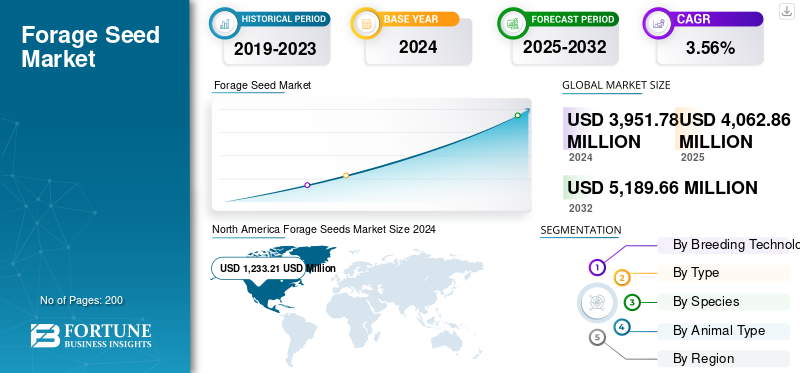
Download Free sample to learn more about this report.
Forage Seeds Market KEY TAKEAWAYS
 Market Size & Forecast
- 2025 Market Size: USD 4062.86 million
- 2026 Market Size: USD 4184.68 million
- 2034 Forecast Market Size: USD 5,630.96 million
- CAGR: 3.78% from 2026–2034
 Market Share
- North America dominated the forage seeds market with a 31.04% share in 2025.
- The hybrids segment is projected to account for the largest market share of 66.36% in 2026.
- The grasses segment is expected to hold a 73.03% market share in 2026.
 Key Regional Highlights
North America
North America held a 31.04% market share in 2025, valued at USD 1261.28 million, and is projected to reach USD 1292.31 million in 2026.
Asia Pacific accounted for 25.33% of global revenue in 2025, reaching USD 1029 million, and is projected to grow to USD 1067.66 million in 2026.
Europe
Europe captured 20.54% of the global market in 2025, valued at USD 834.55 million, and is expected to reach USD 862.25 million in 2026.
U.S.
U.S. The forage seeds market is projected to reach USD 716.22 million by 2026.
Japan
Japan The forage seeds market is projected to reach USD 90.54 million by 2026.
Read More

MARKET DYNAMICS
Market Drivers
Rising Demand for High-Quality Feed to Support Livestock Productivity to Drive Market Growth
Rising demand for high-quality feed is a key driver propelling the forage seeds market growth globally, as livestock productivity is increasingly dependent on nutrient-rich and protein-dense forage crops. Expansion in dairy and meat production, along with increased consumer awareness of animal nutrition, is prompting farmers and feed manufacturers to prioritize advanced forage seeds to achieve better yields with improved varietiers.
- According to the Food and Agriculture Organization report, the global meat production is expected to grow slightly to 371 million tonnes in 2024, led by poultry meat, compared to 364 million tonnes in 2023.
Market Restraints
Climatic Vulnerability and Limited Awareness Among Small Farmers May Hamper Growth
Climatic vulnerability and limited awareness among small farmers are significant factors that could hamper the market growth. Smallholder farmers, who make up a large portion of the market, face challenges such as erratic weather patterns, extended droughts, sudden floods, and rising temperatures, which threaten forage crop yield and quality. At the same time, limited access to timely weather forecasts and a lack of awareness of climate change impact the adoption of climate-resilient practices and improved high-yield seed varieties, thereby constraining market expansion.
- The Food and Agriculture Organization (FAO) reports that smallholder farmers have limited capacity for adopting climate-smart agriculture due to a lack of knowledge, resources, and institutional support. They have inadequate access to information, finances, and effective extension services, which prohibit them from shifting to more resilient practices and technologies required to confront climate change.
Market Opportunities
Technological Advancements and Development of Stress-Tolerant Varieties to Unlock New Growth Opportunities
Technological innovation in breeding techniques, such as molecular breeding and biotechnology, is opening new opportunities for the market. Development of drought-resistant and pest-tolerant hybrids ensures reliable yields even under changing climatic conditions. The rising adoption of precision agriculture, digital seed monitoring systems, and government programs promoting seed quality enhancement presents significant opportunities for seed companies to strengthen their market presence, particularly in emerging economies.
- For instance, in October 2025, Kazakhstan released its first climate-resilient, drought- and heat-tolerant variety of alfalfa named "Tozimdi," developed through collaboration between Kazakhstan's Scientific Research Institute for Agriculture and Plant Growing and the Australian Pastures Genebank. This new alfalfa variety offers reliable harvests despite climate stress by enabling cultivation as a rain-fed crop, which is crucial since retreating glaciers have reduced water availability for irrigation.
Forage Seeds Market Trends
Shift Toward Sustainable and High-Nutrition Forage Crops to Shape Market
Increasing adoption of sustainable agricultural practices in regions such as the U.K., France, Brazil, and Argentina is driven by government initiatives, increasing awareness of soil health, and a shift toward eco-friendly agriculture. These regions emphasize regenerative agriculture, organic farming, reduced chemical use, conservation tillage, crop diversification, and agroforestry to recover soil fertility, reduce environmental impact, and promote biodiversity.
- The U.K. government aims to bring at least 40% of England's agricultural soil under sustainable management by 2028, increasing this to 60% by 2030, through its new farming schemes as outlined in the Environmental Improvement Plan (EIP) 2023.
Download Free sample to learn more about this report.
SEGMENTATION ANALYSIS
By Breeding Technology
The Hybrid Segment Dominated Market Owing to Its Superior Yield and Disease Resistance
On the basis of the breeding technology, the market is segmented into hybrids and others.
The hybrids segment will dominate the market share of 66.36% in 2026. The segment’s dominance is attributed to superior yield, adaptability, and disease resistance of hybrid varieties, making them the preferred choice among commercial livestock producers.
The others segment is expected to grow with a moderate CAGR of 3.06%, supported by smallholder adoption and cost-effectiveness.
To know how our report can help streamline your business, Speak to Analyst
By Type
High Adaptability and Resilience to Lead Others Segment Growth
On the basis of the type, the market is segmented into alfalfa, clovers, ryegrass, bent grass, and others.
The other segment dominated the global forage seeds market share, valued at USD 1,966.63 million in 2024. The others segment, including grass species such as timothy, fescue, and orchardgrass, has resilience, adaptability to diverse environmental conditions, and low maintenance requirements, making them preferred choices for sustainable livestock pastures.
The alfaalfa segment is the fastest growing, expected to grow at a CAGR of 4.99% during the forecast period.
By Species
Grasses Segment to Exhibit High Growth Stoked by Their Adaptability and High Biomass Yield
On the basis of the species, the market is segmented into legumes and grasses.
The grasses segment will continues to hold a larger market share of 73.03% in 2026. Grasses, including ryegrass and fescue, remain essential for large-scale cattle and dairy feed production owing to their adaptability, high biomass yield, and suitability for grazing systems. Their widespread adoption across temperate and subtropical regions strengthens their position as the backbone of global forage seed supply.
The legumes segment is projected to witness robust growth, recording a CAGR of 4.26% (2025–2032) and reaching USD 1,347.98 million by 2032.
By Animal Type
Rapid Disease Control and Cost-Effectiveness Fuels Foliar Application Market Leadership
On the basis of the animal type, the market is segmented into Horse, Cattle, Goat, and Others.
The cattle segment will accounting for the largest share of 40.78%, of the forage seeds market in 2026. The growth is fueled by increasing demand for milk and beef, especially in Asia, Latin America, and Europe. Expanding dairy operations and surging preference for nutrient-dense feed varieties such as alfalfa and ryegrass further enhance demand in this segment.
The goat segment is anticipated to grow at a CAGR of 3.80% during the global forgae seeds market forecast period.
Forage Seeds Market Regional Analysis
Regionally, the report covers the global market analysis across North America, Europe, Asia Pacific, South America, the Middle East & Africa.
North America
North America Forage Seeds Market Size 2025 (USD Million)
To get more information on the regional analysis of this market, Download Free sample
The North America market was valued at USD 1261.28 Million in 2025, capturing 31.04% of global revenue, and is estimated to reach USD 1292.31 Million in 2026, supported by well-established livestock industries in the U.S. and Canada. Advanced seed technologies, precision agriculture adoption, and extensive use of hybrid forage varieties strengthen the region’s position. Increasing demand for high-protein dairy feed and sustainable pasture management further stimulates the regional market growth. The U.S. market is projected to reach USD 716.22 million by 2026.
Aisa Pacific
The market in Asia Pacific reached USD 1029. Million in 2025, representing 25.33% of total market revenue, and is projected to reach USD 1067.66 Million in 2026, fueled by rapid livestock population growth and rising demand for quality animal feed in India, China, and Australia. Government programs promoting improved seed varieties, rural livestock development schemes, and increasing adoption of modern grazing systems are major growth enablers for regional market growth. Expanding dairy and meat industries, coupled with favorable climatic conditions for multi-cut forage crops, further boost regional product demand. The Japan market is projected to reach USD 90.54 million by 2026, while the China market is projected to reach USD 606.69 million by 2026, and the India market is projected to reach USD 138.51 million by 2026.
Europe
In 2025, Europe held 20.54% of the global market, reaching a valuation of USD 834.55 Million, and is projected to grow to USD 862.25 Million in 2026, led by countries such as France, Germany, and the U.K., where expanding dairy operations and government incentives for sustainable farming practices drive the product demand. The region’s emphasis on organic and regenerative agriculture, along with EU Common Agricultural Policy (CAP) initiatives, enhances soil conservation and crop diversification and supports steady market expansion. The UK market is projected to reach USD 78.5 million by 2026, while the Germany market is projected to reach USD 126.39 million by 2026.
South America and Middle East & Africa
South America shows steady growth, having a CAGR of 3.42%, largely driven by Brazil and Argentina’s extensive cattle and dairy sectors. South America recorded a market size of USD 678.24 Million in 2025, capturing 16.59% of the global market share, and is projected to reach USD 697.64 Million in 2026. The region’s adoption of high-yield and drought-resistant forage varieties supports a consistent feed supply across vast pastures. In 2025, the Middle East & Africa market stood at USD 259.79 Million, representing 6.39% of global demand, and is projected to grow to USD 264.82 Million in 2026. The Middle East & Africa region represents an emerging market, where improving agricultural infrastructure and government-backed livestock development programs are fostering gradual growth.
COMPETITIVE LANDSCAPE
Key Industry Players
Growing Focus of Key Players on Investments in Advanced Breeding Programs and Sustainable Forage Seed Solutions Enables Their Dominating Position
The global forage seeds market is moderately fragmented, featuring a mix of multinational seed producers and regional players. Major agribusiness companies are investing in advanced breeding programs and sustainable forage seed solutions to strengthen their global reach. Companies focus on developing hybrid varieties, expanding distribution networks, and collaborating with agricultural institutions to enhance productivity and resilience.
Key Players in the Forage Seeds Market
|
Rank |
Company Name |
|
1 |
DLF Seeds A/S |
|
2 |
Barenbrug Group |
|
3 |
Allied Seed LLC |
|
4 |
La Crosse Seed LLC |
|
5 |
S&W Seed Company |
List of Key Forage Seeds Companies Profiled:
- DLF Seeds A/S (Denmark)
- Barenbrug Group (Netherlands)
- S&W Seed Company (U.S.)
- La Crosse Seed LLC (U.S.)
- Allied Seed, L.L.C. (U.S.)
- Advanta Seeds (UPL Group) (India)
- Limagrain Group (France)
- PGG Wrightson Seeds Limited (New Zealand)
- RAGT Semences S.A.S. (France)
- BrettYoung Seeds Limited (Canada)
KEY INDUSTRY DEVELOPMENTS:
- October 2025: DLF Seeds A/S, a global seed company, introduced eight new forage varieties that represent significant advances in yield potential, persistence, disease resistance, and overall reliability for modern forage seed production.
- September 2025: Rasi Seeds signed a Memorandum of Understanding (MoU) with the Indian Council of Agricultural Research - Indian Grassland and Fodder Research Institute (ICAR-IGFRI), Jhansi, to boost the supply of quality forage seeds for dairy farmers in India. Under this partnership, Rasi Seeds will commercialize two high-yielding varieties of berseem and oats under its forage brand "Sira Seeds," aiming to bridge the green fodder gap, enhance livestock nutrition, increase milk yields, and support the White Revolution 2.0 initiative.
- October 2024: Millborn Seeds launched the OptiHarv forage mix at the 2024 World Dairy Expo. OptiHarv is a diverse forage blend consisting of millets, peas, beans, barley, and brassicas. It is designed to provide high tonnage and quality feed for baleage, haylage, or grazing, supporting multiple harvests from a single field over the season.
- May 2024: S&W Seed Company announced the commercial launch of Double Team Forage Sorghum, a non-GMO, over-the-top grass weed control technology for forage sorghum growers. This technology expands their proprietary sorghum trait portfolio, aiming to deliver improved grass weed control, increased yields under high weed pressure, and enhanced returns on investment for forage sorghum producers.
- December 2023: MAS Seeds launched its new MAS4 range, a portfolio of seed mixtures designed to address the evolving needs of modern agriculture, with a focus on sustainability and regenerative practices. The MAS4 range is divided into four main segments: COVER (cover crops), NUTRI (forage mixtures), EXPERT (specialized blends for beekeepers and vineyards), and ENERGY (mixtures for biogas production).
REPORT COVERAGE
The global forage seeds market industry report analyzes the market in depth and highlights crucial aspects such as global forage seeds market trends, market dynamics, prominent companies, investment in research and development, and end-use. Besides this, the report also provides insights into the global forage seeds market analysis and highlights significant forage seed industry developments.
Request for Customization to gain extensive market insights.
Report Scope & Segmentation
| ATTRIBUTE | DETAILS |
| Study Period | 2021-2034 |
| Base Year | 2025 |
| Forecast Period | 2026-2034 |
| Historical Period | 2021-2024 |
| Growth Rate | CAGR of 3.78% from 2026 to 2034 |
| Unit | Value (USD Million) |
| Segmentations | By Breeding Technology, Type, Species, Animal Type, and by Region |
| By Breeding Technology |
|
| By Type |
|
| By Species |
|
| By Animal Type |
|
| By Region |
|
Frequently Asked Questions
Fortune Business Insights says that the global market was USD 4062.86 million in 2025 and is anticipated to reach USD 5,630.96 million by 2034.
At a CAGR of 3.78%, the global market will exhibit steady growth over the forecast period.
By type, the others segment leads the market.
North America held the largest market share in 2025.
Rising demand for high-quality feed to support livestock productivity drives the market growth.
DLF Seeds A/S, Barenbrug Group, Allied Seed LLC, La Crosse Seed LLC, and S&W Seed Company are the leading companies in the market.
A shift toward sustainable and high-nutrition forage crops is shaping the industry.



- 2021-2034
- 2025
- 2021-2024
- 200
-
(Offer valid till 15th Oct 2026)
Get 30-60 hrs Free Customization
Expand Regional and Country Coverage, Segments Analysis, Company Profiles, Competitive Benchmarking, and End-user Insights.














-
US +1 833 909 2966 ( Toll Free )
-
Get In Touch With Us